
The South African bridge that has remained unfinished for nearly 50 years



The Foreshore Freeway Bridge project in Cape Town has remained untouched by the city for nearly fifty years since construction on the project was halted in 1977.
Capetonians and those visiting the city will have noticed the unfinished bridge running alongside Helen Suzman Boulevard as if it were intended to cross Buitengracht Street and link up with the N1.
The bridge is also famous for appearing in a 2010 First For Women TV advertisement, where friends attempted to reverse from Johannesburg to Cape Town, only to end up driving off the bridge the moment they arrived in the Mother City.
The project dates back to the 1940s and 1950s, when Cape Town experienced increasing congestion. As a result, city planners began conceptualising ways to ease traffic in the busier parts of town, such as Adderley Street.
At the same time, the city also began exploring the idea of building road infrastructure along the foreshore.
Solomon Morris, who was the City Engineer in the 1960s, developed what he believed to be a solution to this problem: a ring road and elevated freeway system.
Morris’s design aimed to relieve congestion, prepare for future population growth, and link the city centre with the northern suburbs by connecting what is now Nelson Mandela Boulevard to the Atlantic Seaboard.
Construction for the project began in the 1970s, starting on either end. However, it was stalled in 1977 and was never picked up again.
This was due to several factors, including running far over budget and resistance from engineers who argued that future traffic could not justify the cost.
There are also claims that the two sides of the bridge did not line up and that there were land acquisition disputes.
While the bridge has remained untouched since construction ended in 1977, it has not been forgotten by the city, with several proposals made over the years to complete it and relieve the congestion experienced in the city.
However, this would be a costly project with South Africa’s Transport Ministry estimating in 2003 that it would cost about R1.8 billion.
In 2012, students at the University of Cape Town were invited to submit redesigns for the bridges, with over 600 submissions made. Ideas included a skate park, a public park, and an elevated walkway.
The City of Cape Town’s Mayoral Committee Member for Urban Mobility, Roberto Quintas, told TopAuto in 2018 that the metro was conducting a feasibility study for the bridge’s construction.
“The intention is to develop an optimum transport and land use solution to facilitate long-term investment and economic growth, while maximising the precinct’s inherent public amenity and development potential,” said Quintas.
While these studies are ongoing, it is reported that the city has no plans to continue construction anytime soon.
Use of the bridge today
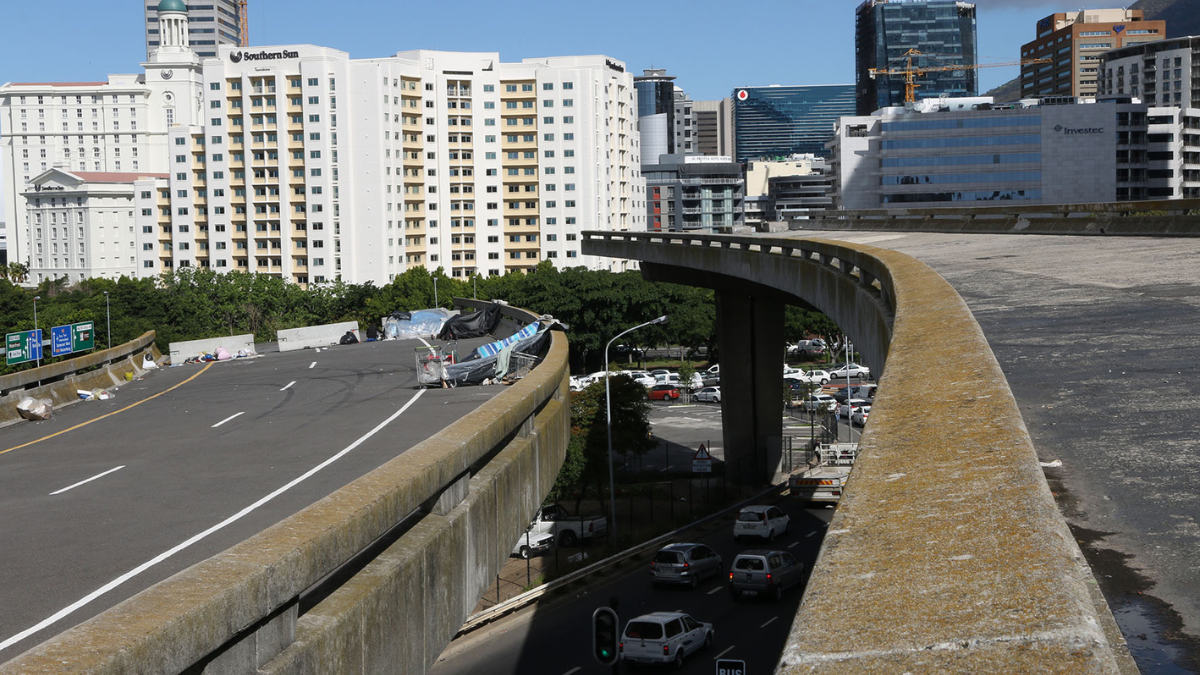
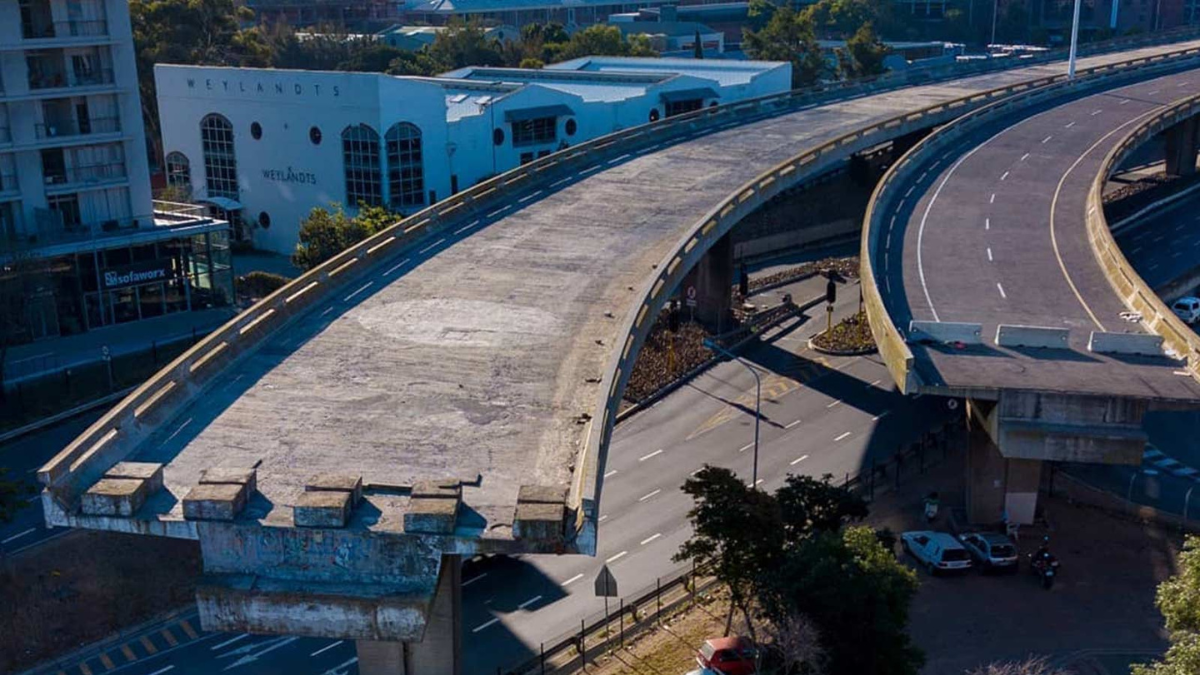
In the meantime, however, the bridge, particularly on the Atlantic Seaboard side, has attracted film crews from all over the world.
Given the height of the bridge alongside Helen Suzman Boulevard, it provides the ideal setting for a film set with a city backdrop, without having to actually film on a busy road.
Anyone driving past the bridge during the summer is likely to see a film crew set up, taking advantage of golden hour and Table Mountain in the background.
Along with other areas in Cape Town, the bridge served as the setting for a scene in “San Junipero,” an episode in the third season of Black Mirror.
South Africans will also remember that a 35-meter-long functional vuvuzela was installed on the bridge during the 2010 FIFA World Cup.
It was intended to be sounded before matches, but this only happened once due to noise concerns.
The area below the Atlantic Seaboard onramp has been converted into a parking lot for Cape Town’s MyCiti buses, while the area below the Western onramp is a parkade near the CTICC.







 Loading ...
Roadway development in Cape Town’s CBD, the Southern Suburbs and further afield towards Somerset West will always be constrained by what the natural environment allows coupled to what residents permit to impinge on their built environment. Where expressways and road widening projects have gone ahead, it seems that the choke points have simply moved to other suburbs. Future planning should take critical cognizance of Cape Town’s rating as one of the most congested cities in the world and plan accordingly, whether that be park-and-ride schemes, promotion of more public transport or simply private vehicle congestion charges.