
SAHRC calls for a national state of disaster in South Africa



The South African Human Rights Commission (SAHRC) has raised the alarm over the country’s worsening water challenges, describing the situation as reaching crisis proportions.
Communities and households across South Africa continue to struggle with limited access to water, a resource the Commission says is a fundamental human right enshrined in section 27 of the Constitution.
“Water is the lifeblood of human existence and plays a critical role in the realisation of several rights, including healthcare, children’s rights, and education,” the SAHRC said on 12 February.
The Commission has repeatedly highlighted the impact of water shortages on essential services.
“The absence of water at schools negatively impacts educational outcomes as learners are forced to miss school,” while hospitals and clinics also suffer disruptions that infringe on the right to healthcare.
The Commission further emphasised that “the lack of access to water disproportionately affects women and girl-children and compromises the attainment of gender equality.”
According to the SAHRC, multiple systemic and structural factors have contributed to the ongoing crisis.
“Insufficient attention and allocation of budget for the maintenance of water infrastructure, poor planning for population growth, high levels of water losses, lack of skilled personnel… water infrastructure vandalism and the emergence of water mafias” are all key drivers of the current challenges.
The Commission warned that these issues are particularly pronounced at municipal level, where service delivery failures most directly impact households.
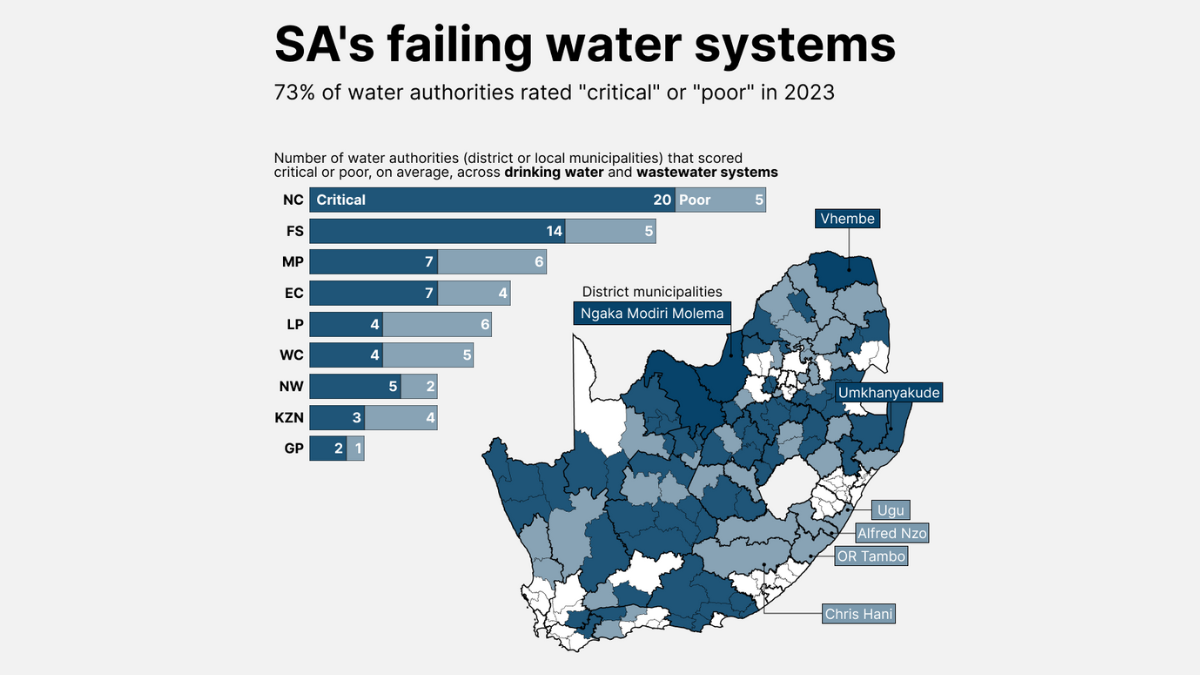
Data from the South African Water Justice Tracker supports the Commission’s concerns.
“Ageing infrastructure, inadequate funding models, skills deficits, and poor intergovernmental coordination as some of the key drivers contributing to the dysfunctionality of water services authorities,” the SAHRC said.
The crisis is not a localised phenomenon but is widespread, affecting many parts of the country.
“The water crisis has reached a level where a broad, integrated and coordinated effort is required to turn the dire situation around.”
Given the severity of the situation, the SAHRC has recommended that the government declare the ongoing water crisis a national disaster under the Disaster Management Act 57 of 2002.
“The classification and declaration of a national disaster constitutes a reasonable measure in the circumstances,” the Commission explained.
The SAHRC added that a national state of disaster would allow for the mobilisation of emergency funds and improved coordination between government departments to address the crisis.
At the same time, the Commission cautioned against the misuse of resources.
“The declaration of a national state of disaster on the ongoing water crisis should not become a breeding ground for corruption, malfeasance, and embezzlement of funds. Sufficient oversight measures to ensure fiscal prudence should be instilled,” the SAHRC said.
It also called on government to continue implementing proactive measures, including:
- Preventative infrastructure maintenance;
- Critical water infrastructure rehabilitation;
- Expediting the finalisation of bulk water projects; and
- Instituting community behavioural change campaigns on water preservation.
The SAHRC will soon issue a formal letter to the Head of the National Disaster Management Centre recommending the national disaster declaration.
Major water woes
As of February 2026, South Africa is grappling with a severe water crisis increasingly described as a national disaster.
While the country has sufficient water in its dams, the system is failing at municipal level due to crumbling infrastructure, financial mismanagement, and extreme heatwaves.
The crisis is acute in Gauteng, where Johannesburg, Tshwane, and Ekurhuleni face a “Day Zero” reality for many residents.
Experts warn that nearly around half of treated water in Johannesburg is lost to leaks before reaching taps, while suburbs like Melville, Parktown West, and Briandene have been without water for over 21 consecutive days.
Authorities have imposed “soft” restrictions and begun load shifting to prevent total collapse.
Municipal strikes and unaddressed burst pipes have further worsened the situation, with Minister Pemmy Majodina saying that R400 billion is needed to fix the country’s municipal water infrastructure.
Durban and KwaZulu-Natal are also under strain.
Soaring temperatures have increased demand beyond what ageing supply lines can handle, while major repairs on the Southern Aqueduct have left Umlazi and surrounding areas without water for extended periods.
Another example is in the Western Cape, where Knysna is currently a declared local disaster area, racing to avoid “Day Zero.”
Its main reservoir is hovering around 20% capacity while the town enforces strict Level 4 restrictions (50 litres per person per day) to manage a system losing over 50% of its water to leaks.
Across the country, experts attribute the crisis not to drought but to governance failure.
WaterCAN’s Dr Ferrial Adam recently told Newsday that “the majority of dry taps we see today are not caused by natural scarcity but by governance failures.”
“Billions have been spent on upgrades that never materialised or were riddled with corruption,” said Adam.
“The problem is less about not having water than not managing water.” “Without competent governance, no amount of rainfall or dam storage will translate into reliable taps.”
WaterCAN has consistently called for:
- Professionalising water services by ending political appointments and hiring qualified engineers.
- Transparent reporting of water quality and infrastructure data.
- Ringfenced budgets to prevent diversion of water funds.
- Expanding citizen initiatives like Water Testing Week.
- Stronger independent oversight through Chapter 9 bodies and civil society action.




 Loading ...
This is a monumental moment. The SAHRC actually got off their asses and did something.