
SIU recoups billions meant for South Africa’s most vulnerable students


In a significant development for South Africa’s higher education sector, the Special Investigating Unit (SIU) has successfully recovered over R2 billion in misplaced money intended for the nation’s most vulnerable students.
The investigation into the National Student Financial Aid Scheme (NSFAS) has resulted in the return of R1.7 billion to the organisation’s coffers.
This marks a pivotal moment in the attempt to stabilise an institution that has long struggled with administrative chaos and financial mismanagement.
To understand the magnitude of this recovery, however, it is essential to examine the turbulent background of the scheme and the systemic failures that necessitated the SIU’s intervention.
NSFAS was established with a noble and essential mandate: to provide bursaries and loans to students from poor and working-class backgrounds who otherwise could not afford tertiary education.
Funded by the taxpayer through the Department of Higher Education and Training (DHET), the scheme covers tuition, accommodation, meals, transport, and personal care allowances, aiming to “promote access to education and redress past inequalities.”
Despite this vital role, the scheme’s history has been marred by operational failures.
According to reports on the scheme’s performance, NSFAS has been plagued by severe, recurring challenges, often leading to protests and student and institutional dissatisfaction.
These challenges range from administrative dysfunction to corruption. A major grievance has been the delay in disbursing allowances, which frequently leaves students without money for food or accommodation.
Furthermore, financial sustainability has become a pressing concern. The scheme has faced massive budget deficits, projected at R14 billion for 2025, raising fears about its ability to support a rising number of applicants.
Compounding these issues were reports indicating “corruption, with allegations of tender irregularities involving direct payment service providers.”
The SIU investigation
It was against this backdrop of “poor governance” and “mismanagement” that the SIU launched its investigation into the scheme’s finances.
They were authorised to investigate allegations of corruption and maladministration in NSFAS’s affairs and to recover any financial losses suffered by the state arising from corruption and negligence.
The investigation focused largely on “unallocated funds”: money transferred to tertiary institutions for students who subsequently deregistered or changed universities.
Under normal regulations, these funds are retained by an institution for one year. However, the investigation revealed that in many cases, the money was kept for more than a year between 2016 and 2021.
The SIU called it “inadequate control systems and a lack of reconciliation processes implemented by NSFAS during that period, resulting in a failure to recover these funds from institutions of higher learning.”
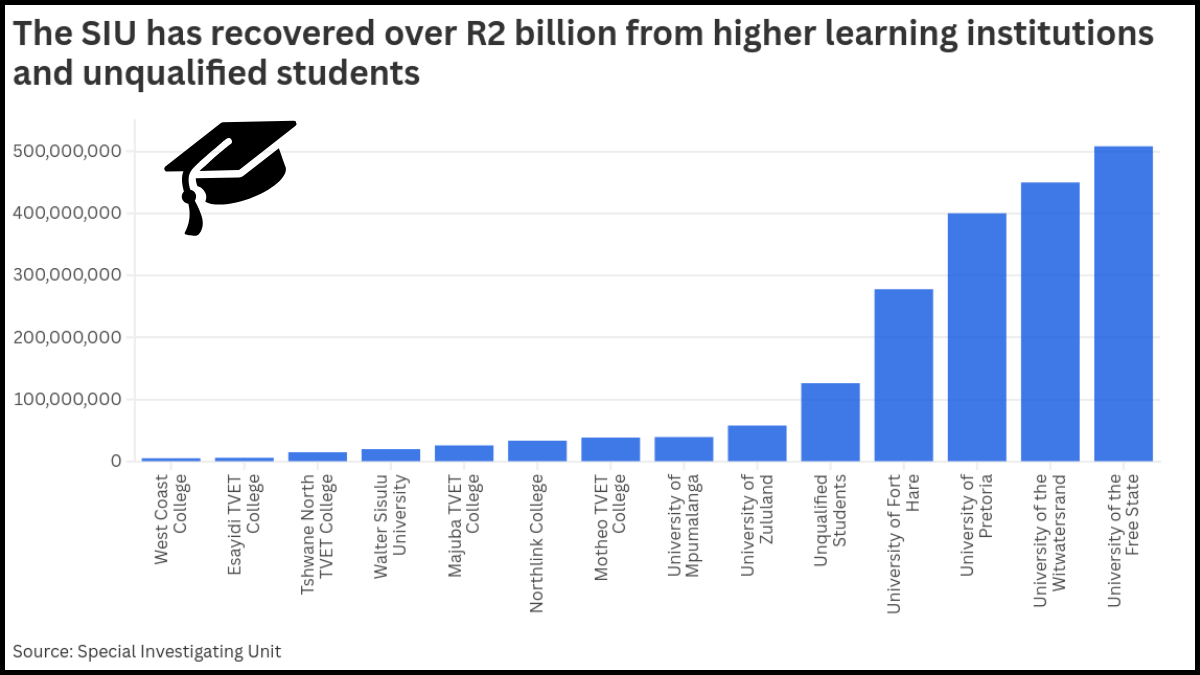
The SIU has returned R1.7 billion to the NSFAS purse, a figure that constitutes the bulk of the R2 billion the unit has recovered so far from universities, TVET colleges, and unqualified former students.
The SIU revealed that it has collected over R126 million from “1055 parents and unqualified NSFAS beneficiaries who have signed AoDs [Acknowledgements of Debt] agreeing to repay the money over time.”
NSFAS has committed to implementing the “SIU’s systematic recommendations by introducing a framework that includes a data-driven reporting process to ensure timely payments to providers.”
This move is intended to improve accountability by generating monthly payment and occupancy reports.
Crucially, NSFAS is reconsidering its reliance on third-party service providers, looking at an in-house payment functionality to streamline financial management and eliminate the middleman.
The SIU has publicly commended NSFAS for “strengthening its systems and moving towards better governance.”






 Loading ...
Theft, but no one goes to jail??