
Vodacom and MTN have a problem


Vodacom and MTN are struggling to monetise the skyrocketing demand for mobile data in South Africa.
Whilst demand for data is increasing data revenue growth is in decline.
This data usage-to-revenue paradox is bad news for South Africa’s two telecommunication giants who are fast approaching a ceiling on the revenue their mobile data businesses can generate in the future.
Newsday analysed the latest financial results of both Vodacom Group and MTN Group. The results are damning. While average mobile data usage increased exponentially, the companies are earning less per byte sold.
Whilst drawing a comparison between MTN and Vodacom is challenging because they report certain metrics under different terminology, the conclusion is the same.
Data usage growth far outpaces the revenue generated by that usage.
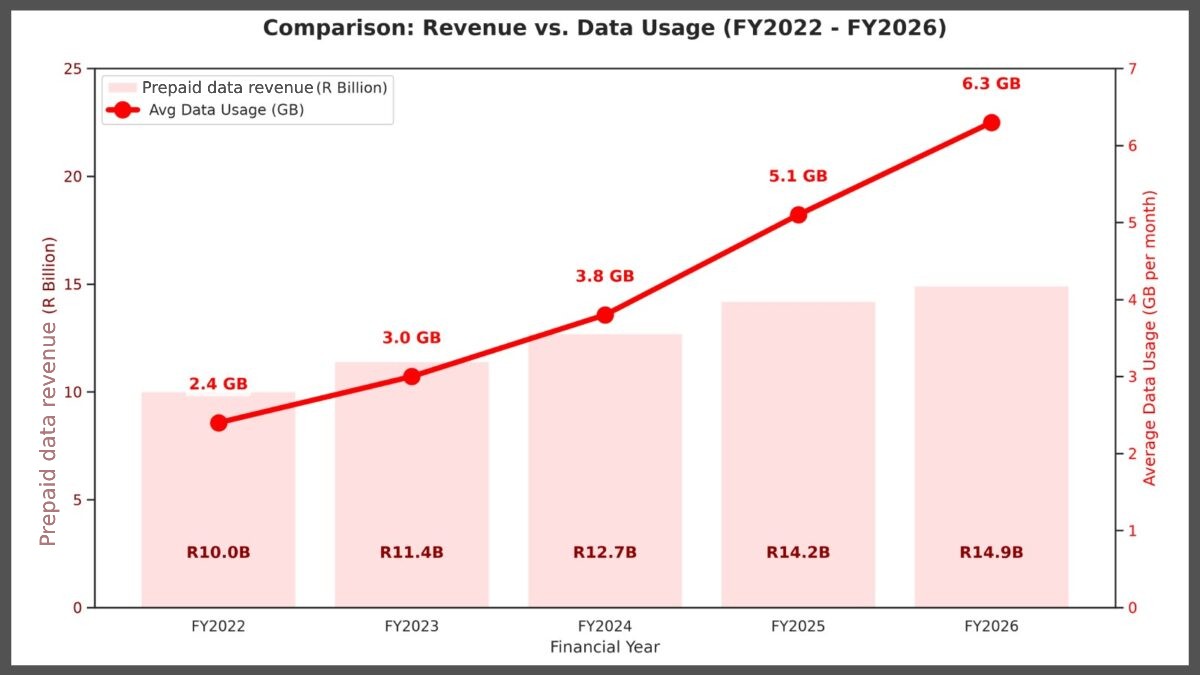
From 2022 to 2025, Vodacom reported that the average monthly data usage per smart device among customers in South Africa increased by approximately 112.5%, from 2.4GB to 5.1GB.
In contrast, over the same period, prepaid mobile data revenue rose from R10 billion to R14.2 billion, a much lower 42% increase.
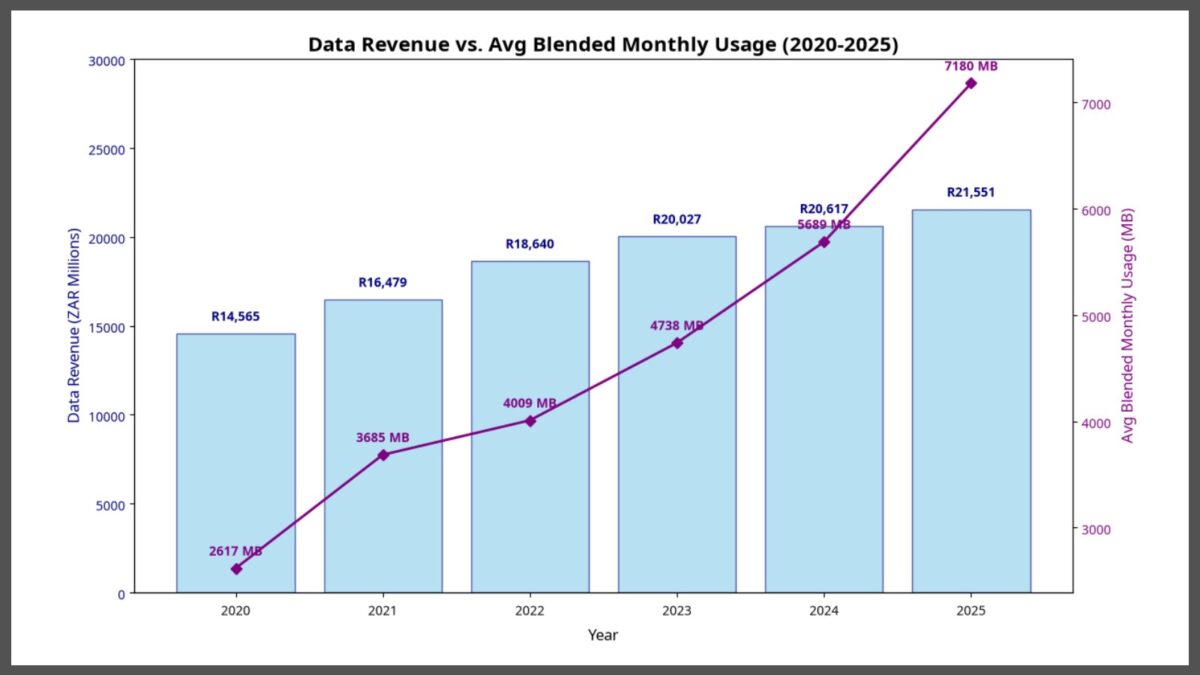
MTN faced a similar predicament with average blended monthly data usage among customers growing by 79.10% between 2022 and 2025, from 4 GB to 7.18 GB.
Meanwhile, data revenue grew only 15.62% over the period, from R18.6 billion in 2022 to R21.5 billion in 2025.
The significant divergence showed high demand for mobile data, but declining yield per megabyte sold to customers.
Vodacom made data cheaper for customers in South Africa
The outpacing of Vodacom South Africa’s demand for data relative to revenue growth is clear as day when looking at metrics reported between 2024 and 2025.
Data usage grew 34.21% year-on-year, compared to revenue at only 11.81%. This means data usage grew nearly three times as fast as revenue.
The main driver was market pressure to lower the barrier of entry for its data products.
These pressures prompted Vodacom to roll out daily and hourly data bundles to better serve its more price-sensitive customers.
“The launch of affordable daily and hourly data bundles (R3 for 50MB and R10 for 100MB) drove data adoption and supported the shift of prepaid customers to bundle usage,” Vodacom said in its previous financial reporting from 2015.
These “bite-sized” bundles were immediately successful, as prepaid data bundle sales skyrocketed 139.2% in 2015.
Vodacom continues to develop competitive packages for lower-income South Africans, and it faces increased pressure to lower prices even further.
This has created the perfect storm. High data demand combined with high adoption of price sensitive products means double-digit data revenue growth from customers has all but disappeared.
MTN Group looks outside of South Africa for data revenue growth
MTN Group’s data revenue growth in South Africa slowed, making other markets far more attractive for capital expenditure and investment.
These were markets where mobile penetration was much lower than in South Africa, creating the opportunity for higher revenue growth compared to data usage.
Nigeria, Ghana and Uganda all showed strong financial performances for MTN in 2025. MTN faced the opposite in South Africa, suffering its first revenue decline in more than a decade that year.
These markets, with a growing smartphone-seeking population, see surging data revenue growth compared to the mature South African market.
MTN Nigeria has already begun to see some of this growth. In 2025, its data revenues increased 74.2%, the largest contributor to the business’s service revenue.
At the company’s recent Capital Markets Day event, Group CEO Ralph Mupita explained that MTN South Africa required a cost reset to remain competitive.
“The South African team has to take the hard medicine now, which is to undergo this structural cost reset,” said Mupita.
“It is very painful, but I think it is necessary medicine. This is because, in aggregate, if you think about what South Africa should be generating, it is not an attractive market.”










 Loading ...
MTN is owned by the anc, they cannot run any organisation, so no surprises here. They cannot even dish things out for free without causing havoc. Look at housing, grants, hospitals and the like. They are a bunch of children in a candy store, but they are stealing the candy, why pay? Paying is what the minority groups does, not the black population.