
Eskom’s unsolvable R100 billion problem



The Eskom Debt Relief Amendment Act has been enacted into law, and Eskom is implementing a smart meter project to boost municipal revenue collection, aiming to address its significant municipal debt problem.
However, it remains uncertain whether any government bailouts or technological investments can fully resolve the entity’s municipal debt crisis.
“While I understand the rationale behind these initiatives, I must express scepticism regarding Eskom’s ability to recover the full approximate R100 billion owed by municipalities,” power and energy expert Professor Vally Padayachee told Newsday.
Padayachee is a strategic advisor to the Association of Municipal Electricity Utilities (AMEU).
He said that both Eskom and municipalities have consistently struggled to secure cost-reflective tariffs from Energy Regulator NERSA.
“Instead, they have been granted lower tariffs as part of balancing affordability, which has ultimately undermined their operational capacity,” he said.
NERSA has recently come under fire for its failure to accurately calculate Eskom’s tariffs, resulting in extra tariff increases. This increase, Eskom argues, is still not enough for financial security.
According to the SA Legal Academy Policy Watch, the debt relief amendment bill is effective from September 3. The act doubles Eskom’s allocation from treasury.
This increased from R40 billion to R80,2 billion for the 2025/2026 financial year, aiming to address Eskom’s own financial issues.
The act also provides for an additional R10 billion to be given to Eskom in the 2028/2029 financial year.
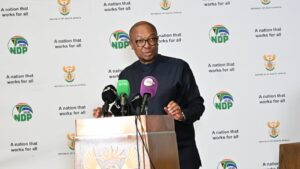
Mmusi Maimane, as Chairperson of the Standing Committee on Appropriations, tabled the act in parliament in July.
He said that, with cities like Johannesburg and Tshwane failing to fulfil their financial obligations, the additional financing is necessary to ensure Eskom’s viability isn’t crippled by municipal debt.
Municipal debt owed to Eskom has skyrocketed from R9.8 billion in 2015, crossing the R100 billion mark just ten years later.
As of September 2025, a total of 75 municipalities have overdue debt to Eskom exceeding R100 million.
Seventy-one of these municipalities have entered into the National Treasury’s Debt Relief Programme.

Debt relief and smart meters won’t solve systemic issues
Most of the municipalities in the Debt Relief Programme are failing to meet the requirements for debt write-offs.
This includes ring-fencing revenue for electricity, keeping up to date with current payments, and having a funded budget for electricity.
Padayachee added that the government’s reliance on municipalities to resolve their own revenue and debt challenges independently will not be sufficient to resolve this crisis.
Dihlabeng municipality’s debt to Eskom, for example, has gone from R74 million to R1.1 billion in under 10 years.
It was recently announced that correcting this situation will take at least five years, according to the Portfolio Committee on Cooperative Governance and Traditional Affairs.
This amount, however, is relatively low compared to Eskom’s top offenders for debt.
Emfuleni Municipality in Gauteng owes Eskom R5.3 billion. R1 billion of this was written off by Treasury, under the condition that the municipality would improve its financial governance.
The municipality, despite no documented reforms in its financial policy, has recently requested another write-off.
According to a top ten list compiled by Eskom, eMahleni in Mpumalanga owes the most municipal debt to Eskom, at R9.9 billion as of November 2024.
Lekwa and Govan Mbeki in Mpumalanga, also claim top positions on this list, owing R5.2 billion and R2.6 billion respectively.
The problem municipalities face with debt collection is non-payment and illegal connections.
In an effort to address this, the National Treasury is expanding its pilot project to install 77,780 smart meters across 11 municipalities this year.
The aim is to install 250,000 meters over three years, according to Deputy Director-General for Intergovernmental Relations, Ogalaletseng Gaarekwe.
The smart meters allow customers to more effectively manage their electricity usage, in line with their financial situation, hopefully resulting in fewer customers failing to pay their municipality.
The first municipalities selected for the pilot in the last financial year were those with the largest outstanding debts to Eskom.
Padayachee is skeptical, however, that this technology will be the final solution to Eskom’s municipal debt.
“While smart meters can facilitate more accurate billing and improved efficiency, they cannot address systemic issues,” said Padayachee.
This includes governance failures, inadequate infrastructure, and a fundamental economic structure that undermines service viability, according to the energy expert.
“It’s clear that simply introducing smart meters or relieving some debt will not remedy the broader issues at play. There is a need for comprehensive reforms,” he said.
Padayachee said this might include structural changes in how electricity is managed at the municipal and national levels, or changes to tariff structures.
He added that greater collaboration between Eskom, municipalities, and the government is needed to ensure a cohesive strategy is developed.
“The role of government is critical. Without a focused strategy that combines financial relief measures, infrastructure investment, and regulatory reforms, municipalities will continue to struggle, and the debt crisis will persist.”








 Loading ...
What has the DA done to address this situation ?????