
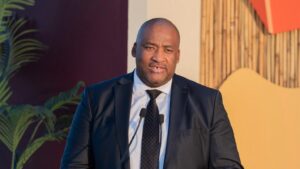
Gayton McKenzie’s department went from R10 million to R67 million in irregular expenditure



Despite tighter controls and promises to strengthen financial oversight, the Department of Sports, Arts, and Culture (DSAC) has seen its irregular expenditure increase over the past year.
To make matters worse, the department has also misreported its irregular expenditure in previous years, with the Auditor-General of South Africa (AGSA) needing to set the record straight.
The Department of Sports, Arts, and Culture, led by Minister Gayton McKenzie, is responsible for providing an enabling environment for the local sport, arts, and culture sectors.
As a state entity, it is also subject to audits by the AGSA, which has flagged numerous issues with the DSAC’s reporting over the year.
For example, in the 2024/25 fiscal year, the DSAC reported incurring irregular expenditure of R10.43 million.
However, when the AGSA audited the department’s reporting, it found that the DSAC had incurred R42 million in irregular expenditure.
The AGSA flagged this issue in its audit report, urging the DSAC to strengthen financial controls and tighten scrutiny over its spending.
The AGSA flagged weaknesses in procurement and internal controls, as well as the slow implementation of audit action plans at the DSAC.
In response to these findings, the DSAC committed to strengthening consequence management, training supply chain staff, and using an external accounting firm.
In response to a Parliamentary question in October 2026, McKenzie reiterated these commitments.
He said his department has been implementing the AGSA’s recommendations, strengthening its financial controls and internal audit capabilities.
McKenzie provided specific measures that his department has implemented to improve financial controls.
For example, he said his department has strengthened its assurance functions and supply chain management (SCM) compliance.
“The annual risk assessment now focuses specifically on SCM and contract management processes,” he said.
“Procurement and contract management reviews have been included in the annual Internal Audit Plan.”
McKenzie acknowledged that the effectiveness of these interventions will be measured by the AGSA’s audit outcomes.
“The Department’s target is an unqualified audit opinion without material findings,” the minister said.
The impact of the DSAC’s efforts

Despite the DSAC’s efforts outlined by McKenzie, the department’s plan did not appear to work in the 2025/26 fiscal year.
The minister said DSAC had developed an audit action plan, reviewed by Internal Audit, which identifies the root cause of each 2024/25 AGSA audit finding.
This plan sets out the corrective action, the responsible programme, and the due date, and progress on implementing the action plan is reported quarterly.
Although these measures have been in place since the 2025/26 fiscal year, the DSAC’s irregular expenditure has increased.
For the 2025/26 financial year, the AGSA identified R67 million in irregular expenditure.
In its audit, the AGSA noted that this figure was likely understated, since the Mandela Bay Theatre Complex and Robben Island had been unable to quantify their irregular expenditure.
The AGSA praised some of the progress the DSAC has made, noting that the number of clean audits increased from 11 in 2023/24 to 13 in 2025/26.
However, it said this improvement in clean audits had been accompanied by limited progress on some previous recommendations.
The AGSA said the DSAC had been slow to implement recommendations and found that its monitoring of audit action plans was ineffective, which contributed to recurring findings.
On irregular expenditure, the AGSA said the DSAC’s progress on addressing historical irregular expenditure has remained slow.
16% of the DSAC’s 2023/24 balance and 5% of the 2024/25 balance had been addressed by year-end.
This means the DSAC’s reported irregular-expenditure balance had declined from R861 million to R839 million over the administration term. The AGSA said this balance is also likely understated.
The AGSA also identified weaknesses in internal audit, audit committee effectiveness, and governance at several DSAC entities.
Some of these weaknesses included inadequate monitoring of corrective action plans, insufficient internal assurance, and short-term extensions to outsourced internal audit arrangements.
You have read 1 out of 5 free articles. Log in or register for unlimited access.





 Loading ...
Cyril is to blame to apiont an man like Gaylon.