
2026 Election Winners: DA dominates in Johannesburg, Cape Town, Ekurhuleni, Tshwane, and Nelson Mandela Bay


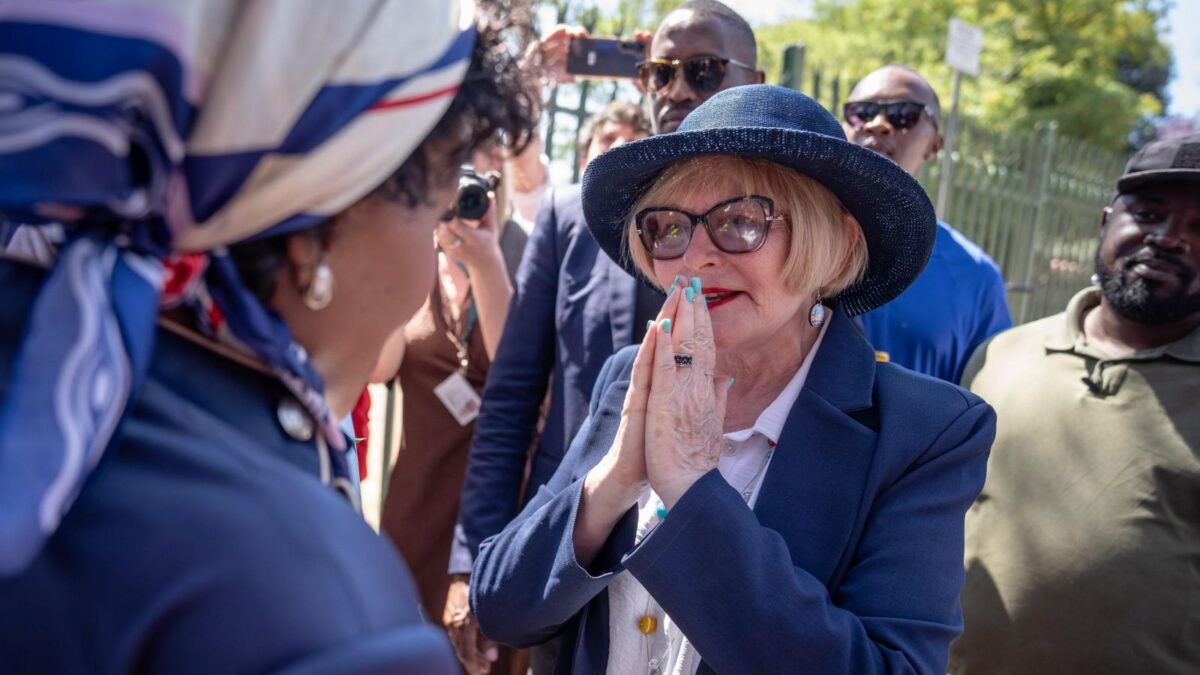
The latest election results prediction from the Council for Scientific and Industrial Research (CSIR) is good news for the Democratic Alliance (DA).
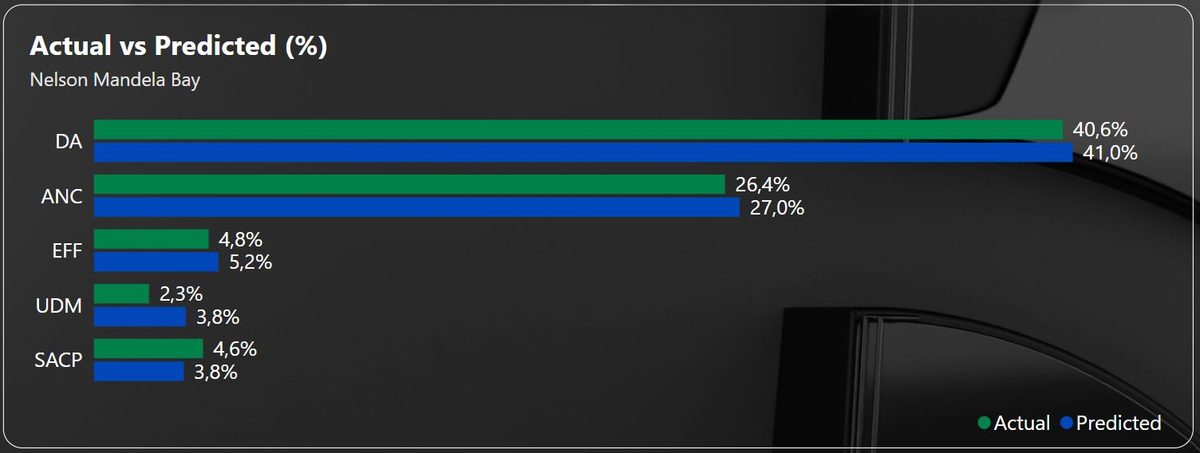
Its information showed that the party will achieve the largest share of the vote in most major metros, including Johannesburg, Ekurhuleni, Tshwane, and Nelson Mandela Bay.
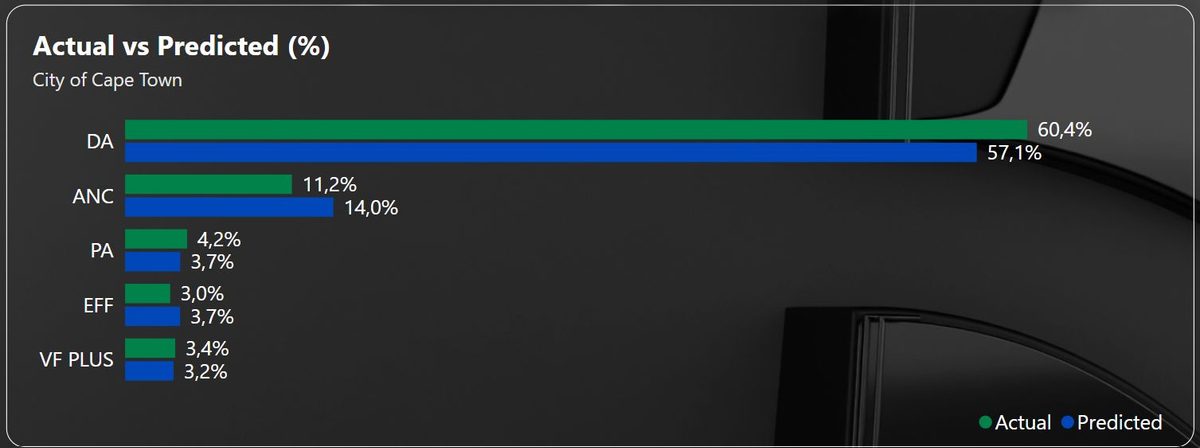
It will also achieve an outright majority in Cape Town, which means that DA leader Geordin Hill-Lewis will remain mayor of the city.
Earlier today, Hill-Lewis claimed victory in Cape Town, saying they expect to receive 58% of the vote in the city.
It is important to note that these are projected results, and that the Electoral Commission of South Africa (IEC) will only release the official results in a few days.
However, the CSIR has developed a forecasting model that uses samples from the official early results to predict the outcome.
This model is so accurate that the CSIR’s early predictions were previously within 1 to 3 percentage points of the final national support levels for most leading parties.
Earlier today, the CSIR predicted that nationally the ANC will get 31.7%, the DA 25.8%, MK 9%, EFF 6%, and ActionSA 5%.
It further predicted that Jacob Zuma’s MK Party would lead in KwaZulu-Natal and the DA would dominate in the Western Cape.
The ANC is set to collect the most votes in the North West, Eastern Cape, Free State, Limpopo, and Mpumalanga.
These results are, however, inconsequential, as the 2026 local government elections are about municipalities and metros.
The biggest battleground in these elections was the big metros, where the DA achieved good results.
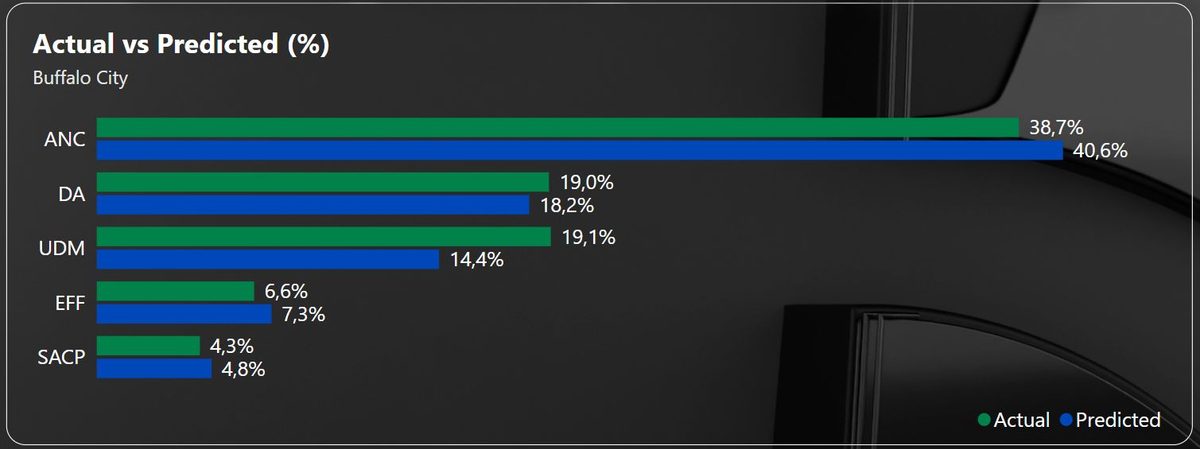
The only cities where it was not the largest party are eThekwini, which includes Durban, and Buffalo City, which includes East London.
In eThekwini, Jacob Zuma’s MK Party is the dominant force, and in Buffalo City the African National Congress retained its lead.
Although the DA received the most support in most of South Africa’s large cities, it only achieved a majority in Cape Town.
That means that it would have to form coalitions to govern in these cities. This is easier said than done.
Coalition negotiations are not an exact science, and smaller parties can often have the last say in who governs and who does not.
Analysts have said that the best option for stability in cities such as Johannesburg would be for the ANC to partner with the DA.
Such local government coalitions would mirror the arrangement in the Government of National Unity (GNU).
One stumbling block may be that the two parties are ideologically opposed on key issues such as racial redress.
The ANC could also decide to team up with the leftist Economic Freedom Fighters and Zuma’s party, uMkhonto weSizwe, cutting out the DA.
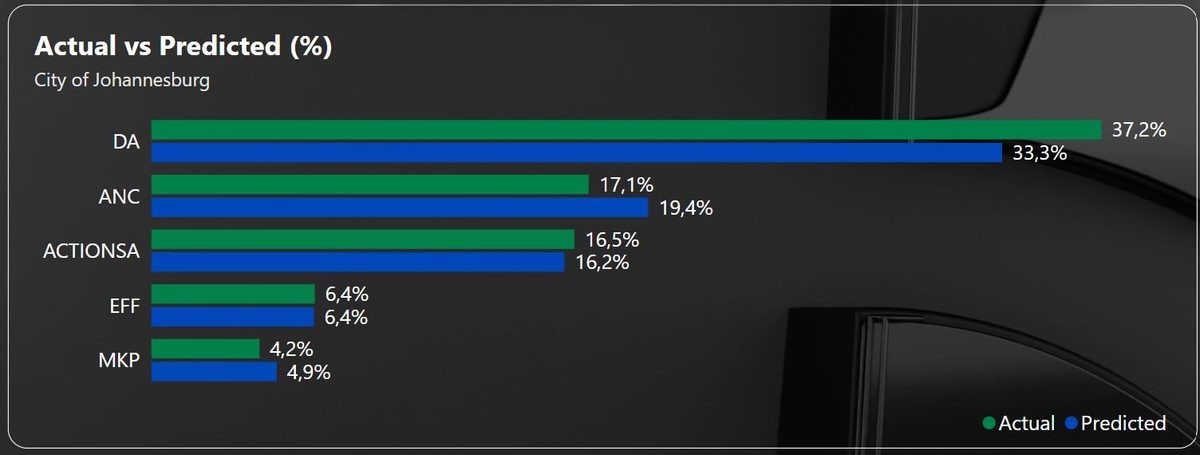
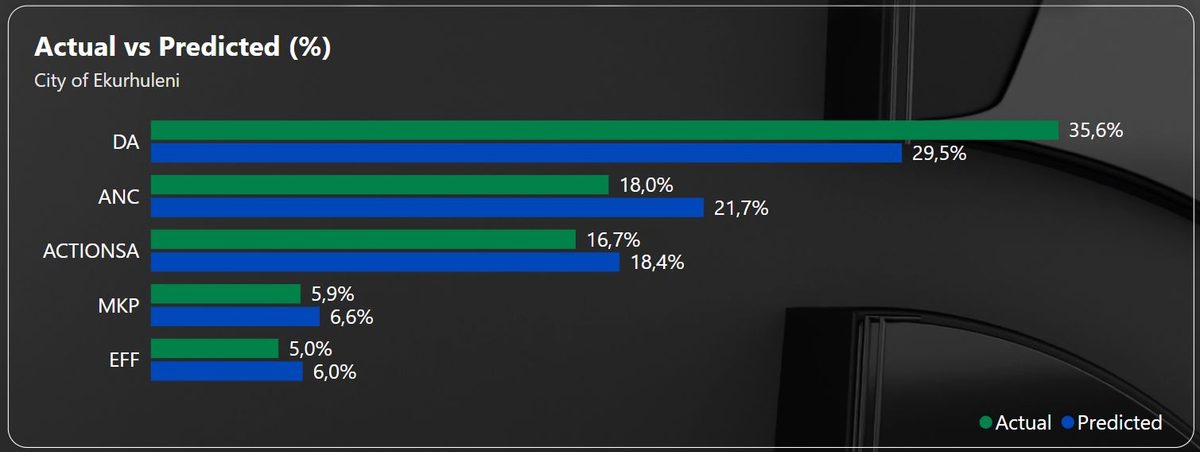
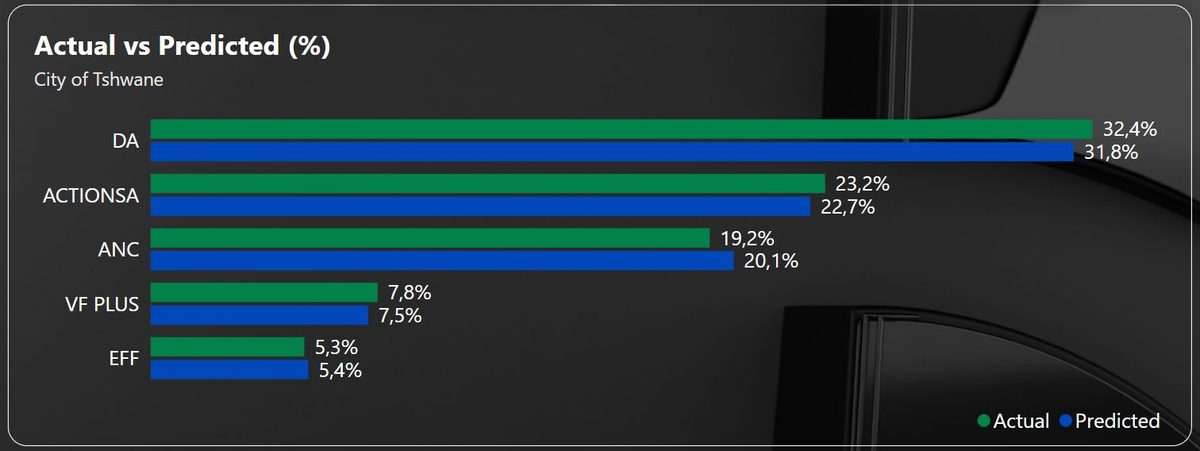
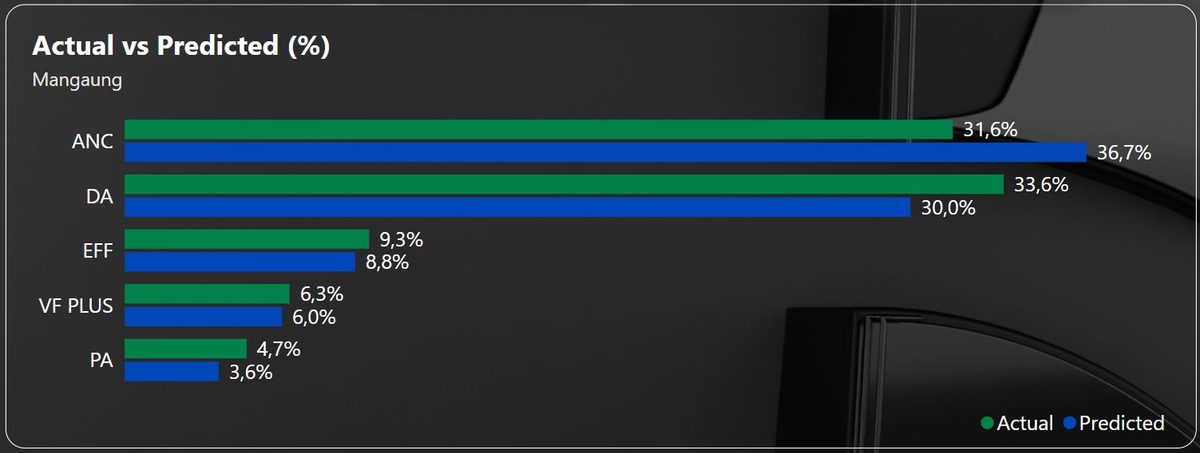
The charts below give an overview of the Council for Scientific and Industrial Research predictions for South Africa’s major cities.
CSIR Johannesburg prediction
CSIR Cape Town prediction
CSIR Ekurhuleni prediction
CSIR Tshwane prediction
CSIR Mangaung prediction
CSIR Buffalo City prediction
CSIR Nelson Mandela Bay prediction






 Loading ...
The DA must comply with the will of the people and form a coalition with the ANC in the metros.
Nationally, it makes sense and is simple. Where a party is dominant it chooses the mayor and executive positions according to its proportion of votes. They don’t have to pander to the demands of the rats and mice parties.
As for Jo’burg and Tshwane, the DA must not get into bed with Hairman who has been antagonising the DA. If the DA gets into bed with this vindictive man it will only be promoting his party. Make him irrelevant by excluding him in ANY coalition.