
The man whom Geordin Hill-Lewis quoted about apartheid in South Africa


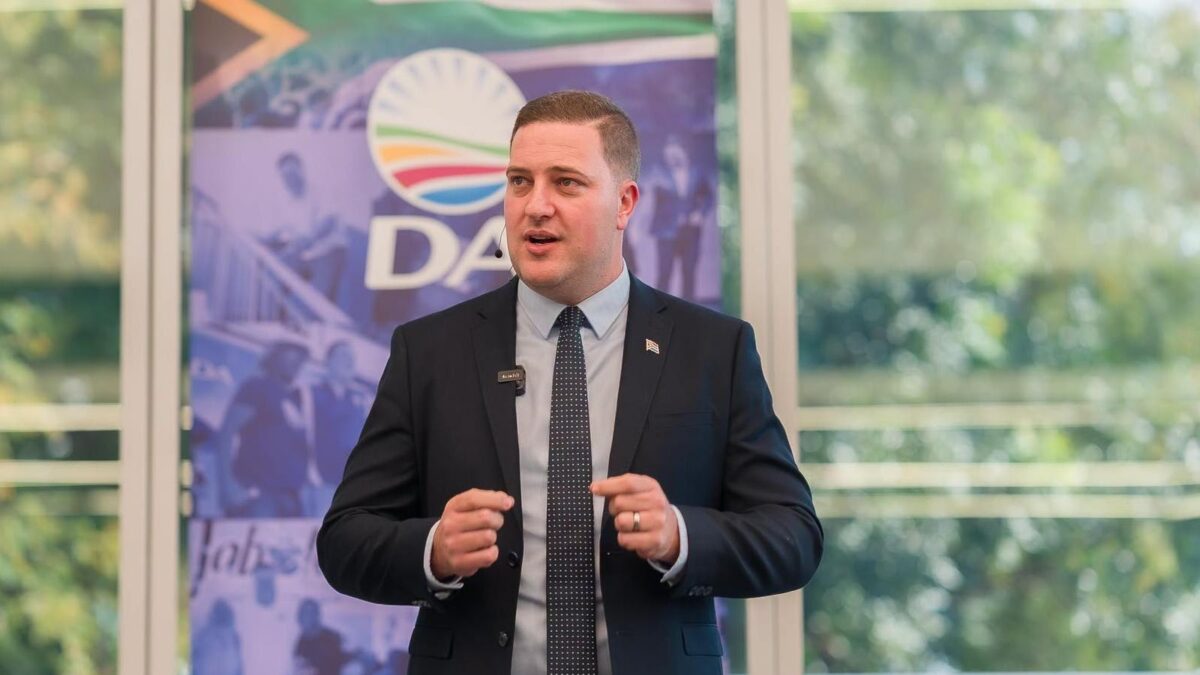
On 2 July 2026, Geordin Hill-Lewis delivered his first major speech as Leader of the Democratic Alliance, Subject to Citizen: a New Vision for South Africa.
In this speech, he set out a vision for South Africa’s future and the road to a government that delivers for every citizen.
“I want to do something that South African politicians don’t do often enough: talk honestly about the state of our politics,” he said.
“We are entering a brand new era. Our second transition. The shape of this transition will be determined by the choices we make in the months and years ahead.”
Hill-Lewis said that apartheid was the system that defined South Africa in many ways. “Apartheid was a moral atrocity,” he said.
“It was a crime against the people of this country that left wounds which have not healed, and may not heal, within our lifetimes.”
Structurally, he said, apartheid was a system of organised dependency which was designed, deliberately and methodically, to achieve this goal.
“It kept the majority of South Africans economically marginalised, politically powerless, and dependent on white permission for the most basic conditions of their existence.”
Hill-Lewis gave a glimpse of who and which analyses shaped his view of apartheid by quoting Mahmood Mamdani.
“To borrow the formulation of Ugandan scholar Mahmood Mamdani, apartheid was built on a distinction between citizens and subjects,” he said.
“It denied black South Africans full and equal citizenship, incorporated into the state not as participants with rights, but ruled by a power they could neither control nor remove.”
The DA leader said that in the early 1990s, something happened that many people had thought impossible.
“People who had every reason to live in a state of permanent mistrust, fear and vengeance. They chose something better. They chose each other,” he said.
“They chose a negotiated settlement that guaranteed rights to every citizen regardless of race, language, belief, or the circumstances of their birth.”
The man who shaped Geordin Hill-Lewis’s views: Mahmood Mamdani

In his speech, Geordin Hill-Lewis mentioned four people: Mahmood Mamdani, Maki Tshabalala, Mteto Nyati, and President Cyril Ramaphosa.
Unlike the others, Mamdani was quoted as an authority on understanding South Africa, particularly apartheid.
This means it is one of the lenses through which Hill-Lewis sees the world, which will impact his decisions as DA leader.
It raises the question about who Mamdani is, how he views the world, and what his theories about Africa are.
Mamdani is a Ugandan academic and the father of Zohran Mamdani, an American politician who currently serves as the mayor of New York City.
Zohran Mamdani is a democratic socialist with strong ties to the Muslim community. He is an advocate for tax increases on the rich and for free government-provided services.
He is widely seen as a progressive and left-wing populist, basing many of his political views on his father’s work.
His father, Mahmood Mamdani, published many controversial views, including that suicide bombers are not barbaric and should be recognised as a category of soldiers.
He argued that modern terrorism is a contemporary political byproduct of Western imperial policies rather than an internal religious crisis within Islam.
Moving to South Africa, he rejected the mainstream view that apartheid was an exceptional, uniquely warped system that stood apart from the rest of Africa.
He argued that apartheid was the generic form of a European colony in Africa, encompassing aspects of indirect rule and association.
Mamdani said segregationist strategies used by the apartheid regime were pioneered by British colonial administrators in Natal during the nineteenth century.
In his 1996 book Citizen and Subject, Mamdani said South African regimes successfully divided and ruled majorities through a bifurcated power structure.
This bifurcated power structure had the urban or civil sphere, the Citizens, and the rural or customary sphere, the Subjects.
He said the black majority was structurally excluded from urban citizenship and fragmented into rural Bantustans and forced into an ethnic identity.
Mamdani calls this system decentralised despotism, trapping people in tribal identities and preventing a unified, non-racial majority from organising across the country.
He praised the anti-apartheid movement because it chose a political solution over a purely military or punitive one.
However, he said the project remains incomplete as South Africa decolonised its political system but did not fully dismantle the underlying social and economic structures.







 Loading ...
GHL is showing his woke self and his tendency towards democratic socialism, a euphemism for communism. Under his leadership, the DA will become indistinguishable from the ANC. Thinking South African voters who have been long-standing supporters of the DA had better rethink and do so before the coming local government elections. I have always voted DA. Now my vote goes to the FF+. They are at least consistent and straightforward. And proof of that is that the Only Cabinet Minister in the GNU who is visibly functioning well is from the FF+.