
Long-term decay of South Africa’s richest city


Political parties are searching for ways to fix public services in Johannesburg, but years of neglect have created a problem that’s hard to solve.
This is the view of political strategist Gareth van Onselen, who shared his thoughts on the state of Johannesburg in an interview on PSG’s Think Big Series.
He said the City of Johannesburg’s problems did not start with the coalition government formed after the 2016 elections.
The infrastructure in Johannesburg has suffered from long-term decay, with the city’s water systems serving as a prime example.
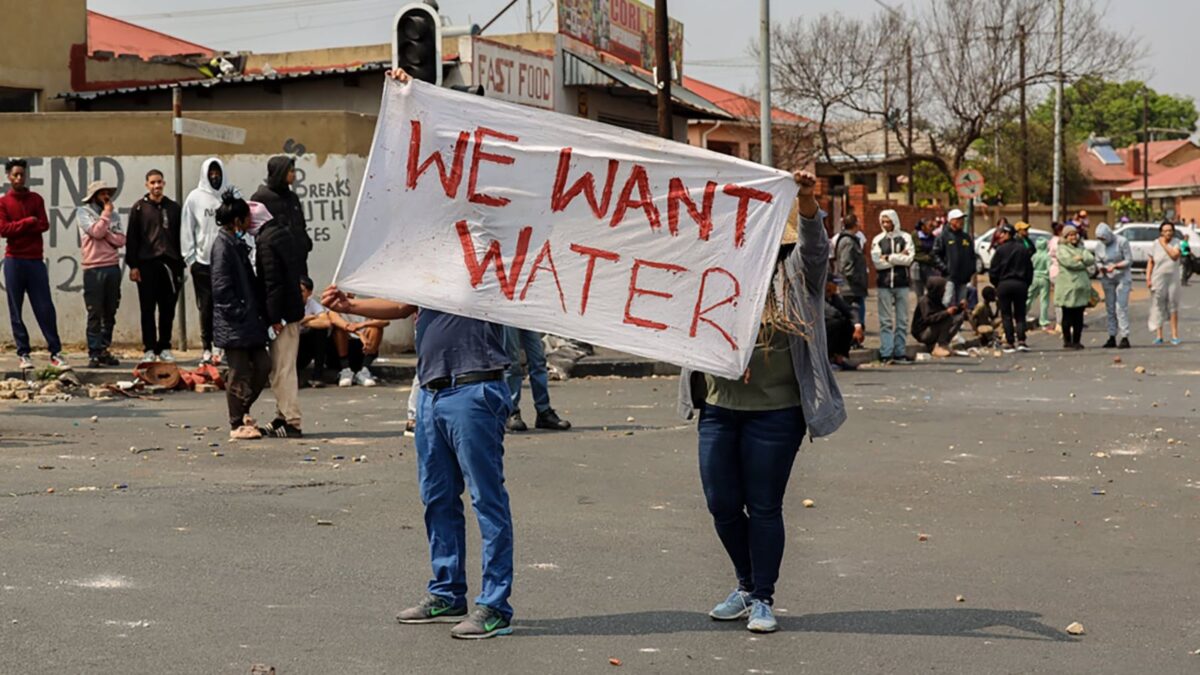
Johannesburg has been plagued by water supply issues in recent years, with some outages lasting many days or weeks.
These outages often occur after planned maintenance, which leads to deeper issues in the water infrastructure being discovered.
Van Onselen said these larger infrastructure problems underpin the recent challenges facing South Africa’s economic heart.
While they have played a role in Johannesburg’s struggles, he said the city’s rapidly changing politics have also had an impact.
The unstable governance in Johannesburg has led to struggles with consistently providing basic services to residents.
“The rapid change in governance in metros such as Johannesburg affects the ability of a particular governance regime to deliver the basics in a consistent way,” he said.
“But there are far more profound problems that underpin that kind of turmoil that can be laid at the feet of far more stable administrations in the past.”
Johannesburg’s political instability started after the 2016 elections, when former Democratic Alliance (DA) member Herman Mashaba became mayor.
This was made possible by forming a coalition with several parties, including the Economic Freedom Fighters (EFF).
Mashaba then left this role in 2019 after a public falling-out with the DA, which led to the collapse of the coalition government.
Since then, Johannesburg has had several mayors, with most leaving the position within a year.
The plans for the city
Van Onselen said Johannesburg’s current mayoral candidates did not have any strong plans to fix the city’s infrastructure crisis.
Although there may be plans to improve service delivery for residents, this does not address the root of the issue.
He was critical of the ANC, the city’s current ruling party, saying it lacks any long-term plans for Johannesburg.
“The ANC doesn’t have any long-term plan other than its existing policy inside Johannesburg, which is clearly not working,” he said.
“It seems to have done no review of where things have gone wrong and offered a new vision – it is essentially offering more of the same.”
Currently, the ANC has not named a mayoral candidate for Johannesburg.
He said the plans proposed by major parties such as the DA and ActionSA do not do enough to address the lack of infrastructure investment in Johannesburg.
“There is no real or powerful 10-year vision for Johannesburg,” he said.
“That is understandable, because the state of the crisis is so profound that really you need five years just to get the systems, the infrastructure, and the human resources established.”
He noted that one challenge in campaigning for infrastructure investment is that many voters focus only on basic service delivery.
“Voters concern themselves primarily with things that are visually problematic to them,” he said.
This means that parties will shy away from campaigning on long-term investments, rather focusing on short-term issues like fixing roads and burst water pipes.
Van Onselen said parties need to find a way to convince voters in Johannesburg that investing in infrastructure, though it has no immediate effects, will benefit the city in the long run.








 Loading ...
Evacuating hijacked buildings in the city will be improved after the expatriation of foreign nationals in the country. We will have opportunity to fix our country though it is too late because funds are depleted.