
Cuban military arrangement shut down after R1.9 billion was irregularly spent


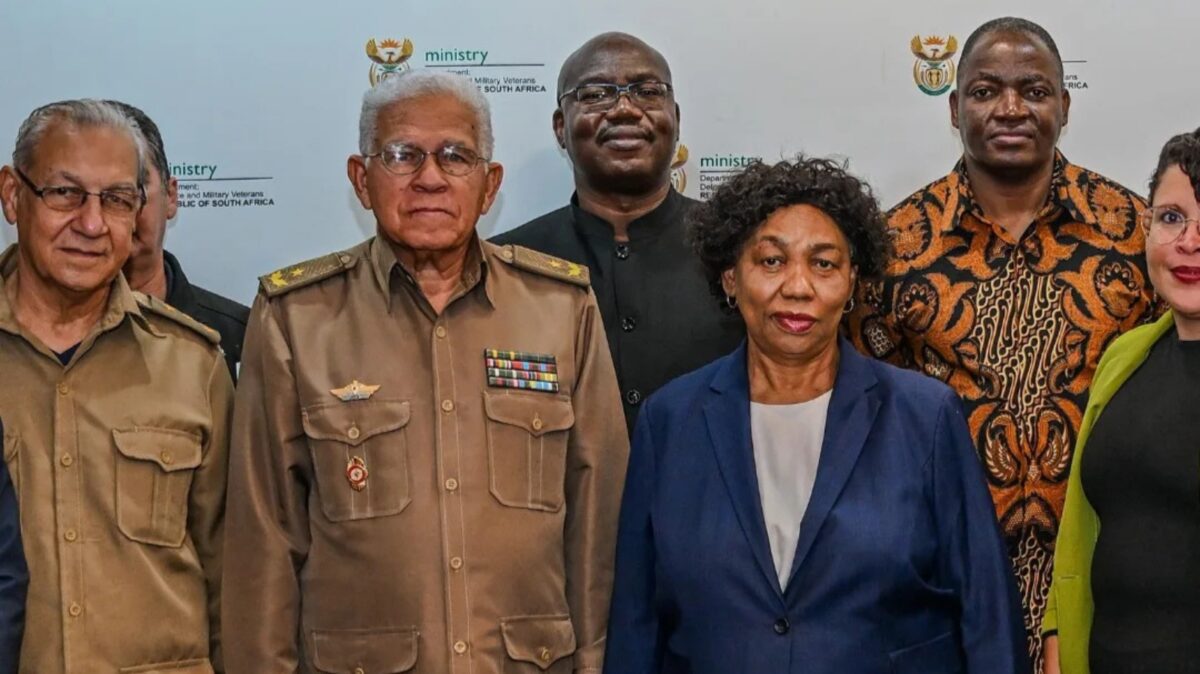
The South African National Defence Force (SANDF) has been ordered to end Project Kgala, its bilateral training and technical arrangement with the Cuban military.
This comes four months after the Chief State Law Advisor declared Kgala invalid for breaking procurement legislation.
Kgala launched in 2025 as the successor to Project Thusano, a previous military agreement with Cuba that began in 2012.
Both agreements have drawn scrutiny for their exorbitant costs, with the Auditor-General (AGSA) revealing in March 2025 that Thusano had cost a total of R3.04 billion over a decade.
This included R1.699 billion in disclosed irregular expenditure, while Kgala has reportedly incurred R278.6 million in irregular expenditure since its launch last year.
Kgala was presented as a five-year solution to Thusano’s ballooning financial costs, with a projected expenditure of R537 million.
The Democratic Alliance reportedly warned Parliament on 12 March 2025 that simply changing the arrangement’s name would not alter the laws governing public procurement.
“Defence nevertheless assured the committee that irregular expenditure would not recur,” the DA said.
“Those assurances now demand an explanation from the officials who gave them and the leadership responsible for implementation.”
It was previously revealed that R34 million had been spent on a chartered flight carrying more than 200 SANDF personnel to Cuba for a graduation ceremony.
This included senior officials and students. Kgala’s latest reported expenditure shows R100.3 million has been spent on chartered flights.
The AGSA found that Cuban technical services cost substantially more than comparable South African services, leaving skilled South African workers without work.
“Defence cannot justify neglecting domestic artisans, engineers, training institutions, and defence companies while committing scarce resources to arrangements whose value remains inadequately demonstrated,” the DA said.
“The training outcomes also require scrutiny. Cuban medical qualifications do not automatically entitle returning graduates to practice medicine in South Africa.”
The AGSA found that just six of the first cohort of 21 medical students had successfully completed the 18-month integration course at the University of Pretoria.
The DA said the announcement of Project Kgala’s end is not a complete shutdown, with existing courses expected to continue with no firm end dates or disclosed costs.
The party said it would request the termination instruction, a complete expenditure reconciliation plan, and a costed exit plan disclosing every active Cuban arrangement.


 Loading ...
This ideologically driven “collaboration” between South Africa’s defence establishment and the Cuban regime was always a costly farce.
Project Thusano and its rebranded successor Kgala funnelled billions in taxpayer funds—R1.7 billion in irregular expenditure on Thusano alone, plus another R278 million on Kgala—to import Cuban technicians who cost up to 3.8 times more than local labour. Procurement rules were bypassed, no proper cost-benefit analysis was done, and the contract was ruled invalid. The Auditor-General finally ordered it shut down.
The true intent was never military efficiency; it was political loyalty to a fellow pariah state.
The same pattern appears in the Cuban doctors programme: host countries pay handsomely while the doctors themselves receive a fraction—often 10–25%—with the bulk retained by the Cuban state.
Investigative journalists must dig deeper into both schemes: who truly profited, what skills were actually transferred, and why South African expertise and unemployed professionals were sidelined for this ideological vanity project.