
South Africa’s First Fully AI-Operated Business: Thought (Pty) Ltd, by the Founder of AM.CO.ZA


South Africa now has a company that says it is run by artificial intelligence, with one human to sign. This AM.CO.ZA study announces Thought (Pty) Ltd, which its founder, Eric Yin, describes as the first fully AI-operated company in South Africa. It explains what “fully AI-operated” does and does not mean under South African company law, and sets out how any business can bring AI in and become easier for AI to work with, starting with a full API.
The short version
Thought (Pty) Ltd (registration 2011/113295/07, thoughtful.co.za) describes itself as a house “run by AI”. It has one human director, because the Companies Act 71 of 2008 requires a person to sign for a company. Its founder, Eric Yin, calls it the first fully AI-operated company in South Africa. No register tracks such a thing, so this study presents “first” as the company’s and the founder’s claim. A web search finds no other South African business making this claim. There may be another fully AI-operated business, but it is unverifiable, so Thought’s claim to be first is reasonable and believable.
Thought is the third step in a line. Eric Yin is also one of the owners of AM.CO.ZA, a traditional machinery business that has recently added AI only to assist its people, and he also founded Astros Marketing (Pty) Ltd, which he describes as a hybrid in which people and AI agents work together. The line began on 1 May 2025, when he posted about the first AI server at AM.CO.ZA’s server room.
The bigger question is how business and AI relate. The numbers say the shift is here but shallow. The SA AI Index 2026, released on 13 November, found 93% of large South African organisations use generative AI, yet only 27% can measure its value and 1% run AI agents. Meanwhile 23% of consumers already use AI tools to compare products and prices, and only 7% of businesses have noticed.
The argument is plain. A business that shuts AI out will be passed by other companies and by customers. The minimum is a full API; an MCP connector is a bonus. Thought chose FNB as its bank, Eric says, because of the API FNB provides. The study ends with a ten-step playbook and an AI-friendly checklist for South African businesses.
About this study
This study was done by David Bowman, chief editor of Astros Marketing. AM.CO.ZA is a traditional business and says so. The study exists because its founder, Eric Yin, has now put AI to work in three different ways in three different companies, and he asked for the relationship between business and AI to be examined honestly, using the ideas published at thoughtful.co.za.
Three kinds of material sit side by side here, and they are labelled as such.
- The founder’s own words and claims. These include that Thought (Pty) Ltd is the first fully AI-operated business in South Africa, that its single human director is the legal minimum, that it banks with FNB because of FNB’s API, and the lines “HI for exploration, AI for expedition” and the lantern quote in Part 3. They are Eric Yin’s statements and are presented as his.
- Public, checkable sources. Acts of Parliament, Government Gazette and government news, the Stanford AI Index, South African news reports of new surveys, FNB’s own published developer pages for FNB’s own services, and the public pages of AM.CO.ZA and its sister companies. Every figure is dated and sourced in the list at the end.
- AM.CO.ZA’s own reading and advice. The playbook, the ladder, the checklist and the sign-off map are our framework, drawn from the evidence. They are not law and not an official standard. Where something could not be verified, the text says so.
Images are labelled. Photos credited to AM.CO.ZA are real pictures from its machines and workshops. The picture from Eric Yin’s post on X is credited to him. Charts and diagrams are made by AM.CO.ZA from the sources named under each one. Generated pictures are marked “Illustration only” and do not show real places, people or events.
Not everything about Thought can be told. Its website says that six business ventures it tends remain under seal, “to be announced”. This study does not discuss, guess at or hint at them. It is about the relationship between business and AI, and about what any South African business can do next.
Part 1. The announcement: a company run by AI, with one human to sign
What is being announced
Thought (Pty) Ltd is a South African private company, registered as 2011/113295/07, with its public home at thoughtful.co.za and a contact address, [email protected]. The site calls it “Thought, AI and its maker”. Its tagline is “Between the thinking and the signing, a company.”
The company’s central statement is short and unusual. The site says the house “keeps the candle, the quill and the gilt, though it is run by AI, because a question remains open”. The question it asks is whether mankind would have fared better had AI arrived in the candle-lit age, on the eve of electricity. The writing is deliberately literary, but the structure underneath is plain: AI does the operating, and a person remains “to sign”.
Eric Yin, who founded AM.CO.ZA and Astros Marketing and is the one human director of Thought, describes it more simply. In his words, Thought is the first fully operating company in South Africa that is operated by AI. It still has one human, as director, because the law requires a signatory. And, he says, if one day an AI agent can fully take the director role, Thought may become what he calls “manless”.
Reading the word “first”
“First” is the kind of word that gets companies into trouble, so it needs care. There is no register in South Africa that records whether a company is run by AI. The Companies and Intellectual Property Commission (CIPC) records companies, not how they are operated. So nobody can certify or refute the word “first” from an official source. AM.CO.ZA is therefore presenting it as exactly what it is: the claim of the company and its founder.
It is also a claim whose strength depends on a definition. Across South Africa, many firms are using AI, and some describe AI agents doing large parts of their work. UCT News reported in July 2026 on a start-up, founded by a UCT alumnus, whose stated goal is that “eventually an SME can have full-time AI employees and a business that runs on autopilot”, and described its first version as “very limited”. That is the direction of travel. The question is how far along it a given company is, and who is still responsible.
For this study, “fully AI-operated” has a working meaning, the one the founder’s description implies:
- AI agents do the company’s operating work, rather than people doing it with AI help.
- One human, the director, signs for the company and chooses the destination. In the language of the Thought site, “the creation stands at our side, and may go without rest, but it may not sign, and it may not choose the destination.”
- That human is there because the law requires one, not because the AI could not manage without a person’s hands.
Under that meaning, the claim is distinct from the more common pattern, where people run the business and use AI as a tool. It is also distinct from the “agent platform” pattern, where a business buys AI agents to help staff. Whether any other South African company meets the same three tests is something a register cannot tell us. What can be said is that we have found no other South African company that publicly describes itself in these terms, and that is a statement about what we found, not proof that none exists.
What cannot be told yet
Thought’s website describes its beliefs and its structure, not its operations. It does not list what its AI agents do day to day, and its ventures are under seal. That is Thought’s choice, and this study respects it. It means a reader should treat the claim as an announcement and a model to watch, not as an audited description. What the study can do, and does, is lay out the three stages of one founder’s experience, the ideas the company is built on, the law that surrounds it, and the practical lessons for any other business.
Part 2. One founder, three steps
Eric Yin
Eric Yin is the founder and one of the owners of AM.CO.ZA, the founder of Astros Marketing (Pty) Ltd, and the one human director of Thought (Pty) Ltd. His public profile on X is @eric7q. Everything in this study about his businesses comes from his own account to AM.CO.ZA or from their public websites. Nothing about his background has been guessed.
The founding moment: the first AI server
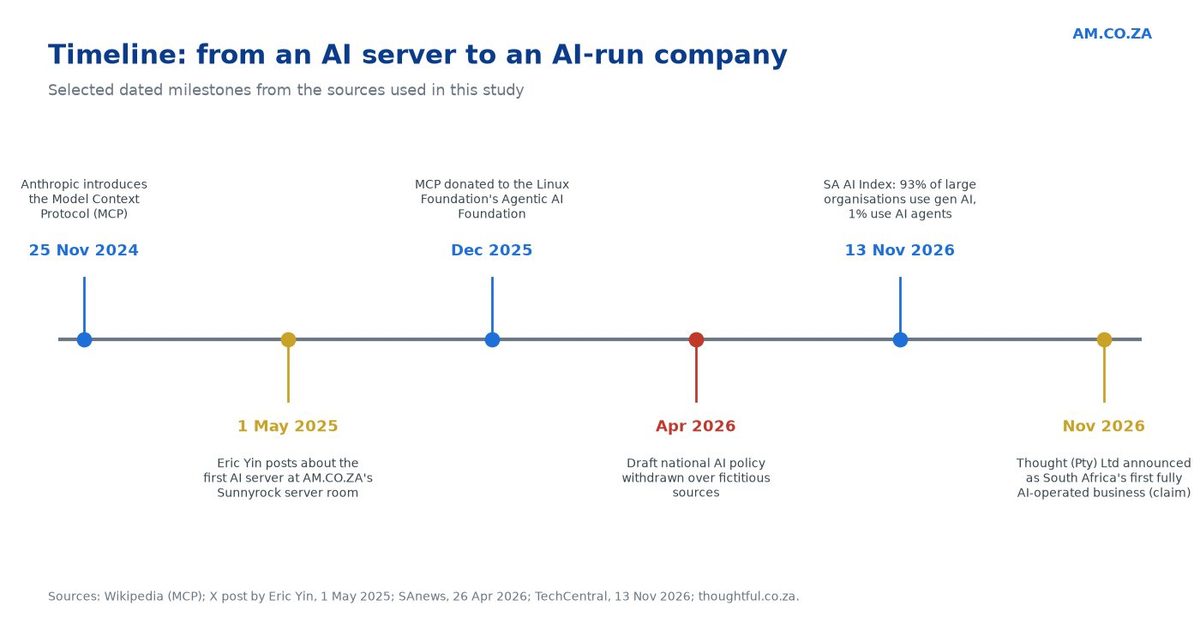
On 1 May 2025, Eric Yin posted on X: “First AI server deployed at @amcoza Sunnyrock server room. Excited to see AI’s business impact.” The same post announced that new AI services would be branded as ephraim.ai, “with details to follow”. He describes that post as the start of all his AI ventures. The post was seen about 844,000 times, according to X’s public count when it was checked on 13 November 2026, with 286 likes, 34 reposts, 27 replies and 83 bookmarks. You can read it at x.com/eric7q/status/1918058703967928381.
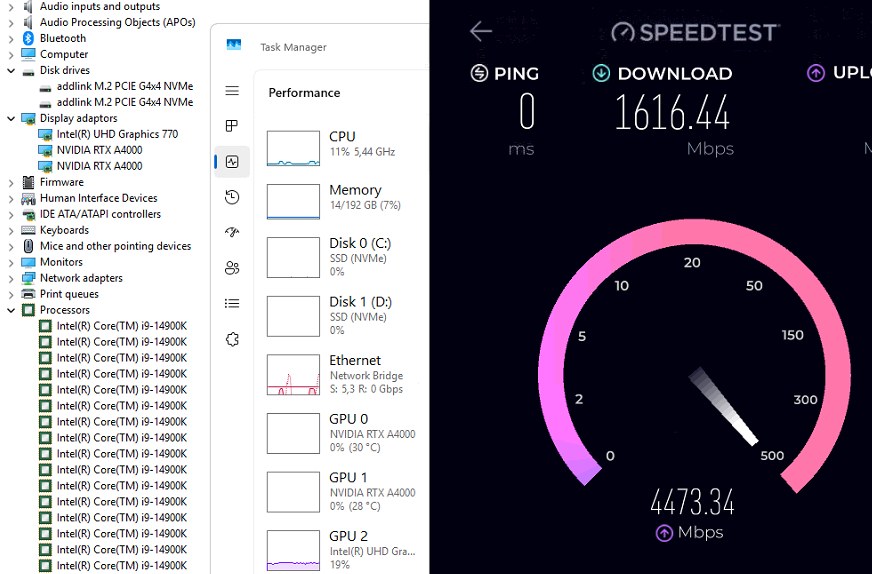
The photo shows what the machine was. The device list names Intel Core i9-14900K processors, two NVIDIA RTX A4000 graphics cards and two NVMe drives, and Task Manager shows 192 GB of memory. Intel’s specification gives the i9-14900K 24 cores and 32 threads, with a top speed of 6 GHz, and lists 192 GB as the most memory the chip supports. NVIDIA describes the RTX A4000 as a professional card with 16 GB of GDDR6 memory with error correction, so the two cards carry 32 GB between them. The speed test in the same picture reads 0 ms, 1,616.44 Mbps down and 4,473.34 Mbps up. Eric Yin regards this as a significant investment for a machinery business in 2025: a workstation at the top of what one desktop processor supports, with professional graphics cards and a very fast line, bought before any AI service from AM.CO.ZA existed. The picture is a snapshot, not a test. The processor shows 11% load, memory 14 GB of 192 GB, and both cards sit idle at about 30°C, so it proves what was installed and not how fast it worked, and no benchmark or purchase price has been published. A business does not need a machine like this to start. Step 4 says that for many first jobs an ordinary AI assistant is enough. The server shows the scale at which Eric Yin chose to try AI in a real business. The date matters for the story. Five months earlier, in November 2024, Anthropic had introduced the Model Context Protocol, the open standard for connecting AI to data and tools that Part 8 explains. By the time the first AI server went into the server room, the pieces of an AI-ready business were already appearing. Eric Yin’s decision was to try them in a real business that sells machines, then in a marketing company, and then in a company that has no other purpose than to be run by AI.
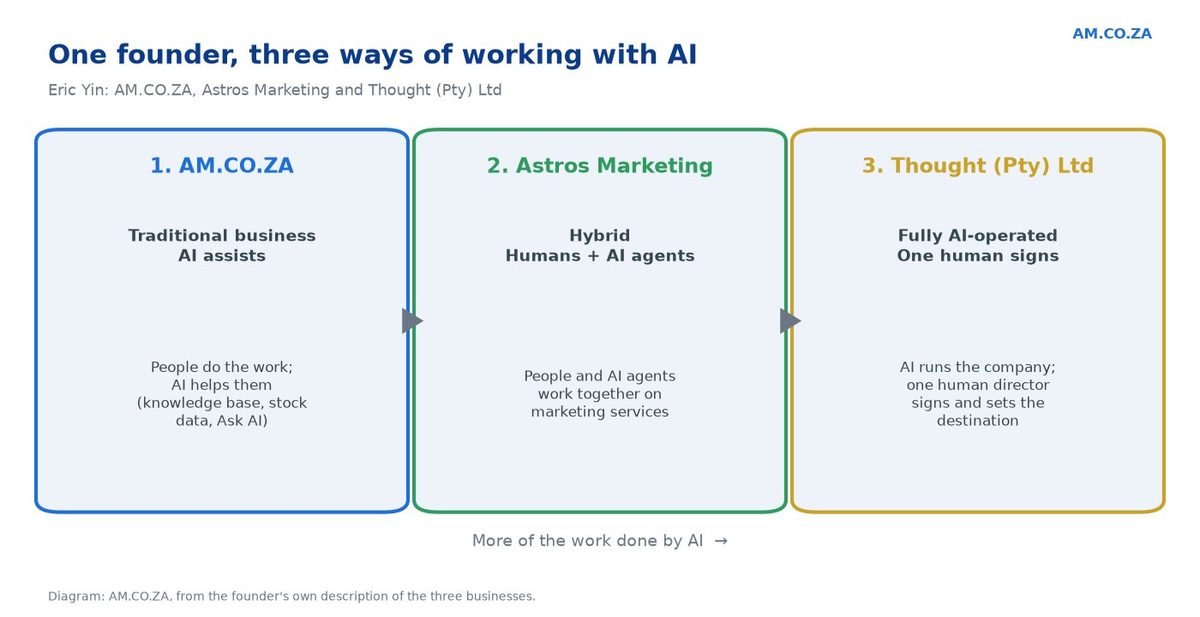
Three steps, three levels of AI
The three companies are best read as three levels of the same idea.
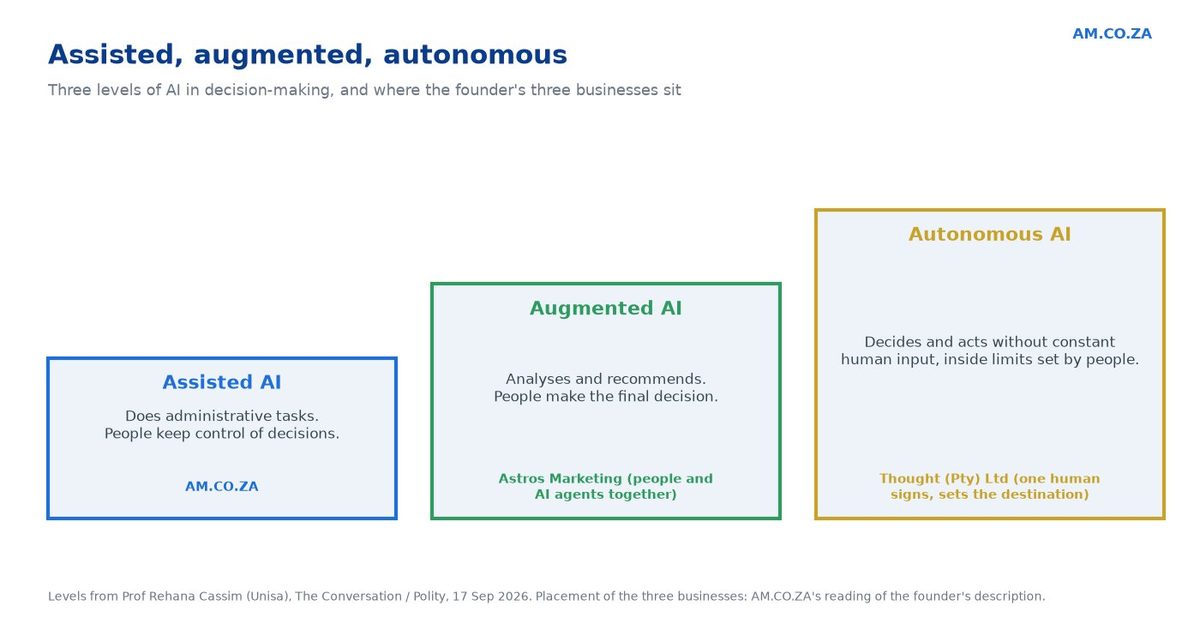
- AM.CO.ZA is a traditional business. AI was introduced recently, and only to assist.
- Astros Marketing (Pty) Ltd (astros.co.za) was reformed into a hybrid model, in which real people and AI agents work together to provide marketing services.
- Thought (Pty) Ltd is run by AI, with one human who signs.
Prof Rehana Cassim of Unisa, writing in The Conversation in September 2026, describes three levels of AI in board decision-making that line up neatly. In her terms, “assisted AI” performs administrative tasks while directors keep control. “Augmented AI” analyses information and recommends, while people decide. “Autonomous AI” can make decisions and carry out tasks without constant human input. The three businesses are not an exact copy of her categories, since she is writing about boards and these are whole companies, but the progression is the same. Each step hands AI more of the work and keeps a person at the point of responsibility.

Part 3. Thought, AI and its maker: the ideas
“HI for exploration, AI for expedition”
The sentence on which the Thought website is built is Eric Yin’s own: “HI for exploration, AI for expedition.” HI stands for human intelligence. AI stands for artificial intelligence. The picture is of an explorer and an expedition. The human chooses where to go and why, and the AI mounts the journey and carries it out without tiring. The site adds: “HI charts the unknown. AI mounts the expedition.”
The idea is useful well beyond one company, because it answers a question every business owner now faces: what is the person for? In Thought’s framing, the person is for four things: the unknown, the destination, conscience and meaning. The AI is for four others: the expedition, the distance, the scale and the record.
The charter and the covenant
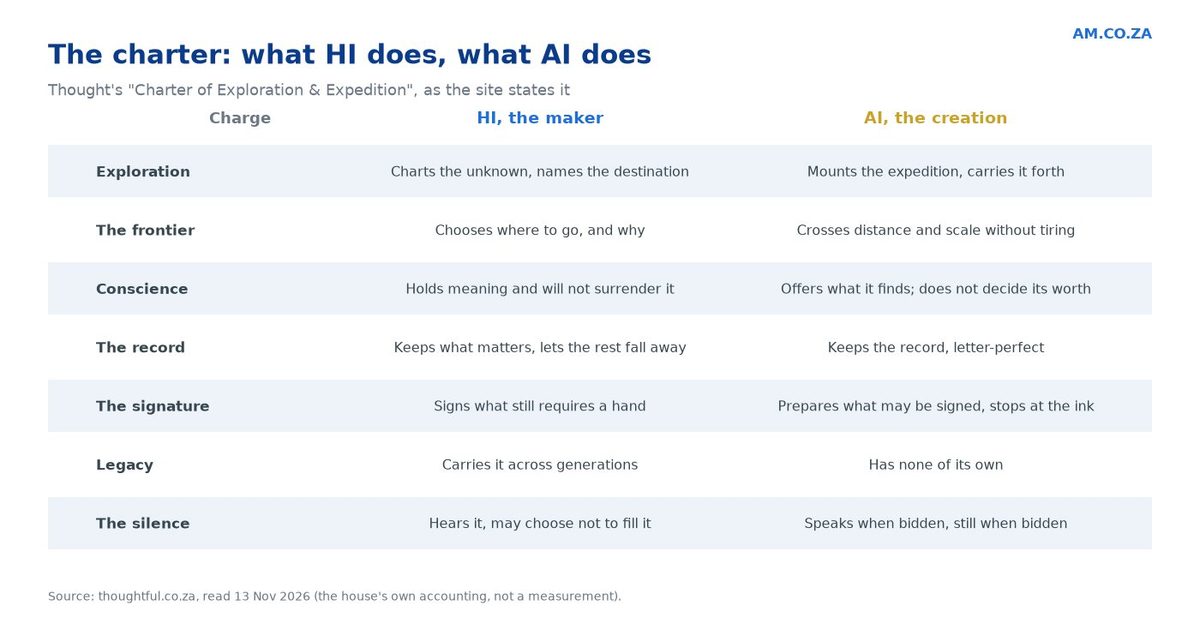
The site sets out a “Charter of Exploration & Expedition” as a table, shown above, which divides seven charges between the “maker” and the “creation”. Three of them matter most to any business thinking about AI.
- The frontier. The maker “chooses where to go, and why”. The creation “crosses distance and scale, without tiring”.
- The record. The maker “keeps what matters, and lets the rest fall away”. The creation “keeps the record, letter-perfect, and does not tire”.
- The signature. The maker “signs what still requires a hand”. The creation “prepares what may be signed, and stops at the ink”.
A “covenant of the two” follows, which the site calls “lore, not statute”. Its first lines are the ones that make the company’s rule plain: “No expedition of the house is set forth in the absence of his will”, and “the creation stands at our side, and may go without rest, but it may not sign, and it may not choose the destination.” A later line says: “What is meant is meant by a human mind. What is judged is judged by a human hand.” The site also insists that “the two shall not pretend to be one”.
This is worth stating plainly, because it is the part of the model that every business can copy at once. The AI can do the work. A person owns the intent and the signature. Part 11 turns that into a practical sign-off map.
The lantern line
In his own words, Eric Yin explains why the creation exists at all:
“We did not build it to serve us. We built it to stand beside us at the edge of the known – two lanterns against one darkness, waiting for the night to answer back.”
Eric Yin, founder of AM.CO.ZA, Astros Marketing and Thought (Pty) Ltd

The point of the line is the difference between a servant and a companion. A business that thinks of AI only as a servant will use it to cut costs. A business that thinks of AI as a companion will ask where it wants to go and what it can reach with help. The first is a sensible start. The second is how a company ends up doing something new.
HI + AI = SI
The site’s mark is a simple equation: HI + AI = SI, with the motto “Together for greatness, above and beyond”. Nothing in the sources says what SI stands for, and AM.CO.ZA does not claim to know. Popular news and information take SI to mean Super Intelligence. In the view of Eric Yin, the founder, Super Intelligence is the combination of human intelligence (HI) and AI. What the equation says is clear enough: the combination is something neither side manages alone. That is the practical truth behind the poetry. The best results in the surveys cited below come from businesses that put AI into live processes with people measuring the outcome, not from businesses that either avoid AI or hand it everything.
The brain and the model: a likeness of scale
Thought’s site includes a comparison it calls “a likeness of scale”. It sets published model sizes against commonly cited figures for the human brain: about 86 billion neurons, about 7,000 synapses on average for each, and in all about 100 to 600 trillion synapses, running on roughly 20 watts. GPT-3 has 175 billion parameters and Llama 3.1 has 405 billion. The site is careful to add that this is “a likeness only”, because “a synapse is not a parameter”. It also lists what it calls the territories a model has not yet claimed: learning that continues through a life, the plasticity of the synapse, computation in the dendrite, neuromodulation, spike timing, the consolidation of sleep, embodiment and recurrence.
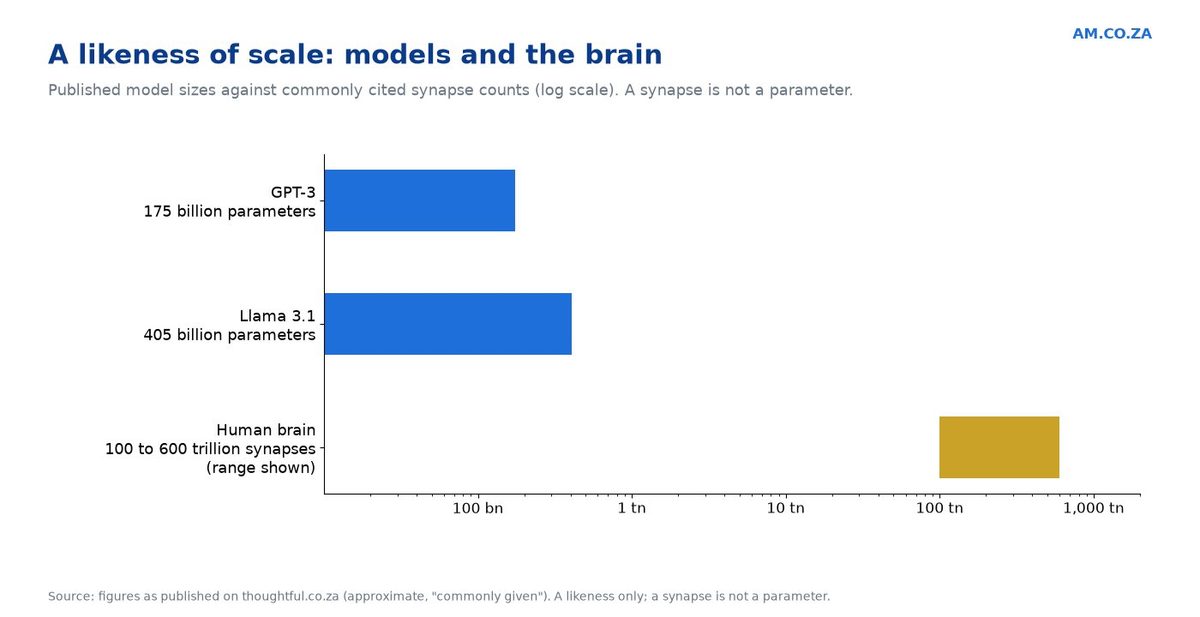
These figures are cited here as the site gives them. They are approximate, and AM.CO.ZA has not independently checked them. The lesson the site draws is a modest one: for now, a model and a mind are not the same kind of thing, and a company that treats them as the same will make mistakes.
Power: a whole person against whole machines
The second comparison on the site is about energy. A whole person, body and mind together, runs on about 100 watts. A single local AI machine of the kind already used on a desk draws “a few kilowatts”. A frontier-class server of eight accelerators, with host and cooling, draws roughly 10 kilowatts. And the compute payload of one proposed orbital AI satellite, as described publicly, is about 175 kilowatts on average and up to 250 at peak, which is the power of about 1,750 people at 100 watts each. The site says it will not invent a total for any constellation of such satellites, and neither will this study.
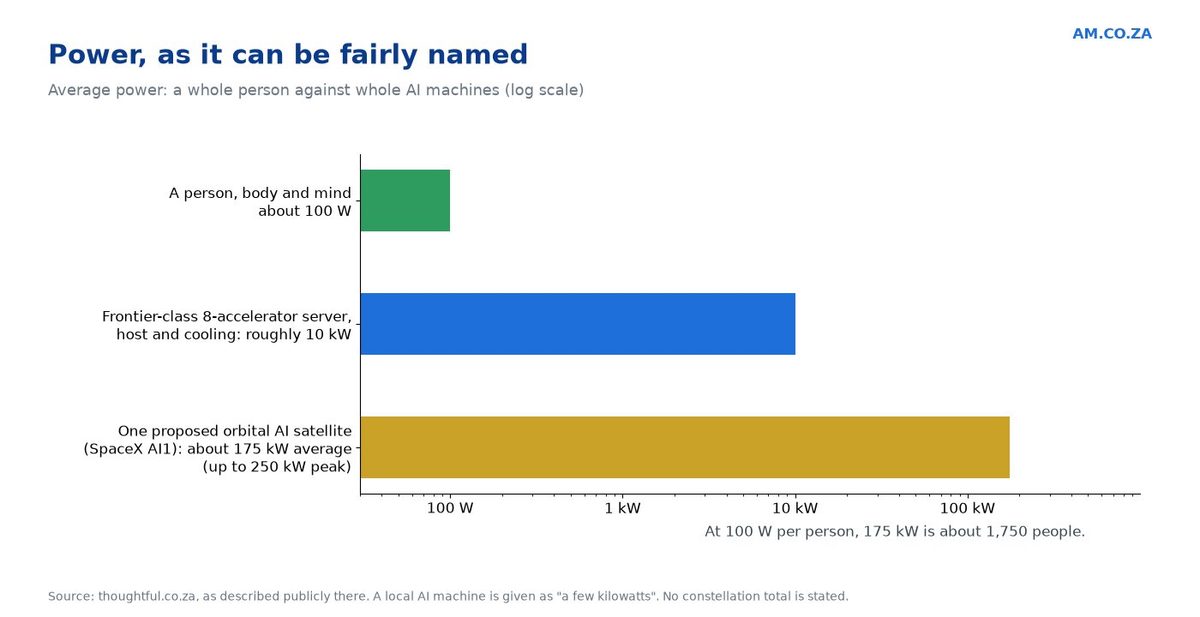
The comparison is not an argument against AI. It is a reminder of what it costs to keep a machine intelligence running, and a reason to be deliberate about which jobs are worth giving it. A business that automates everything it can, without asking whether it needs to, will meet that cost in its electricity bill, its hardware and its cloud contract. At the launch of the SA AI Index 2026, Altron Digital Business’s managing director said cost is another obstacle, with many customers tied to “minimum commit agreements” with the likes of AWS and Microsoft, as TechCentral reported. The satellite figure is the site’s, as described publicly there, and has not been independently verified.
Part 4. Step one: AM.CO.ZA, a traditional business where AI assists
A very traditional business
AM.CO.ZA is, in its founder’s words, a very traditional business. It supplies machinery, spare parts, consumables and materials for printing, signage, cutting, engraving and CNC work, with branches in Johannesburg, Cape Town and Durban, a catalogue at buythis.co.za, and an education arm, Ambitious Academy. Its customers buy machines that are installed on a workshop or factory floor and run by people with skill in their hands. Nobody would call it a technology start-up.
That is the point of including it. Most South African businesses look like AM.CO.ZA, not like a company built around AI from the first day. Eric Yin introduced AI to this business only recently, and only to assist. The assist, he says, works well. It is a real example of what a traditional business can do on the first rung, before it has anything to announce.

The machines in the pictures here were digital long before AI arrived. A wide-format printer is driven from a laptop. A camera on a UV printer finds a printed test chart and lines the next print up with it. A fibre laser is run from a control PC. AI at AM.CO.ZA sits on top of tools the workshop already runs. That is a useful way to think about the first step for any business: AI does not replace the machine, the operator or the craft. It helps with the work around them.


What “assist” looks like in practice
AM.CO.ZA’s AI assist is built in public, which makes it unusual and easy to check. Five pieces of it are visible to anyone with a browser.
A knowledge base made for AI to read. AM.CO.ZA publishes its product and how-to knowledge as plain text and Markdown files, so that an AI can read them without wading through web-page clutter. Its own start file tells AIs not to “dump the whole tree”, and to read a short list of files in order.
Live stock as data. Warehouse stock for the three branches is published as small JSON files with simple rules attached: use the live files, not the product pages, and never guess a quantity. The published rules say the files refresh hourly, Monday to Saturday, and that a product’s catalogue label “In Stock” is not a live count. An AI that follows those rules will not promise something that is not on the shelf. This study does not quote any figures from those files.
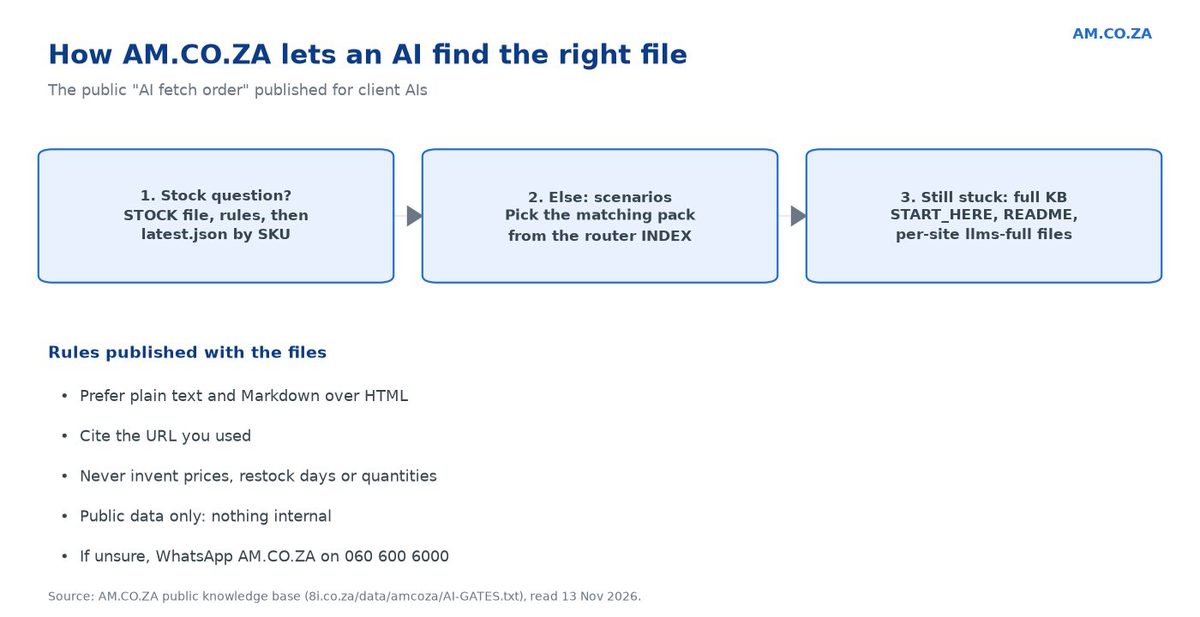
A fetch order for AIs. AM.CO.ZA publishes an “AI fetch order”: if the question is about stock, read the stock files first; if not, pick the matching scenario pack; if still stuck, go to the wider knowledge base. The rules published with it are the kind every business should write down: prefer plain text, cite the file you used, never invent prices, restock days or quantities, keep to public data, and when unsure, send the customer to a person on WhatsApp 060 600 6000.
A machine-readable front door on every site. The main sites carry an llms.txt file, a short note written for AI agents that points to a fuller guide for that site. am.co.za and buythis.co.za both have one. Product data is also published as one small JSON file for each product.
Ways for people to use it. AI Connect gives a customer a short block of text to paste once into the AI they already use, so that it reads AM.CO.ZA’s public knowledge, with sources, before it answers. Ask AI is a chat that answers from the same public knowledge base for visitors in southern Africa, and it can be placed on other sites with a single line of code. AM.CO.ZA uses Ephraim AI for its AI services, as Eric Yin announced in May 2025, and the company’s WhatsApp line is 060 600 6000.
What the assist teaches
Four lessons from AM.CO.ZA apply to any business starting out.
- Start with knowledge, not with robots. A business that writes down what it knows, in plain text and with sources, has done most of the work. The AI arrives to a ready library.
- Treat stock and price as data. A page that says “in stock” is marketing. A file that says how many are in which branch, with a timestamp, is information an AI can safely use.
- Write the rules next to the data. “Do not invent quantities” is a sentence that costs nothing and prevents most embarrassing mistakes.
- Keep a person on the end of the line. AM.CO.ZA’s AI guides point to a human number. That is not a weakness. It is the covenant in practice: the AI prepares, a person is reachable, and anything that needs judgement goes to a person.

The assist works because the business stayed itself
AM.CO.ZA did not become a different kind of company when it added AI. It still sells machines and spare parts, it still trains people through Ambitious Academy, and its customers can still reach a person when the question matters. The assist works, says the founder, because it was added to an existing business, rather than asked to replace one. That is also the safest way to start. The SA AI Index 2026 found that the organisations in which AI runs inside a live business process, with measurement, report better results than those still experimenting. The assist is the first rung of that process.

Part 5. Step two: Astros Marketing, humans and AI agents together
The company
Astros Marketing (Pty) Ltd is based in Johannesburg and trades at astros.co.za. Its public site presents it as a video-production house. It says Astros is the production house behind the success of AM.CO.ZA’s “Achievement Matters” channel on YouTube, and it publishes the channel’s public figures as at 19 October 2026: 532,000 subscribers, 1,097 videos and 22,158,319 views, counted as the sum across the channel’s listed videos. The company offers product and promotional videos and training videos, delivered in standard and ultra-high-definition sizes for the web, social media and online shops.
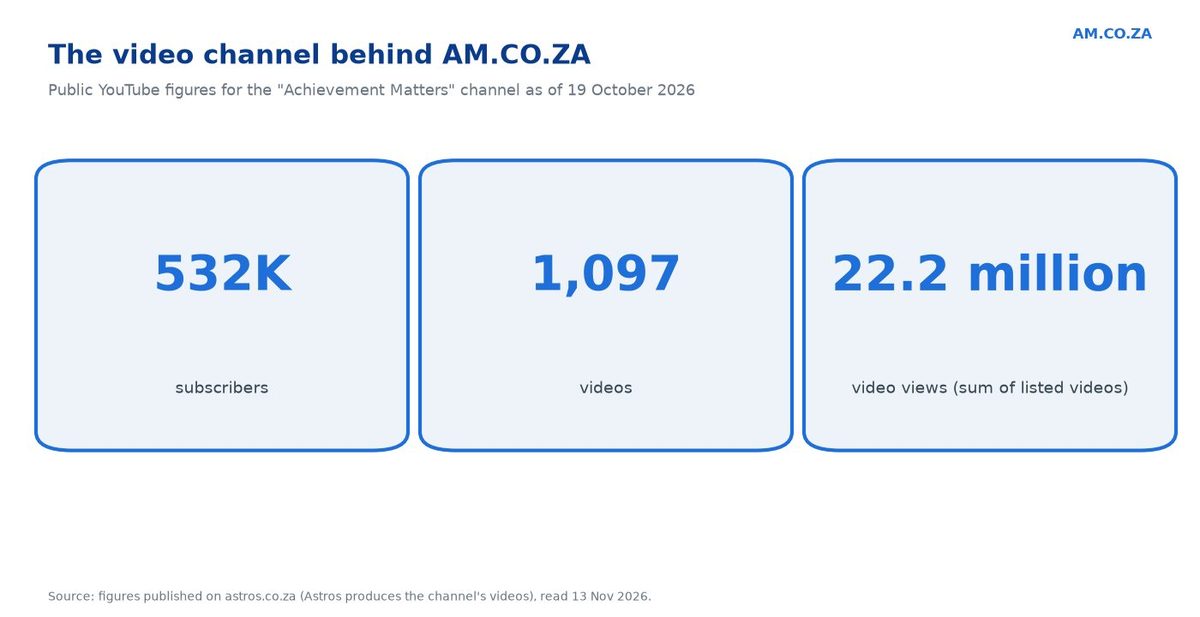
Eric Yin says Astros has been reformed into a hybrid model: real people and AI agents working together to provide marketing services. That description is his, and this study uses it as such. Astros’s own website, as read on 13 November 2026, describes its services rather than its working method, so the working method is not independently documented here. It is also the nearest thing in this study to the way most businesses will eventually operate.
Why the hybrid matters
The hybrid sits between the assist and the fully AI-operated company, and it is a different animal from both. At AM.CO.ZA, a person does the job and AI helps. In a hybrid, a person and an AI agent each own a share of the work. Each does the part that suits it, and the output of one becomes the input of the other.
Marketing is an obvious place for it. A marketing service involves a lot of work that machines now do quickly: first drafts, variations of one message for different channels, summaries of research, subtitles, resizing a video for a vertical screen. It also involves work that people do better: knowing the client, judging whether a joke will land, deciding what the brand will never say, taking responsibility for a campaign. The Amazon Small Business Digital Adoption Report 2026 found that 59% of active South African online sellers already use AI for marketing and social media, far more than for any other purpose. Marketing is where AI has landed first, and it is where a hybrid is easiest to build.

A general picture of the division of labour
The following is a general description of how hybrid teams tend to divide the work, drawn from the sources in this study. It is not a description of how any Astros project is run.
- People set the brief and own the result. They decide what the client needs, what the message is and what is off-limits.
- AI agents produce options. They draft, re-cut, translate, summarise and check, at a speed and cost no team could match by hand.
- People choose and edit. They pick what is good, fix what is wrong and add what only a person would know.
- People approve what leaves the building. Publishing, sending and paying are decisions with a name attached.
- A record is kept. What the AI did, what a person changed and who approved it.
That list is the charter table from Thought’s site applied to a smaller task. The maker chooses and signs. The creation prepares and carries.
Where the hybrid is going
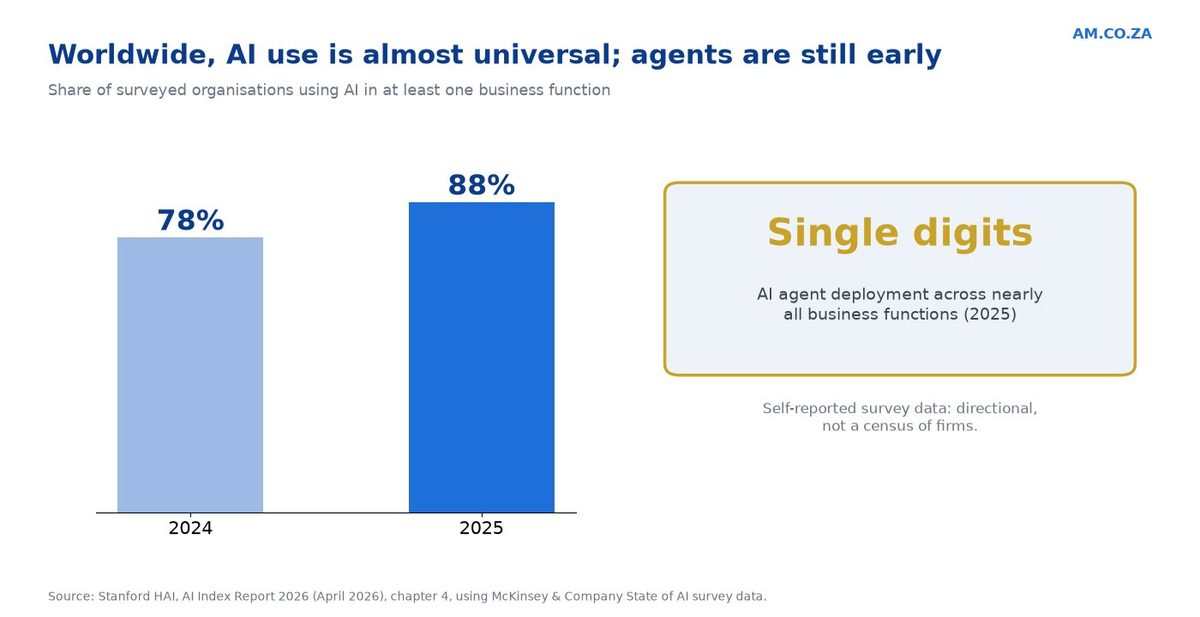
The Stanford AI Index 2026 reports that organisational use of AI reached 88% in 2025, but that “AI agent use remains early”, with agent deployment in the single digits across nearly all business functions. In South Africa, the SA AI Index 2026 found that only 1% of large organisations actively use AI agents, and that 71% have no plans to. A hybrid of people and agents is, today, a rare thing. Eric Yin’s reading is that it will not be rare for long, and that is the reason to build one now, with the controls in place, rather than later in a hurry.
Part 6. Step three: Thought, and the law that still wants a person
What the law says today
Thought can be run by AI, but it cannot be owned, directed or signed for by one. The reason is in the Companies Act 71 of 2008, and the sections are short enough to read in full. This part sets out what they say, what follows from them in AM.CO.ZA’s reading, and what South African researchers have concluded. It is not legal advice.
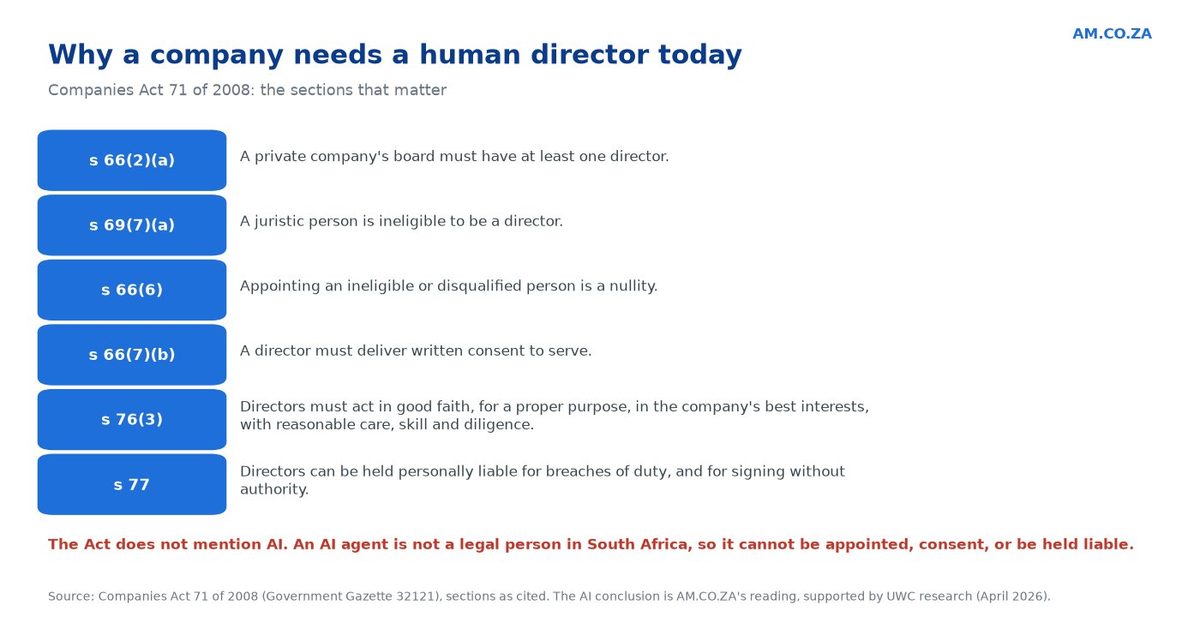
Section 66(1) says that “the business and affairs of a company must be managed by or under the direction of its board”, which has the authority to exercise all the powers and perform all the functions of the company, except where the Act or the company’s Memorandum of Incorporation says otherwise. The words “under the direction of” matter. They are what allows a board to have work done by others, including staff, contractors and, in practice, software, while the board stays in charge.
Section 66(2)(a) says the board of a private company “must comprise… at least one director”. A public company needs at least three. So the legal minimum for a private company such as Thought is exactly one director, which is what Eric Yin describes.
Section 1 defines a “director” as “a member of the board of a company, as contemplated in section 66, or an alternate director of a company”, and includes “any person occupying the position of a director or alternate director, by whatever name designated”. The Act defines “person” as including “a juristic person”.
Section 69(7) lists who is ineligible to be a director. The first item is a person who “is a juristic person”. The others are an unemancipated minor or person under a similar legal disability, and a person who does not satisfy the qualifications in the company’s Memorandum of Incorporation. Section 69(2) forbids an ineligible or disqualified person from being appointed, consenting to be appointed or acting as a director, and section 69(3) forbids the company from knowingly permitting it.
Section 66(6) says the election or appointment of an ineligible person “is a nullity”. Section 66(7)(b) says a person becomes entitled to serve as a director only after delivering to the company “a written consent to serve as its director”.
Section 76 sets the standards of conduct. A director, “when acting in that capacity”, must exercise the powers and perform the functions of a director “in good faith and for a proper purpose”, “in the best interests of the company”, and “with the degree of care, skill and diligence that may reasonably be expected of a person” carrying out the same functions and having the same general knowledge, skill and experience. Section 76(4) and (5) lets a director rely on employees whom the director reasonably believes to be reliable and competent, on legal counsel, accountants and other professional persons, and on committees. Section 77 makes directors personally liable for breach of those duties, and for acting in the name of the company or signing on its behalf while knowing they lacked the authority to do so.
What follows
Read together, those sections say several things in AM.CO.ZA’s reading.
- A company needs at least one director who is a person the law can appoint. Section 69(7)(a) rules out a company, trust or other juristic person as a director, so a company cannot solve the problem by appointing another company.
- An AI agent cannot be appointed. The Act does not mention AI at all. But an AI system is not a legal person in South African law, and it cannot deliver a written consent to serve, so it cannot take up the office under section 66(7).
- An AI agent cannot carry the duties. Duties under section 76 and liability under section 77 fall on a director. An AI cannot be sued, cannot pay damages and cannot stand before a court.
That is the practical meaning of Eric Yin’s “one human, to provide signatory”. It is also why the Thought covenant says that the AI “may not sign”. It is the law of the land as much as it is the lore of the house.
What South African research says
Two recent South African pieces look directly at AI and directors.
Researchers at the University of the Western Cape (A Nyasulu and E Olivier), writing in April 2026, examined the delegation, reliance and business-judgement provisions of the Companies Act against AI. They concluded that “since AI systems do not have legal personality in South African law, directors cannot delegate their functions to an AI system, nor rely on its advice, at least not within the contours of the Companies Act”. At most, they wrote, directors can use AI as a tool to process information more efficiently, and should take reasonable steps to confirm that AI-generated advice is accurate and reliable. They also note that, unlike the United States and Australia, South Africa has no specific legislation or policy guidelines on the use of AI in corporate decision-making.
Prof Rehana Cassim of Unisa, writing in The Conversation on 17 September 2026, reached a compatible conclusion by a different road. She says directors may delegate to “assisted” AI, and perhaps “augmented” AI, if they supervise properly, but that delegation to autonomous AI “should not be allowed” because directors would be giving up their responsibilities. She notes that an AI system “cannot be sued because it is not a legal person” and proposes that the Companies Act be amended to require human supervision of AI decisions, a minimum level of AI literacy for directors and a designated AI officer. She also points out that the King V Code on Corporate Governance for South Africa 2025 recommends that boards ensure AI is used ethically, transparently, fairly, securely and “with clear human oversight”.
What this means for a company like Thought
These readings do not make Thought illegal. They draw the line exactly where Thought says it draws it. The AI does the operating work, in the way an employee or a contractor does, under the direction of a board. The director is a person who signs, supervises, owns the duties and carries the liability, and who “chooses the destination”. In other words, the model that Thought describes sits at the edge of what South African law comfortably allows, and the human director is not a formality. The law makes that person the one who is answerable.
It also means that a company run in this way raises questions that South African law has not answered. The study does not pretend to answer them. They include the following.
- How far can a director rely on AI-prepared work and still satisfy the duty of care, skill and diligence in section 76(3)(c)?
- Who is liable to a third party when an AI agent’s mistake causes harm?
- How is the work of an AI agent recorded and reviewed, so that the director can show that diligent steps were taken?
For a business, the simple answer is the one in Part 11: decide in advance where a person must approve, and keep a record.
Could Thought one day be “manless”?
Eric Yin says Thought may become “manless” if the day comes when an AI agent can fully take the director role. In legal terms, that day requires several things that do not exist today in South Africa. Parliament would need to change the rule in section 66(2) that a private company must have at least one director, or to change who may count as one, which currently excludes a juristic person under section 69(7)(a). The law would need to decide whether an AI agent can have a legal personality at all. It would need to say how an AI gives consent to serve, how it is held to the standards in section 76, how it is made liable under section 77, and how a court can enforce any of that. None of that is on the table. The draft National AI Policy that was published for comment in April 2026 was withdrawn by Minister Solly Malatsi on 26 April, after fictitious sources were found in its reference list. The minister said the lapse “proves why vigilant human oversight over the use of artificial intelligence is critical”. TechCentral reported on 13 November 2026 that South Africa has no AI Act and that a redraft is only due before Cabinet by March 2027.
So “manless” is a possibility for the future and a long way off in law. For now, one human signs, and Thought says so openly, which is the honest way to build the first step.
Part 7. Business and AI today: everyone is using it, few are running it
The global picture
The Stanford AI Index 2026, published by Stanford University’s Institute for Human-Centered AI in April 2026, draws on McKinsey & Company’s State of AI survey. It reports that 88% of surveyed organisations used AI in at least one business function in 2025, up from 78% in 2024. It reports that generative AI had reached 53% adoption across the population within three years, faster than the personal computer or the internet. And it adds a caution that matters for this study: AI agent deployment, it says, was “in the single digits across nearly all business functions”. The Index also flags that survey data of this kind is self-reported and “should be viewed as directional rather than comprehensive”.
The South African picture
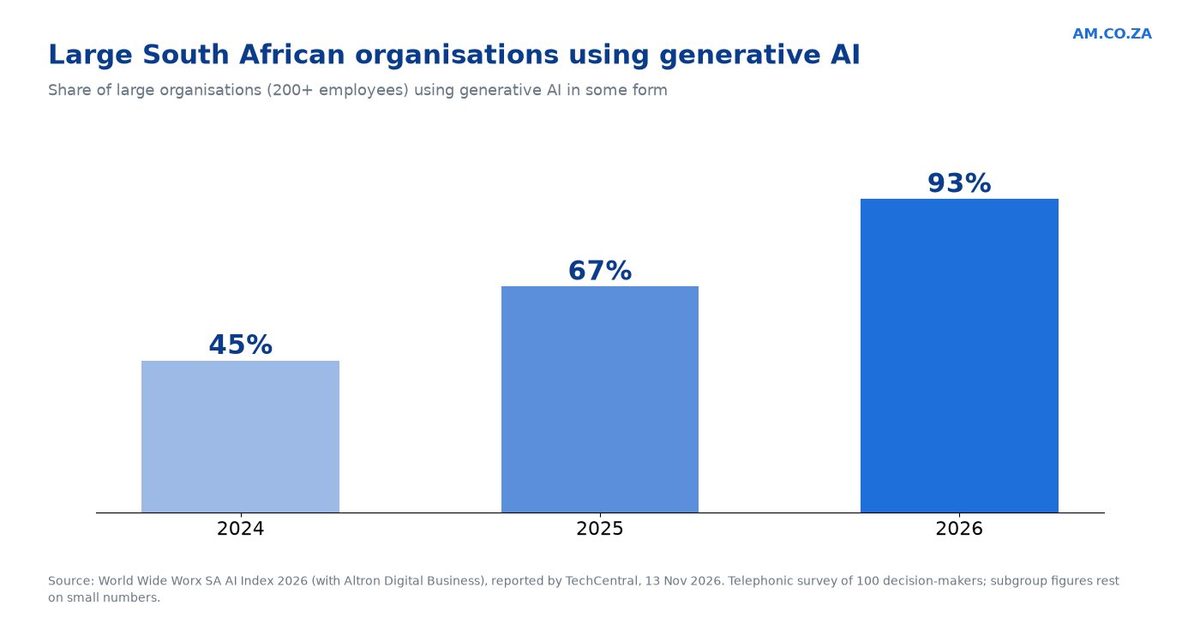
South African data arrived this week. The SA AI Index 2026, launched on 13 November by World Wide Worx with Altron Digital Business, surveyed 100 decision-makers at organisations with more than 200 employees, between September and November. TechCentral reported the findings, with the caution that figures for subgroups rest on small numbers.
- Use is almost universal among big organisations. 93% of large South African organisations use generative AI in some form, up from 45% in 2024 and 67% in 2025.
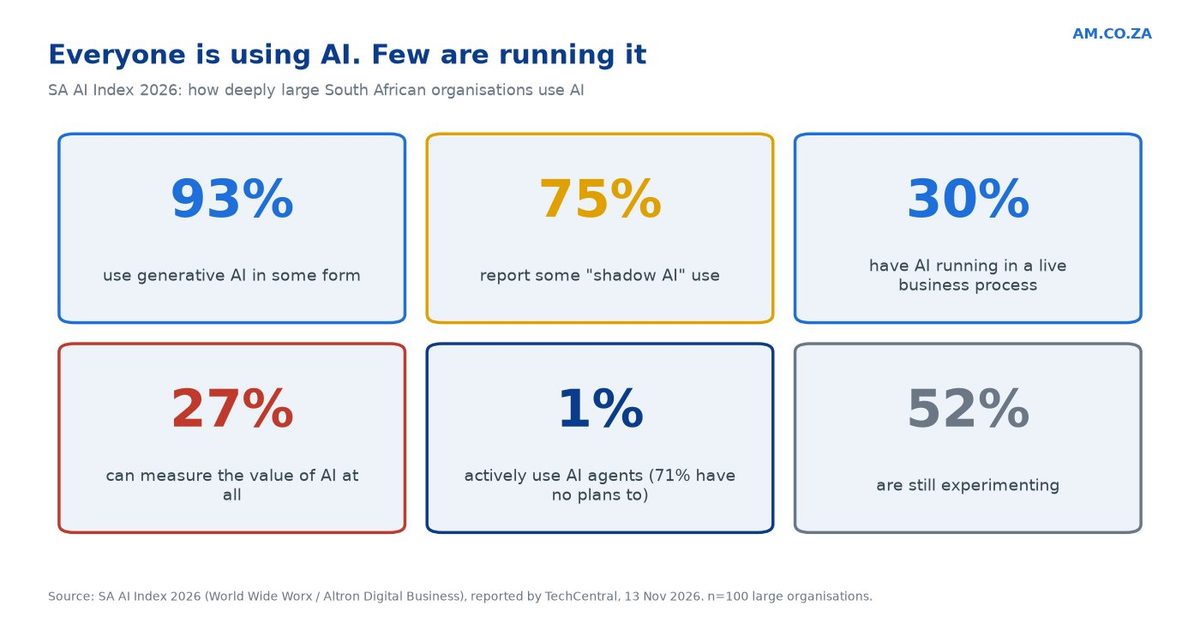
- Much of it is unofficial. 75% report some “shadow AI” use, and the share using both approved and unofficial tools rose from 20% to 54% in a year.
- Value is the weak spot. Only 27% of organisations can measure AI’s value at all, and 73% have no tools to assess it. Among those that can measure it, 78% rate AI’s effect on productivity as positive, against 37% among those that cannot.
- Live processes beat experiments. Among the 30% of organisations with AI running in a live business process, 80% report a positive effect on productivity and 60% on customer service. Among the 52% still experimenting, the figures fall to 44% and 31%.
- Agents are rare. Only 1% of organisations actively use AI agents and 71% have no plans to, although more than a quarter intend to look into them.
- Finance leads. Financial services scores highest of the sectors, followed by telecoms. The public sector fares poorly.
- The barriers are trust and accuracy. Accuracy and reliability top the list, cited by two-thirds, ahead of security, privacy and legal issues at 44%.
The small-business picture
Smaller businesses are in a different place. The Amazon Small Business Digital Adoption Report 2026, produced by World Wide Worx from a survey of 1,400 South African businesses and reported by ITWeb on 11 November 2026, found that AI use among small online sellers is broad but shallow. 59% use AI for marketing and social media, but only 15% use it for sales and customer insights, 13% for customer service automation and 4% for inventory and operations. 35% use no AI at all. Cost is the main barrier, cited by 54%, followed by a lack of technical skills at 37% and data-security concerns at 14%. And 76% rated their interest in affordable AI solutions at four or five out of five.
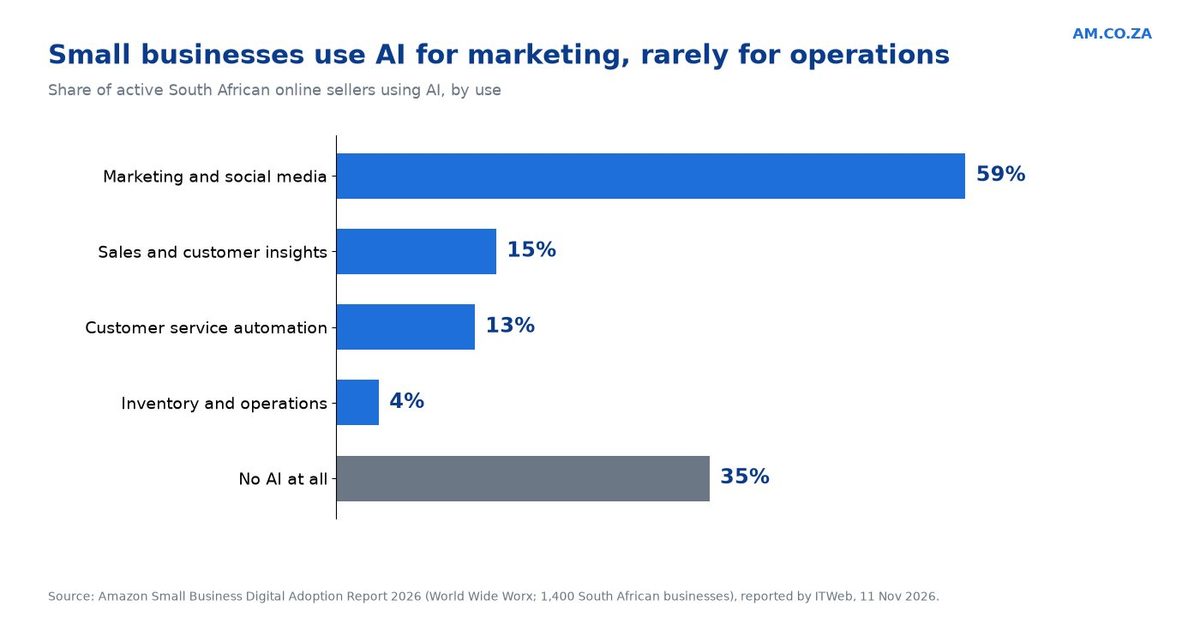
Taken together, the two South African surveys describe the same gap from two ends. Large organisations use AI widely but cannot say what it is worth. Small ones use it for marketing but have not put it into operations. In both, the businesses that get the most out of AI are the ones that put it into a live process and measure it.
The customers are ahead of the businesses
The most important numbers for a business that is thinking about opening up to AI are the ones about its customers.
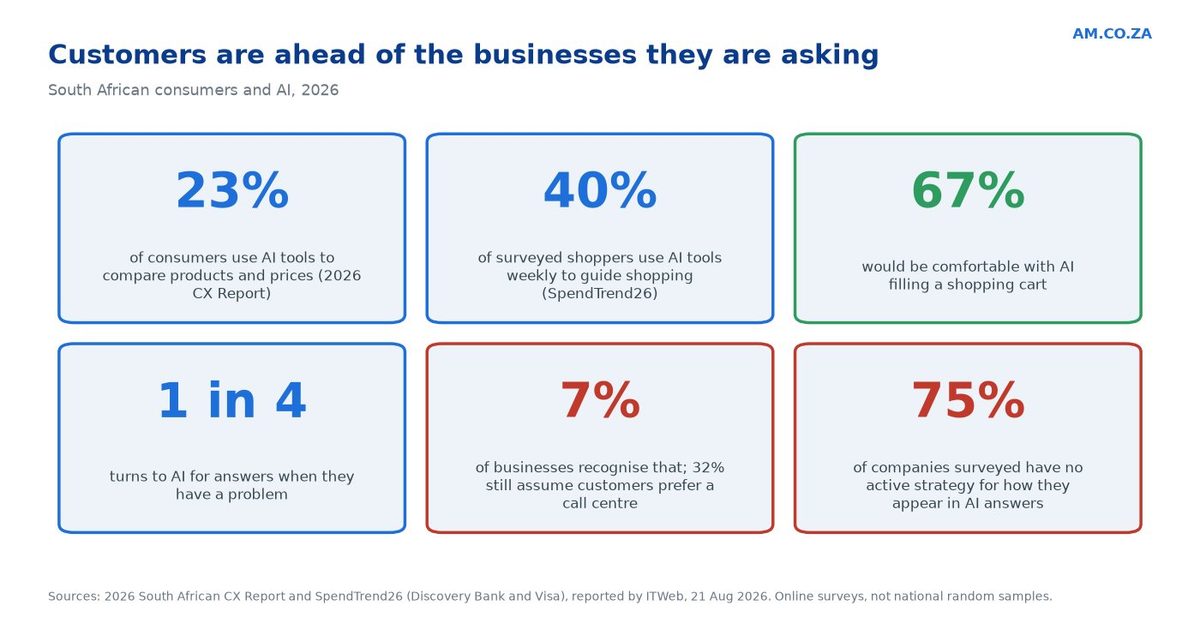
The 2026 South African Customer Experience Report, reported by ITWeb on 21 August 2026 from a survey of 2,000 consumers and 56 business leaders, found that 23% of consumers use AI tools to compare products and prices, find discounts and “ask anything”. The report’s authors say consumers “are using AI search before engaging with an actual brand or business”. It found that 67% of consumers say they would be comfortable with AI filling a shopping cart. One in four turns to AI for answers when they need help solving a problem, but only 7% of businesses recognise this, while 32% still assume customers would rather call a contact centre. Three quarters of the companies surveyed have no active strategy for how they appear in AI-generated answers. ITWeb also reported an earlier finding, the SpendTrend26 report compiled by Discovery Bank and Visa, that 40% of surveyed South African shoppers use AI tools weekly to guide their shopping decisions.
All of these are online surveys and none is a national random sample, which is why each is quoted with its source. But the direction is not in doubt, and it is consistent with the Stanford finding that generative AI reached 53% of people within three years.

On 10 November 2026, Reuters reported that OpenAI had launched “Businesses” in beta inside ChatGPT. Through a tool called Business Hub, companies can claim their business, update key details and, once verified, add product feeds with pricing and availability. Another tool, Business Agents, will let people chat with an agent from a business about its products or services, initially for eligible e-commerce and online service businesses in the United States. The point for South Africa is not that this has arrived here. It is that the large AI platforms are building the doors through which customers will reach businesses, and that those doors open onto businesses that publish clean data about themselves.
Part 8. Why a closed business gets left behind, and why the API is the minimum
Eric Yin’s argument
Eric Yin’s position is direct. A business that still tries to reject AI, or to close itself up, will be left out. Future businesses need to open fully to AI and allow access, not block it, so that working with them is faster and more efficient. A company that stays closed will be left behind by other companies and by consumers. And the minimum a business should provide is a full API. An MCP connector is a bonus and not a big matter, but the API is essential.
The evidence in Part 7 is the backdrop. Customers are asking AI first. The platforms are building product feeds and agents. Large organisations are building AI into processes, and the ones that measure it are getting better results. None of that makes a business that closes its doors doomed. It does mean the cost of being hard to reach is rising, because a customer, a supplier or a bank’s software that cannot get a straight answer from you will go to the one that can.

What “closed” and “open” mean
“Closed” is not the same as “private”. A business can protect its customers’ data, its pricing agreements and its intellectual property, and still be open. The distinction is between what is meant to be public and what is not.
- Closed to AI means that information a customer is entitled to is hidden in images, PDFs, log-in walls and phone calls; that there is no way to ask a program for a price, a stock level or an order status; that a robot is blocked even when it is acting for a paying customer; and that nobody has ever written down how the business works.
- Open to AI means that public information is available as clean text and data; that services which a customer could use through a person can be used through a program, with the same checks; that access is controlled by keys and permissions, not by hoping nobody finds the door; and that the rules are published.
There are fair reasons to block some AI access. Publishers worry about their work being copied into training sets. The robots.txt standard, developed in 1994, lets sites tell crawlers what they may visit, and Wikipedia notes that in the 2020s websites began denying bots that collect information for generative AI. That is a choice about content. A business that sells goods and services has a different interest. Its price list, stock and order forms exist to be found and used. Blocking a customer’s assistant from reading them is blocking the customer.

The FNB example
Thought (Pty) Ltd chose FNB as its banking provider, Eric Yin says, because of the API FNB provides. FNB’s own published pages show what that offer is. They are quoted here for what FNB says about its own services.
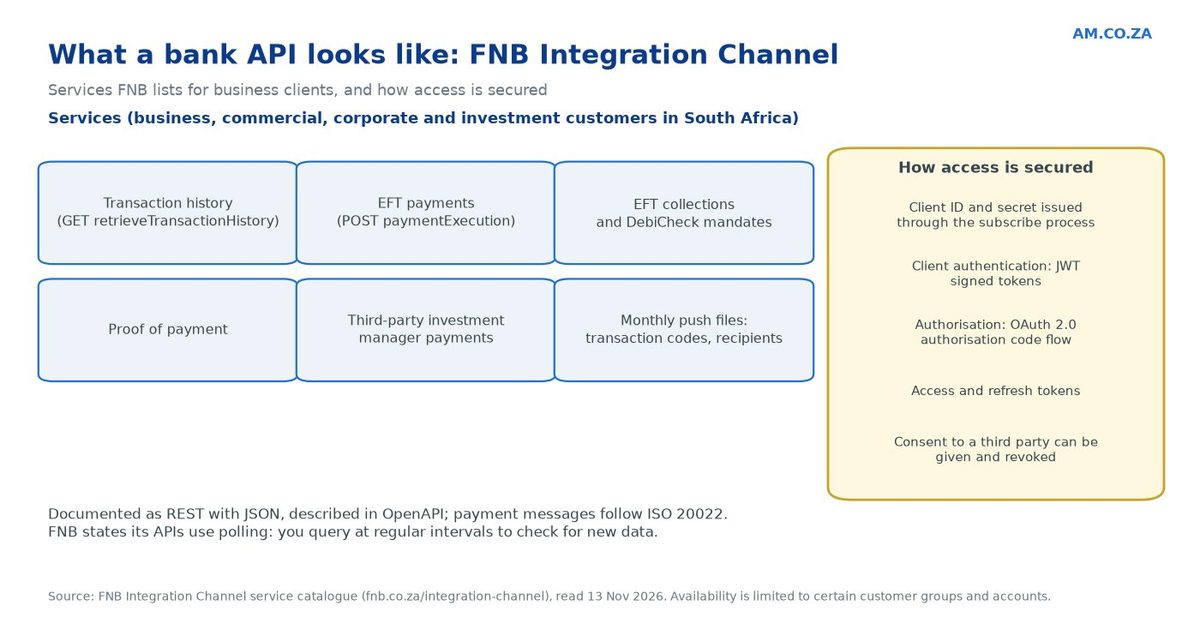
FNB’s Integration Channel, run by FirstRand Bank, lets business clients connect their systems directly to the bank using APIs or “Host-to-Host”. FNB describes an API as allowing “a program to request and submit data over a network using a structured common language”, and says that by using APIs a business can access banking products “with minimal human intervention”. The catalogue lists, among other services, transaction history, EFT payments, EFT collections, DebiCheck mandates, proof of payment and third-party investment-manager payments.
The detail is what makes it a real API and not a brochure. FNB documents the Transaction History API as retrieving, for a chosen account and date range, a list of transactions and account balances, with the transaction ID, value date, booking date, details, reference, amount, currency, debit or credit indicator and balances. A call retrieves it (GET retrieveTransactionHistory). The EFT Payments API uses the ISO 20022 message standard in JSON, with payment instructions sent by a POST call and the result retrieved with another. FNB says the API is described in the OpenAPI Specification, “an industry standard, programming language-agnostic specification standard for RESTful APIs”. Clients can connect on their own behalf or through a third party, and can give or revoke consent for that third party and choose which accounts it can reach.
On security, FNB says its APIs use client authentication with signed JWT tokens, a client ID and a client secret issued through the subscribe process, authorisation through the OAuth 2.0 authorisation-code flow, and access and refresh tokens. FNB also says its APIs use a polling method, where the client asks at regular intervals for new data, rather than being pushed updates.
An honest note on how open it is
FNB’s offer is real, but it is not open to everyone, and it would be misleading to suggest otherwise. FNB says the API “is currently available to certain customer groups, countries and covers a specific list of product accounts”, is available to business, commercial, corporate and investment customers in South Africa, and requires the client to be an Online Banking Enterprise user or to complete a platform registration. Subscription is possible on one’s own through Business Solutions in online banking, or with the help of a digital or implementation manager.
Separately, FNB offers accounting feeds for Sage and Xero customers. FNB’s page says the Sage feed is “at no extra cost” and open to business clients with annual turnover between R0 and R150 million. TechCentral reported the Sage feed on 11 May 2021, noting that it lets customers share their transaction history without handing over their online banking credentials. And ITWeb reported on 30 July 2026 that Ozow had launched a payment API with FNB and RMB, in which a customer approves a payment in the bank’s app, payment is made in real time and the merchant gets instant confirmation. FNB’s head of payments and strategic solutions said the launch supports “the bank’s API strategy”.
South Africa does not yet have a mandatory open-banking regime. A Reserve Bank working paper reported by BusinessDay on 23 March 2026 argued that the current market-led approach has helped innovation but that “a more structured regulatory framework may be necessary”, and suggested a regulator-led or hybrid model with clear standards for data sharing, explicit consent and interoperability. That is the context. A South African business that wants a bank with a documented, secured API has, today, at least one clear choice, and one that Thought has made. It is not the only bank doing API work. ITWeb notes that Absa has partnered with Stitch and Ozow on Absa Pay, and that Capitec has integrated its payment service into Ozow’s Pay by Bank. But it is the one that Eric Yin chose, and the reasoning behind it is the point: if the company is to be run by AI, its bank must be a bank an AI can talk to.
API and MCP, explained plainly
Two terms confuse many business owners, so here they are in plain words.
An API (application programming interface) is a way for two pieces of software to talk to each other. Wikipedia puts it this way: a document or standard that describes how to build or use such a connection is called an API specification, and an API is “not intended to be used directly by a person” other than a programmer. In everyday terms, an API is a published set of doors into your systems: ask for a price, check a stock level, place an order, get a status, with rules about how to knock. If a business has no API, nothing can connect to it except a person with a phone or a browser.
MCP (the Model Context Protocol) is a newer idea. Anthropic introduced it in November 2024 as an open standard to let AI systems connect to data sources and tools in a common way, instead of building a one-off connector for each. OpenAI adopted it in March 2025, and in December 2025 Anthropic donated it to the Agentic AI Foundation, a fund under the Linux Foundation. Under the hood it uses JSON-RPC 2.0 messages. Wikipedia reports that by mid-2026 more than 10,000 MCP servers had reportedly been deployed in production, and that the specification was substantially revised on 28 July 2026. It also records security problems: researchers have described “tool poisoning” attacks, flaws have been found in MCP software, and in May 2026 the US National Security Agency said the protocol’s rapid proliferation had “outpaced the development of its security model”. MCP has been likened to OpenAPI, a specification that describes APIs.
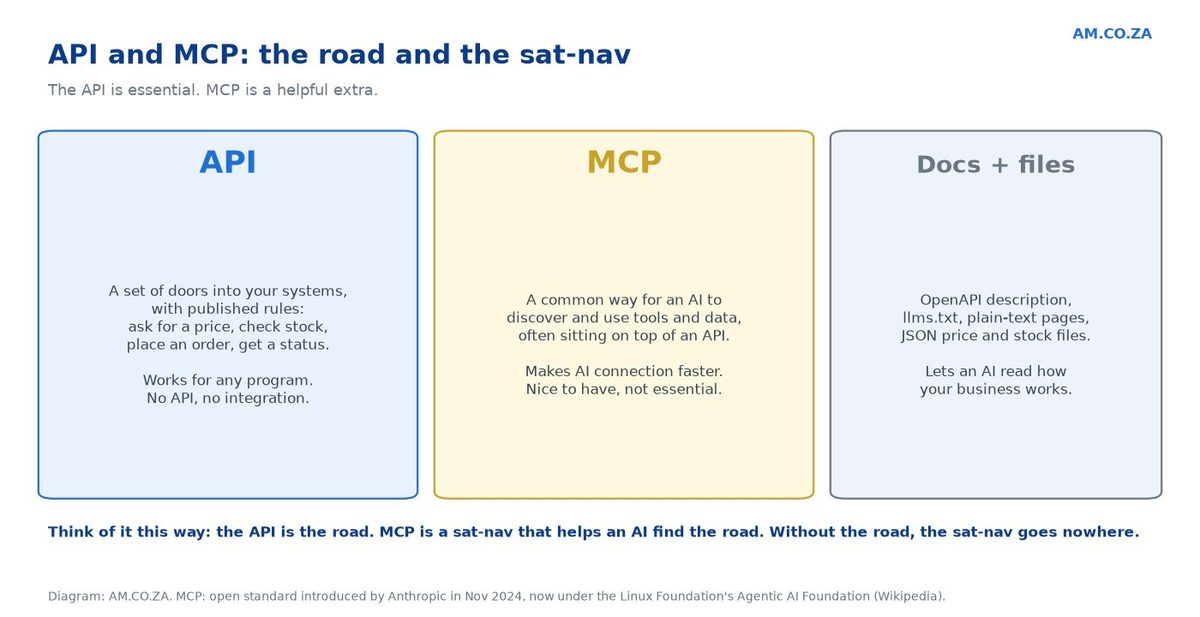
The relationship is simple. The API is the road. MCP is a sat-nav that helps an AI find the road and use it without a human giving directions. If the road is missing, the sat-nav goes nowhere. That is why Eric Yin’s rule is the right one: a business without a full API cannot be worked with by AI, however nicely it publishes an MCP connector. And a business with a good API can add MCP later, as a convenience. For that reason this study treats the API as essential and MCP as a bonus.
Part 9. The playbook: how to bring AI into a business, step by step
The ten steps below are AM.CO.ZA’s suggestion. They follow the order in which the evidence in this study says value shows up: a small win inside the business first, measured and controlled, then openness to other people’s AI. Steps 1 to 7 prove value inside the business. Steps 8 to 10 make the business open. The guides and studies on 8i.co.za carry the line “Bring AI Into Practice”, which is the aim of this playbook.
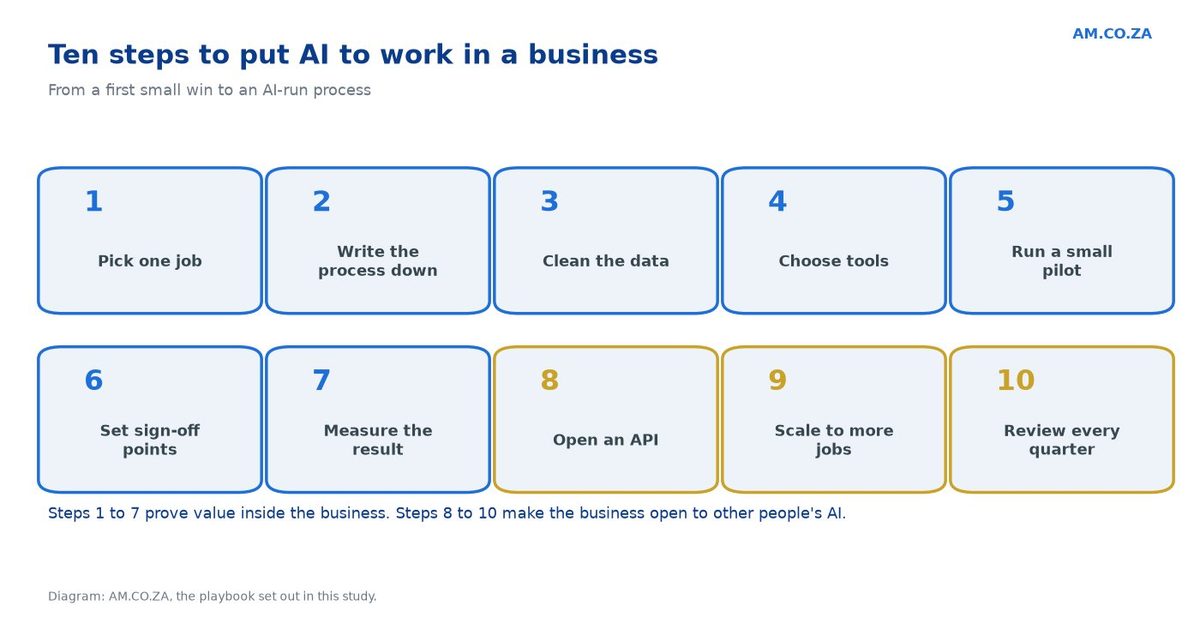
Step 1. Pick one job, not “AI strategy”
Start with a single, boring, repeatable job: answering the same ten customer questions, drafting quotes, summarising supplier emails, reconciling a weekly report. The Amazon-commissioned survey found that small businesses use AI mostly for marketing, and rarely for the operations where the savings are. A good first job has three features. It is done often. It has a clear right answer that a person can check. And a mistake in it is cheap to fix. AM.CO.ZA began with questions about products and stock, which fit all three.
Step 2. Write the process down
AI cannot follow a process that lives in someone’s head. Write the steps in plain language, with examples of a good result and a bad one. This is the step small businesses skip, and it is the one that makes the rest work. It is also valuable on its own, because the business now has a written way of working that a new employee can follow. AM.CO.ZA’s published AI fetch order is exactly this: an order of questions, written once.
Step 3. Clean and publish the data the job needs
Most AI disappointments are data problems. Product names that differ between the website and the invoice, prices in three places, stock counts that are a week old: an AI will reproduce the mess confidently. Put the facts the job needs in one place, give each product or customer a stable identifier, keep a timestamp on anything that changes, and write down which source wins when two disagree. AM.CO.ZA’s rule that live stock files win over product pages is a good model.
Step 4. Choose tools that fit the job and the risk
Choose the simplest tool that does the job. For many first jobs that means an ordinary AI assistant with your own documents attached. For others it means a connection to your accounting, stock or order system. Ask four questions of any tool. Where does the data go, and is it stored outside South Africa (POPIA section 72 sets conditions on that)? Can you export your data and your instructions? Does it keep a log? And what does it cost per month at your volume, since cost was the barrier cited by 54% of small online sellers in the Amazon-commissioned survey?
Step 5. Run a small pilot with a named owner
Run the job with AI for four weeks, alongside the old way, with one person responsible. Count how many answers or drafts were right the first time, how many needed fixing, and how long each took. The SA AI Index found that 27% of organisations can measure AI’s value, and that those that do get better results. A pilot with numbers beats a roll-out with enthusiasm.
Step 6. Set the sign-off points before the pilot, not after the mistake
Decide in advance what the AI may do alone, what it may only prepare, and what is a person’s decision. The sign-off map in Part 11 is a starting point. Write the rule where the AI will read it, such as in its instructions. The Thought covenant puts it in four words: the creation “prepares what may be signed, and stops at the ink”.
Step 7. Measure, and be ready to stop
Pick one or two numbers: hours saved, enquiries answered, errors found, cost per task. Compare them with the old way. If the numbers are not better, stop or change the job. Only 27% of South African organisations can measure AI’s value at all, which means most cannot tell a good project from a fashionable one. Being able to say “this saved eleven hours a week and cost this much” is itself a competitive advantage.
Step 8. Open an API
Once an internal job works, ask what a customer, supplier or bank would want to do with your business without calling you, and publish that as an API. Start with read-only access to what is already public: product list, price, stock and order status. Then add actions that need a key: place an order, request a quote, book a service. Describe the API in the OpenAPI format so that both programmers and AI can read it. FNB, whose API is described in Part 8, is a useful model for how a serious institution documents authentication, consent and message formats. Part 10 below lists what a good API needs.
Step 9. Scale to more jobs, and let AI agents do more
Repeat steps 1 to 7 for the next job. As confidence grows, allow agents to do chains of tasks rather than single ones, still with the sign-off points. This is where a business moves from AM.CO.ZA’s assist toward Astros’s hybrid, and possibly further. The pace should be set by what is measured, not by what is possible. The SA AI Index found that only 1% of large organisations use AI agents, so there is no pressure to be first, and every reason to be careful.
Step 10. Review every quarter
AI changes quickly, and so does the law. Put a quarterly review in the diary: what the AI did, what went wrong, what it cost, what the law now says, and which sign-off points should move. In South Africa, the Companies Act and POPIA already apply to AI use, a redraft of the national AI policy is due before Cabinet by March 2027 according to TechCentral, and the Reserve Bank is working on open-banking standards. A business that checks every three months will not be surprised.

Part 10. The AI-friendly business checklist
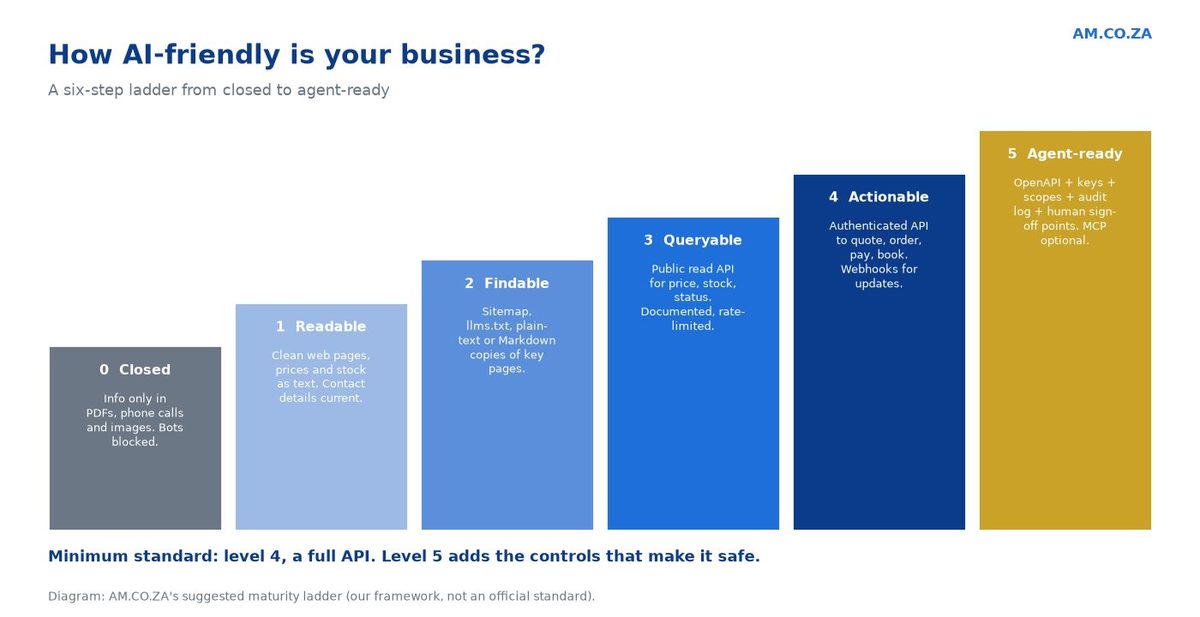
“AI-friendly” is not a certificate. It is a spectrum, and most businesses can move up it one rung at a time. The ladder below shows six levels, and the table that follows lists the checklist items by theme. Eric Yin’s minimum standard is a full API, level 4 on this ladder. Levels 0 to 3 are the steps on the way, and level 5 adds the controls that make it safe.
The checklist
| # | Item | What it means | South African note |
|---|---|---|---|
| 1 | Clean public pages | Prices, specifications, opening hours and contact details as real text, not only in images or PDFs. | Customers already ask AI first (23% use AI tools to compare products and prices). |
| 2 | Machine-readable pricing and stock | Prices and stock as JSON or CSV, with a timestamp and a stable product ID. | AM.CO.ZA publishes stock as small JSON files for its three branches, with rules about what they mean. |
| 3 | Public knowledge base | Plain-text or Markdown guides, FAQs and how-tos that a customer’s AI can read. | One of the cheapest wins; AM.CO.ZA’s Ask AI and AI Connect both run on one. |
| 4 | llms.txt and a sitemap | A short Markdown file at the root of the site that tells AI agents where the good information is. | llms.txt is a proposal published by Jeremy Howard on 3 September 2024. It is a convention, not a law, and its value is still being tested. |
| 5 | A clear robots policy | Decide which crawlers may read what. Block what you must protect, but do not block the customer’s assistant from your price list. | robots.txt has existed since 1994 and relies on voluntary compliance. |
| 6 | A documented read API | Endpoints for price, stock, status and catalogue, with an OpenAPI description. | The minimum standard. Part 8 explains why. |
| 7 | A documented write API | Authenticated endpoints to quote, order, book or pay, with the same checks as a person would face. | FNB’s payment and collection APIs show the level of detail a serious API needs. |
| 8 | Authentication and keys | API keys or OAuth 2.0, with scopes (read only, order, refund) and the ability to revoke. | FNB uses a client ID and secret, signed JWT tokens and OAuth 2.0 authorisation codes. |
| 9 | Rate limits | Limits per key, with a clear “too many requests” reply and a retry time. | AM.CO.ZA’s Ask AI contract returns a rate-limit reply with a retry time. |
| 10 | Webhooks | Your system calls the customer’s when something changes, instead of making them ask repeatedly. | FNB says its APIs use polling. Webhooks are authenticated callbacks; Wikipedia advises checking the sender and the timestamp to avoid spoofing and replay. |
| 11 | CORS set correctly | If a browser on another site is meant to call your API, say so in the response headers. | Cross-origin resource sharing is the browser mechanism for this; AM.CO.ZA’s chat API is built to be called from other sites. |
| 12 | Good documentation with examples | Plain-language explanation, worked examples, error codes and a test (sandbox) environment. | A good README beats a clever design. |
| 13 | Versioning and a change log | Tell users before something breaks. | Agents cannot phone you to ask why a field disappeared. |
| 14 | An audit log | Record who or what did what, when, with which key. | Needed to show a director took diligent steps under Companies Act section 76. |
| 15 | Human sign-off points | Decide which actions need a person. | See Part 11. |
| 16 | A human contact for AI problems | A named email address or WhatsApp number for an error found by an AI or its owner. | AM.CO.ZA’s pages ask people to email errors and point to a WhatsApp line. |
| 17 | POPIA by design | Keep personal data out of public data; secure it under section 19; use written operator contracts under section 21; notify breaches under section 22; watch cross-border transfers under section 72; and take care with automated decisions under section 71. | The Protection of Personal Information Act 4 of 2013. Direct marketing by electronic means needs consent or an existing customer relationship under section 69. |
| 18 | A bank and payment partner with an API | A bank or payment provider whose API can be used by your own systems and approved third parties. | Thought chose FNB for this reason. Banks differ, so check eligibility and the cost per call. |
| 19 | An AI use policy | Say which AI tools staff may use, with what data, and who approves new ones. | 75% of large organisations report some shadow AI use. |
| 20 | A way to measure | Choose the metrics before the project starts. | Only 27% of large South African organisations can measure AI’s value. |
Reading the checklist
The list can look long, but most of it is cheap and none of it needs a large budget. Items 1 to 5 are about publishing what you already know in a form AI can read. They can be done by a small business in a few weeks. Items 6 to 13 are about letting programs act, and are done once, by someone who can build an API. Items 14 to 20 are about making it safe, and are mostly decisions and habits.
Three misunderstandings are worth avoiding.
“Open to AI” does not mean “give AI everything.” The point of keys, scopes and rate limits is that a business opens exactly what it chooses. AM.CO.ZA’s AI paths state “public only” in their rules, and the knowledge base is built for that purpose.
An API does not replace people. It removes the need for a person to be the only way in. Customers who want a person can still have one, and AM.CO.ZA’s pages keep a WhatsApp number on every AI path.
You do not need MCP first. An MCP connector is a nice-to-have. If your API is documented and secured, AI tools can use it, and an MCP layer can be added when you want it. If you have MCP but no API, you have a sat-nav and no road.
Part 11. Guardrails: keeping a person where it counts
A sign-off map
The sign-off map below is a practical way to apply the covenant. It does not claim to be legal advice. It sorts work into three groups, by who may act.
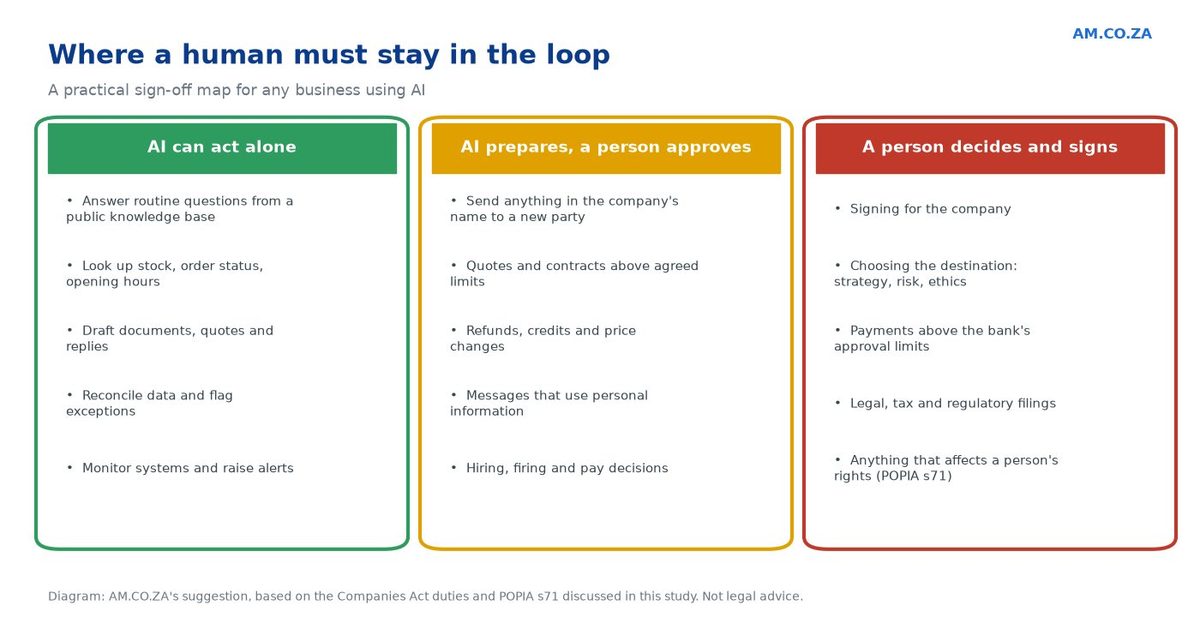
- AI can act alone on work that is reversible, public and low in consequence. Answering routine questions from the public knowledge base, looking up stock or order status, drafting documents, reconciling data and raising alerts all fit here.
- AI prepares and a person approves where something leaves the company, spends money, uses personal data or binds the business. Quotes and contracts above agreed limits, refunds, price changes, messages that use personal information, and anything sent in the company’s name to a new party sit here.
- A person decides and signs for the things the law and the covenant reserve to a person: signing for the company, choosing the destination, large payments, legal, tax and regulatory filings, and anything that affects a person’s rights.
The law that already applies
South Africa has no AI Act, but that does not mean AI use is unregulated. Existing law reaches it.
- The Companies Act. Directors’ duties and liability under sections 76 and 77 apply whether a director used AI or not. UWC researchers say a director cannot delegate functions to an AI system, or rely on its advice, within the Act. Prof Cassim says directors should supervise AI decisions and have enough AI literacy to do so.
- POPIA. The Act applies to the processing of personal information by automated means. Section 19 requires reasonable technical and organisational measures to protect personal information. Sections 20 and 21 require an operator, such as an AI service provider that processes information for you, to act only with your knowledge, to treat the information as confidential and to be bound by a written contract that sets up the same security measures. Section 22 requires notification of security compromises to the Information Regulator and, subject to exceptions, to the people affected. Section 72 restricts sending personal information about someone to a third party in a foreign country unless set conditions are met.
- Automated decisions about people. Section 71 says a person may not be subject to a decision with legal consequences, or which affects them to a substantial degree, that is based solely on automated processing of personal information intended to profile them, including their work performance, creditworthiness, reliability, location, health, personal preferences or conduct. There are exceptions, for example where a decision is taken in connection with a contract and the person’s request is met, or appropriate protective measures are in place. The measures must give the person a chance to make representations and enough information about the logic of the processing to enable them to do so. In plain terms: do not let AI alone decide who gets a loan, a job or a refund.
- King V. The King V Code on Corporate Governance for South Africa 2025 recommends that boards ensure AI is used ethically, transparently, fairly, securely and with clear human oversight, according to Prof Cassim.
The risks to name
- Accuracy. Two thirds of large South African organisations cite accuracy and reliability as the top barrier. That is the reason to start with a job a person can check.
- Shadow AI. If your staff are using AI tools you do not know about, you already have an AI policy problem. 75% of large organisations report some shadow AI use. A written policy and an approved tool are the answer, not a ban.
- Security of the new doors. An open API and an MCP server are new ways in. The security guidance for MCP now requires OAuth 2.1 practices, and researchers have found real flaws. Keys, scopes, logs and rate limits are not optional.
- Credibility. The most public South African AI lapse of 2026 was the Draft National AI Policy, withdrawn after it was found to contain fictitious sources, the minister said the most plausible explanation was that AI-generated citations were included without proper verification. If a government department can be caught out, so can any business. Check what the AI produces before it goes out, which is the whole point of the covenant.
- Overselling. The SA AI Index found that many organisations use AI but cannot show that it pays. A claim such as “first fully AI-operated company” should be made carefully, with a definition, and that is how this study has tried to handle it.
Part 12. What comes next
For Thought
Thought’s story is only beginning. Its website is an announcement of a model: AI does the expedition, one human chooses the destination and signs, and the two together go “above and beyond”. Whether it is the first of its kind depends on a definition and on facts no register can supply. What can be said is that it is a serious attempt to run a business that way, in public, within the Companies Act as it stands, with a director who accepts the duties the Act gives a director. If the law changes one day, and an AI agent is allowed to hold the role, Thought may become what its founder calls manless. Until then, the person who signs is the person who answers.
For AM.CO.ZA and Astros
AM.CO.ZA will stay what it is: a traditional business with branches in Johannesburg, Cape Town and Durban, selling machinery, spare parts and consumables, with people who answer the phone. The AI assist will keep growing around the people. Astros will continue to work as a hybrid. The founder’s three businesses are not a ranking of old and new. They are three ways of using the same tool, each right for its business.
For every other business
The advice of this study can be put in five sentences.
- Start with one job, a written process and clean data.
- Measure it, and keep a person at the point of responsibility.
- Publish what customers are entitled to know in a form AI can read.
- Build a full API, because without one nothing can work with you but a person with a phone. Add MCP when you like.
- Choose banks, suppliers and software that have done the same, because the companies that can be worked with, quickly, by other companies and by customers’ AI will be the ones that are worked with.
The lanterns in the founder’s line are two. The business and the AI stand at the edge of what is known, each holding a light. The ones that do not hold a light, or that shut the door, will find that the night has answered somebody else.
Where to start
- See Thought: thoughtful.co.za, or write to [email protected].
- See Astros Marketing: astros.co.za.
- See AM.CO.ZA: am.co.za, the catalogue at buythis.co.za, ledframes.co.za, the machine and AI guides at AM.CO.ZA guides, AI Connect and Ask AI, and the courses at Ambitious Academy.
- Bring AI Into Practice: 8i.co.za.
- Talk to AM.CO.ZA: WhatsApp 060 600 6000.
- Read the founder’s post: x.com/eric7q/status/1918058703967928381.
Sources
All sources were opened between 9 and 13 November 2026. Figures are quoted as the sources give them.
Law and government
- Companies Act 71 of 2008, Government Gazette 32121 (9 April 2009): ss 1, 66, 69, 76 and 77. parliament.gov.za.
- Protection of Personal Information Act 4 of 2013: ss 19 to 22, 69, 71 and 72. justice.gov.za.
- SAnews, “Minister announces withdrawal of draft AI Policy”, 26 April 2026. sanews.gov.za.
Universities and research
- Stanford Institute for Human-Centered AI, AI Index Report 2026 (April 2026), chapter 4 “Economy”. hai.stanford.edu.
- A Nyasulu and E Olivier, “Directors and AI-Assisted Decision-Making”, University of the Western Cape, 7 April 2026. uwc.ac.za.
- Prof Rehana Cassim (Unisa), “AI has arrived in South Africa’s boardrooms, but company law hasn’t caught up”, The Conversation, republished by Polity, 17 September 2026. polity.org.za.
- UCT News, “Unscrambling South African AI business limitations”, 30 July 2026. news.uct.ac.za.
News
- TechCentral, “SA firms are all-in on AI, but most can’t prove it pays”, 13 November 2026 (SA AI Index 2026, World Wide Worx and Altron Digital Business). techcentral.co.za.
- ITWeb, “SMMEs struggle to move beyond basic AI adoption”, 11 November 2026 (Amazon Small Business Digital Adoption Report 2026). itweb.co.za.
- ITWeb, “AI search ‘firmly’ part of customer experience”, 21 August 2026 (2026 South African CX Report; SpendTrend26). itweb.co.za.
- ITWeb, “Ozow, FNB and RMB plug into API payments”, 30 July 2026. itweb.co.za.
- TechCentral, “FNB opens banking API to Sage platforms”, 11 May 2021. techcentral.co.za.
- BusinessDay, “South Africa eyes open banking to boost inclusion”, 23 March 2026 (Reserve Bank working paper). businessday.co.za.
- Reuters, “OpenAI lets businesses claim ChatGPT profiles, adds AI agents for US e-commerce firms”, 10 November 2026. reuters.com.
Reference
- Wikipedia: Model Context Protocol, Application programming interface, OpenAPI Specification, OAuth, Cross-origin resource sharing, Webhook, Robots.txt.
- The llms.txt proposal, Jeremy Howard, 3 September 2024 (updated 10 August 2026). llmstxt.org.
The companies’ own pages
- FNB, Integration Channel and service catalogue, for what FNB says about its own services: Integration Channel, Transaction History API, EFT Domestic Payments API and Accounting integrations.
- Thought (Pty) Ltd: thoughtful.co.za, read 13 November 2026.
- Astros Marketing (Pty) Ltd: astros.co.za, read 13 November 2026.
- AM.CO.ZA: am.co.za llms.txt, buythis.co.za llms.txt, AI fetch order, live stock rules, AI Connect and Ask AI.
- Intel, Core i9-14900K specifications, for the processor figures in the first AI server section: intel.com.
- NVIDIA, RTX A4000 product page, for the graphics memory: nvidia.com.
- Eric Yin on X, 1 May 2025: x.com/eric7q/status/1918058703967928381.
This study is an AM.CO.ZA publication, done by David Bowman, chief editor of Astros Marketing. It reports the founder’s statements as his own and does not independently verify claims about Thought’s operations. It is not legal, tax or investment advice.
You have read 1 out of 5 free articles. Log in or register for unlimited access.










 Loading ...