
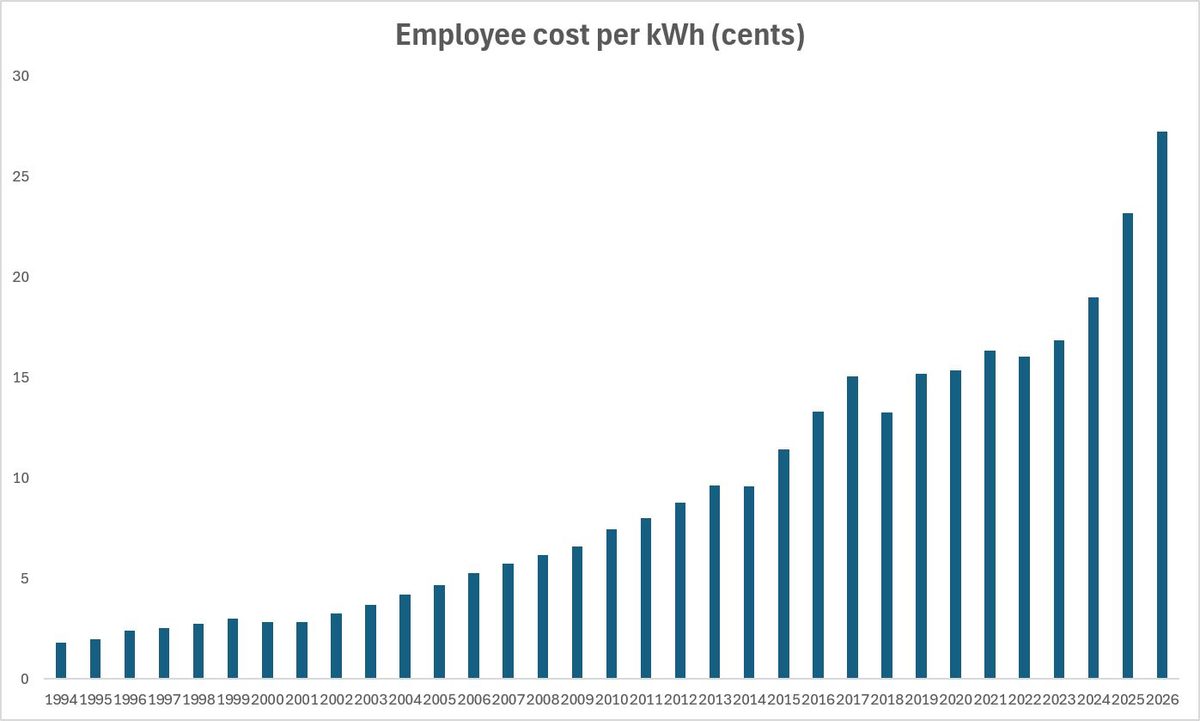
Eskom’s employee costs to produce a kWh of electricity increased by 1,422% between 1994 and 2026



Eskom’s employee cost per kilowatt-hour (kWh) of electricity produced rose from 1.79 cents in 1994 to 27.25 cents in 2026, a 1,422% increase.
Employee cost per kilowatt-hour, typically expressed as cents per kWh, is a key operational efficiency and cost-effectiveness metric for power utilities.
It measures the labour expense incurred in generating, transmitting, or distributing a single unit of electricity.
This metric shows how effectively a power producer uses its workforce relative to its core operational output.
A lower ratio generally indicates high workforce productivity, automation, or economies of scale.
In Eskom’s case, employee cost per kilowatt-hour points to a significant problem in its employee productivity.
In 1994, Eskom produced 160,293 GWh of electricity and had a total employee bill of R2.868 billion. This equals an employee cost per kilowatt-hour of 1.79 cents.
Throughout the 1990s and early 2000s, employee costs per unit generated remained low, rising gradually to 3.68 cents per kWh in 2003.
This period at Eskom was known for its high operational efficiency and expanding generation volumes. The numbers confirmed this.
However, things started to change after load-shedding hit, and Eskom began to struggle due to mismanagement and corruption.
Between 2009 and 2017, employee cost per kWh more than doubled from 6.60 cents to 15.08 cents, which illustrates the impact of Eskom being mismanaged.
This shift was influenced by headcount growth, annual wage adjustments, and increased overtime.
Employee costs per unit were stabilised between 2017 and 2023 due to cost-containment measures, freezes on executive bonuses, and headcount reduction.
However, this was short-lived. Between 2023 and 2026, under the new board, with chairman Mteto Nyati at the helm, employee costs ballooned.
It included big salary adjustments across non-executive levels, higher operational performance bonuses, and the reinstatement of the short-term incentive (STI) scheme.
Despite the big increase in employee costs, the power utility did not produce significantly more electricity.
This, in turn, resulted in the employee cost per kilowatt-hour increasing by 61% over three years, from 16.88 cents to 27.25 cents.
What is telling is that Eskom’s power generation fell from 195,702 GWh in 2025 to 184,966 GWh in 2026.
Over the same period, Eskom increased its headcount by 1,244 people and its employee costs rose from R45.4 billion to R50.4 billion.
This is unsustainable and is the reason why Eskom has to implement large price increases to make ends meet.










 Loading ...
I’m no maths genius but I understand how bad an increase of 1,422% is. Time for new leadership.
The current batch of managers clearly don’t have a grip on things.