
145 race laws in South Africa of which 38% were adopted after Apartheid ended


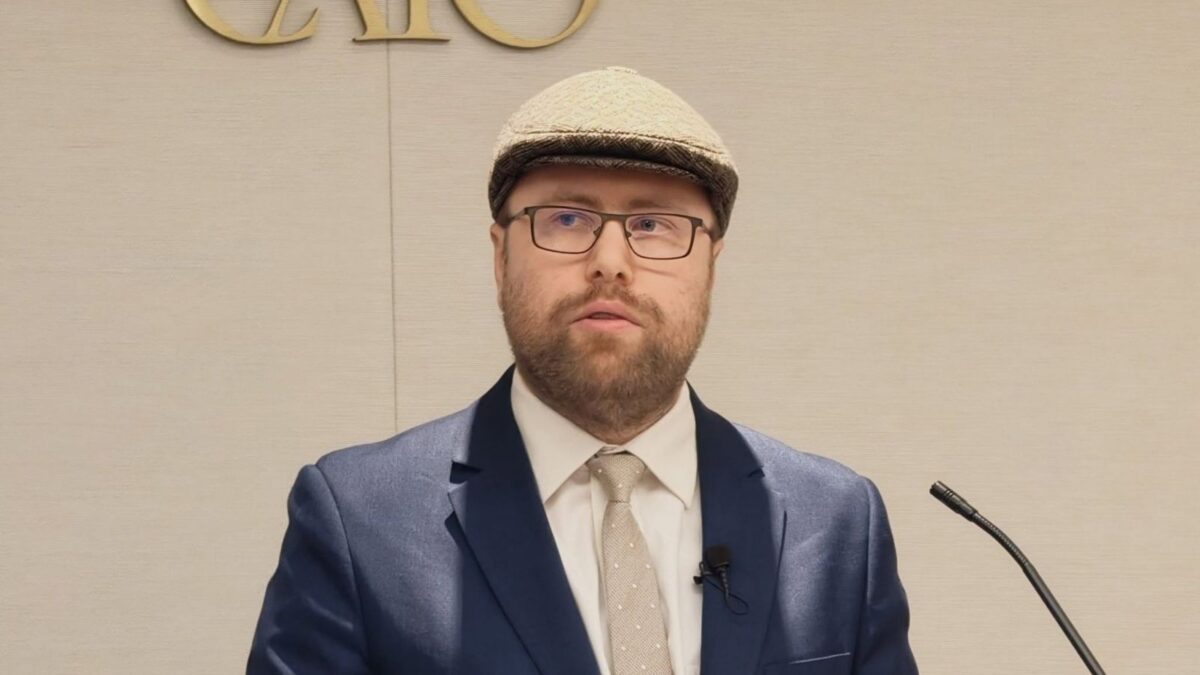
Martin van Staden, the man behind the infamous race law count in South Africa, said that race laws are alive and thriving in the country.
He shared this information during a speech on 25 September 2026 at the National Press Club in Washington, DC, United States.
Van Staden is the Head of Policy at the Free Market Foundation and serves on the boards of the Foundation, Rule of Law Project, and Free Speech Union SA.
He said that in January 2025, the world became aware that race and skin colour continue to play a fundamental role in South African law.
This, he said, was due to the efforts of Elon Musk and senior officials in the United States, including President Donald Trump.
“This was underpinned by the work done by AfriForum, the Institute of Race Relations, the Free Market Foundation, and later Lex Libertas,” he said.
He said that while many people believed that race laws had ended in 1994, the Index of Race Law showed that race law is alive and thriving in South Africa.
This is illustrated by the Index of Race Law, which Van Staden maintains has records since the establishment of the Union of South Africa in 1910.
He defined a race law as any statute that takes a common-law legal subject and makes race, skin colour, or ethnicity a legally relevant factor.
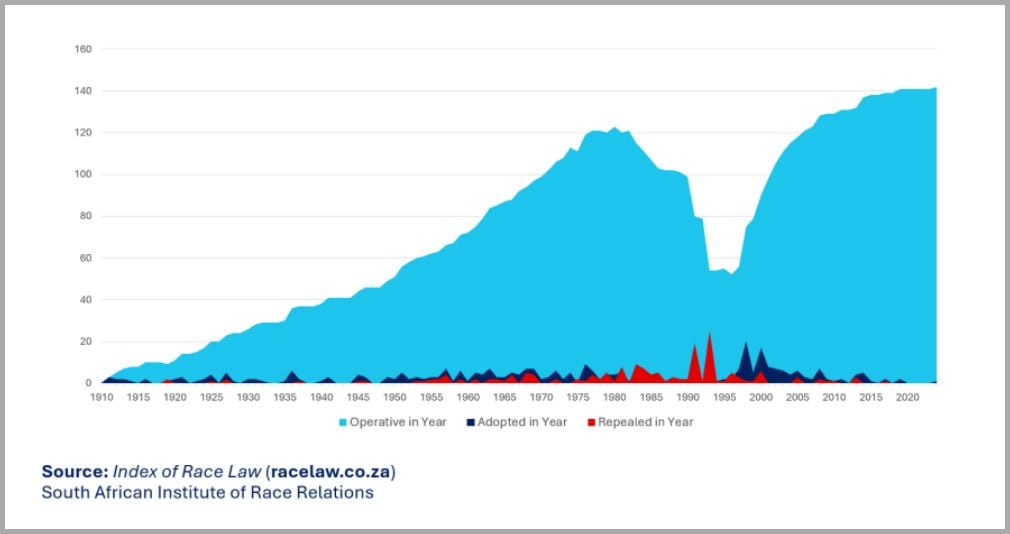
“Since 1910, Parliament has adopted 324 race laws. Of those 324, 145 remain on the books, and 136 remain racially operative,” he said.
“Since the end of Apartheid, Parliament has adopted 122 of these laws. 38% of South Africa’s race laws were adopted after Apartheid ended.”
The chart below shows the change in the number of race laws between 1910 and 2025, based on Van Staden’s definition.
Martin van Staden’s views on race laws
Van Staden said that it was not arbitrarily decided that South Africa would continue to legislate by race after the end of white minority rule in 1994.
“Many in South Africa try to present this phenomenon as a perfectly natural reaction to the racial injustice of the past,” he said.
“They argue that if people were impoverished on the basis of their race in the past, they must be empowered on the basis of race today.
“In other words, the race laws we have today are well-intended. They are redress laws. They are necessary and therefore good.”
He added that many people argue that, because they are well-intended, they cannot be classified as race laws. “Only laws with bad intentions could qualify as race laws.”
Van Staden dismissed this argument. “Intentions are not a seriously recognised test in public policy or lawmaking for whether a given law is beneficial or harmful,” he said.
“We must look to the actual text and effect of the law to determine that. Intention plays no substantive role.”
He added that the race laws in South Africa are about representivity, which focuses on ensuring all races are equally represented across all spheres.
“Each racial population group is neatly contained to the demographic quantity it represents in the country,” he said.
Simply put, if whites are only 7% of the population, then ideally only 7% of land may be owned by whites.
That does not mean that only 7% of big companies may then be owned by whites. “Only 7% of the shareholding in big companies may be owned by whites,” he said.
“The laws do not really mind a 100% black-owned company. This is in fact celebrated openly, and officially by the state.”
He said that race laws in South Africa are a basic rejection of normality and are formally totalitarian.
“It touches every domain of society, from public procurement, sports, education, and virtually all commerce,” he said.
Van Staden argued that the situation in South Africa is racial persecution, in its most obvious form.
“A powerful, entrenched political elite is using the inborn group characteristics of legal subjects to victimise them in official policy,” he said.
South Africans are fighting back with the help of the United States
Van Staden said that the situation in South Africa is far from hopeless, given its active and resilient civil society and private sector.
“Racial minorities, with the help of friends among the black majority, have been resilient in adapting to and overcoming the harm that race laws are designed to create,” he said.
“Combined with decades of corruption and ineptitude by the South African political elite, this has ensured that the totalitarian ambitions of race law cannot be achieved.”
“Much damage is done in the attempt, but any little resistance that is relentless and sustainable guarantees their failure.”
He said that minorities, like white people, love South Africa, and most want to stay in the country instead of emigrating.
“Some, of course, understandably seek to make use of the generosity of the United States and take up refuge there,” he said.
He thanked the United States for its opposition to South Africa’s racial discrimination and its support of minorities in the country.
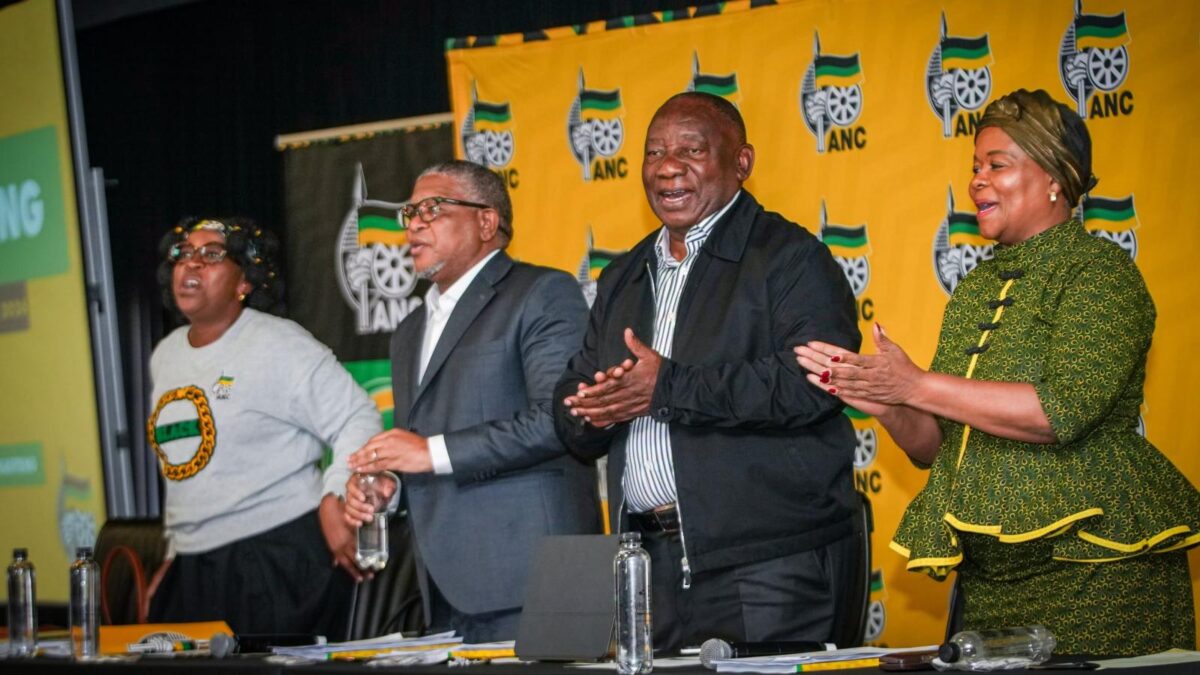
“Your renewed interest in South Africa has been remarkably helpful. The ANC and its ideological allies know they are being watched now,” he said.
He said that before the United States’ interventions, the ANC thought it could do as it pleased.
“The United States’ interest has to a large degree normalised criticism of the ANC and racial socialism, and I ask that you keep it up,” he said.
“We are potentially on the cusp of finishing the unfinished business of 1994, which is to finally rid South Africa of racially discriminatory law.”










 Loading ...
The ANC is obsessed with race. Just about everything you do as a business has some sort of government imposed race quota on it.
It’s ridiculous.