
South Africa’s economic growth is 78% lower than Sub-Saharan Africa


The latest International Monetary Fund (IMF) data showed that South Africa’s economic growth is much lower than that of Sub-Saharan Africa.
This was contained in the IMF’s Regional Economic Outlook Update Sub-Saharan Africa report, released in October 2026.
The International Monetary Fund said that Sub-Saharan Africa is expected to grow by 4.5% in both 2026 and 2027.
Global supply adjustments, favourable export receipts in some countries, and earlier reforms have helped cushion the shock from the war in the Middle East.
However, the IMF added that steady regional growth masks differing country experiences, such as South Africa’s.
It states that there is slowing growth in non-resource-intensive economies and continued resilience in resource-intensive ones.
“Pre-war fiscal adjustment and declining debt ratios are important achievements for many countries,” the IMF said.
However, high interest burdens, low reserves in many countries, and declining aid leave limited room to absorb another adverse shock.
“Risks remain decidedly tilted to the downside. Policies should sustain needed fiscal adjustment,” it said.
“Policies should also save temporary commodity windfalls, target support to vulnerable households, and contain persistent inflation.”
It added that protecting productive investment and enabling private-sector growth are essential to make future shocks less costly and improve longer-term living standards.
South Africa’s poor economic growth
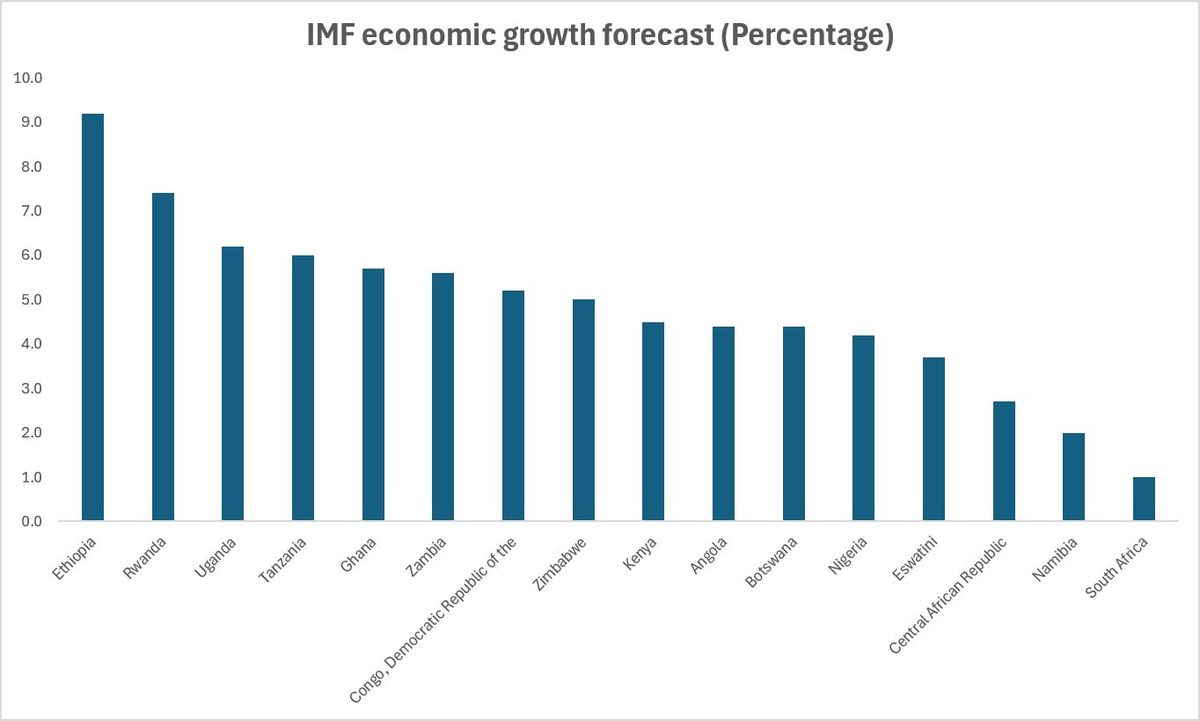
South Africa’s projected economic growth for 2026 is 1%, 78% lower than Sub-Saharan Africa’s 4.5%.
What makes this poor growth concerning, apart from it being among the lowest in Africa, is that South Africa is a resource-rich country.
Other resource-intensive economies, such as the DRC, Zambia, and Ghana, have achieved strong growth.
The DRC is set to grow at 5.2%, Zambia’s economic growth is expected to reach 5.6%, and Ghana’s growth is projected at 5.7%.
This means that South Africa’s growth is slowed by structural problems, such as poor policies, rather than global pressures.
Business leader and Eskom chairman, Mteto Nyati, said that South Africa’s economic underperformance is not an accident of history.
He explained that the country’s poor economic performance is largely the result of the choices the government continues to make.
“We talk endlessly about creating an enabling environment for business and investment, both local and international. Yet the actions do not match the rhetoric,” he said.
“Red tape, inconsistent policy, and slow decision-making continue to choke investment across almost every sector of the economy.”
He explained that investors and South African entrepreneurs do not wait forever. “Capital is mobile. Talent is mobile. Opportunity is mobile,” he said.
“If we are serious about growth, jobs and shared prosperity, our leaders across government, business and civil society must become more self-critical.”
He said that South Africa cannot keep blaming external factors while avoiding the hard internal work.
This work includes simplifying regulation, speeding up approvals, creating policy certainty, and treating business as a genuine partner rather than a problem.
“The solutions are known. Many countries have done the hard work of cutting bureaucracy and prioritising execution,” he said.
“We can too, but only if we are honest enough to confront where we are falling short and disciplined enough to change.”
Economic growth forecasts for 2026





 Loading ...
F1 to Rwanda…..