
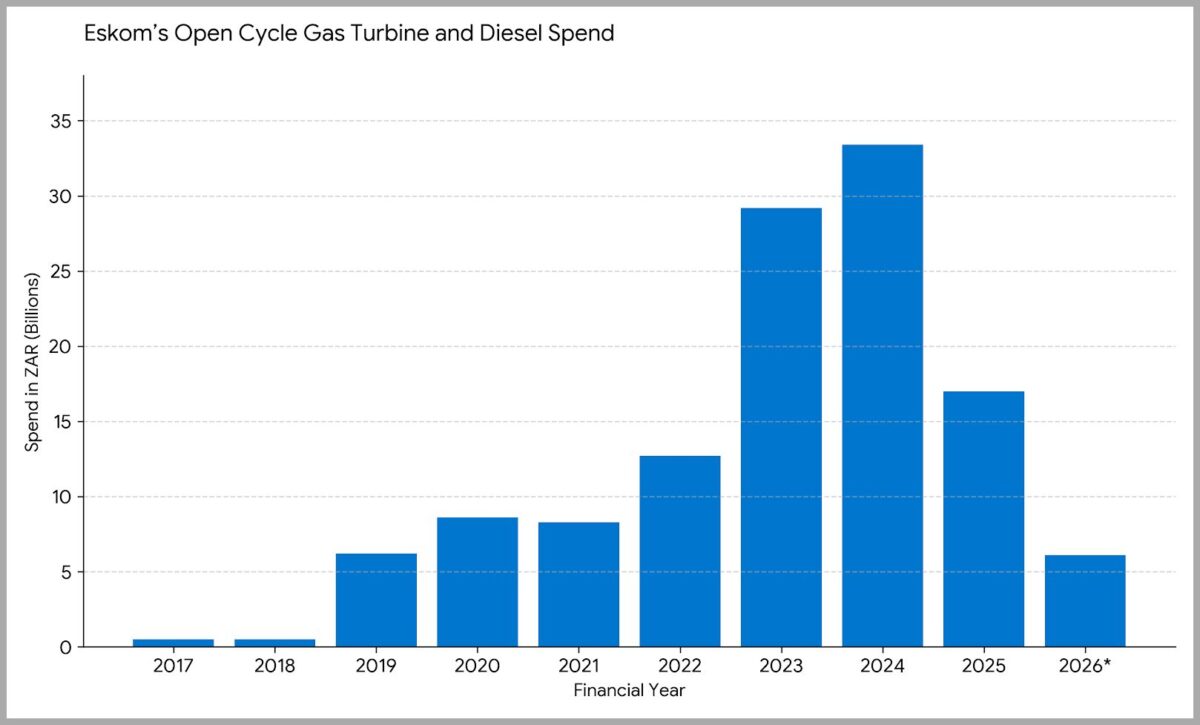
Eskom’s diesel and OCGT spending increased from R340 million to R6.4 billion in 9 years


Minister of Electricity and Energy Kgosientsho Ramokgopa celebrated Eskom’s lower diesel expenditure. However, the numbers point to serious challenges.
Eskom relies on Open Cycle Gas Turbines (OCGTs) as a safety valve for the South African electricity grid.
These OCGTs, predominantly the Ankerlig and Gourikwa stations, are used as peaking stations to run for short bursts to meet peak demand and keep the grid balanced.
OCGTs work like giant jet engines. They burn diesel to drive a turbine and can go from completely stationary to supplying full power to the grid in 5 to 20 minutes.
When a major coal unit suddenly trips or demand unexpectedly spikes, the System Operator turns to OCGTs to bridge the immediate deficit.
However, in recent years, Eskom’s coal fleet, which supplies the baseline power, performed so poorly that it began using OCGTs for base load.
This comes at a cost. Generating electricity by burning diesel in an OCGT is multiple times more expensive than burning coal at baseload stations like Medupi or Kusile.
Eskom Coal Fleet generates power at R546 per MWh, while OCGTs cost between R6,000 and R8,300 per MWh.
This is seen in the numbers. Last month, Minister of Electricity and Energy Kgosientsho Ramokgopa shared details about Eskom’s diesel usage.
He said that between 1 April and 18 June 2026, diesel expenditure stood at R640.27 million, lower than the R4.515 billion incurred over the same period last year.
Ramokgopa added that, in the 2026 financial year, diesel expenditure totalled R6.4 billion, well below the budgeted R11 billion.
Eskom has also previously stated that its diesel expenditure is well below the R34 billion peak in the 2024 financial year.
However, these figures omit the fact that they remain high compared to the amount of diesel Eskom used when it was operating normally.
In the 2016 financial year, Eskom spent only R340 million on diesel, as peaker run hours remained low due to least-cost merit-order dispatch.
During this period, limited load shedding was needed, as the coal-fired power stations produced the required electricity.
However, in the 2019 financial year, things changed due to higher unit trips and starting challenges in the coal fleet.
OCGT usage increased significantly to keep the lights on, which caused Eskom’s diesel and related costs to increase to R7.9 billion.
This trend peaked in the 2024 financial year, during the height of the energy crisis, when the total OCGT and diesel spend reached R34 billion.
The improvement in Eskom’s coal fleet performance saw OCGT and diesel spend decline to R17.7 billion in 2025 and R6.4 billion in 2026.
However, this is still much higher than what it should be. The only reason it looks relatively good is that Eskom was in such a poor state previously.
In many of Eskom’s previous annual reports, diesel expenditure was not even mentioned because it was an irrelevant amount.
However, because Eskom’s coal-fired power fleet has become so unreliable, diesel expenditure has become an important figure. This should not be the case.
The chart below shows Eskom’s total Open Cycle Gas Turbine and diesel spend over the past nine years.









 Loading ...
I love this, The extinction rebels buy electric cars to “help the earth”, meanwhile diesel is being used to generate electricity for these cars. And the diesel mafia laughs all the way to the bank . But we have enough coal to generate electricity far cheaper than diesel. Oh yes Spoornet has been derailed , thanks to other mafias.