
South Africa’s richest province heading for disaster


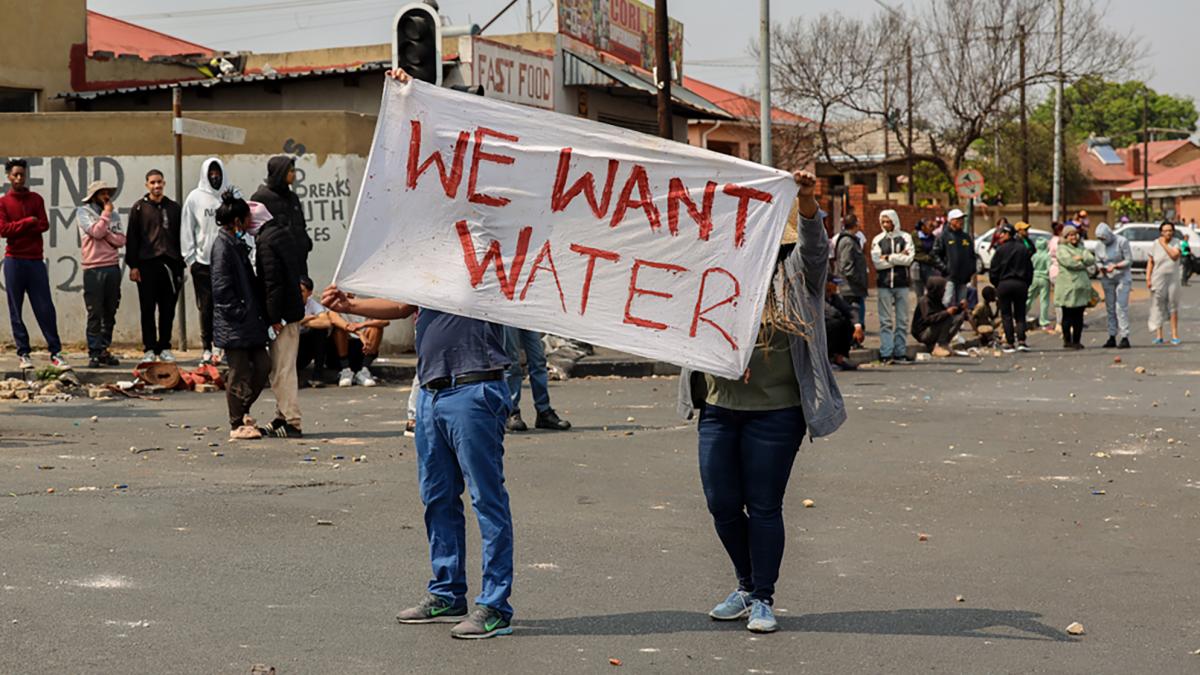
Residents of South Africa’s richest province are facing a worsening water crisis, as a combination of ageing infrastructure, mismanagement and high demand combine to put immense pressure on a failing system.
Speaking on the state of the province on Thursday, Official Leader of the Opposition in Gauteng, the Democratic Alliance’s Solly Msimanga, said that water was listed as a priority for Gauteng Premier Panyaza Lesufi in his 2025 State of the Province Address.
Despite this, the issue has now reached crisis proportions.
Selby, Kensington, Bez Valley, Johannesburg CBD, Houghton Estate, Norwood, Killarney, Orange Grove, Ivory Park, Radiokop, Eldorado Park, Kliptoen, Klipsruit West, Richmond, Rossmore, Brixton, Helderkruin, Melville, Emmerentia, Greenside, Westcliff, Parktown West, Midrant, Diepkloof and Orlando all experience daily water outages.
While the province continually blames exceedingly high demand for the water problems, this is only partly true. While population growth and migration have caused actual demand to spike, there is another cause of this increase.
“That demand is the total demand, which includes water that’s lost in the distribution system, and there’s been a deterioration in the distribution systems in the municipalities in Gauteng,” said Director General of South Africa’s Department of Water and Sanitation Sean Phillips.
Speaking to Jeremy Maggs on Investec Focus Radio, Phillips estimates that about 35% of the water supplied by Rand Water to Gauteng is lost in distribution.
The Director General said that municipalities in Gauteng urgently need to address these infrastructure issues despite budget and resource constraints. The national government’s hands are tied when it comes to municipal distribution systems.
“They need to improve their billing and revenue collection systems. They need to reduce the losses in their distribution systems and take other measures to ensure that non-revenue water comes down,” he said.
“Money’s not going to come from anywhere else. They’re not going to get money from national government to make up for the fact that they’ve got high non-revenue water.”
Phillips added that municipalities in Gauteng do not distribute money collected from water billing to their water entities alone. For example, in Johannesburg, Joburg water doesn’t get all the revenue collected from the sale of water.
“So Joburg Water doesn’t have the right incentives to optimise to manage its network in a way that will optimise revenue collection,” he said.
“The budget that they get every year from the city will be the same regardless of how much revenue is collected.”
Residents called on to reduce consumption
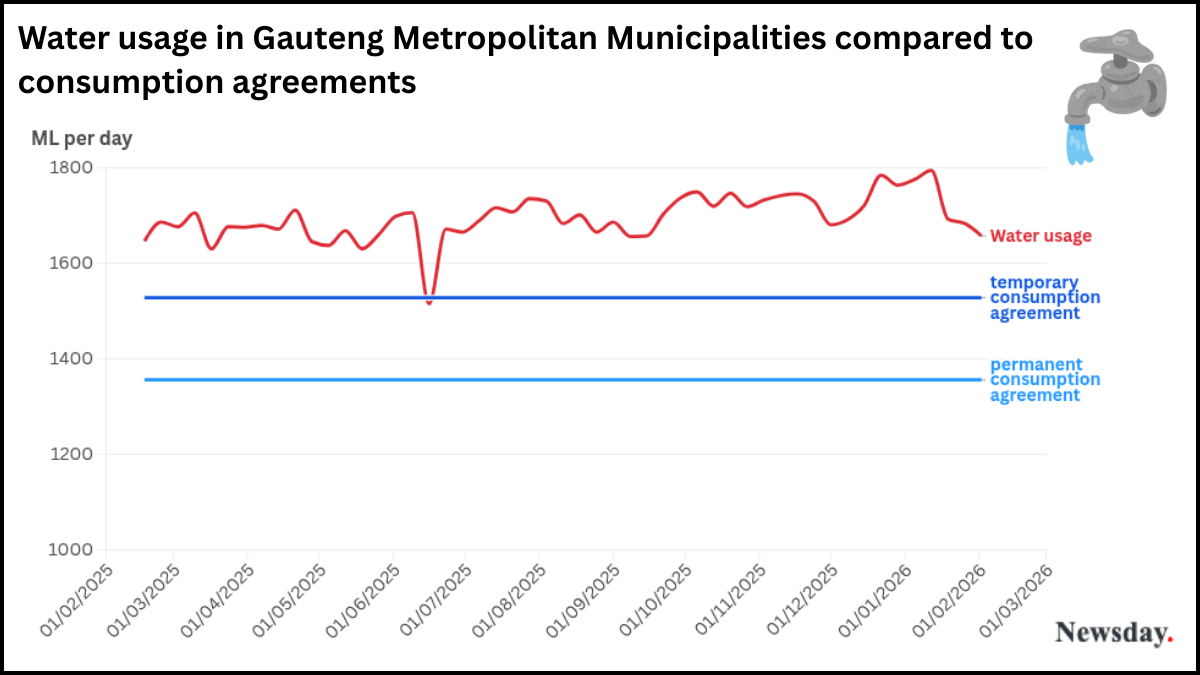
Data from Rand Water shows that demand for water in Gauteng metros is consistently above consumption agreements.
In the long term, Phillips explained that there are plans underway to increase supply. The province is about halfway through the second phase of building the Lesotho Highlands project.
This will allow Rand Water to abstract more water from the Vaal Dam by around 2028 or 2029. Rand Water is currently under a restriction that prevents it from abstracting any more water.
He added that the next project will involve collecting water from the Thukela catchment in KwaZulu-Natal, 600 km away; an expensive and lengthy project.
Even when this is concluded, however, Phillips said that in the long term, this will not be enough to curb the crisis.
While pressure needs to be continuously applied to municipalities to reduce water losses, Phillips said there is no getting around the fact that water users in Gauteng will need to cut their consumption.
National and provincial government is asking residents to use water sparingly, but Phillips said there is no cause for concern.
“It doesn’t mean that people who are using water moderately and very carefully have to reduce their usage by 40%. It means that those people who are using excessive amounts of water must stop doing so,” he said.
This was echoed by Ferial Adam from WaterCAN, who said during a press briefing on 18 February that South Africans need to understand that this is a water-scarce country and act accordingly.
“We have to start asking the very uncomfortable questions. Should we all be having a swimming pool in our yard? That’s probably not the way to go,” he said.








 Loading ...
A DISASTER is unfolding, which will make Covid look like a picnic. It’s now time for “Moue Oprol en Hef Aan”