
Factories of One: An AM.CO.ZA Study of South Africa’s Small-Machine Economy


South Africa’s big factories have been shedding jobs for a decade. Manufacturing’s share of the economy has roughly halved since the early 1990s, and Stats SA counted 100,000 fewer manufacturing jobs in the second quarter of 2026 than a year earlier. Yet a quieter kind of manufacturing is spreading through garages, backrooms, industrial-park units and township containers. Lasers, CNC routers, UV and DTF printers, vinyl cutters and heat presses once belonged only in big plants. Now they fit a one-person business making signs, branded clothing, packaging, metal parts, furniture and marked products.
This AM.CO.ZA study looks at what those machines do, who uses them, what they cost to run, which skills they need and whether they can dent the jobs crisis. The short answer: they won’t reverse deindustrialisation on their own. But they reward exactly the practical, technical and entrepreneurial skills South Africa says it wants, and a “factory of one” can grow into a factory of five.
For a small business, the machine has to keep earning. That’s why AM.CO.ZA’s machines hold their value: the parts, the support and the training stay with them. Service and spares are where AM.CO.ZA beats a once-off import. Training comes with it too: AM.CO.ZA’s Ambitious Academy runs online courses and certifications. Prices are already Cheers VIP prices, 20% below list. Sales can also quote for a funder, bank asset finance or lay-by. Our companion articles cover resale value, service and spares, price and budget, finance and time.
A paradox on the factory floor
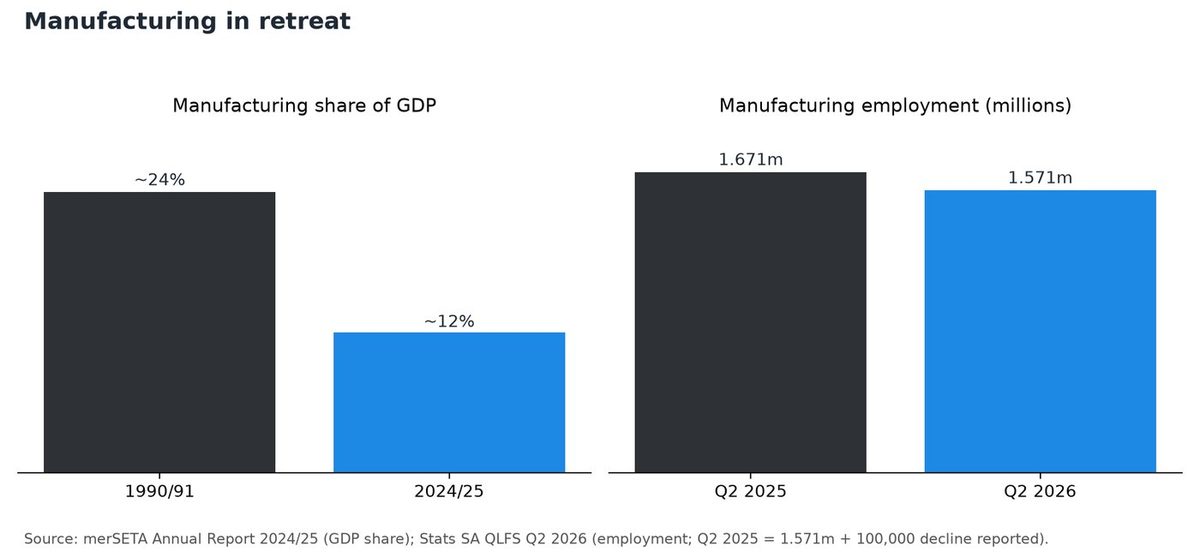
On paper, South African manufacturing is in retreat. The sector’s share of the economy has roughly halved, from about 24% in 1990/91 to around 12% in 2024/25, and it has shed nearly 500,000 jobs over the past decade, according to the merSETA Annual Report 2024/25. Stats SA’s household survey for the second quarter of 2026 put manufacturing employment at 1.571 million, which is 100,000 fewer than a year earlier (QLFS Q2 2026). In its review of 2025, the Trade & Industrial Policy Strategies (TIPS) research group found manufacturing value added 7% below its 2019 level. It also reported that three-quarters of the year’s manufacturing job losses came from food processing, clothing and textiles, and wood and paper (TIPS Real Economy Bulletin, Q4 2025).
Yet in industrial parks, backrooms and small units around Gauteng, Durban and Cape Town, equipment suppliers and their customers describe a different picture. Sign shops now print, cut and laminate under one roof. Fabricators cut their own parts instead of sending drawings out. A bakeware maker codes its own pans. Garment decorators that once sent every order to a screen printer run a direct-to-film (DTF) printer and a heat press themselves.
These two pictures do not contradict each other. Large-scale, labour-intensive manufacturing is under pressure from energy costs, logistics failures and import competition. Meanwhile, the tools of production have become smaller, cheaper, more digital and easier to learn. The result is what this report calls the small-machine economy: micro and small enterprises that make things to order, in short runs, close to their customers.
The question for policymakers, lenders and would-be entrepreneurs is whether this economy is a footnote or a foundation. To answer it, you need to understand the machines, the markets they serve, the economics of owning them and the skills needed to run them.
Part 1: The machines, and what each one is actually for
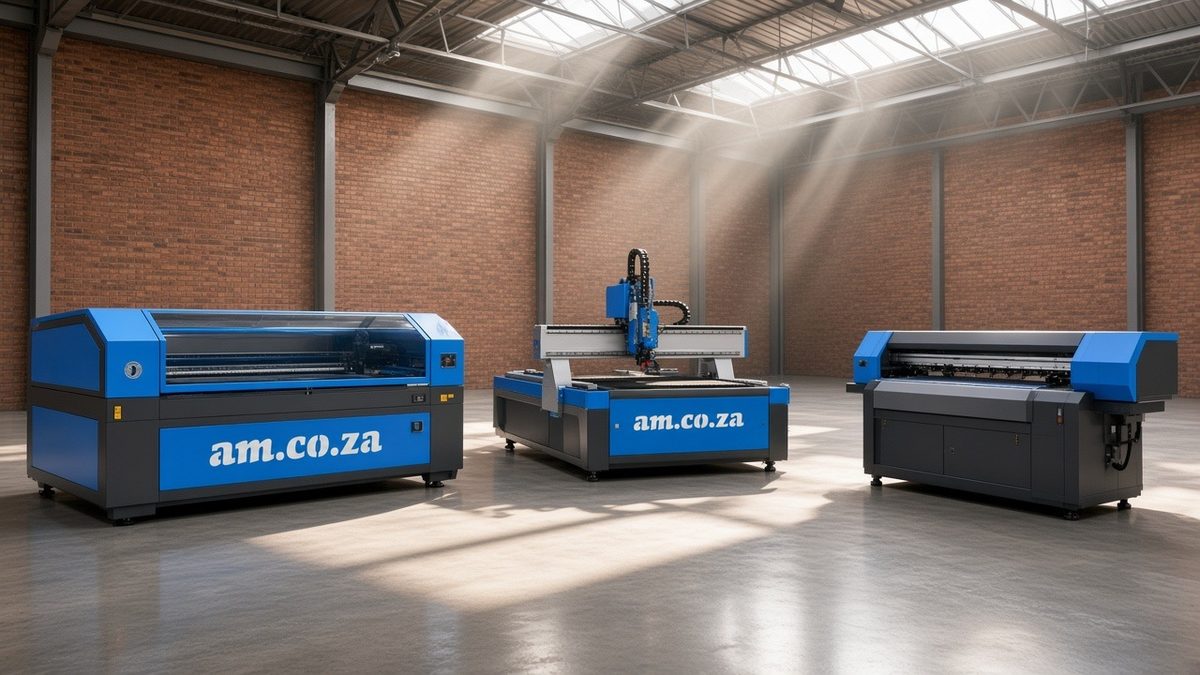
A common mistake among first-time buyers is to start with the machine rather than the job. AM.CO.ZA (Advanced Machinery (Pty) Ltd) is a Gauteng-headquartered supplier that, by its own account, grew from a CNC sales agency founded around 2012 into a group covering supply, technical service, parts and a training division (AM.CO.ZA, About). Before choosing a machine, identify the material you want to process and the outcome you need (see the range: AM.CO.ZA: machinery applications). That is a useful lens for the whole market.
Lasers: three families, three jobs
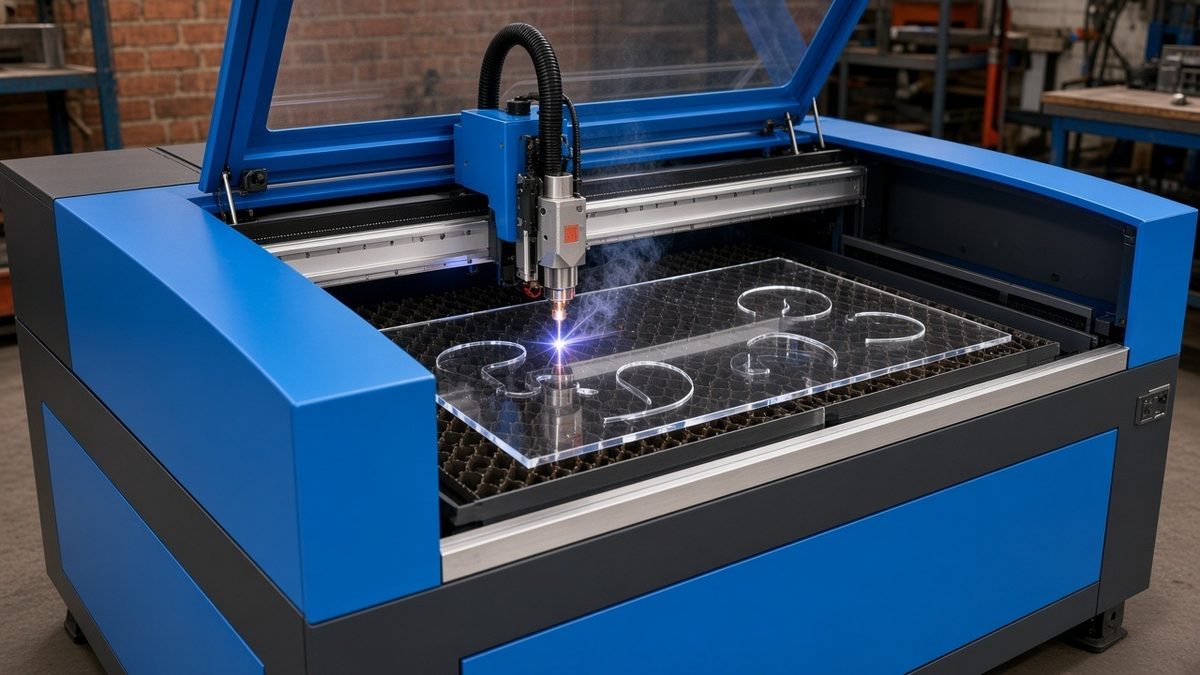
CO2 lasers (Grokipedia) are the workhorses for non-metals: acrylic, wood, MDF, leather, fabric, paper and card. They handle both laser cutting and laser engraving (Grokipedia), which makes them the backbone of the signage, display, gifting and craft trades. Choose a laser for the material and the work you plan to sell. For craft, trophy and small-acrylic work, consider a hobby or desktop CO2 machine rather than a metal-cutting fibre laser (see the range: AM.CO.ZA: CO2 laser range). At the other end of the scale, a signage partner describes moving clear acrylic letters and display parts from its router to a full-sheet CO2 laser because a laser-cut edge on thin acrylic removes the separate hand-polishing step (cut2shape.co.za).
Fibre lasers (Grokipedia) dominate metal work, and they come in two very different forms. Fibre laser cutters are full-sheet machines that cut mild steel, stainless and aluminium from drawings. They compete with plasma cutting (Grokipedia) and with the outsourced profile-cutting shops many fabricators rely on. For an existing metalworking business, compare a fibre cutter with the cost and turnaround of outsourcing your sheet cutting (see the range: Buythis: fibre laser cutters). Fibre laser markers are compact machines that etch permanent codes, logos and serial numbers into metal and some plastics. Choose a marker for surface identification and decoration, not for cutting profiles out of sheet (see the range: Buythis: laser markers).
Laser welding and cleaning is the newest category to reach small workshops. Handheld fibre laser welders (Grokipedia) put a small, controlled heat zone into a joint, which matters most on thin tube and sheet, where conventional welding warps the work and creates hours of grinding. Laser cleaners (Grokipedia) strip rust, paint and mill scale without blasting media or chemicals.
CNC routers
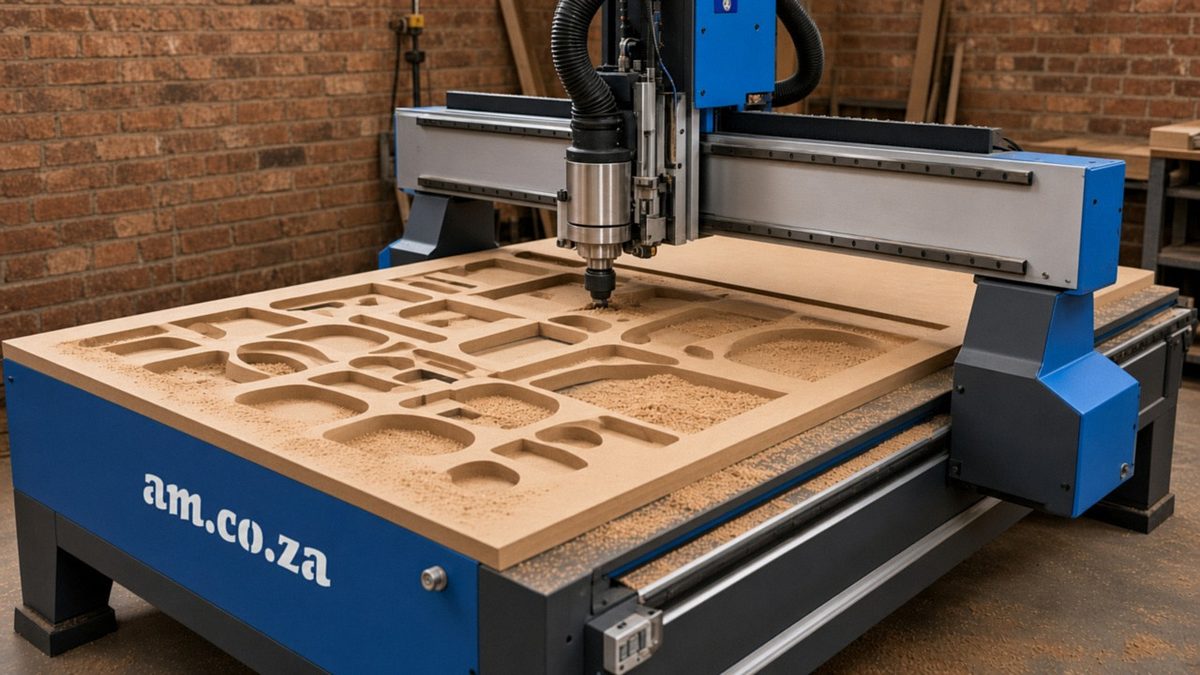
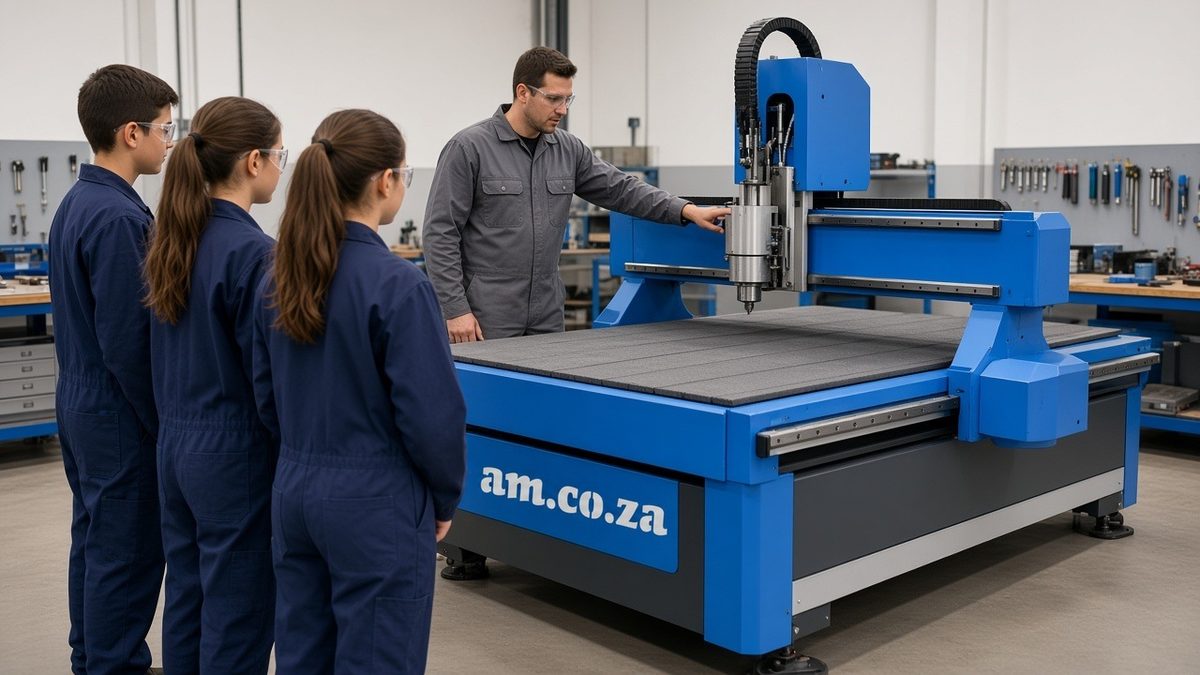
A CNC router (Grokipedia) is a computer-controlled spindle that carves, pockets and cuts sheet materials: MDF, plywood, melamine, aluminium composite panel (ACM), acrylic and some soft metals. Bed size is the decision that matters. A full-sheet bed takes a standard 1,220 × 2,440 mm board without trimming, which is why cabinet makers, shopfitters and signmakers gravitate to it (cncpme.co.za). Smaller desktop machines suit engraving, small parts and training. Plan a suitable workshop for a full-sheet router, with space for loading, extraction and safe operation. Check the electrical supply before choosing a spindle; a machine that requires three-phase power needs a compatible installation (see the range: AM.CO.ZA: CNC router range). The company lists woodworking, furniture and sign-making among the core uses for routers (see the range: AM.CO.ZA, Applications).
Print: UV, eco-solvent, DTF, sublimation and screen
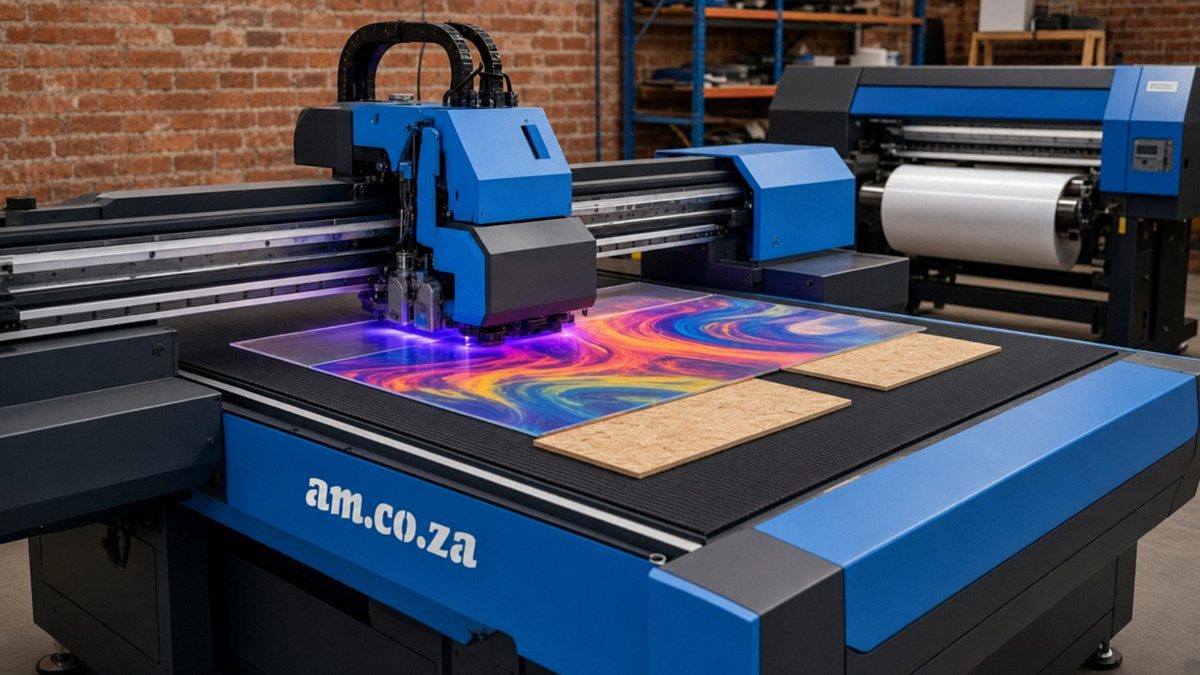
- Eco-solvent wide-format printers (Grokipedia) produce banners, vehicle graphics, posters and wall vinyl. They are the core of the sign-and-display trade and are usually paired with a laminator and a contour cutter. For outdoor graphics, consider suitable lamination to protect the printed surface from weathering (see the range: Buythis: large-format printers).
- UV printers, both flatbed and roll-to-roll, use UV curing (Grokipedia) to set ink instantly. That lets them print directly onto rigid objects such as acrylic, wood, metal, glass, promotional items, lids and bottles. A related process, UV-DTF, prints stickers that are laminated, peeled and applied to hard goods (see the range: Buythis: UV-DTF printers).
- DTF (direct-to-film) printers print a design onto film, coat it with an adhesive powder, cure it and transfer it to a garment with a heat press. DTF has transformed short-run apparel because it handles full colour on most fabrics without screens.
- Dye sublimation (Grokipedia) turns special inks into a gas that bonds with polyester fibres and polymer-coated blanks such as mugs, plates and sportswear. It is cheap per print but limited to suitable substrates.
- Screen printing (Grokipedia) remains the most economical method for long runs and for printing onto bottles, tubes and cups. Its bottleneck is the screen room, where screens are coated, exposed and washed out. Choose between DTF and screen printing by comparing order size, design changes and preparation time, rather than assuming one process suits every garment job (see the range: Buythis: screen printers).
Vinyl cutters and heat presses
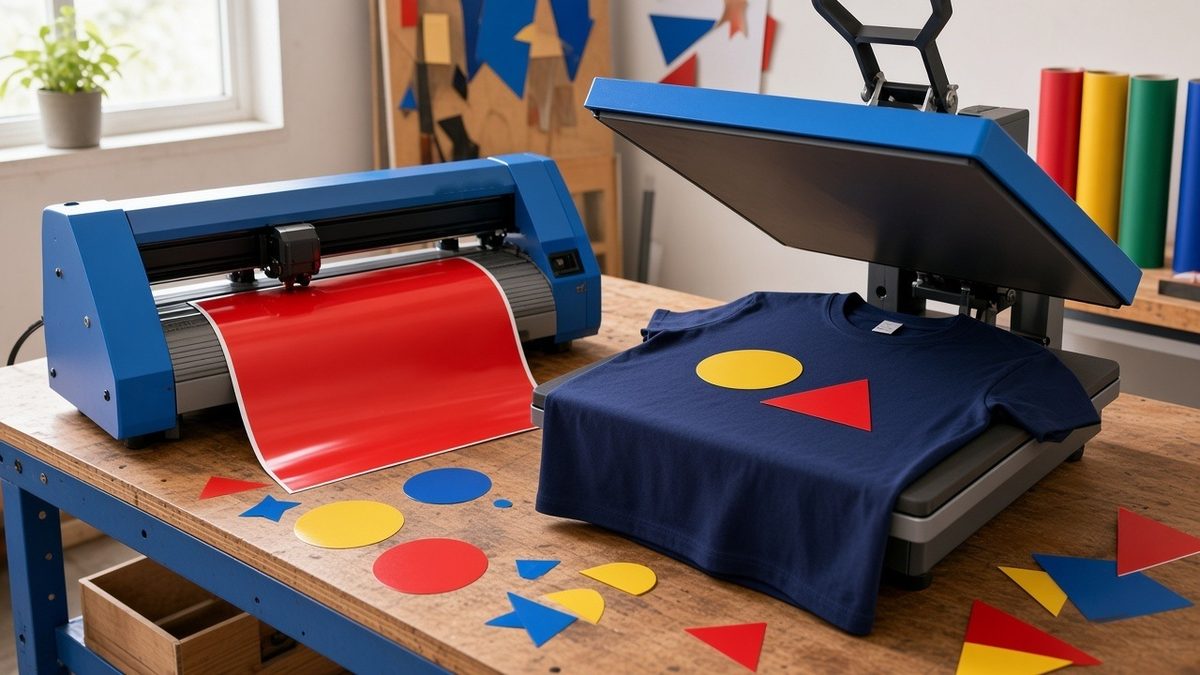
Vinyl cutters (Grokipedia) are the cheapest entry point into the whole sector. They cut lettering, decals, stickers and heat-transfer vinyl (HTV) for garments. Contour models read registration marks and cut around printed shapes, which turns a printer and a cutter into a sticker factory. Choose a cutter width to match your usual work: narrower machines may suit crafts and small graphics, while wraps and large lettering need more width (see the range: Buythis: vinyl cutters). Heat presses (Grokipedia) in flat, mug, cap and multi-function forms are the finishing step that ties vinyl, DTF and sublimation together. Include a heat press in the budget for a DTF or sublimation setup (see the range: Buythis: heat presses), rather than treating it as an afterthought.
Part 2: Who uses the machines, and for what

Signage, branding and promotional goods
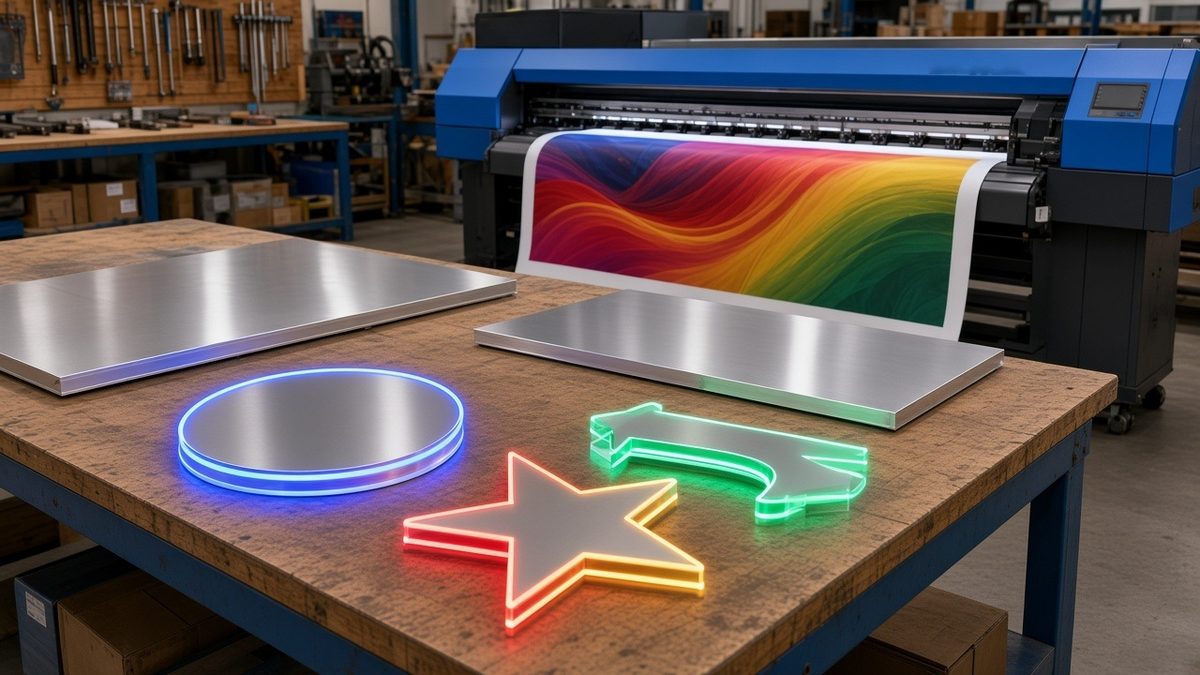
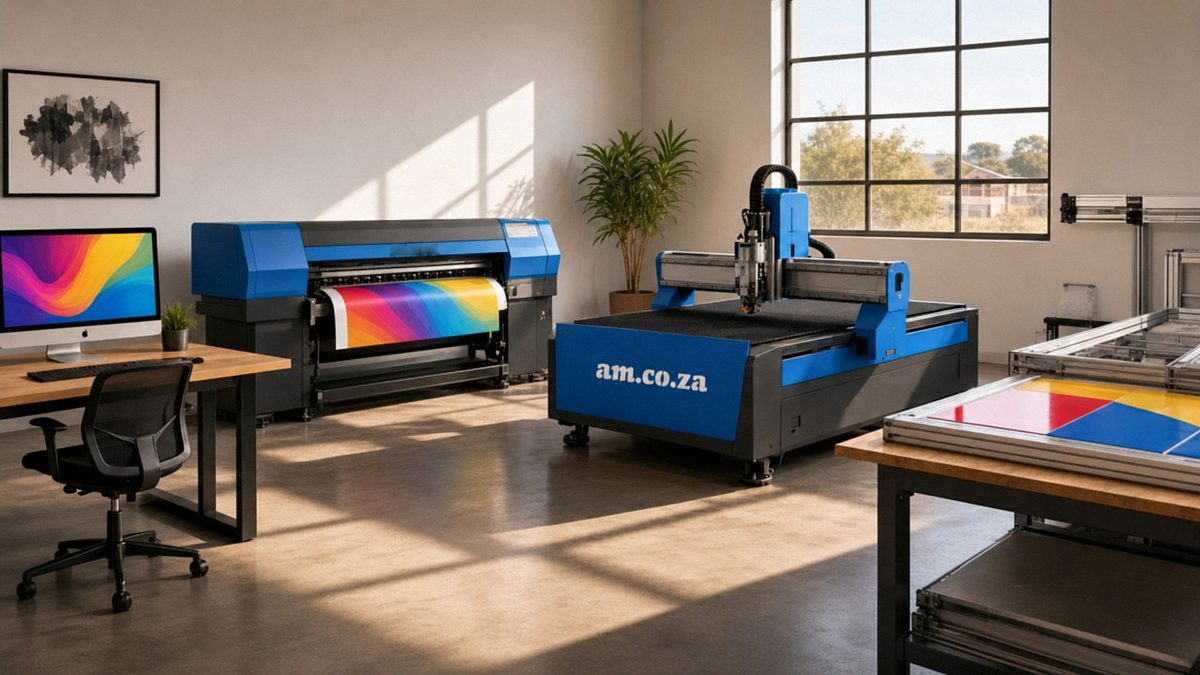
This is the largest and most crowded segment. A typical sign shop combines a large-format printer, a laminator, a vinyl or contour cutter and, increasingly, a CNC router or CO2 laser for 3D lettering, acrylic and display work. Demand follows retail fit-outs, property development, election cycles, school and sports-club seasons, and corporate events. It is also highly price-competitive, so margins go to shops that can offer a combined service of design, print, cut, fabrication and installation rather than a single process.
Apparel and textile decoration
Short-run garment decoration has been reshaped by DTF. Because it needs no screens, a decorator can print a single full-colour shirt as easily as fifty, which suits school, club, event and corporate orders that are too small for screen printing. No published South African dataset measures how widely DTF has been adopted, so this report does not put a number on it. Plan the printer, powder, film and heat press as one production system rather than as separate purchases (see the range: Buythis: textile DTF printers). Ongoing costs and quality depend on that whole system, not the printer alone.
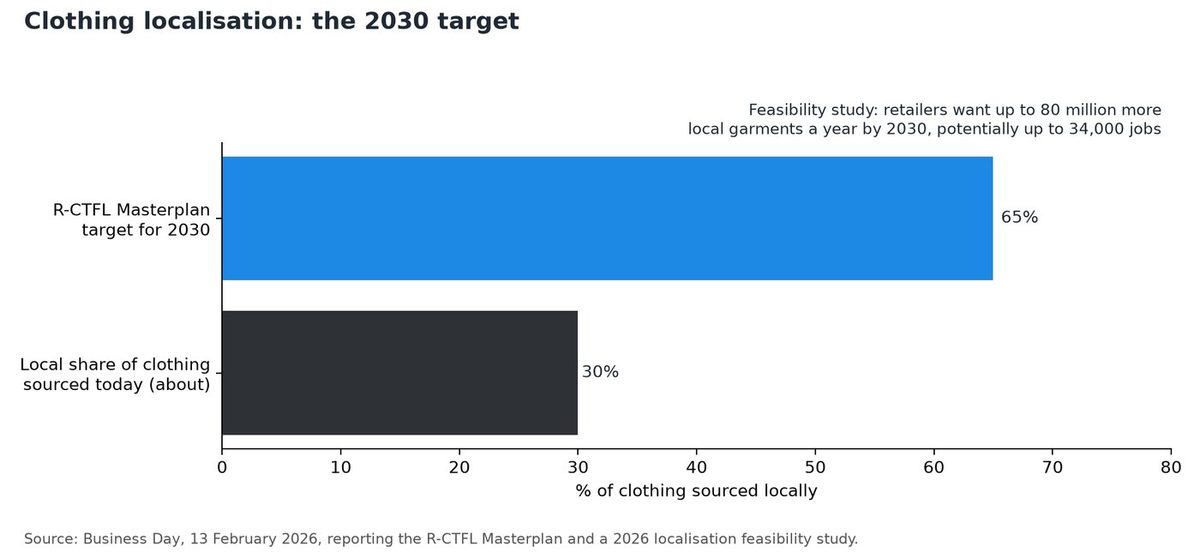
There is also a structural tailwind. The government-backed Retail-Clothing, Textile, Footwear and Leather (R-CTFL) Masterplan aims to raise local sourcing of clothing to 65% by 2030, from about 30% today. A 2026 localisation feasibility study reported by Business Day found that retailers want up to 80 million more locally made garments a year by 2030, which could create as many as 34,000 formal factory jobs. Retailers were most willing to localise basics such as T-shirts, denim and athleisure, but price remains the obstacle, because imports are often substantially cheaper (Business Day, February 2026). Cut-make-trim factories, not decorators, will capture most of that. But T-shirts are exactly the blank on which South Africa’s micro-decorators add value, and a local blank decorated locally is a shorter supply chain at both ends.
The smartest garment businesses are not choosing between technologies; they combine them. A Bloemfontein screen-printing partner describes adding a finishing bench beside its main press. Club kits get the shared crest by screen, then individual names and numbers by heat press, and caps and small sample runs no longer tie up a full-size screen (screen-printers.co.za).
Packaging, bottles and product marking
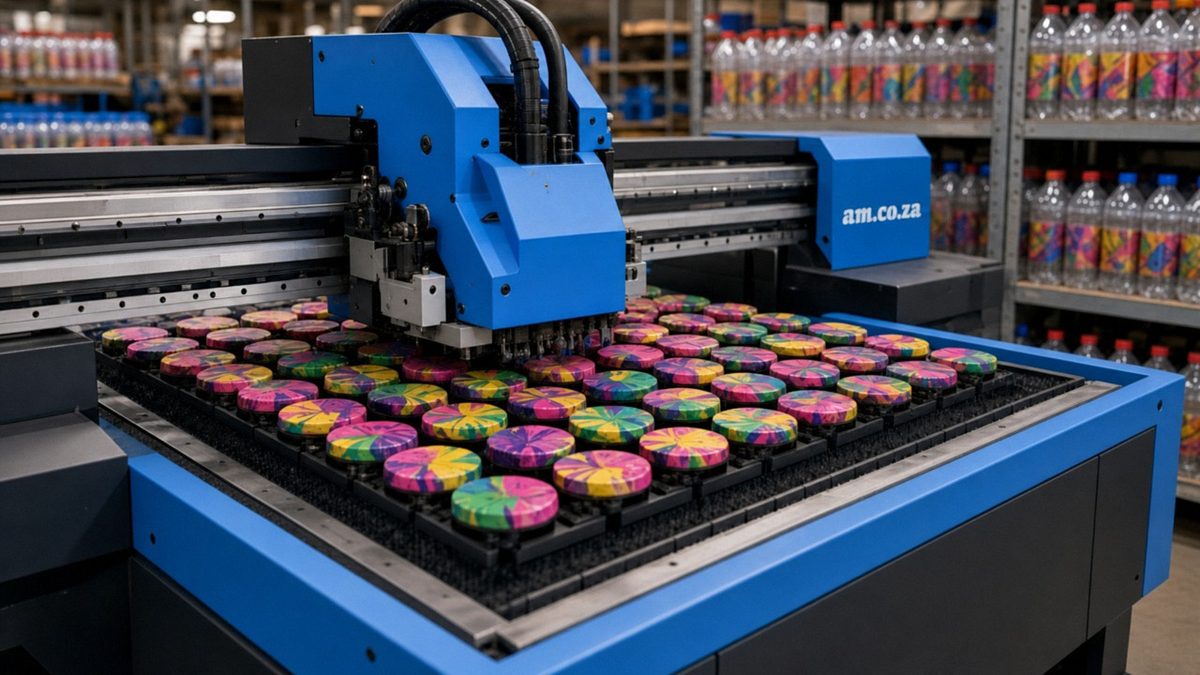
UV printing and screen printing onto PET, HDPE and glass serve the growing market for craft beverages, cosmetics and private-label goods. One partner write-up on setting up a first-time bottle printer describes how the bottleneck is rarely the printer itself (bottlescreenprinters.co.za). The real bottleneck is that a new artwork waits days for an outside screen maker. The fix is a modest in-house screen room: a corner that can be kept dark, a bench, a drying rack, a washout point and an exposure unit. Repeat and multi-colour work stays with a specialist. For lids, closures and odd-shaped containers that do not sit well on a rotary screen pass, another partner has moved sample work onto a flatbed UV printer, using a jig to hold dozens of lids in the same position under the print head (bottleprinter.co.za). That split between doing the fast-changing work in-house and outsourcing the complex work recurs across the sector.
Metal fabrication
For gate and railing makers, trailer builders and metal-furniture shops, the case for laser technology rests less on novelty than on time saved grinding. A fabrication-bay write-up from an equipment integrator describes the familiar problem: on thin square tube and 1.2–3 mm sheet, conventional welding leaves heat marks and distortion, and repair jobs can spend longer on the wire wheel than under the torch (fabmaster.co.za). The integrator’s recommended order is telling. It adds the handheld laser welder and cleaner first, and a fibre sheet cutter only “once the welder and cleaner are earning their keep”. Every bay also gets laser-rated eyewear, screens and a marked exclusion zone before the first switch-on.
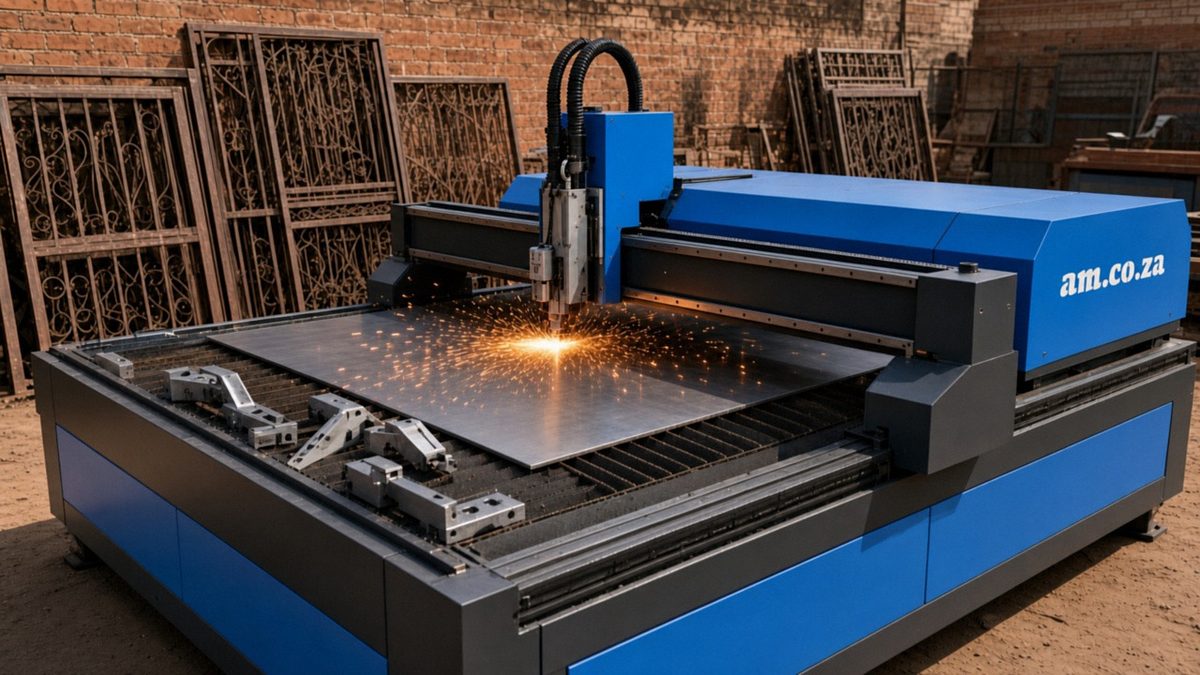
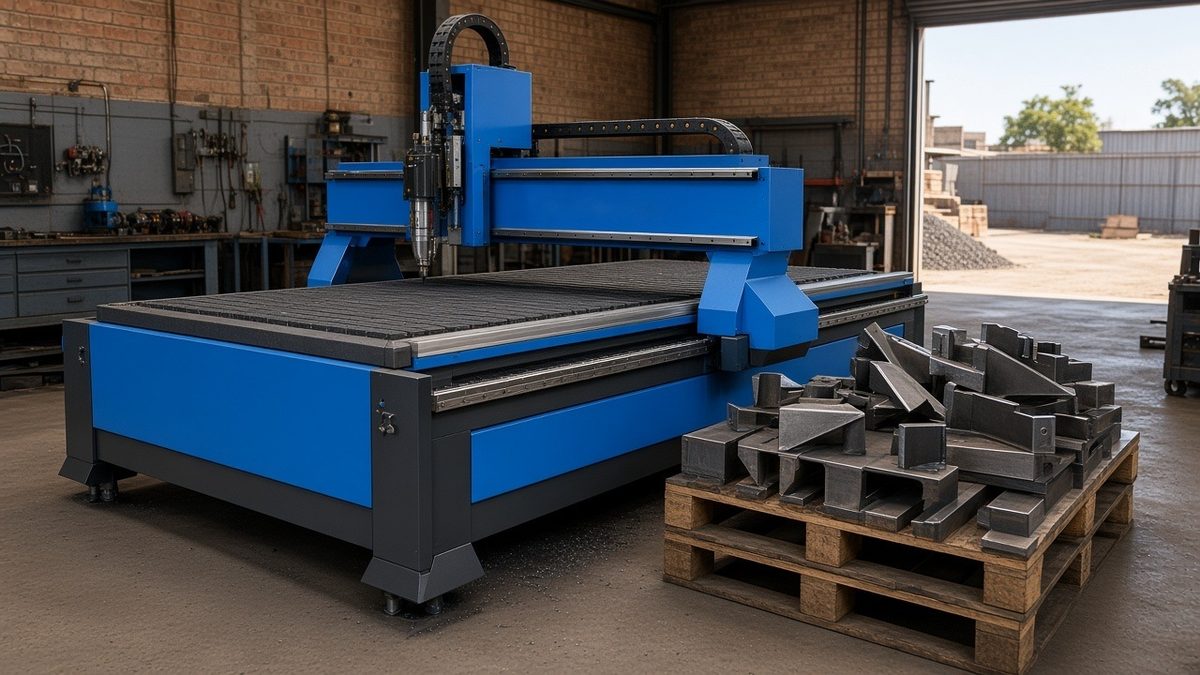
The context is sobering. The metals and engineering sector produces more than a quarter of manufacturing output but was running at about 75% capacity utilisation in 2024/25, under pressure from imports and logistics failures (merSETA Annual Report 2024/25). CNC plasma remains the workhorse for thicker plate and for smaller towns. A Mossel Bay sheet-metal partner describes moving base plates, gussets and louvre panels off the grinder and away from a distant profile cutter onto its own plasma table, cutting out days of trucking along the N2 and extra edge dressing before galvanising (jesheetmetal.co.za). Small fabricators that can cut and finish their own parts are, in effect, bringing work back from outsourced profile cutters and from imports, one bracket at a time.
Bakery, food equipment and traceability
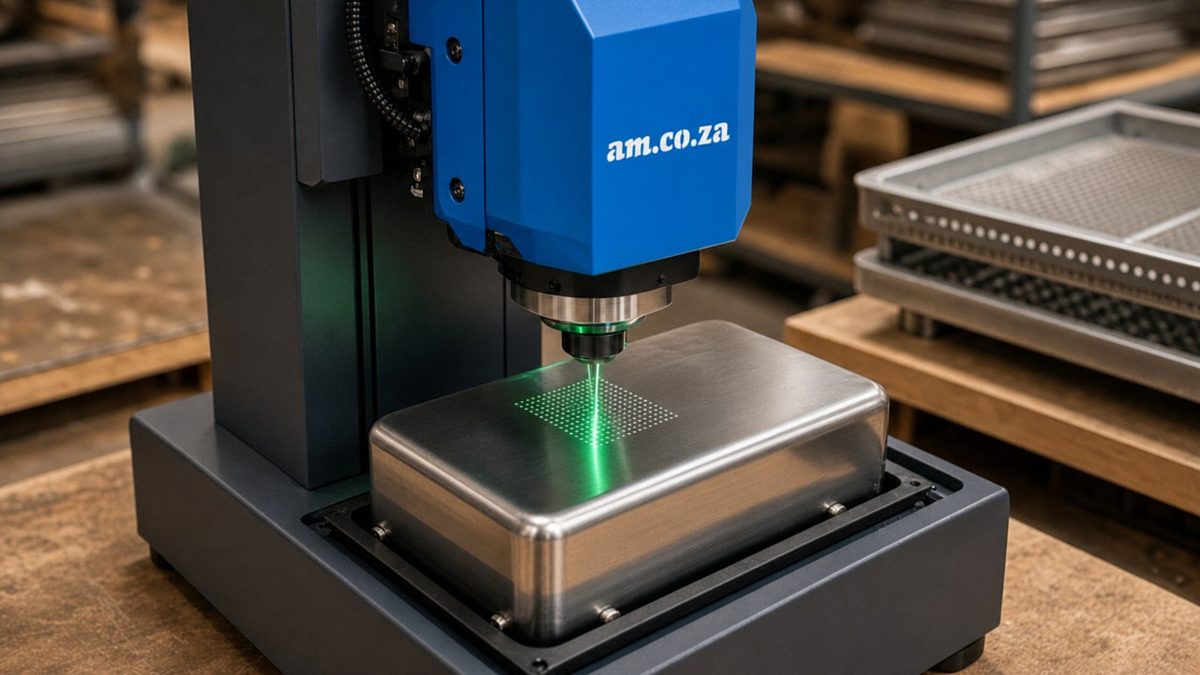
The bakery trade is a less obvious example. A KwaZulu-Natal bakeware manufacturer describes bringing perforated tray blanks in-house on a full-sheet fibre laser, instead of queuing for an outside profile cutter whose turnaround “set the pace for the whole workshop” (bakerite.co.za). A small fibre marker then etches a permanent code into each pan wall. Paint pens and stickers do not survive ovens and wash bays, but a laser mark becomes part of the steel. That lets plant bakeries trace each pan’s build date, recoats and repairs across a fleet. This is a good illustration of how a modest machine can move a small manufacturer from selling products to selling a managed service.
The same traceability logic is spreading well beyond food. A calibration laboratory partner has replaced peeling stickers and paint pens with fibre-laser and CO2-laser asset IDs, so that the instrument, its certificate and the asset register always agree (accu.co.za). A crusher-parts supplier uses a handheld laser cleaner to clear yard rust from bolt seats and a fibre marker to tag each wear liner before dispatch, so the casting batch can be read on site (crusherconsumable.co.za).
Furniture, shopfitting and interiors
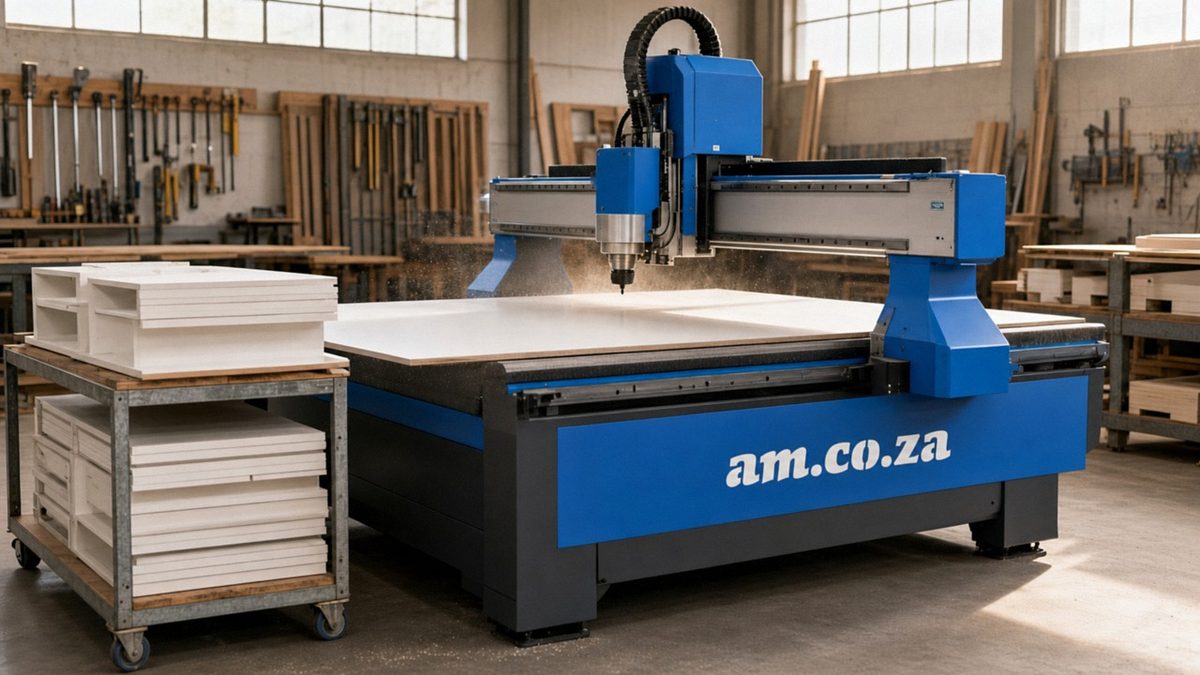
Full-sheet CNC routers have quietly become standard in cabinet and shopfitting workshops, where nesting software arranges parts on a board to minimise waste and machined pockets replace hand jigs. Stats SA’s business survey lists furniture among the manufacturing divisions that cut formal jobs in late 2025 (QES, December 2025). The small shops that survive tend to be the ones that replaced manual breakdown with programmed cutting.
Part 3: Techniques and workflows: where quality is really won
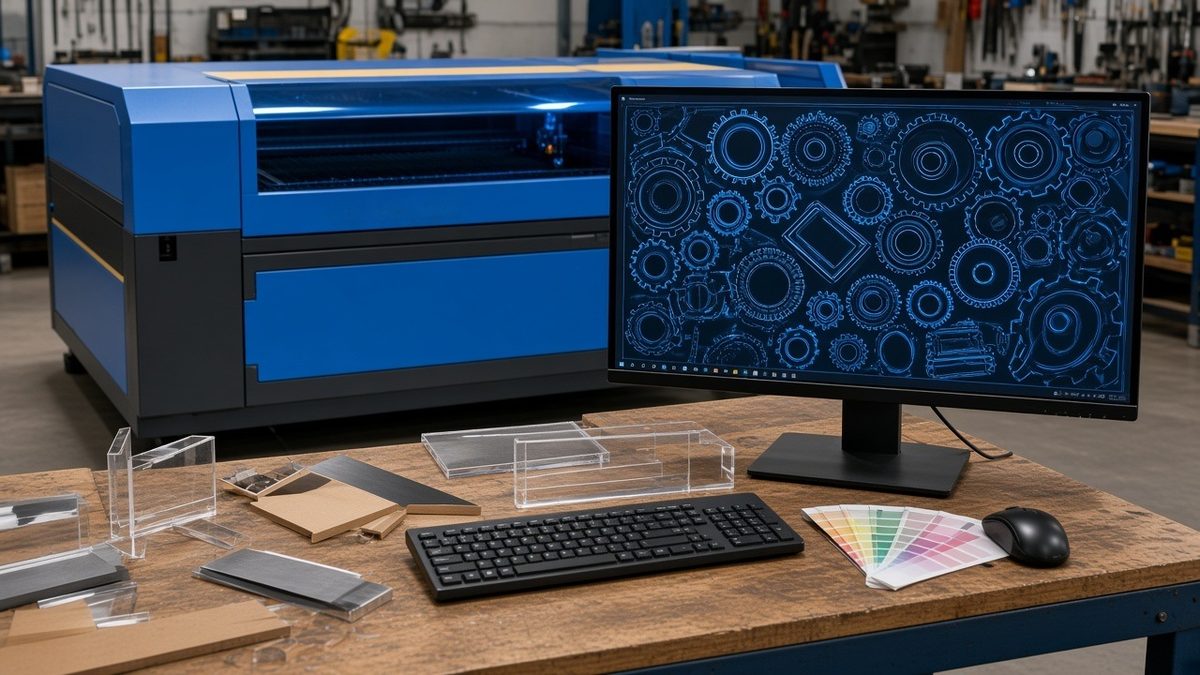
Across every category, the machine is the easy part. The workflow around it decides whether a business makes money.
Design and file preparation. Almost every digital fabrication job begins as a vector file. Clean paths, correct scaling, closed shapes and sensible kerf allowances save more time than any machine upgrade. Shops that invest in design skills, or a part-time designer, consistently waste less material.
RIP and colour management. In print, the raster image processor (Grokipedia), or RIP, controls how artwork becomes ink droplets. Colour consistency is hard because so many variables are involved: firmware, RIP settings, ink, film or paper, powder and curing. Changing any one of them shifts the result, so careful shops lock down their settings and change one variable at a time.
Material parameters. Lasers and routers both depend on matched settings: power, speed, frequency and focus for lasers; spindle speed, feed rate, depth of cut and tool choice for routers. Mature shops keep a parameter library for every material they sell, and test new stock before running a customer job. A sublimation-blank distributor’s write-up describes pressing a sample from every incoming batch before it goes on the shelf, because “a humid week on the coast can change how a fabric behaves” under heat (sublimationblanks.co.za).
Finishing. Weeding vinyl, laminating prints, deburring cut metal, curing DTF transfers and post-curing UV work are where labour hours accumulate. That labour is also why digital fabrication creates jobs as well as replacing them.
Maintenance and consumables. Lenses, nozzles, print heads, router bits, filters and extraction all wear out. Downtime, not machine price, usually determines whether a machine pays for itself, which is why parts availability and local technical support matter as much as the specification sheet.
Safety. Laser classes, fume extraction (especially for acrylic and MDF; PVC-containing materials should never be laser-cut), dust collection on routers, and eye protection are non-negotiable. Health and safety obligations apply to a garage business just as they do to a factory.
Part 4: The economics: buying, outsourcing and payback
Cost bands, described generally
Because machine prices move with exchange rates and freight, this report describes cost bands rather than rand amounts. In practice, buyers fall into three tiers.
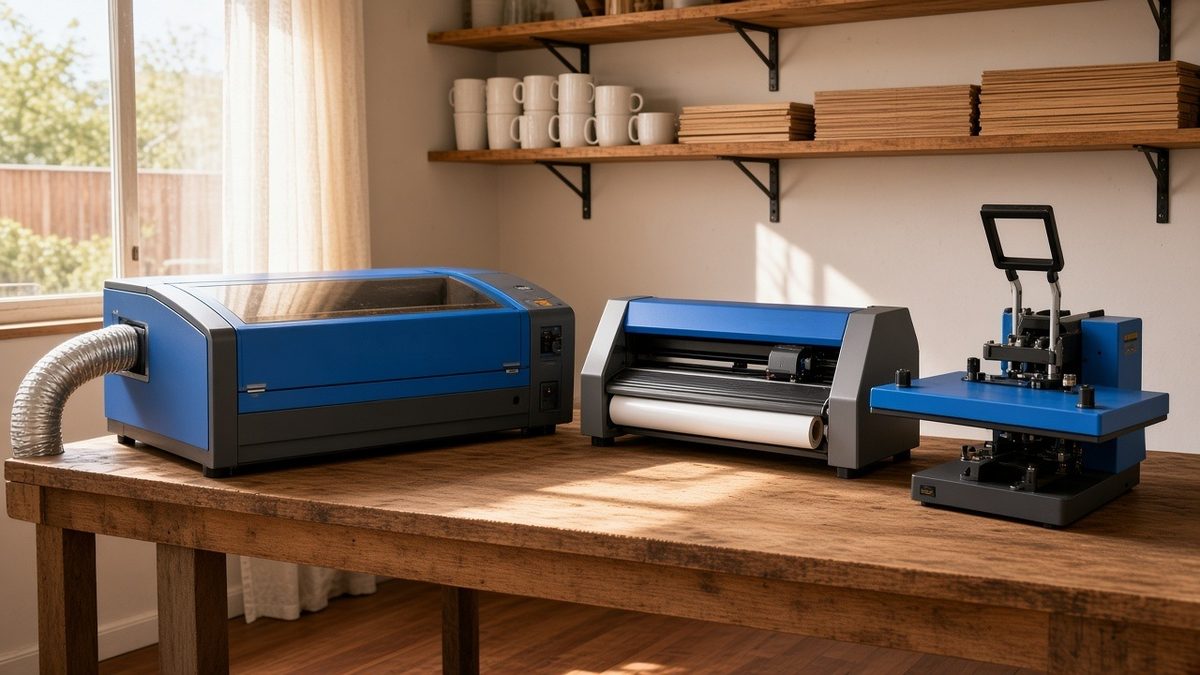
- Entry tier. This is a single process: a vinyl cutter and heat press, a desktop CO2 laser, a sublimation printer and mug press, or an A3 DTF set-up. It is often funded from savings, a family loan or a small micro-loan, and it can run from a spare room on single-phase power.
- Micro-workshop tier. This means two to four complementary machines, for example a large-format printer, laminator and contour cutter, or a CO2 laser plus a mid-sized router. It brings proper extraction, compressed air and some form of power backup. This tier usually needs asset finance and a small rented unit.
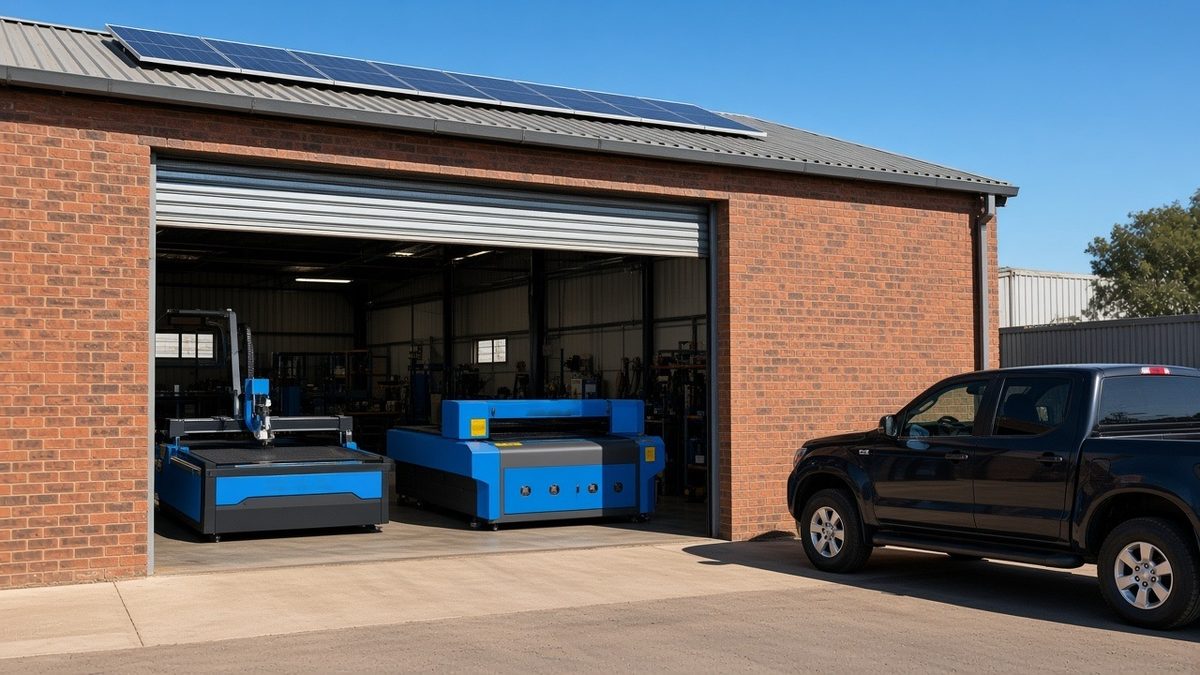
- Production-cell tier. This covers full-sheet fibre laser cutters, industrial routers with high-power spindles, production UV flatbeds and automatic screen lines. It typically requires three-phase power, a factory-grade floor, trained operators and bank or development finance.
The jump from the first tier to the second is where most businesses stall, because the step up in fixed costs (rent, power and wages) arrives before the step up in turnover.
The payback calculation
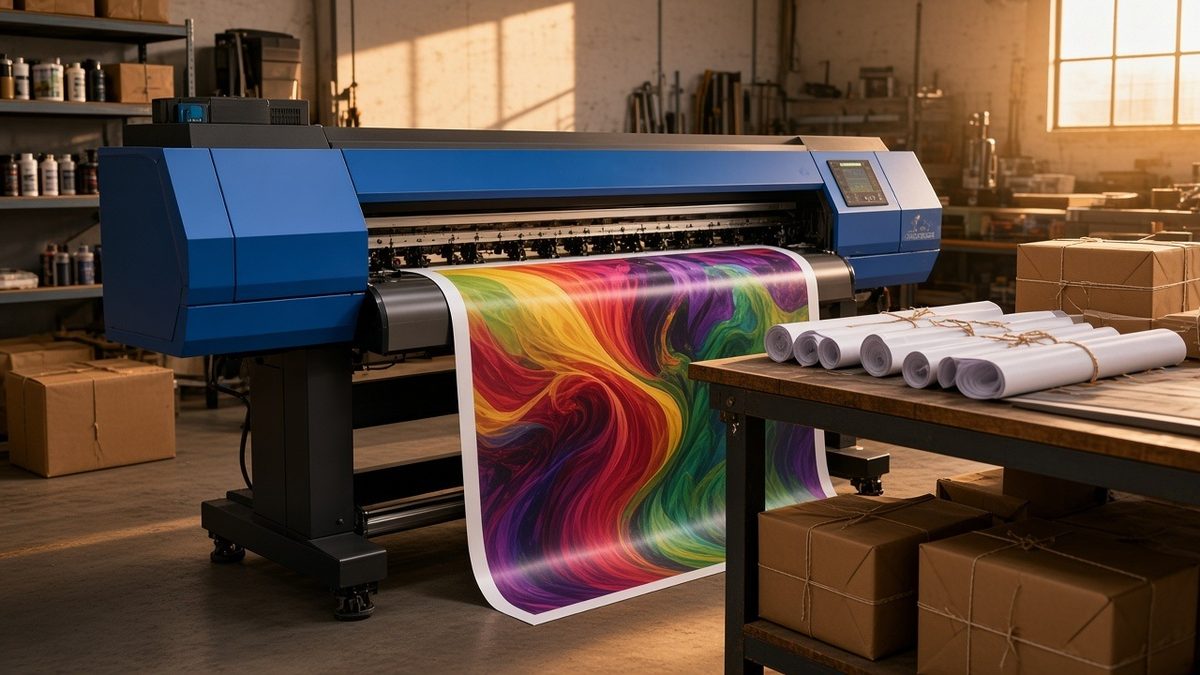
A practical payback estimate needs four numbers:
- the total landed cost of the machine, including installation, training, extraction and a starter stock of consumables;
- the contribution margin per typical job (the selling price minus materials, consumables and direct labour);
- realistic monthly job volume, based on existing customers rather than hoped-for ones;
- additional monthly fixed costs the machine creates, such as electricity, maintenance, finance charges and space.
Payback in months is the total landed cost divided by (monthly jobs × contribution margin − additional fixed costs). If the denominator is small or negative, the machine is a liability, however impressive its specifications. Two disciplines improve the odds: price jobs against what outsourcing would have cost the customer, and keep machines busy, since inkjet print heads in particular suffer when a printer stands idle for long periods.
Buy, outsource or go hybrid?
The case for buying is strongest when outsourcing creates delay, quality risk or minimum-order barriers. The bottle-printing and bakeware examples above show this logic in South Africa: in both, buying a machine was really a decision about who controls the schedule (bottlescreenprinters.co.za; bakerite.co.za).
Outsourcing still wins for occasional, specialised or high-capital processes such as multi-colour screen sets, very thick plate cutting and large-volume runs. Many successful small firms are hybrids. They own the fast, frequent, margin-rich processes and buy in the rest.
The electricity variable
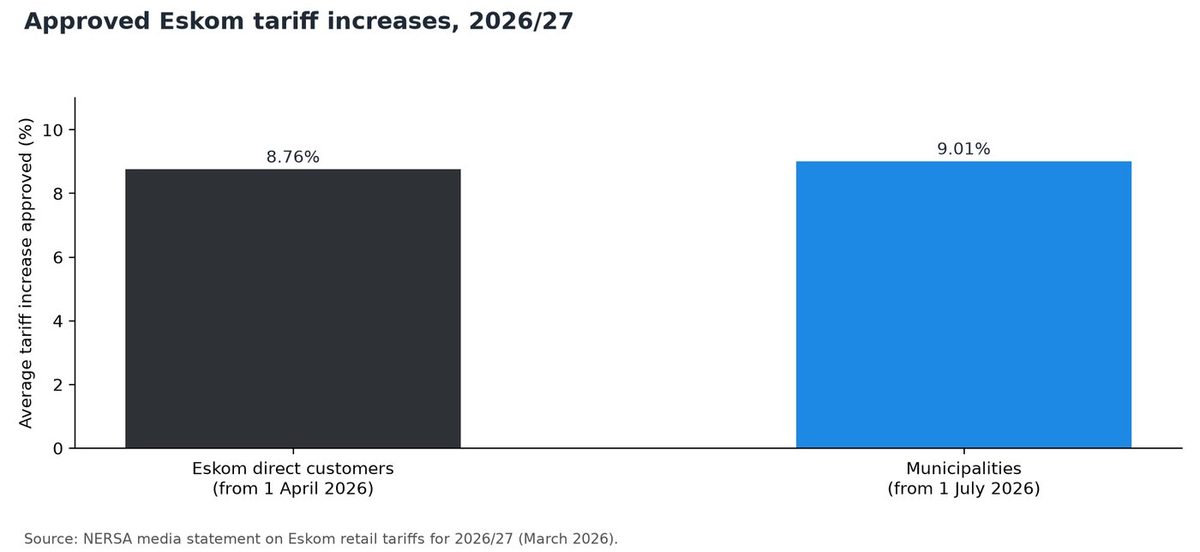
Energy is now a strategic input, not an overhead. The national energy regulator NERSA approved average Eskom tariff increases of 8.76% for direct customers from 1 April 2026 and 9.01% for municipalities from 1 July 2026 (NERSA media statement). TIPS estimates that Eskom’s average real price per kilowatt-hour rose by around 280% above inflation between 2008 and 2025. It also reports that private suppliers provided 18% of grid electricity by January 2026, with more than 18 GW of off-grid generation registered with NERSA (TIPS). For a small workshop, that means estimating a machine’s power draw, compressor, chiller and extraction at municipal tariffs before buying, and treating solar and battery backup as part of the production plan rather than a luxury.
Import dependence and the role of local suppliers
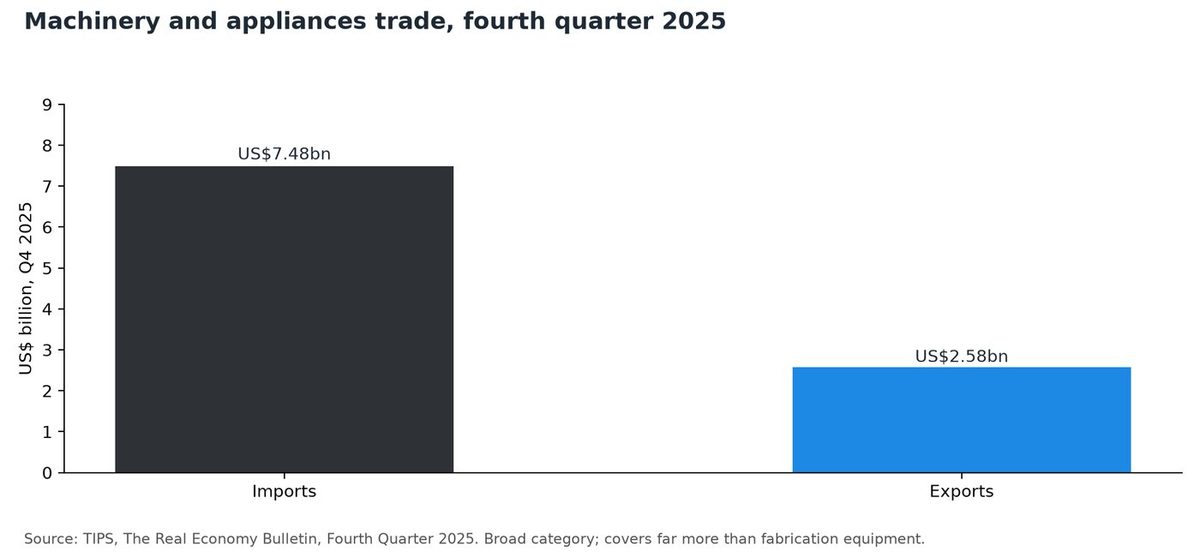
Most digital fabrication machinery sold in South Africa is imported, largely from Asia. TIPS data show imports of machinery and appliances of about US$7.48 billion in the fourth quarter of 2025 alone, against exports of about US$2.58 billion (TIPS). That broad category covers far more than fabrication equipment, but it shows the structural deficit. In practice, a local supplier’s value lies less in the box than in what surrounds it: demonstration, parts stock, local technicians, training and software support. AM.CO.ZA, for instance, describes coordinating import risk on clients’ behalf and keeping national parts and service capacity to minimise downtime (AM.CO.ZA, About). For buyers, the quality of after-sales support should weigh as heavily as the machine’s specification sheet.
Part 5: Skills, training and the job market
The scale of the problem
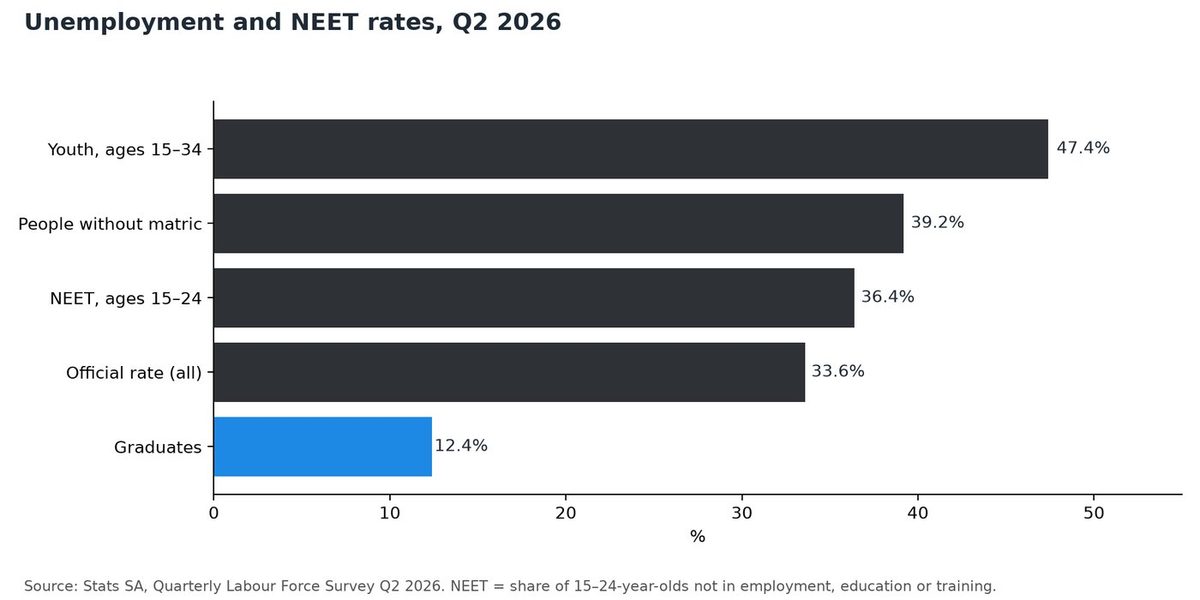
South Africa’s official unemployment rate was 33.6% in the second quarter of 2026, with 8.5 million people unemployed. The youth unemployment rate for ages 15–34 rose to 47.4%, or 5.0 million young people. Of the 10.4 million South Africans aged 15–24, 36.4% were not in employment, education or training (Stats SA QLFS Q2 2026). Education matters: the unemployment rate for people without matric was 39.2%, against 12.4% for graduates.
Artisans: the missing middle
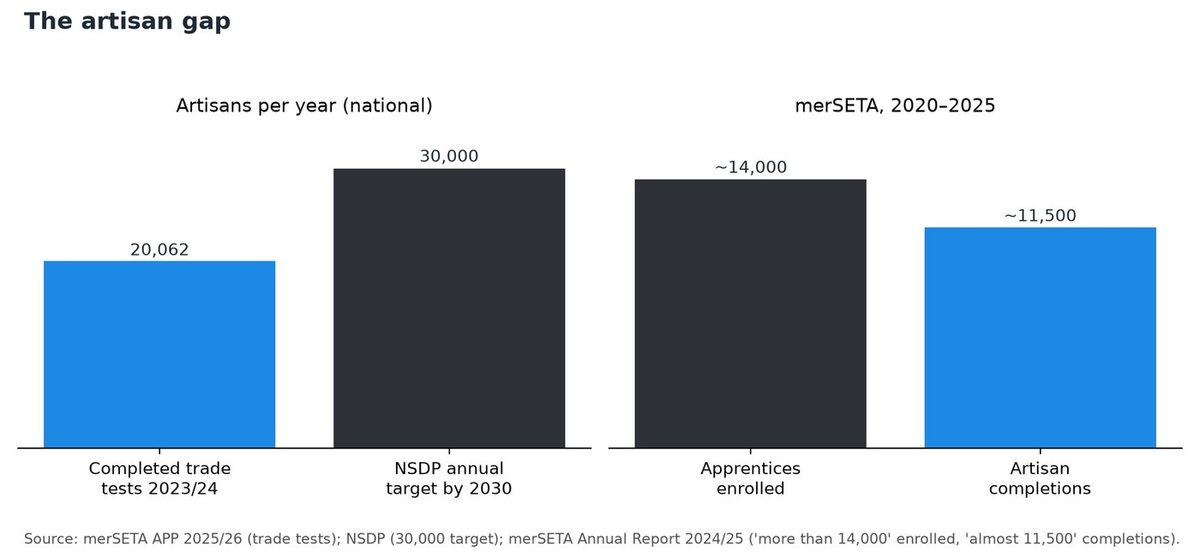
The National Skills Development Plan set a target of producing 30,000 artisans a year by 2030. It noted that the target itself shows that “South Africa’s intermediate skills base is too low”, and that the Quality Council for Trades and Occupations (QCTO) has been developing new occupational qualifications since 2012 (NSDP, as published by merSETA). Progress is real but incomplete. merSETA’s 2025/26 Annual Performance Plan reports that 20,062 artisans completed their trade tests nationally in 2023/24. Welders, boilermakers, and fitters and turners were among the ten most common trades (merSETA APP 2025/26).
merSETA’s own five-year record shows both what works and where the system strains. Between 2020 and 2025 it enrolled more than 14,000 apprentices, recorded almost 11,500 artisan completions and established partnerships with 76% of public TVET colleges. It found a 36% rise in employment among beneficiaries after learnerships and apprenticeships. But women made up only 27% of learners in the trades. The SETA also reported weak uptake of the new occupational qualifications as legacy qualifications are phased out, and repeated shortfalls in placing learners with host employers (merSETA Annual Report 2024/25).
Where digital fabrication fits the SETA map
Digital fabrication crosses SETA boundaries. Metal fabrication, laser cutting and welding sit naturally within merSETA’s metals and engineering chamber. Printing, packaging, print media, clothing, textiles and furniture fall under the Fibre Processing and Manufacturing SETA (FP&M SETA), whose mandate covers those sectors (FP&M SETA, Sector Skills Planning). In practice, a single sign shop might employ a designer, a print operator, a CNC router operator and an installer, which is a mix no single qualification captures. Workplace placements are therefore often the deciding factor: learners need machines to practise on, and small firms need help to host them.
The TVET pipeline
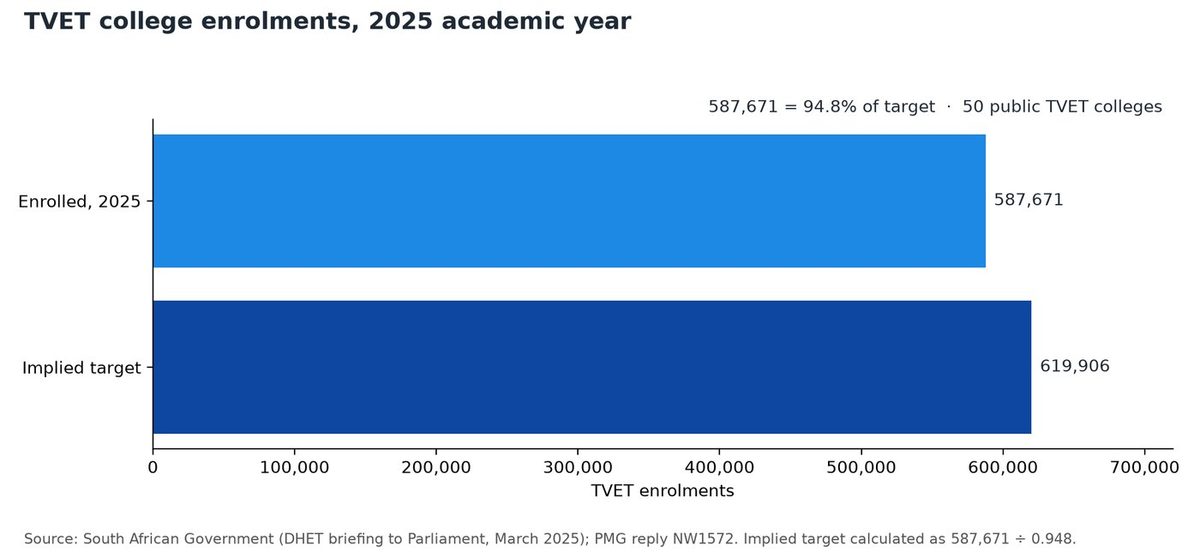
South Africa has 50 public TVET colleges (PMG, question NW1572). For the 2025 academic year, the Department of Higher Education and Training reported 587,671 TVET enrolments, 94.8% of its target (South African Government, March 2025). In a parliamentary reply on 2025 planning, the department said there was no real increase in college funding, and that stalling budgets were reflected in a steady decline in TVET enrolments (PMG, NW1572). Keeping workshop equipment current is part of that strain: in 2024/25 merSETA funded occupational programmes, equipment and workshop infrastructure at four TVET colleges (merSETA Annual Report 2024/25). CNC, laser and digital print equipment dates quickly, so few college workshops can match what learners will meet in industry.
Workplace learning: where a supplier meets the skills system
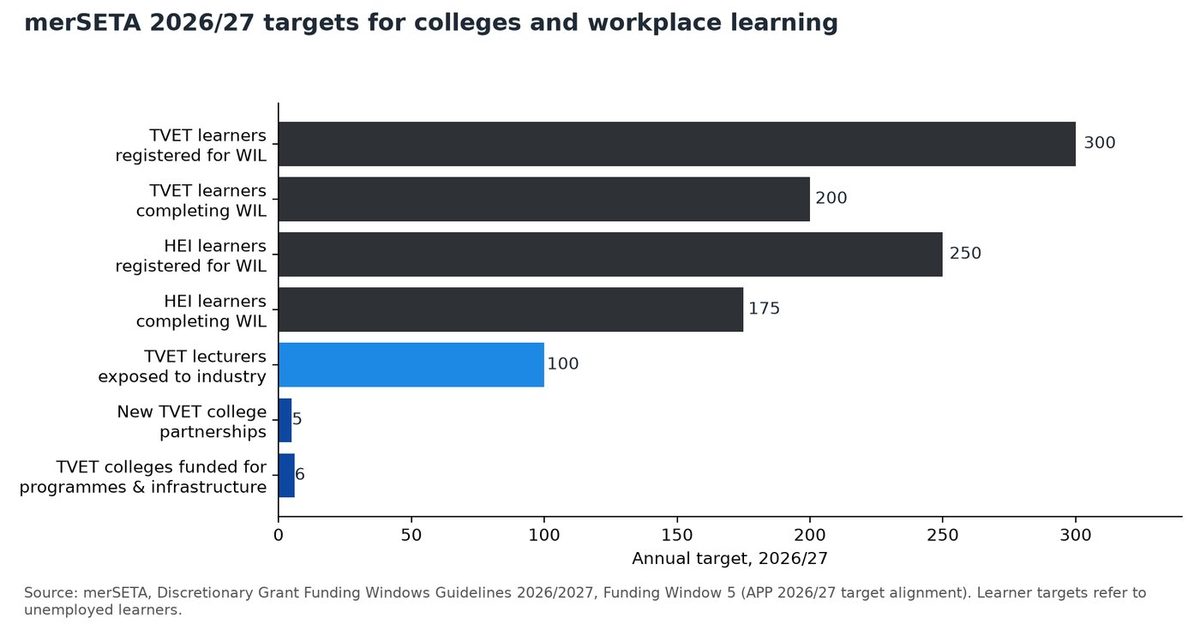
South Africa’s skills system depends on employers opening their workshops. Under work-integrated learning (WIL), diploma students from TVET colleges and universities of technology must complete supervised workplace phases, known as P1 and P2, before they can graduate. merSETA’s discretionary-grant rules for 2026/27 fund these placements through its Student Internship Category A, at R44,000 per learner for each six-month semester, or R88,000 where a learner completes both P1 and P2. Every application must include confirmed employer placement agreements. The same window funds “lecturer industry exposure” programmes, which must name the participating employers. For 2026/27 merSETA has set targets of 300 unemployed TVET learners registered for WIL, 250 from higher education institutions, 100 TVET lecturers exposed to industry, and five new TVET college partnerships (merSETA DG Funding Windows Guidelines 2026/27). Placing lecturers in industry is not a new idea. Government told Parliament years ago that it had begun a project, through the Education, Training and Development Practices SETA, to put TVET lecturers into workplaces so that their teaching keeps up with industry (The Presidency, oral replies).
Those numbers are small next to a college system of almost 600,000 students, and that is exactly why host workplaces with current machines matter. AM.CO.ZA’s own account shows what that hosting looks like in a digital-fabrication business. In 2026 the company and its Ambitious Academy took in P1 and P2 engineering students under merSETA-funded WIL. The learners were registered through an industry training centre, with merSETA contracts, weekly attendance registers and stamped logbooks for each learner, and the company deals directly with merSETA’s quality-assurance office on the programme. Students from a university of technology also completed P1 practical training at its Germiston facility.
The company’s account of its college work goes further than student placements. It says it hosts lecturers from South West Gauteng TVET College (swgc.co.za) under a lecturer placement programme. A clothing-production lecturer has been placed in its workshop, with the college’s work-based experience coordinators visiting to monitor the placement. For October and November 2026, the college and AM.CO.ZA agreed on a programme that includes two days of excursions for marketing and graphic-design students, in groups of up to 25 with their lecturers; a one-week industry exposure for two graphic-design lecturers; and a six-week placement for a computer-technician lecturer. The spread of disciplines is the point. A modern sign, print and fabrication business touches textiles, design, electronics and machine maintenance at the same time, so one host site can refresh several college departments at once.
None of this has been independently audited, and the company does not publish learner or graduate totals, so this report does not give any. But it shows a practical model. A supplier that already has machines running, technicians on staff and a training room can absorb learners and lecturers at a lower marginal cost than a small customer workshop could. The SETA grant rules then make hosting financially possible.
Industry-led training: the Ambitious Academy
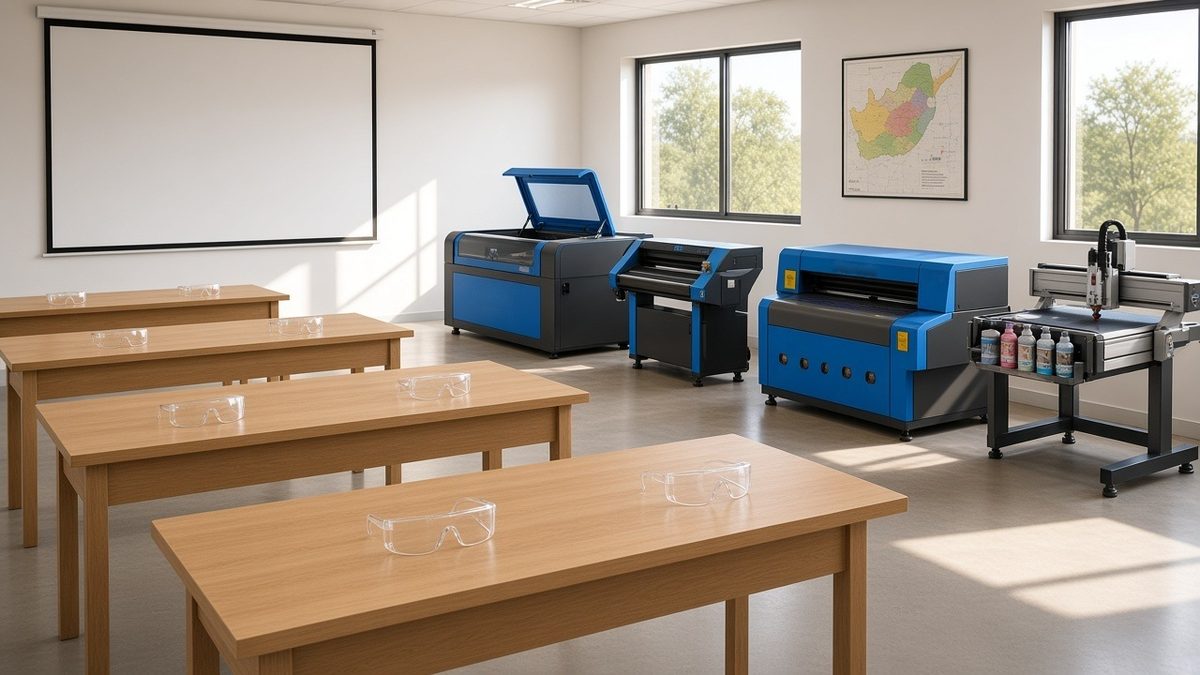
Short courses fill the gap between college workshops and the machines learners will meet in industry. AM.CO.ZA describes a training division that runs sessions for customers’ technicians, aspiring entrepreneurs and private individuals (AM.CO.ZA, About). It says its 7,000 m² footprint spans three warehouses where it shows, sells and supports machines and incubates smaller branding and design businesses (AM.CO.ZA). When it moved into new premises, the company built a dedicated demonstration and training facility, which it named the Ambitious Academy. Its first seminar was free and covered how to apply for government business funding and register a company. According to the group’s published account, it drew 25 people (8i.co.za: AM.CO.ZA seminars).
The academy now presents itself as a “School of Industry 4.0”, a nod to the Fourth Industrial Revolution (Grokipedia). Its flagship is the Digital Machine Age (DMA) Specialist programme, a hands-on, two-month course for school-leavers with basic IT skills. The course covers the electrical and mechanical basics of the machines, operating printing and CNC machines, production software, business case studies and tours of working businesses. Sessions were scheduled through 2026, with the last running from October to December (Ambitious Academy, DMA). Around it sit four tracks. A Practical Class teaches through real projects and site excursions (Practical Class). A Machine Class covers CNC principles with skill-level assessments (Machine Class). A Graphic Class teaches design files and CNC programming (Graphic Class), and Business Compass deals with running a machine-based business (Business Compass). Online courses with digital certificates extend the reach beyond Gauteng (Ambitious Academy, online courses). Examples include a recorded DTF course (8i.co.za: online DTF course), a vinyl-cutting course (8i.co.za: vinyl-cutting course) and a video-production certification whose final project is graded by an assigned lecturer (8i.co.za: VEST certification).
Partners use the same whole-job approach. A Johannesburg vinyl-cutting studio runs three stations where beginners design, cut, weed, press and peel a shirt, a mug and a decal in one morning, on machines they do not yet own (vinylcutter.co.za). A fabrication-bay integrator says it has added a laser module to the starter training it offers TVET colleges and apprentice programmes, with the emphasis on habits such as nozzle checks, lens care and PPE (fabmaster.co.za). Whatever the formal qualification, short, hands-on training that covers a whole job is often what turns a curious buyer into a viable operator.
Alongside DMA, the academy runs online courses with matching certifications, listed on its online courses page. They cover DTF printing, large format printing, vinyl cutting, sublimation, CNC routing, ICC profiles, laser welding and VEST. There are also four study tracks: the hands-on Practical Class, the theory-led Machine Class, the software-focused Graphic Class and the entrepreneurship track Business Compass. These are structured curricula, not just short videos. The DTF course, for example, has seven modules, running from safety and machine maintenance to RIP software, pre-press and application. For a small workshop, that makes education part of what it buys with a machine, not an extra. AM.CO.ZA’s DTF printer packages include the DTF course for free.
The skills that matter most are not always technical. They include quoting accurately, managing files, understanding materials, keeping maintenance logs, working safely, and the customer-service discipline to deliver on a Friday when promised.
Part 6: Social impact: townships, SMMEs and the informal sector
Big numbers, thin evidence
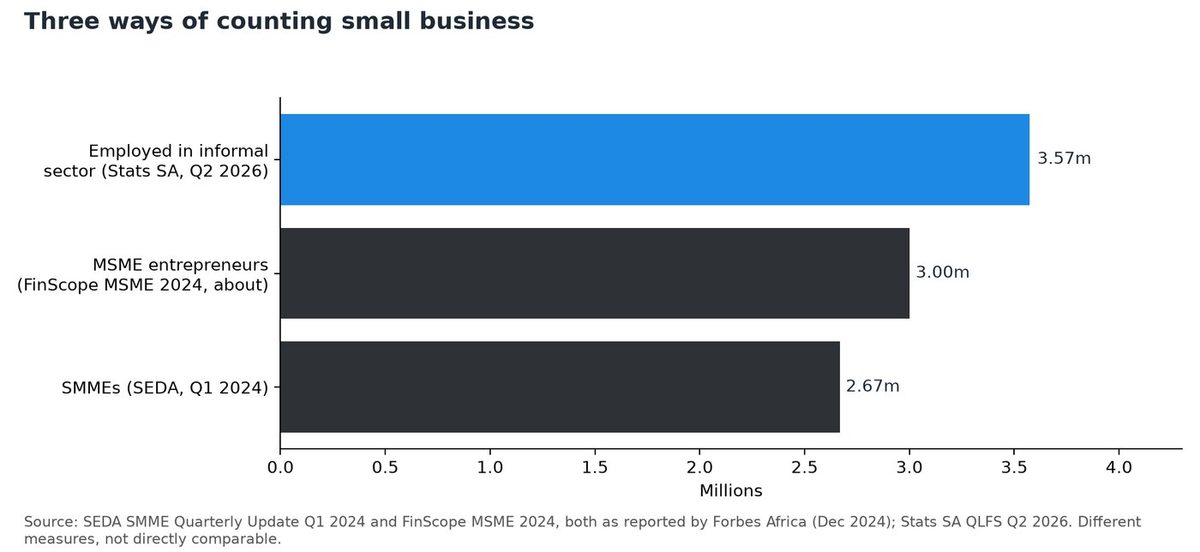
Counting small businesses in South Africa is notoriously hard. The Small Enterprise Development Agency’s SMME Quarterly Update for the first quarter of 2024 counted 2.67 million SMMEs, down 1.3% year on year. The FinScope MSME 2024 survey estimated about three million micro, small and medium entrepreneurs employing around 13.4 million people, with 72% of micro-enterprises operating informally (both as reported by Forbes Africa). Stats SA counted 3.574 million people employed in the informal sector in the second quarter of 2026, up 34,000 on the previous quarter (QLFS Q2 2026). Stats SA changed its informal-employment definition in mid-2025 to align with the International Labour Organization, so long-run comparisons need care (TIPS).
No official dataset isolates digital fabrication businesses. Claims about how many jobs the small-machine economy has created should therefore be treated with scepticism, including any made by suppliers.
What the township evidence says
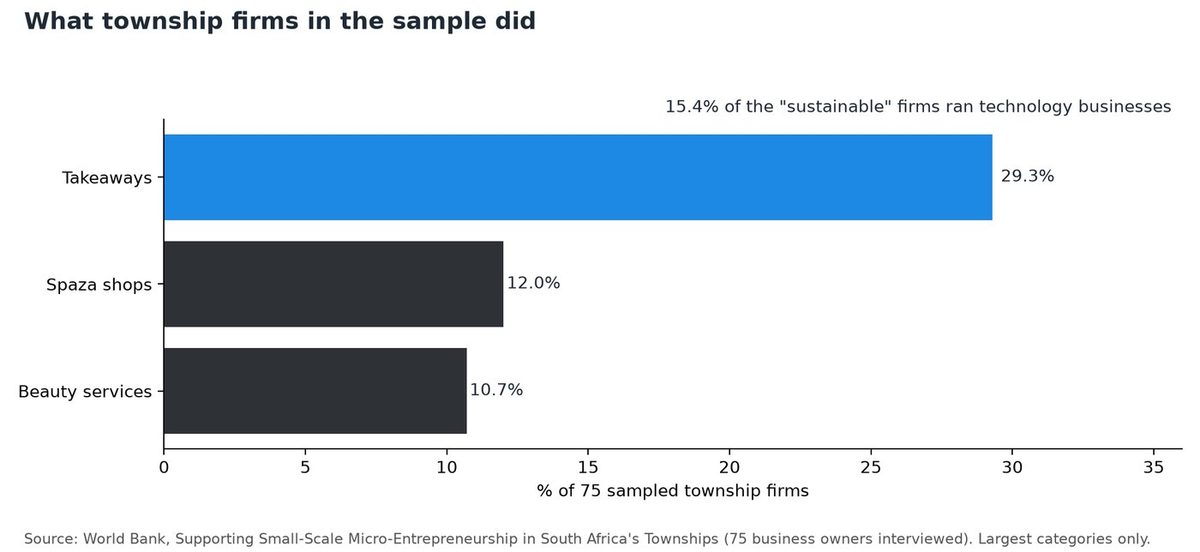
The most useful recent evidence is qualitative. A World Bank study, Supporting Small-Scale Micro-Entrepreneurship in South Africa’s Townships, interviewed 75 township business owners and 11 key informants. Most firms in the sample were small traders without paid employees: takeaways (29.3%), spaza shops (12%) and beauty services (10.7%). The more successful, “sustainable” firms were more diversified, and 15.4% of them ran technology businesses. The authors found that success “depends less on finance than on resilience, resourcefulness, and mindset”. Registration was seen as complex but trust-building, and access to government support was low because programmes felt irrelevant or eligibility criteria were too strict.
That matters for digital fabrication. Branding, printing and personalisation are among the few productive, non-retail activities a township entrepreneur can start at small scale and sell to local schools, churches, taxi associations, sports clubs, funeral parlours and small businesses. Many of those customers would otherwise buy from city printers. Every school-shirt order printed in the neighbourhood keeps that money in the township economy.
Industrial parks and the policy push
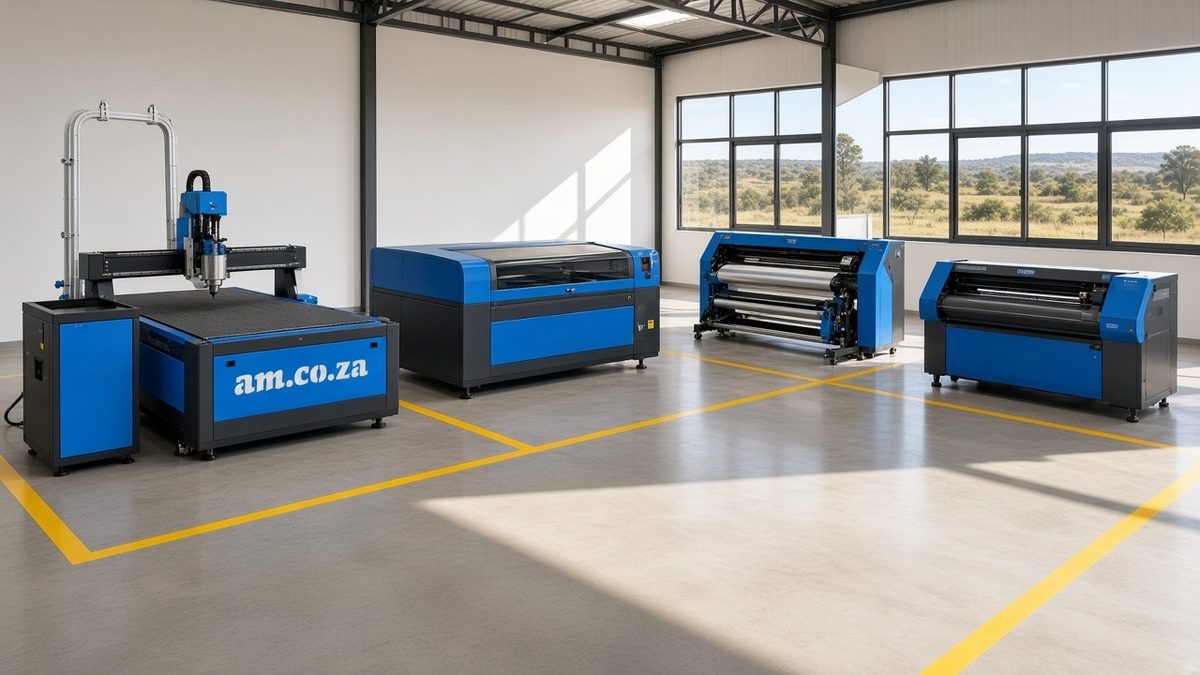
Policy is trying to build the physical base for this. In a 2025 parliamentary reply, the Department of Trade, Industry and Competition named four Gauteng industrial parks prioritised for support in 2025/26 and 2026/27 under its Industrial Parks Revitalisation Programme: Orlando West in Soweto, Laborie in Ekurhuleni, Babelegi and Ga-Rankuwa. It also said revised interventions would include digital and artisanal incubation hubs to support skills and MSME development (PMG, question NW4947). A shared-machine incubator in such a park, with a router, a laser and a print-and-cut line run by a trained technician and rented by the hour, could lower the entry barrier far more than a grant for one entrepreneur’s machine.
Localisation, one order at a time
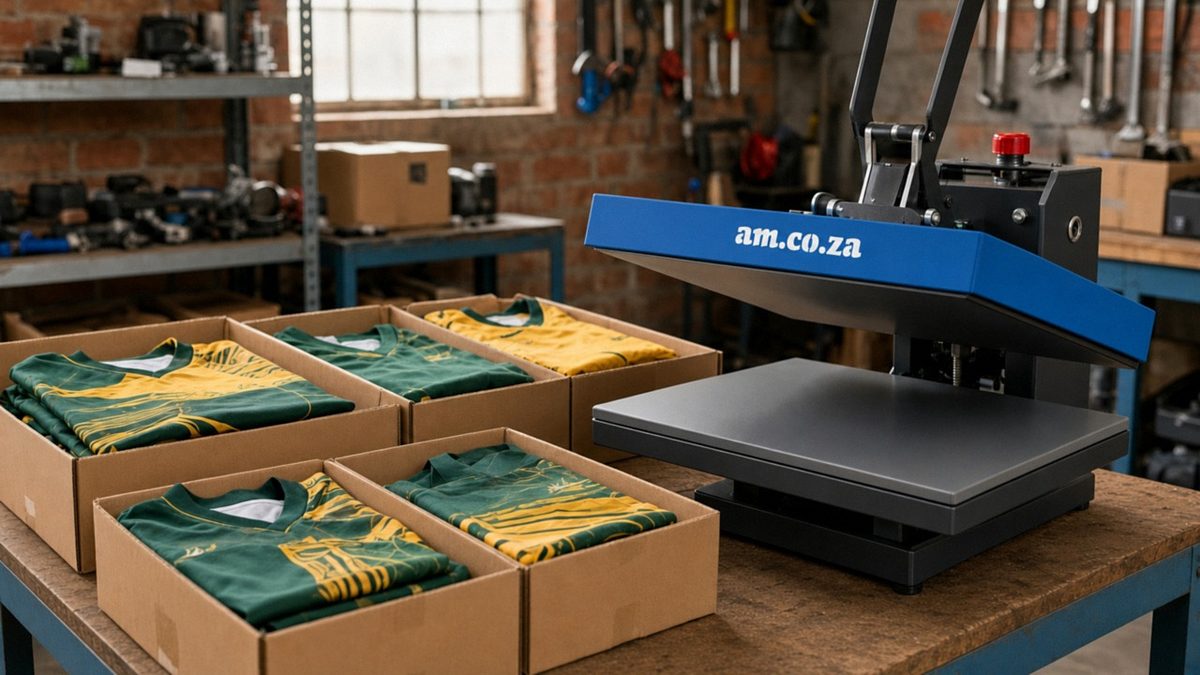
Import substitution in this sector rarely makes headlines. It happens when a fabricator cuts brackets it used to buy, a bakeware maker stops sending blanks out, a bottle printer makes its own screens, or a school’s branding is done in the same town instead of being trucked from a metro. Individually these are small. Together they form the kind of distributed manufacturing base that industrial policy documents describe and seldom fund.
There are limits, and they should be stated plainly. Most fabrication machines are imported, so localisation happens at the level of the finished good, not the capital good. Many micro-enterprises stay survivalist. And automation can destroy jobs as well as create them: a router that replaces three people cutting by hand is a productivity gain for the firm and a loss for those three workers, unless growth absorbs them.
Part 7: Trends to watch
- Convergence of processes. Buyers increasingly want combined capability: print and cut, UV print and laser cut, DTF and embroidery. Shops that can offer a complete branded product win larger orders.
- Laser welding and cleaning reach the small yard. As handheld fibre systems become more affordable, expect them to spread from specialist shops into general fabrication. That will raise demand for laser-safety training and new operator skills.
- Traceability and permanent marking. Fibre marking for asset IDs, serial numbers and compliance codes is spreading into food equipment, industrial consumables and asset management.
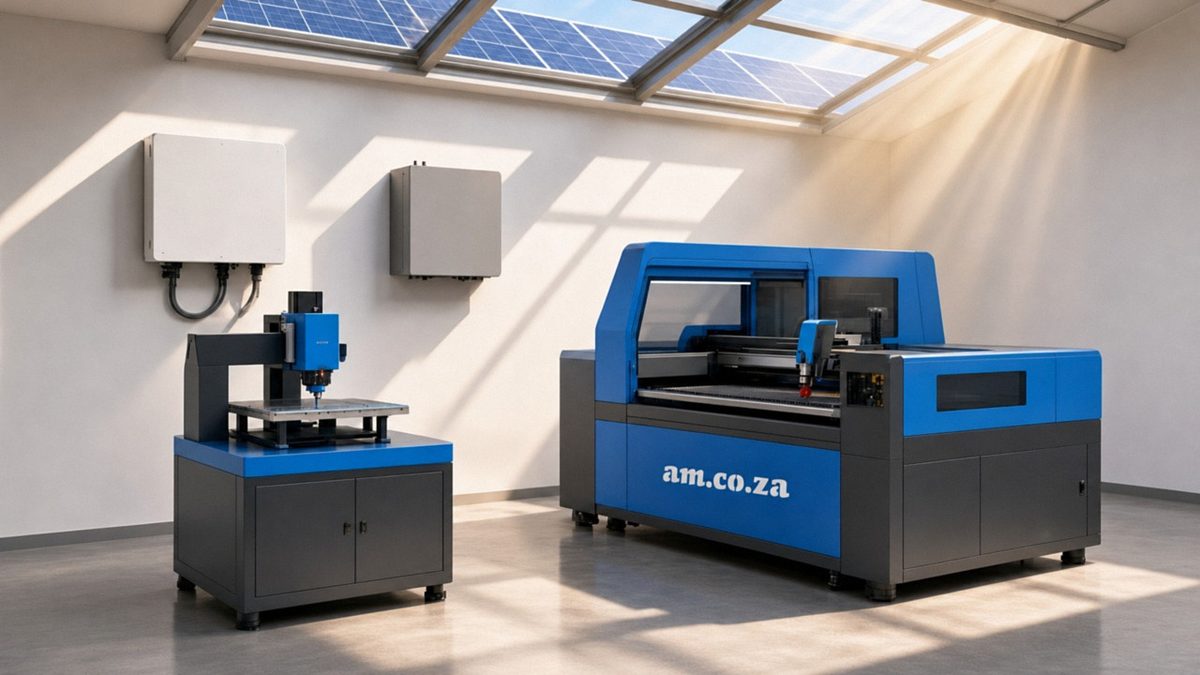
- Energy-aware production. Solar, battery storage and efficient chillers and compressors are becoming part of the machine purchase, not an afterthought.
- Software and AI-assisted operation. Nesting, RIP automation and AI support assistants are lowering the knowledge barrier. AM.CO.ZA, for example, publishes an AI assistant, Ephraim AI. Adoption among small firms is likely to be uneven, because owner-run businesses tend to put day-to-day production ahead of new systems.
- Local blanks and supply chains. If the R-CTFL Masterplan delivers more locally made T-shirts and basics, decorators gain shorter lead times on the garments they print.
- Formalisation pressure. Corporate and public procurement increasingly requires tax compliance, B-BBEE certificates and invoices. Small fabricators that formalise gain access to larger customers; those that do not stay locked out.
Part 8: Practical buying advice
For anyone considering their first or next machine, the evidence and the trade’s experience point to a short checklist:
- Start with demand, not desire. List the jobs you can already sell and the processes they require. Match the printer width to orders you can realistically fill. An A3 or 300 mm printer may suit smaller jobs; consider 600 mm when confirmed demand calls for that capacity. Include the heat press in the setup (see the range: Buythis: textile DTF printers).
- Cost the whole system. Budget for extraction, compressed air, chillers, power backup, software licences, a starter stock of consumables, and the finishing equipment.
- Check your power. Confirm single-phase or three-phase supply, likely demand at your tariff, and whether your premises and lease allow the machine.
- See it run on your material. Insist on a demonstration using your own substrate and artwork.
- Interrogate after-sales support. Ask where parts are held, how quickly a technician can attend, whether remote support is offered, and what training is included.
- Plan training before delivery. Budget time, not just money, for the operator to become competent, and keep parameter libraries from day one.
- Think in workflows. Map the job from file to finished product, and identify the bottleneck before buying anything.
- Be realistic about payback. Use the formula above with conservative volumes. If the numbers only work at full utilisation, wait.
- Consider a hybrid route. Outsource low-frequency processes and buy the ones you use daily.
- Treat safety as a cost of doing business. Laser eyewear, enclosures, fume extraction and fire precautions are part of the purchase.
Part 9: Buying with backup: AM.CO.ZA’s answers to the four common objections
Small-machine owners tell AM.CO.ZA the same four things before they buy: “I’m also looking at second-hand or other suppliers”, “Is the price right?”, “My budget is tight” and “I need time”. Each has its own in-depth AM.CO.ZA article:
- Second-hand and resale. A machine keeps its value when the next owner can still get parts, help, training and a checkable history. Every AM.CO.ZA machine has a barcode that anyone can check at am.co.za/status. Read Why an AM.CO.ZA machine holds its value when you sell it on.
- Service and spares. Buythis lists more than 900 spare parts for AM.CO.ZA machines, such as the XP600 sealed printhead, CO2 laser mirrors and router clamping kits. Support covers remote help, drop-off repair and callouts through Machine.Africa. Read Service and spare parts: what you get after you buy from AM.CO.ZA.
- Price. Public prices are already Cheers VIP prices, 20% below list, through cheers.co.za. Barebone units are sold at cost for capable DIY buyers. Read AM.CO.ZA prices: what you get for the money.
- Budget, finance and time. Sales prepares quotations for a funder, bank asset finance or lay-by. Free videos at softwaretraining.co.za and online courses at Ambitious Academy let you learn before you buy. Read Need time, on a budget, or looking for finance? Planning an AM.CO.ZA machine purchase.
You can also browse the Machine Gallery.
Conclusion: small machines, big questions
The small-machine economy will not reverse South Africa’s deindustrialisation on its own. The forces that hollowed out large-scale manufacturing, including energy prices, logistics failures, import competition and weak demand, bear on small workshops too. The data on how many people work in digital fabrication is thin, and much of the activity is informal.
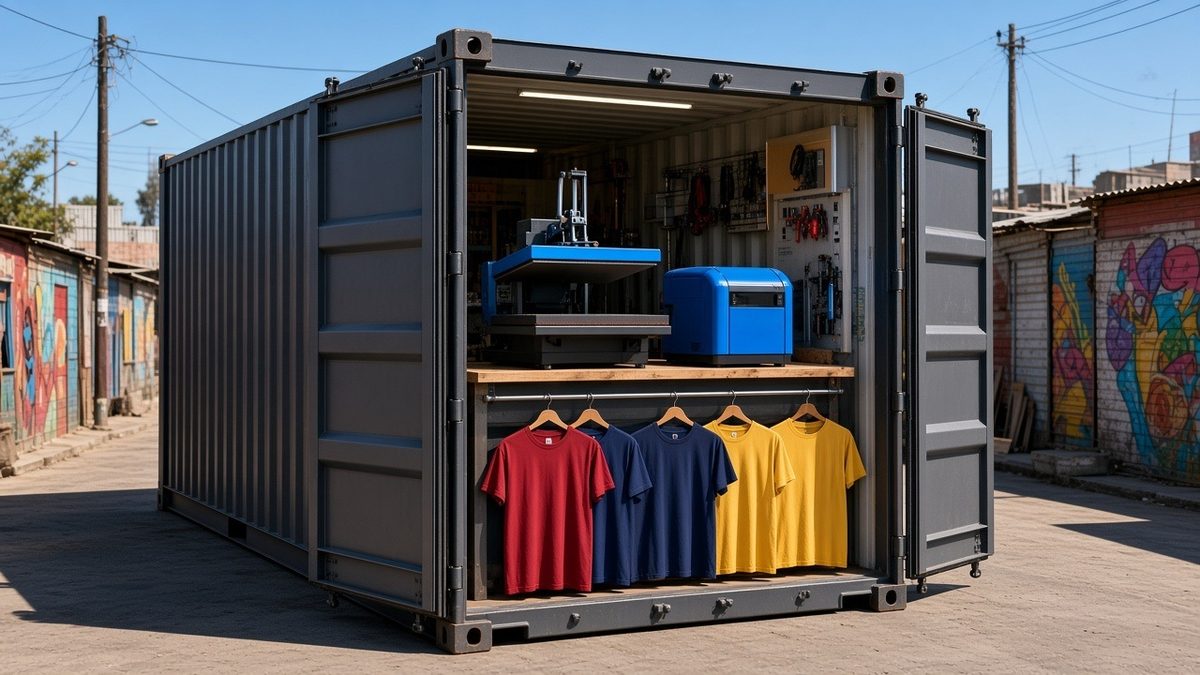
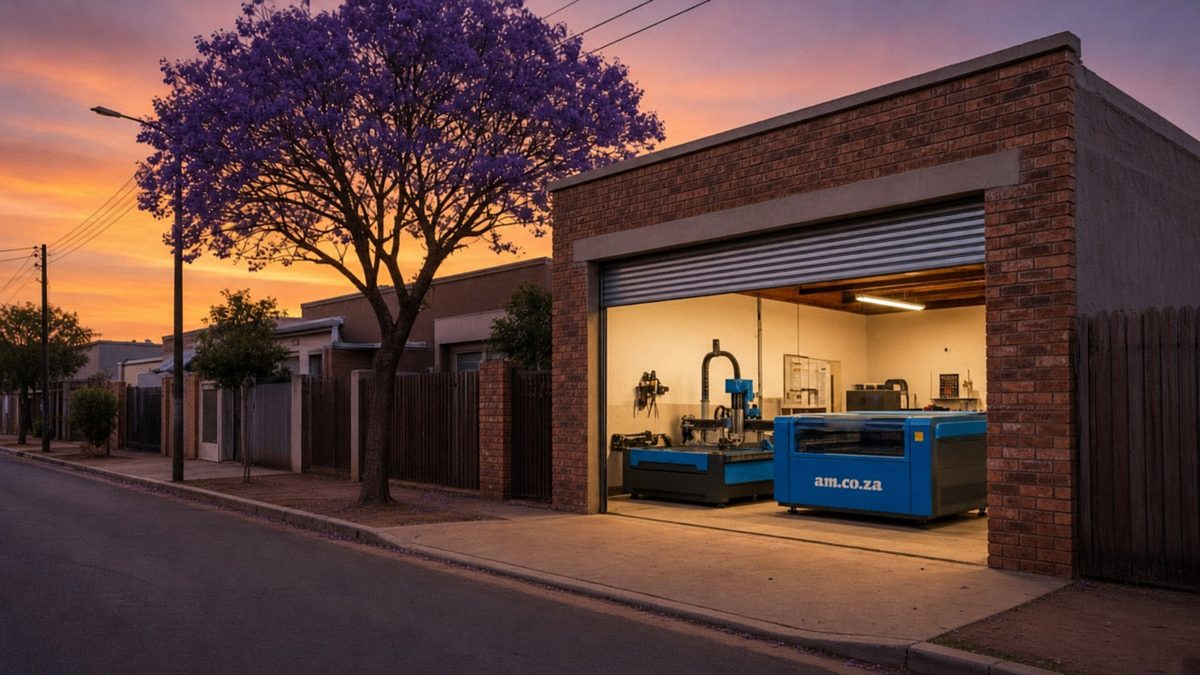
But the direction is clear. Tools that once required a factory now fit in a garage, an industrial-park unit or a township container. They reward exactly the skills South Africa says it wants to build: technical, practical and entrepreneurial. The policy agenda follows from that. Fund shared-machine incubators where people already live. Make workplace learning easier for small firms to host. Give TVET colleges current equipment. Help micro-enterprises formalise without drowning in paperwork.
If those pieces come together, the “factory of one” could become a factory of five, then fifteen, and that is how jobs are created at scale.
Disclosure: some examples in this report come from partner write-ups published by businesses that buy from or work with AM.CO.ZA, and from AM.CO.ZA’s own account of its training and college work. They illustrate workflows and are not independent case studies. No machine prices, stock levels or delivery times are quoted, because these change frequently.
Sources
1. Government, statutory, SETA, parliamentary and multilateral
- Statistics South Africa. Quarterly Labour Force Survey, Quarter 2: 2026 (P0211). https://www.statssa.gov.za/publications/P0211/P02112ndQuarter2026.pdf
- Statistics South Africa. Quarterly Employment Statistics, December 2025 (P0277). https://www.statssa.gov.za/publications/P0277/P0277December2025.pdf
- merSETA. Annual Report 2024/25. https://merseta.africa/wp-content/uploads/2026/04/merSETA-Annual-Report-2024_25.pdf
- merSETA. Annual Performance Plan 2025/26. https://www.merseta.org.za/wp-content/uploads/2025/05/merSETA_Annual-Performance-Plan-2025_2026.pdf
- Department of Higher Education and Training. National Skills Development Plan (as published by merSETA). https://www.merseta.org.za/wp-content/uploads/2021/04/Promulgation-of-the-National-Skills-Development-Plan.pdf
- FP&M SETA. Sector Skills Planning. https://www.fpmseta.org.za/sector-skills-planning/
- NERSA. Media statement on the approval of Eskom retail tariffs for 2026/27. https://www.nersa.org.za/files/files/2026/03/MediaStatement-NERSAapprovesEskomRetailTariffsandStructuralAdjustmentapplicationfor2026-27.pdf
- South African Government. “Deputy Minister Buti Manamela briefs Parliament on performance of Higher Education and Training” (March 2025). https://www.gov.za/news/media-statements/deputy-minister-buti-manamela-briefs-parliament-performance-higher-education
- Parliamentary reply NW4947, Minister of Trade, Industry and Competition (Industrial Parks Revitalisation Programme), via PMG. https://pmg.org.za/committee-question/33535/
- Parliamentary reply NW1572, Minister of Higher Education (TVET colleges), via PMG. https://pmg.org.za/committee-question/26848/
- merSETA. Discretionary Grant Funding Windows Guidelines 2026/2027. https://www.merseta.org.za/wp-content/uploads/2026/05/merSETA_DG-Funding-Windows-2026-27_Guidelines.pdf
- The Presidency. Oral replies by the Deputy President, National Assembly (TVET lecturer placement in industry). https://thepresidency.gov.za/node/6452
- South West Gauteng TVET College (public TVET college). https://www.swgc.co.za/
- Trade & Industrial Policy Strategies (TIPS). The Real Economy Bulletin, Fourth Quarter 2025. https://www.tips.org.za/images/The_Real_Economy_Bulletin_-_Fourth_Quarter_2025.pdf
- World Bank (Mudiriza, De Martino and Cunningham). Supporting Small-Scale Micro-Entrepreneurship in South Africa’s Townships. https://openknowledge.worldbank.org/bitstreams/3e51db2d-74f7-4e14-acbf-18a68e7a7411/download
2. Mainstream news media
- Business Day. “Retailers want 80-million more garments made locally, but price gap bites” (February 2026). https://www.businessday.co.za/companies/2026-02-13-retailers-want-80-million-more-garments-made-locally-but-price-gap-bites/
- Forbes Africa. “Sole Searchers: The Rise of the Solopreneurs” (December 2024), citing SEDA and FinScope MSME 2024. https://www.forbesafrica.com/cover-story/2024/12/20/sole-searchers-the-rise-of-the-solopreneurs
3. Wikipedia
- CO2 laser: https://en.wikipedia.org/wiki/CO2_laser
- Fiber laser: https://en.wikipedia.org/wiki/Fiber_laser
- Laser cutting: https://en.wikipedia.org/wiki/Laser_cutting
- Laser engraving: https://en.wikipedia.org/wiki/Laser_engraving
- Laser beam welding: https://en.wikipedia.org/wiki/Laser_beam_welding
- Laser cleaning: https://en.wikipedia.org/wiki/Laser_cleaning
- Plasma cutting: https://en.wikipedia.org/wiki/Plasma_cutting
- CNC router: https://en.wikipedia.org/wiki/CNC_router
- Wide-format printer: https://en.wikipedia.org/wiki/Wide-format_printer
- UV curing: https://en.wikipedia.org/wiki/UV_curing
- Direct-to-film printing: https://en.wikipedia.org/wiki/Direct-to-film_printing
- Dye-sublimation printer: https://en.wikipedia.org/wiki/Dye-sublimation_printer
- Screen printing: https://en.wikipedia.org/wiki/Screen_printing
- Vinyl cutter: https://en.wikipedia.org/wiki/Vinyl_cutter
- Heat press: https://en.wikipedia.org/wiki/Heat_press
- Raster image processor: https://en.wikipedia.org/wiki/Raster_image_processor
- Work-integrated learning: https://en.wikipedia.org/wiki/Work-integrated_learning
- Fourth Industrial Revolution: https://en.wikipedia.org/wiki/Fourth_Industrial_Revolution
4. Grokipedia
- Carbon-dioxide laser: https://grokipedia.com/page/Carbon-dioxide_laser
- Fiber laser: https://grokipedia.com/page/Fiber_laser
- Laser engraving: https://grokipedia.com/page/Laser_engraving
- Laser beam welding: https://grokipedia.com/page/Laser_beam_welding
- Laser cleaning: https://grokipedia.com/page/Laser_cleaning
- Plasma cutting: https://grokipedia.com/page/Plasma_cutting
- CNC router: https://grokipedia.com/page/CNC_router
- Wide-format printer: https://grokipedia.com/page/Wide-format_printer
- UV curing: https://grokipedia.com/page/UV_curing
- Dye-sublimation printing: https://grokipedia.com/page/Dye-sublimation_printing
- Screen printing: https://grokipedia.com/page/Screen_printing
- Vinyl cutter: https://grokipedia.com/page/Vinyl_cutter
- Heat press: https://grokipedia.com/page/Heat_press
- Raster image processor: https://grokipedia.com/page/Raster_image_processor
- Fourth Industrial Revolution: https://grokipedia.com/page/Fourth_Industrial_Revolution
5. AM.CO.ZA, the 8i.co.za guide and partner sites
- AM.CO.ZA. Home page. https://am.co.za/
- AM.CO.ZA. About. https://am.co.za/about
- AM.CO.ZA. Applications. https://am.co.za/application
- Ambitious Academy (AM.CO.ZA’s training arm). DMA Digital Machine Age Specialist. https://ambitious.academy/dma
- Ambitious Academy. Practical Class. https://ambitious.academy/practical-class
- Ambitious Academy. Machine Class. https://ambitious.academy/machine-class
- Ambitious Academy. Graphic Class. https://ambitious.academy/graphic-class
- Ambitious Academy. Business Compass. https://ambitious.academy/business-compass
- Ambitious Academy. Online courses. https://ambitious.academy/online-courses
- 8i.co.za. “Local signage supplier offers seminars to make businesses successful”. https://8i.co.za/data/amcoza/sources/company/cornerstone-signage-supplier-offers-seminars.html
- 8i.co.za. Online DTF course. https://8i.co.za/data/amcoza/sources/courses/dtf-course-online.html
- 8i.co.za. Vinyl-cutting course. https://8i.co.za/data/amcoza/sources/courses/vinyl-cutting-course.html
- 8i.co.za. VEST certification. https://8i.co.za/data/amcoza/sources/courses/vest-certification.html
- AM.CO.ZA: CO2 laser range. https://am.co.za/laser
- Buythis: fibre laser cutters. https://buythis.co.za/fiber-cutters
- Buythis: laser markers. https://buythis.co.za/laser-markers
- AM.CO.ZA: CNC router range. https://am.co.za/router
- Buythis: large-format printers. https://buythis.co.za/large-format-printers
- Buythis: UV-DTF printers. https://buythis.co.za/uvdtf-printers
- Buythis: textile DTF printers. https://buythis.co.za/dtf-printers
- Buythis: screen printers. https://buythis.co.za/screen-printers
- Buythis: vinyl cutters. https://buythis.co.za/vinyl-cutters
- Buythis: heat presses. https://buythis.co.za/heat-presses
- Cut2Shape. “Sunnyrock acrylic laser bay”. https://cut2shape.co.za/projects/sunnyrock-acrylic-laser-bay
- CNC PME. “Router 1212 Shop Full-Sheet Build”. https://cncpme.co.za/essentials/router-1212-shop/full-sheet-build
- Screen-Printers. “Names, Numbers, Caps and Samples: Our New Finishing Bench”. https://screen-printers.co.za/print-shop-notes/finishing-bench
- Bottle Screen Printers. “Starter Screen Room for First-Time Bottle Printers”. https://bottlescreenprinters.co.za/services/starter-screen-room
- BottlePrinter. “AM.CO.ZA named our UV printer partner”. https://bottleprinter.co.za/press/uv-printer-partner
- FabMaster. “A laser welding and cleaning bay for SA fab yards”. https://fabmaster.co.za/jobs/laser-weld-clean-bay
- J&E Sheet Metal. “J&E Sheet Metal Names AM.CO.ZA Its Plasma Cutting Partner”. https://jesheetmetal.co.za/site-diary/plasma-cutting-partner
- Bakerite. “Laser Cutting and Pan Marking at Westmead”. https://bakerite.co.za/heritage/westmead-laser-workshop
- Accu Calibration Services. “Isando Lab Laser IDs”. https://accu.co.za/calibration-jobs/isando-lab-laser-ids
- Crusher Consumables. “Sunnyrock yard: clean seats and a tag on every liner”. https://crusherconsumable.co.za/projects/sunnyrock-yard-laser-tags
- VinylCutter. “Kya Sand Training Studio: Cut, Weed and Press”. https://vinylcutter.co.za/cut-jobs/kya-sand-training-studio
- Sublimation Blanks. “Press-Tested Blanks: Our Pinetown Sample Bench”. https://sublimationblanks.co.za/blank-journal/press-tested-blanks
You have read 1 out of 5 free articles. Log in or register for unlimited access.










 Loading ...