
Important South African municipality hurts crime prevention by cutting private security companies’ access to camera system



On 21 September 2026, the George Municipality ended independent monitoring of its National Vehicle Intelligence Cloud (Navic) camera system for all private security companies.
The George Local Municipality is located within the Garden Route District Municipality in the Western Cape Province.
The areas under its jurisdiction include George and coastal settlements such as Wilderness, Victoria Bay, Herolds Bay, Kleinkrantz, and Gwaing.
It is famous for its long coastal drives, diverse scenery, and tourist attractions such as the Outeniqua Power Van, the Redberry Farm, and the Woodville Big Tree.
Navic is the largest unified database of license plates in the country and serves as a crucial tool for crime prevention and public safety.
It provides external security companies and organisations with the resources to flag stolen vehicles, hijackings, ATM card scams, stock theft, and kidnappings.
George Herald reported that Rupert Pretorius, former chairperson of the George community policing forum (CPF), condemned this restriction.
He raised concerns that private security companies, the CPF, and neighbourhood watches will be unable to access critical information to monitor criminal activity.
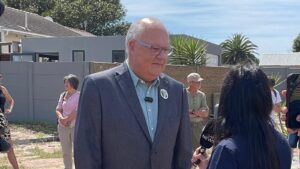
The Executive Mayor of George from the DA, Browen Johnson, reassured the public that they are working with SAPS and using the system successfully to enforce the law.
However, a 2026 audit conducted by the DA under Ian Cameron found that 56% of SAPS stations nationwide were unresponsive when called during emergencies.
People have repeatedly complained about the police’s long response times, which can take hours or even days and, in some cases, go unaddressed.
Factors contributing to this issue include vehicle shortages, inadequate maintenance, unanswered phone calls, limited resources, staffing constraints, and system backlogs.
CEO of Randburg-based private security company Ghost Squad, Francois Marais, told BusinessTech that private security services are pricey and not everyone can afford them.
But “people ultimately pay because they know we will be there when they call,” Marais said.
With rising crime rates, a lack of response from SAPS, and the unaffordability of private security, the CPF and neighbourhood watches became popular.
These parties play an essential role in patrolling and monitoring criminal activity by increasing visibility in areas where the police cannot be present.
The CPF bridges the gap between SAPS and the public and holds monthly meetings with the communities where members can express their safety concerns.
Safety restrictions in George Local Municipality

Private security organisations and AfriForum repeatedly attempted to engage with the Municipality to determine the reason for the sudden restriction of their access to the database.
“Community safety cannot operate in isolation. SAPS, municipalities, neighbourhood watches, farm watches, and other community stakeholders depend on one another.”
“When a decision hampers this cooperation, it is reasonable to expect the Municipality to be willing to explain its decision and be held accountable for it,” AfriForum said.
Pretorius noted that the success in combating crime was due to the safety organisations’ collaboration and their ability to monitor criminal activity more effectively.
He argued that while the municipality owns the cameras, it is not the custodian of the information stored on the system.
Access to the system is strictly regulated, and only registered and authorised operators may use it.
Operators who breach rules or raise safety concerns are monitored and, where necessary, immediately removed.
AfriForum argued that the restrictions are in direct contradiction to the DA’s “Whole of Society” approach.
On 30 October, AfriForum submitted a formal application in terms of the Promotion of Access to Information Act (PAIA) to the George Municipality to compel answers.
AfriForum requested interim monitoring arrangements and engagement to ensure public safety, noting that reduced monitoring capacity poses a significant risk.
Dr Dean O’Neil, the acting municipal manager, refused to meet with AfriForum.
However, Mayor Johnson said he will respond to questions once internal processes are completed.
You have read 1 out of 5 free articles. Log in or register for unlimited access.








 Loading ...