
South Africa’s political opinion polls are rigged in the DA’s favour – ActionSA



ActionSA has tabled a bill in parliament to regulate South Africa’s polling industry, requiring political polling companies to disclose their sponsors, methodologies, and sample sizes.
The party argues that political opinion polling plays a major role in shaping public perception and guiding media coverage, therefore influencing campaign strategies and ultimately affecting election results.
However, the party says that polling firms and sponsors were “defensive, even hostile” in their reactions to their proposed Election Integrity Bill.
ActionSA’s proposed bill would establish the Office of the Polling Ombud as an independent oversight body within the Electoral Commission to regulate the polling industry.
Polling companies would then be required to disclose sponsors, methodologies, and other relevant information.
They would also be prohibited from publishing political opinion polls within seven days of voting day.
ActionSA argues this is standard practice in countries such as Brazil, France, Canada, and Italy and a third of the world’s countries, where polls are regulated and understood as having the ability to influence voters.
“Why would anyone oppose the idea that a poll should disclose its sample size, methodology and sponsor?” asked said ActionSA’s parliamentary Chief Whip Lerato Ngobeni.
“The answer is simple. Only those with something to hide would resist such transparency,”
“Just as political donations can distort democracy, so too can unregulated polling. In an era where voters see ‘momentum’ and ‘growth’ as indicators of electoral viability, pollsters wield an obvious power to influence outcomes.”
“Particularly, those benefiting from incestuous relationships between polling companies, media outlets and political parties,” she added.
Incestuous relationships between pollsters and political parties
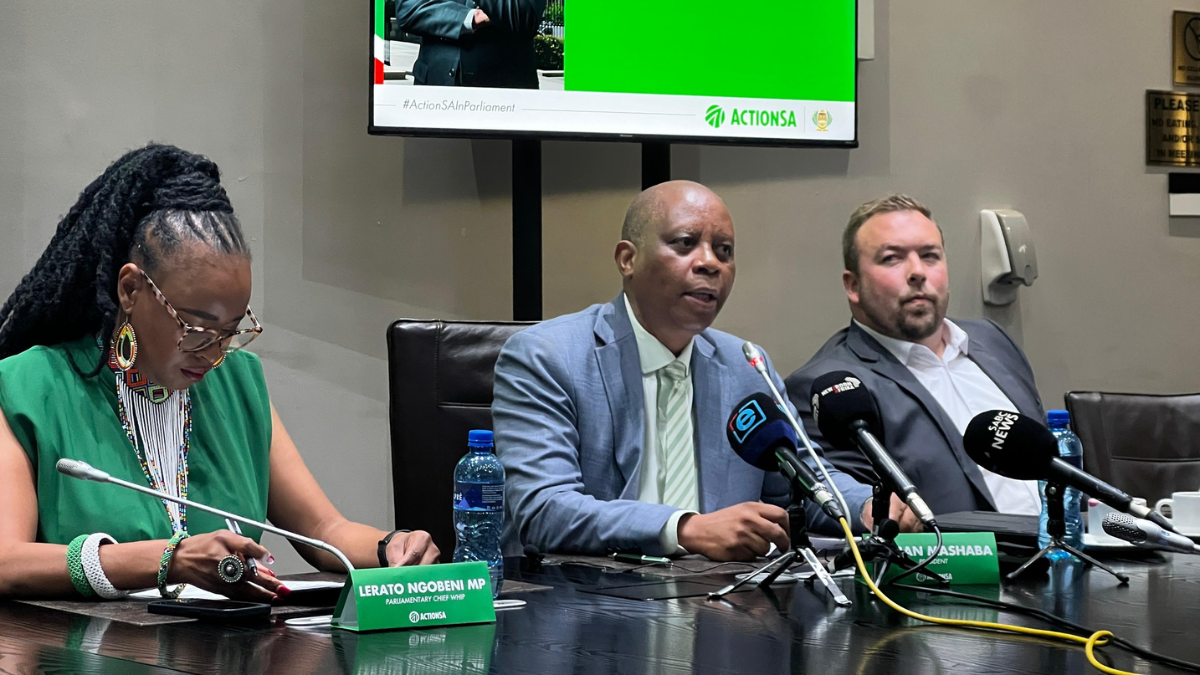
Ngobeni claimed that many polling companies have links to the Democratic Alliance (DA), including the Institute of Race Relations (IRR), the Social Research Foundation (SRF), and Victory Research.
“The IRR is deeply intertwined with the DA, employing or being led by several of its senior figures, including Helen Zille herself,” said Ngobeni.
Zille is the DA’s federal Executive Chairperson and Johannesburg mayoral candidate.
ActionSA added that the IRR’s spokesperson served as the DA’s media manager in Gauteng. “Despite this, the organisation regularly sponsors and publishes polls it claims are independent,” said Ngobeni.
The SRF, ActionSA argues, is connected to the DA because it is led by a former IRR CEO, Frans Cronje.
Both the IRR and SRF employ a company called Victory Research to conduct some of their bigger polling projects.
The firm’s directors include a DA former Chief of Staff and Director of Communications, Gareth van Onselen.
“These entities defend themselves by pointing out that their projections were ‘close’ to final results, but closer scrutiny tells another story,” said Ngobeni.
In earlier polls, the SRF projected that the DA would win 31.2% of the vote in the 2024 National Elections. The IRR projected 26.1%.
The DA ultimately received 21.8%, ActionSA argues that the projections overstated the party’s strength.
However, it should be noted that in its final poll, published by the SRF on 27 May, two days before the election, the SRF put the DA’s support at 21.6% – underestimating their support.
While the SRF and IRR did not include ActionSA in its Political Opinion Polls leading up to the 2024 elections, market research agency Ipsos did.
The Ipsos poll predicted ActionSA would get 3.4% of the vote. This was an overestimation, as the party received only 1.3%.
Responding to ActionSA’s allegations against the polling companies, Van Onselen questioned: “Should I respond to this load of lies and rubbish and absolutely demolish every single point with so much evidence it would be embarrassing?”
“Or does no one take it seriously enough for me to bother?”
The party further criticised the publication Rapport for publishing anonymous polling results before the elections, suggesting the DA and African National Congress (ANC) were neck and neck.
The party took a complaint to the Press Ombudsman about the poll, who ruled that the publication should have disclosed the source of the data.
Sister publication to Rapport, City Press, published an article following the news that ActionSA would table the bill, arguing that ActionSA is guilty of publishing polls without this key information as well.
“In the run-up to the municipal election on 1 November 2021, the party boasted about an internal poll conducted between 19 August and 20 September among registered voters in Johannesburg,” the publication said.
“According to this poll, ActionSA enjoyed 31.7% support, the ANC 30.5% and the DA 24%. ActionSA ultimately drew 16% support, the ANC 33.6% and the DA 26.1%.”
ActionSA said that these responses to the bill and the outrage that ActionSA received from tabling it ‘only underscore the need for the legislation.’


 Loading ...
ActionSA is such a pathetic party.