
The South African city going it alone



The City of Cape Town has issued a tender for independent electricity traders and will begin the process of getting an electricity trading company to provide it with additional power as part of its efforts to reduce its reliance on Eskom.
The city of Cape Town is the first South African city to try to break the monopoly held by power utility Eskom.
Cape Town has already made progress in this regard, entering into separate supply agreements with companies to build generation capacity.
However, the tender shows that the city is looking to outsource the task of securing power to a private company, which will then source electricity from suppliers, according to reports from Bloomberg.
“We’ve learned a lot of hard lessons. Negotiating contract by contract is excruciating. The market has moved on,” said Mayor of Cape Town Geordin Hill-Lewis.
The city has been pushing to diversify its energy supply away from Eskom over recent years, stepping into what Hill-Lewis says is a gap in national government that the city shouldn’t have to fill.
Speaking to the Cape Town Press Club in 2025, the mayor said that despite the lull in loadshedding, the city must continue to reduce its reliance on Eskom “as quickly as possible” due to the affordability issue.
“Every single megawatt the city was buying from sources other than Eskom was cheaper than the electricity on offer from the state-owned entity,” he said.
“I think the debate is increasingly going to turn to the affordability of power, and not so much availability.”
This has become more vital as the National Energy Regulator of South Africa (NERSA) has raised Eskom’s electricity tariff by almost 9% annually for the next two years. While the City of Cape Town is fighting the increase, it is also making strides in its energy independence projects.
In an interview with Heart FM, Hill-Lewis said that to reduce its reliance on Eskom, the city is taking a multi-pronged approach.
“There’s not going to be one Silver Bullet solution to power Security in South Africa, it’s going to be a whole lot of things that you stack on top of each other,” he said.
No silver bullet for power security
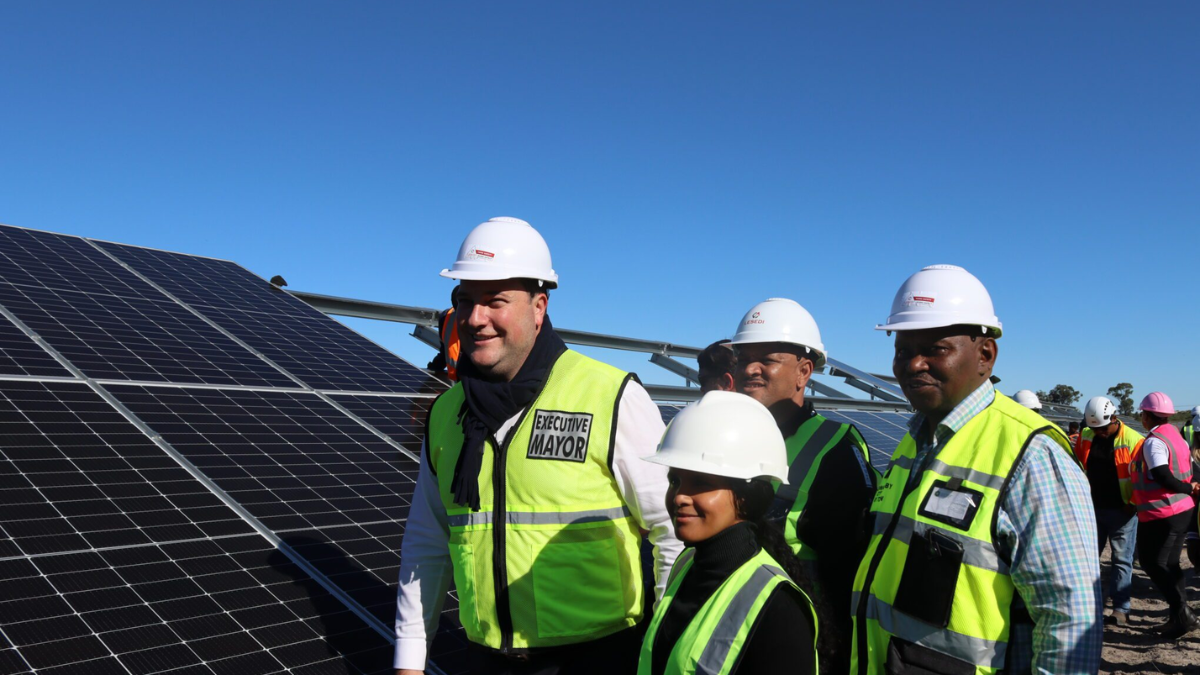
Cape Town already has power agreements in place for about 300MW and is additionally building 60MW of its own generation capacity prior to its announcement of the new tender.
This includes the building of the first municipal utility-scale solar photovoltaic plant in Atlantis, which began in October 2024. The 7 MW plant is now nearing completion.
The city also launched a new gas-to-energy facility at the Coastal Park landfill in December 2025, which produces power for 4,000 households from garbage.
The facility captures methane produced by decomposing waste and feeds it into generators, which then supply the grid and power on-site operations.
Cape Town plans to scale up on these projects, with more gas-to-power facilities planned for Bellville South and Vissershok, with R82 million earmarked for this.
A total amount of R200 million has been allocated to diversifying local power sources and easing pressure on the grid.
Hill-Lewis added that Cape Town’s “cash for power” initiative has helped it become more energy independent.
The programme allows businesses and homeowners to sell their excess electricity generated from their own solar panels back to the grid, which over 900 customers were already doing by 2024.
The city further opened up its grid in 2025, allowing private electricity producers to sell power directly to third-party customers using the city’s distribution grid.
Additionally, Cape Town’s infrastructure, such as wastewater treatment plants and depots are run on city-funded solar systems, protecting them from Eskom power outages.
As part of the Small-Scale Embedded Generation programme (SSEG), the city has invested R20.6 million in three renewable energy plants at municipal facilities.
“All of it will add up over time,” Hill-Lewis said, “to a point where the city is not so reliant on Eskom anymore, which is our ultimate goal.”










 Loading ...