
White farmers make it difficult for government to buy back land – Minister


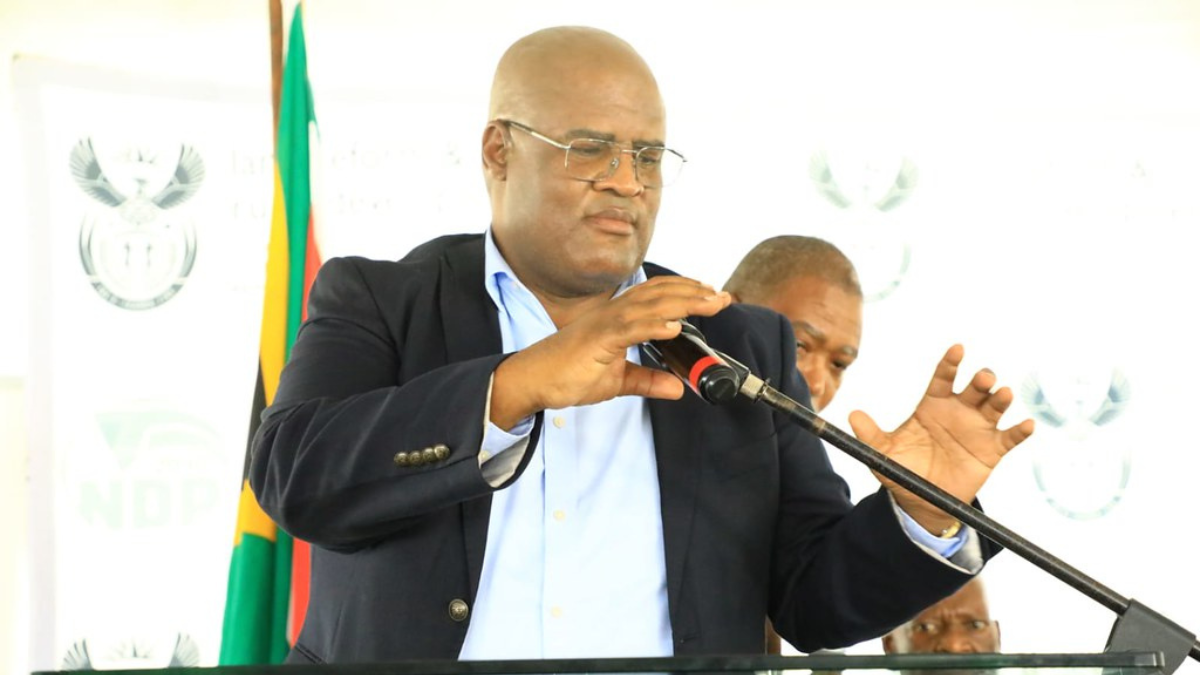
The Minister of Land Reform and Rural Development, Mzwanele Nyhontso, says that land reform is stalling “because white farmers are making it difficult for the government to buy back land.”
Speaking on the sidelines of the State of the Nation Address (SONA) on Thursday, Nyhontso said that “the key to real liberation is the land.”
“It is taking too long because there is a whole lot of issues,” he said. One of which is the problem of redistributing land away from the landowners.
“The land owners, or the white farmers, let me say so, are making it very difficult for us to buy land and to buy farms. They are coming up with exorbitant prices of land,” said the President of the Pan Africanist Congress, who is the party’s sole representative in Parliament.
Secondly, Nyhontso said delays in land reform are also caused by “our own people fighting among themselves about the very same land claims that they are lodging.”
He said that black people lodging land claims cannot agree on the issue among themselves, often taking each other to court.
“Our own people taking each other to court about the very same land and the very same disputes that we are trying to resolve,” he said. “That takes a lot of time to resolve.”
However, he said, the process is going ahead nonetheless: “land is being redistributed to people, claims are being resolved and settled, and the land is being restored to its rightful owners,” he said.
South Africa’s land debate centres on correcting racial inequality in land ownership created by colonialism and apartheid.
Laws such as the 1913 Natives Land Act and apartheid-era forced removals dispossessed millions of black South Africans, leaving lasting landlessness and insecure tenure.
Since 1994, South Africa’s land reform agenda has been framed around land redress.
In policy terms, the emphasis has been on transferring land to black South Africans and addressing racial inequality in ownership patterns.
In practice, however, much of the land made available through post-apartheid reform has remained under state ownership.
The Department of Land Reform was allocated R3.63 billion for the 2025/2026 financial year for restitutions, with plans to settle 277 land claims, a small portion of the 5,719 outstanding land claims.
Government hoarding 2.5 million hectares of land
Reflecting on 2025, chief economist of the Africultural Business Chamber of South Africa (Agbiz), and member of President Cyril Ramaphosa’s Economic Advisory Council, Wandile Sihlobo, said that land reform was “quite frankly, dismal in 2025.”
In January, Sihlobo said that “We did not see any meaningful progress on land reform beyond a few high-level policy statements that sought to spark more conversation rather than implementation.”
The South African government has initiated the “Pro-Active Land Acquisition Strategy”, which strategically buys high-potential agricultural land, holds it in a state trust, and leases it to Black farmers.
While the minister places the blame on white farmers and land claimants, Sihlobo noted that the South African government has roughly 2.5 million hectares of land for this strategy, which has not been released.
The Agbiz chief economist said that the Department of Land Reform and Rural Development should refocus on the approach previously led by former minister Thoko Didiza.
This approach supported land release through a Land Reform Agency endorsed by organised agriculture and the Land Bank.
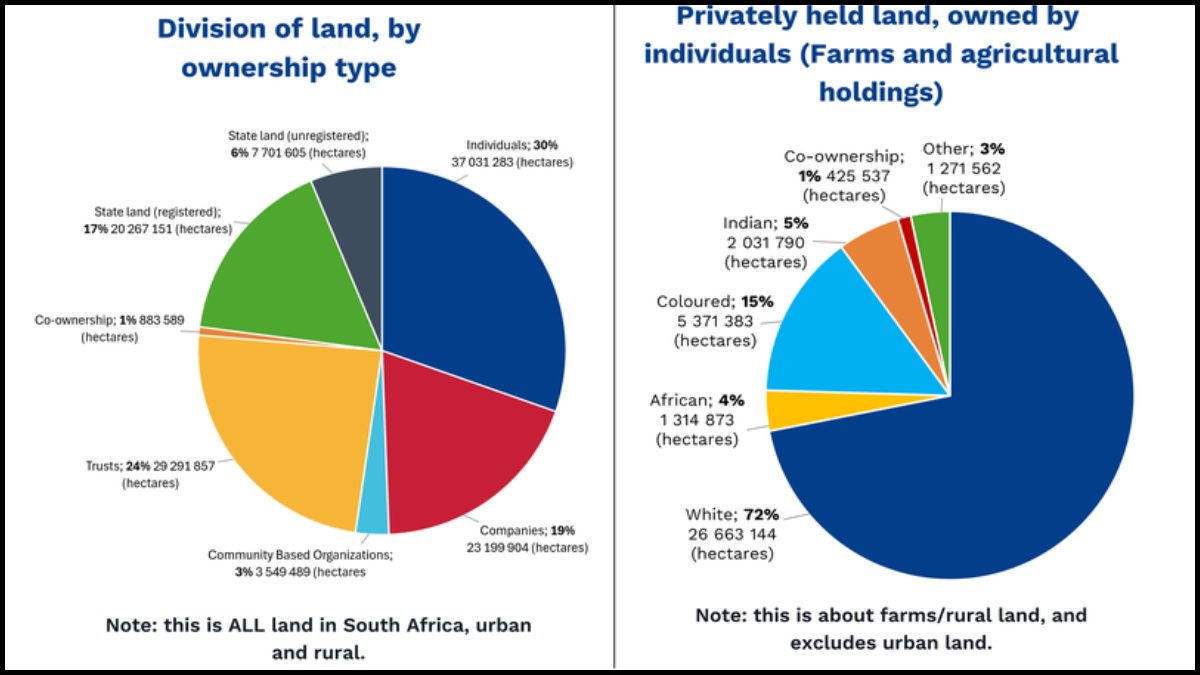
It is often said, without proper contextualisation, that 72% of the country’s farmland is owned by “white” people as opposed to only 4% owned by “black” people.
Terence Corrigan, Projects and Publications Manager at the Institute of Race Relations, explained that the data showing the 72%-4% split comes from the official 2017 land audit report.
This data pertains only to freehold land owned by individuals and registered at the Deeds Office.
The report indicates that people of colour own 15% of this land, Indian people own 5%, “others” own 3%, and co-ownership schemes account for 1%.
However, the IRR notes that land under these conditions represents roughly a third of the total land in the country.
While often labelled as farmland, much of this land is better categorised as “rural” land, as a significant portion is not used for agriculture.
Landholding across South Africa – urban and rural – is held in the following manner:
- Individuals, 30.4%;
- Trusts, 24%;
- The state, 23%;
- Companies, 19%;
- Community-based organisations, 2.9%; and
- Co-ownership schemes, 0.7%.




 Loading ...
A couple of questions:
1. What test was used to determine the race of the landholders and when was this done?
2. The state is a major holder of land. Nothing and nobody is stopping it from giving away that land.
3. Why should commercial farmers (that feed the nation) give their land away for anything below market value? History tells us that land given away this way becomes infertile in only a handful of years.