
No hope on the horizon for Cape Town housing crisis



Minister of Tourism, Patricia De Lille, has backtracked on her department’s plans to implement legal thresholds on short-term holiday rentals in Cape Town.
Cape Town is facing a deepening housing crisis as short-term rentals replace residential units, outpricing locals and leaving them out of the Cape Town housing market.
Despite this, De Lille is no longer pursuing legislation to put a threshold on Airbnb listings, due to complications in implementing these laws with existing laws and by-laws.
She discussed the matter in an interview on Talk702 on 11 February 2026.
In the Cape Town Central Business District Local Spatial Development Framework published in October 2025, it was found that 70% of residential units in the CBD are hotel-managed or listed on Airbnb.
The city admitted in this report that about 49% of households earn less than R22,500 per month, and that “beyond property ownership, it is extremely difficult to find affordable rental accommodation within the central city.”
Even the mayor of Cape Town, Geordin Hill Lewis, admitted during a podcast episode on Politically Aweh that he “can’t afford to live in the city.”
The city’s Airbnb market, on the other hand, is soaring, boasting more listings than Sydney and San Francisco combined.
Data from Inside Airbnb in 2025 found that there are 26,484 active listings in the city. This surpasses the number sported across numerous popular tourist destinations like San Francisco (7,888), Amsterdam (9,310), Athens (13,274), Berlin (13,759), Sydney (15,548), Tokyo (16,518) and Barcelona (18,925).
Airbnb regulation seven years in the making
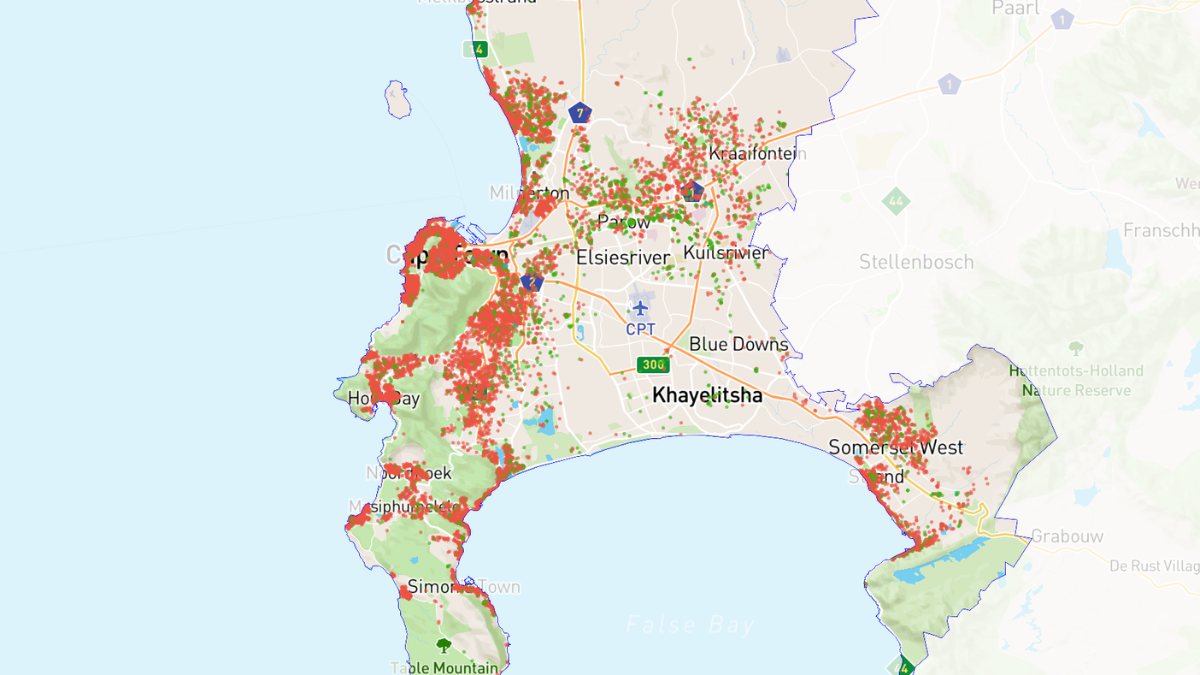
While Minister De Lille places the blame for Cape Town’s housing crisis on other factors, namely high demand and apartheid spatial planning, many other key tourist cities have connected an increase in Airbnb listings to a rising housing crisis.
An example is Barcelona, where communities protested the rise of short-term rentals like Airbnb, arguing that their surge has pushed out local businesses essential for residents, replacing them with tourist-focused services and increasing living costs.
As a result, the Mayor of Barcelona, Jaume Collboni, announced in 2024 that short-term rentals (such as Airbnb) will be banned from the end of 2028 to tackle what he described as “Barcelona’s biggest problem”, the housing crisis.
The Department of Tourism has been toying with the idea of implementing legislation to regulate Airbnb listings since 2019.
A bill was introduced in 2019 under Minister Mmamoloko Kubayi-Ngubane to regulate short-term rentals.
“That bill was never pushed through parliament, I think it died a natural death,” Minister De Lille said.
When De Lille took over the portfolio, a white paper to review regulations on short-term rentals was approved in 2024.
It was promised that the white paper would lead to a new regulatory system and framework for improved reporting on short-term rentals, and give the Minister the power to determine thresholds for Airbnb locations in South Africa.
This would include limits on how many nights a customer can book at one location. De Lille said the paper was out for public comment in August 2024, and that she would take the matter to cabinet for consideration thereafter.
However, over a year later, at a press briefing in January 2026, De Lille said that the plan hit a major roadblock when she went back to look at the Tourism Act of 2014.
Minister has no power to implement

“It empowers the minister to come up with a framework code of conduct, not regulate,” she said. This means the minister can only create voluntary frameworks, and not binding legislation.
This is not the only legislative obstacle preventing the minister from pursuing the matter.
De Lille said on Talk702 on Wednesday that the regulation of short-term rentals is controlled by metropolitan municipal by-laws.
“That is more related to their rates and taxes, and so we still have to consult with all the cities too and see what their bylaws imply and how we can find the balance between short-term rentals and the need for more housing opportunities.”
Section 8 of the Tourism Act of 2014 states that codes of conduct created by the Minister are limited to guidance, but that this does not include provisions for any penalties if this guidance is not followed.
After discovering this, De Lille said the plan is now to gazette a voluntary code of conduct for Airbnb instead.
“We have consulted with the short-term rental association, with Airbnb, and in the next two weeks, I will be publishing this code of good practice for public participation,” she said.
However, at the media briefing two weeks ago, De Lille said that the code of conduct would be gazetted in two weeks.
De Lille said that the housing crisis can’t be remedied through tourism regulations alone, and that the city needs to change where housing is being built, “correcting the spatial planning through the cities” where apartheid-era spatial planning has left low-cost housing far away from the city centre.










 Loading ...
“…..and give the Minister the power to determine thresholds for Airbnb locations in South Africa.”
OMG. Power to the R47 million border fence made of chicken wire Minister. Thank goodness that was stopped. The only solution is to amend the backbreaking legislation and rules and guidance and and and, that constitutes the world of property development. There is so much red tape, developers are just walking away, especially from green-field development, which is what we need. We also need to build high rises. Because of Cape Town’s mountain and see borders, we cannot build outwards. We must build up, with compulsory underground parking.