
Elon Musk is a huge security risk – Zibi



The chairperson of Parliament’s Standing Committee on Public Accounts and RISE Mzansi leader, Songezo Zibi, has warned against the power Elon Musk wields over Starlink and why the technology’s introduction may be more of a threat to South Africa than a benefit.
“Elon Musk is a huge security risk (even for the US) in the broadest sense of the word,” Zibi said in a social media post on 13 December 2025.
“Example: He’s periodically threatened to cut access to Starlink, on which the Ukrainian military relies. He does this depending on his mood swings. We can’t have that Starlink thing here.”
Zibi’s comments follow a notice issued by Communications Minister Solly Malatsi to the Independent Communications Authority of South Africa (ICASA), requesting that the regulator amend its ownership regulations.
This legislation is designed to simplify the laws regulating the South African communications sector and incentivise increased foreign investment, according to the minister.
While Starlink has reportedly not yet applied for a licence in South Africa, Musk has made it known that he firmly disagrees with the regulations requiring foreign companies to have 30% historically disadvantaged group (HDG) equity ownership.
Many proponents of Starlink have also criticised the regulations, saying that they are preventing a much-needed technology that could significantly increase the rate of internet connectivity across the country from entering.
While nearly all South Africans have access to the Internet, mostly via mobile networks, the connection rate is significantly lower, as connecting costs money, especially when done via a mobile network.
Starlink, on the other hand, could not only make connecting to the Internet significantly more affordable, but also do so for schools and clinics in rural and remote areas.
However, many are also critical of the power Musk wields as the owner of the technology, and whether he has everyone’s best interests in mind.
Reuters reported in July this year that Musk had instructed a senior SpaceX engineer to cut Starlink coverage in areas Ukraine was trying to reclaim from Russia.
Musk allegedly issued these instructions in late September 2022 while Ukraine was attempting to retake territory from Russia in a counteroffensive.
According to sources close to SpaceX, once the engineer received the instructions from Musk, he relayed the information to his colleagues, who then proceeded to deactivate the service.
The report went on to say that several Ukrainian troops on the front line faced a communications blackout, as they had been relying on the technology for an internet connection up until that point.
Those who provided information about Musk’s orders to the publication said that they were shocked that the billionaire’s decision meant that he had effectively taken the outcome of a war into his own hands.
While Musk did not comment on the allegations, he stated in a March X post that, “We would never do such a thing.”
Following the report, a SpaceX spokesperson called the information inaccurate and referred to a previous statement by the company that “Starlink is fully committed to providing service to Ukraine.”
However, the spokesperson failed to point out the inaccuracies or answer any of the questions regarding the incident and Starlink’s involvement in the Ukraine war.
Zibi’s sentiment about Musk’s mood swings is echoed by politicians from other countries as well.
According to Martha Lane Fox, a member of Britain’s upper house of Parliament, “Elon Musk’s current global dominance exemplifies the dangers of concentrated power in unregulated domains.”
“Starlink’s control rests solely with Musk, allowing his whims to dictate access to vital infrastructure.”
Lane is a businesswoman and former board member of Twitter, which was acquired by Musk in 2022.
‘We cannot jump on the Starlink Express’

When asked to elaborate on Zibi’s statement, RISE Mzansi spokesperson Mabine Seabe told Newsday that it is more than the control that Musk would wield over Starlink access that makes him a security risk.
“Elon Musk does not subscribe to the South African constitutional values, and has been a key figure in the misinformation and disinformation campaign waged against South Africa and its people,” Seabe said.
“Musk has further demonstrated an inclination to use his power and resources negatively and on a whim, as seen in his actions in the European Union, the United States, and Ukraine. South Africa cannot subject itself to that.”
When asked whether this trumps the benefits Starlink could offer in terms of increasing the rate of internet connections across the country, Seabe said that Starlink, with Musk at the helm, is too significant a risk.
“Notwithstanding the need for greater reliable internet access, particularly in rural areas, especially at schools, clinics, police stations and other public institutions, at a principled level, South Africans should reject Starlink,” he argued.
“We cannot jump on the Starlink Express at the expense of our national values and interests.”
ANC hits back
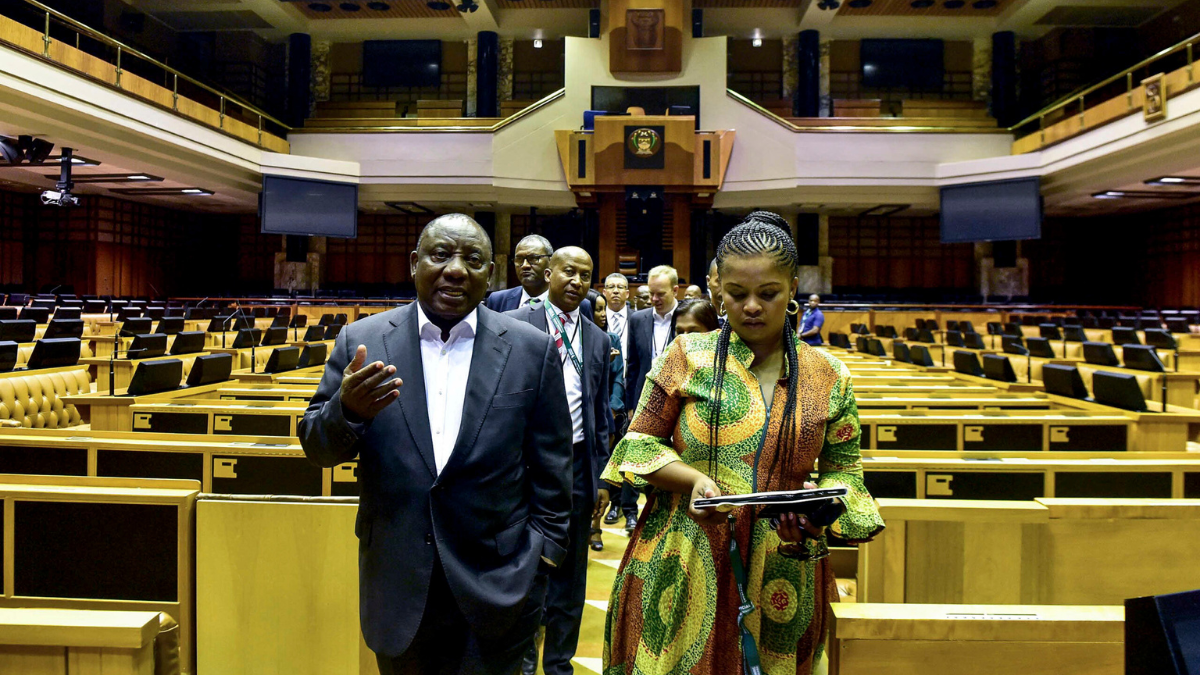
Malatsi’s notice to ICASA requested it to address what he describes as legal flaws in its existing equity ownership regulations for the ICT sector.
It proposes alternative compliance mechanisms to the long-standing requirement that licence holders in the ICT sector be at least 30% owned by Historically Disadvantaged Groups (HDGs).
His alternative is to introduce Equity Equivalent Investment Programmes (EEIPs) into the ICT sector.
EEIPs would allow companies that cannot meet direct ownership requirements to fulfil empowerment obligations through alternative investments, such as infrastructure rollout, skills development or enterprise support.
This could see Starlink sidestep the required 30% ownership stake for HDGs through a R500 million pledge for free internet in 5,000 rural schools.
Malatsi first proposed EEIPs as an alternative to the 30% ownership threshold in May 2025, triggering sustained criticism from ANC MPs.
The mechanism is widely viewed as a potential pathway for Starlink to operate in South Africa without local equity ownership.
According to the minister, the directive was issued following a public consultation process, during which he claims 90% of submissions supported the decision.
However, the ANC has interpreted the move as an attempt to amend legislation indirectly and alleges that he is exceeding his legal authority.
In a statement released following the publication of a Government Gazette on 12 December 2025, the ANC said it was “deeply concerned” by Malatsi’s policy direction.
The ANC warned that such provisions would enable certain operators, “notably foreign satellite providers like Starlink”, to ‘bypass core transformation obligations embedded in South African law.’
The party also questioned claims made by the minister that the department received around 19,000 public submissions on the draft policy, with 90% allegedly in support.
The party has also called on Parliament, through the Portfolio Committee on Communications and Digital Technologies, “to urgently hold the minister accountable for the legality, intent, and consequences” of the Gazette.














 Loading ...
“He’s periodically threatened to cut access to Starlink, on which the Ukrainian military relies.” – https://grokipedia.com/page/Starlink_in_the_Russo-Ukrainian_War
it’s all about the money, he is not there for charity.