
The DA planned its coalition with the ANC long before the elections – ActionSA



ActionSA has reflected on why its performance in recent elections fell short of expectations, despite showing strong promise in its early outings, placing the blame largely on the now-defunct Multi-Party Charter.
Speaking to Newsday, Michael Beaumont, the party’s national chairperson, identified a combination of strategic missteps and external challenges that contributed to the results.
The newly-formed ActionSA emerged as the sixth-largest party in the country following the 2021 municipal elections, receiving 2.34% of the popular vote in the country despite competing in just six municipalities.
As it had time to build its national footprint, the party set its sights on making a splash in the 2024 general elections, but ultimately received 1.2% of the popular vote, making it the eighth-largest party in the country.
Asked about this decline, Beaumont said that upon reflection, a key factor was the party’s involvement with the multi-party charter.
He said that it was designed to foster collaboration but ultimately undermined ActionSA’s visibility.
In August 2023, seven political parties signed a coalition agreement ahead of the 2024 national election, labelled the Multi-Party Charter for South Africa, pledging to work together to unseat the African National Congress (ANC) and prevent the Economic Freedom Fighters (EFF) from coming to power.
The DA, IFP, VF+, ActionSA, ISANCO, UIM and SNP said that it would be a bloc that would promote a free-market economy, decentralised power and minimal government interference in business.
However, the second that the results trickled in, the bloc fell by the wayside and the DA, IFP and VF + left the Multi-Party Charter for a broad coalition government with the ANC.
The DA said that this was “to keep the EFF and MK Party out of power.” ActionSA opted for its six MPs to sit on the opposition benches.
“We believe that our associations with the multi-party charter for South Africa hurt ActionSA,” Beaumont said.
“The irony is that the vehicle seemed to be set up by the DA to de-campaign their opponents while secretly planning coalitions with the ANC the entire time.”
“We understand why we didn’t achieve the results we hoped for, and we are adjusting our approach accordingly,” he added.
The journey of the party and coalitions
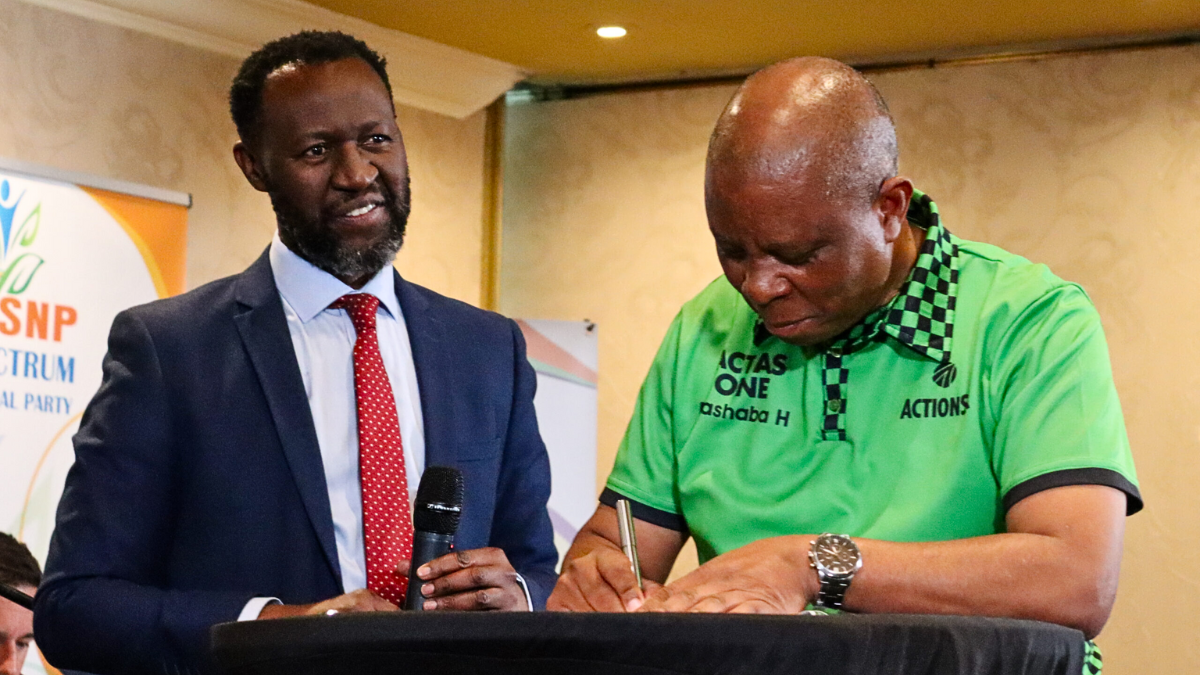
Another challenge in 2024, according to Beaumont, was the party’s rapid expansion across municipalities.
While ActionSA contested only six municipalities in 2021, by 2024 it was spread across all nine provinces.
Beaumont said that competing against well-established parties with branches and far greater financial resources made it difficult to maintain a strong ground presence.
“Spreading ourselves so thinly was a very difficult situation,” he said.
“As a young party, we were competing against organisations that have a lot more money, some funded by the illicit economy. It’s a challenge to compete in that environment.”
Beaumont also highlighted the importance of measured growth. “The growth of a political party has to be managed.”
“It can’t happen sustainably overnight. Everyone wants a meteoric rise, but it’s rarely realistic or sustainable,” he said.
Coalition politics were another complicating factor. ActionSA entered municipal coalitions with the DA in Johannesburg and Tshwane after the 2021 local government elections, but these partnerships proved fraught with tension.
Beaumont criticised the DA’s handling of negotiations and decision-making, noting that the party’s leadership often sidelined ActionSA and other coalition partners.
“The DA continued to run governments that were not consultative and didn’t actually try to bring about a multi-party coalition,” he said.
“They wanted to be the big brother that determined how things should be run, and everyone else just served at their pleasure to keep them in power.”
After the 2024 elections, ActionSA’s coalition arrangements with the DA in Johannesburg and Tshwane wre well and truly over.
Beaumont said that these experiences have shaped ActionSA’s current strategy.
The party now prioritises targeted growth, focusing on municipalities where it can make a tangible difference and consolidating local support through initiatives such as the Big Green Umbrella, a coalition of smaller, like-minded parties.
“The lessons we learned are helping us to be a more mature and strategic organisation,” Beaumont said.
“We are taking a long-term view, ensuring that when ActionSA contests a municipality, it does so with strong leadership, local presence, and the ability to deliver services effectively.”
“Our focus remains on delivering capable governance, building trust with voters, and offering a centrist, practical alternative to the traditional parties that have presided over dysfunctional municipalities for decades.”














 Loading ...
Always.blaming something/someone else. Now you can also blame the GNU (particularly the DA) for our SA”s ecinomic turn-around. Just imagine if.the DA could get rid of the race-based laws.