
The AI Shift: An AM.CO.ZA Study of What Artificial Intelligence Means for South Africa’s Small and Medium Businesses


Illustration only.
Three years ago, artificial intelligence was something most South African small-business owners read about. Today many use it before breakfast. A survey of 427 South African small businesses by accounting platform Xero, run in January and February 2026, found that 52% were using AI tools daily or weekly (Xero, 2026 State of Small Business Report).
The technology is arriving into a hard economy. Stats SA put official unemployment at 33.7% in the third quarter of 2026, with 8.6 million people unemployed (QLFS Q3 2026). Small and micro businesses carry a large share of the country’s work: FinScope’s 2024 survey counted about 3 million micro, small and medium entrepreneurs employing around 13.4 million people (FinMark Trust, FinScope MSME South Africa 2024). What AI does to those businesses is one of the biggest economic questions South Africa faces this decade.
This AM.CO.ZA study — from a Johannesburg-headquartered machinery supplier with branches in Cape Town and Durban (AM.CO.ZA, About) — covers adoption, practical uses, costs and access, jobs and skills, privacy and fraud risks, government policy after a public false start, and AI alongside the machines that earn their money. It ends with a getting-started checklist. AI is not a magic employee and it is not the end of work: it is a new layer of tools, and the businesses that learn to check and steer it will out-compete those that ignore it or trust it blindly. This is the second study in a series that started with Factories of One, published by Newsday in November 2026.
The big picture in ten numbers
- 52% of South African small businesses surveyed by Xero use AI tools daily or weekly; 56% want more help to work out how AI fits their business (Xero, 2026).
- 39% of SMEs on large digital platforms in ten OECD countries used an AI application in 2025, up from 26% a year earlier (OECD D4SME Survey 2025).
- Only 29% of SMEs that use generative AI use it in their core activities; the rest use it for peripheral tasks (OECD, Generative AI and the SME Workforce).
- 40% vs 22%: the share of large and smaller organisations scaling AI agents in 2026 (McKinsey, The state of AI in 2026).
- 37% of organisations in McKinsey’s survey attribute any profit (EBIT) impact to AI, even though 80% of respondents say AI has improved their own productivity (McKinsey, 2026).
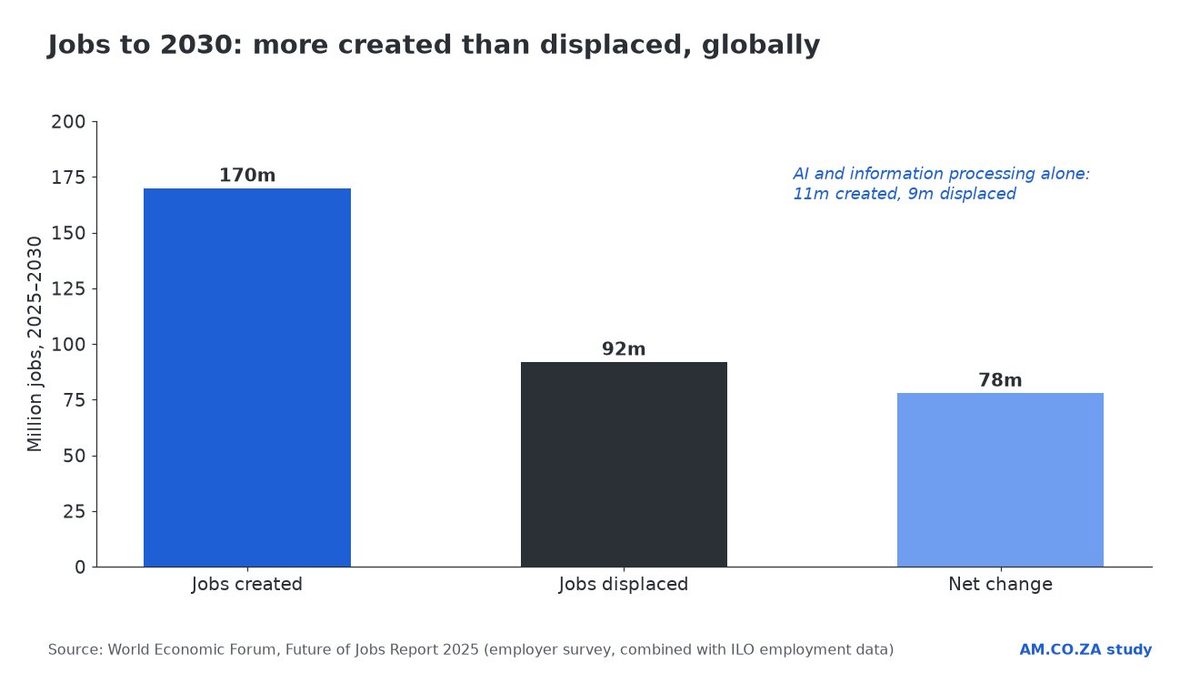
- 170 million jobs created and 92 million displaced worldwide by 2030, a net gain of 78 million, according to employers surveyed by the World Economic Forum (WEF, Future of Jobs Report 2025).
- 1 in 4 jobs worldwide is in an occupation potentially exposed to generative AI, but only 3.3% of employment is in the highest-exposure group (ILO and NASK, May 2025).
- 85.6% of South African households have some internet access, but only 20.6% have a fixed connection at home (Stats SA, General Household Survey 2025, tables 14.1 and 14.3).
- R2.4 billion was lost to digital banking crime in 2025, up from about R1.9 billion in 2024, with AI named as a growing enabler of convincing scams (SABRIC, Annual Crime Statistics 2025).
- 16 days: how long South Africa’s draft national AI policy lasted after it was gazetted on 10 April 2026 before it was withdrawn on 26 April over fictitious references (Government Gazette 54477; SAnews, 26 April 2026).
Part 1: The economy AI is arriving into
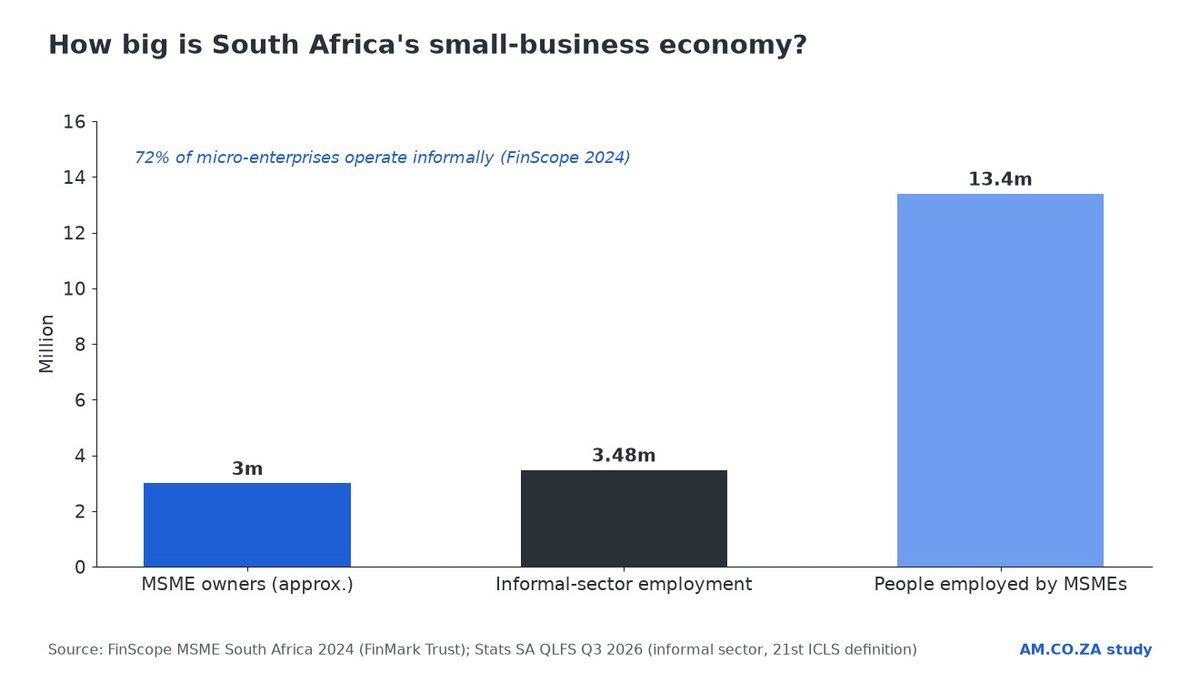
Any honest discussion of AI and South African business has to start with the businesses themselves. They are many, they are small, and a large share of them are informal. FinScope MSME South Africa 2024 found that more than 2.5 million of the roughly 3 million enterprises it counted were micro-enterprises, and that 72% of those operated informally. The sector has an estimated turnover of more than R5 trillion and accounts for 80% of the workforce by FinScope’s measure, yet 15% of owners remain financially excluded. Only 30% of owners are 35 or younger, which FinMark Trust’s analysts called “too low” (FinMark Trust, 2024).
Stats SA’s labour survey tells the same story from the other side. In the third quarter of 2026, the informal sector employed 3.476 million people, 98,000 fewer than in the second quarter, while formal-sector employment rose by 268,000 and the household sector fell by 68,000 (QLFS Q3 2026). Stats SA changed its informal-sector definition from the third quarter of 2025, so these figures cannot be compared directly with older series.
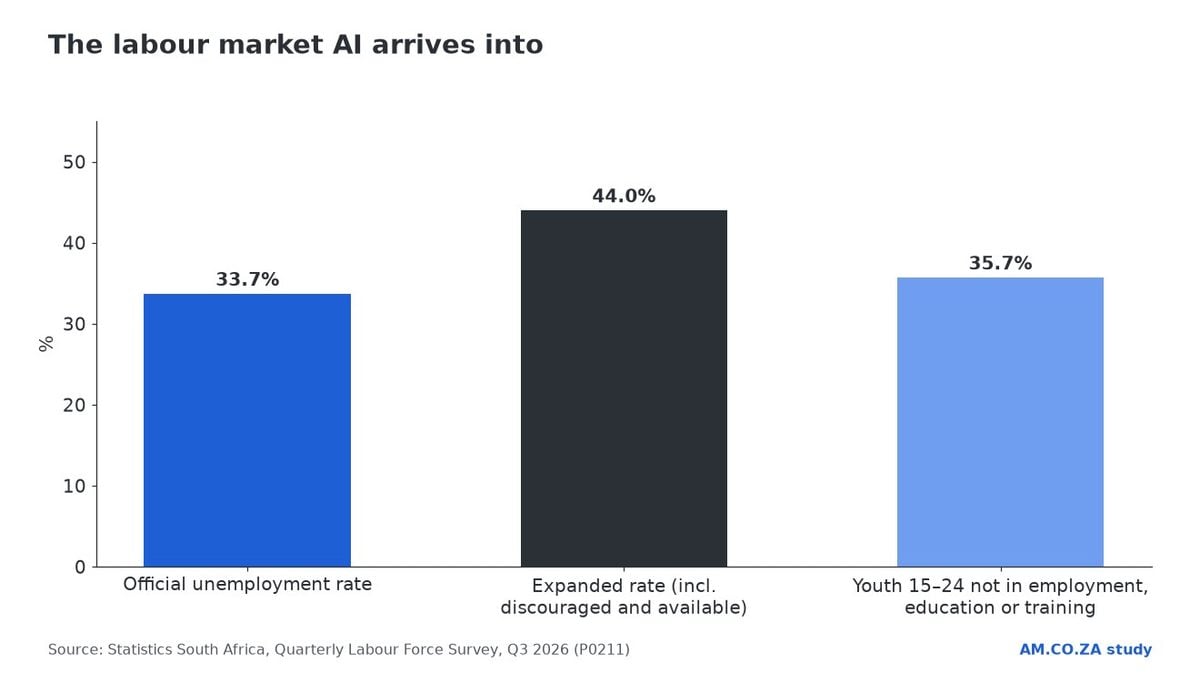
The wider labour market is under heavy strain. The official unemployment rate rose 0.1 of a percentage point to 33.7% in the third quarter of 2026. The expanded measure, which adds people who want work but have stopped looking or are not immediately available, stood at 44.0%. Of about 10.4 million young people aged 15 to 24, 35.7% were not in employment, education or training (QLFS Q3 2026).
That context changes the AI debate. In rich countries, the main fear is that AI will take away good office jobs. In South Africa, the more pressing question is whether AI helps millions of very small businesses become more productive, more formal and better able to hire, or whether it widens the gap between connected, well-capitalised firms and everyone else. Both outcomes are possible. Which one happens depends on access, skills, trust and policy, all of which this study examines.
Small businesses already run on digital tools
The ground is more prepared than many people assume. Xero’s 2026 survey found that 85% of South African small businesses called digital adoption a top or significant priority, 45% already used online invoices with payment links, and 39% had connected their digital tools so they share information automatically (Xero, 2026). Cash flow is the pressure point: 62% had cash-flow problems over the past year, 53% of owners had sacrificed their own salary, and 42% struggled with late payments. Of those chasing late payers, 46% spent up to four hours a week doing so and another 46% spent between four and ten hours. That is exactly the kind of repetitive work where software, including AI, earns its keep.
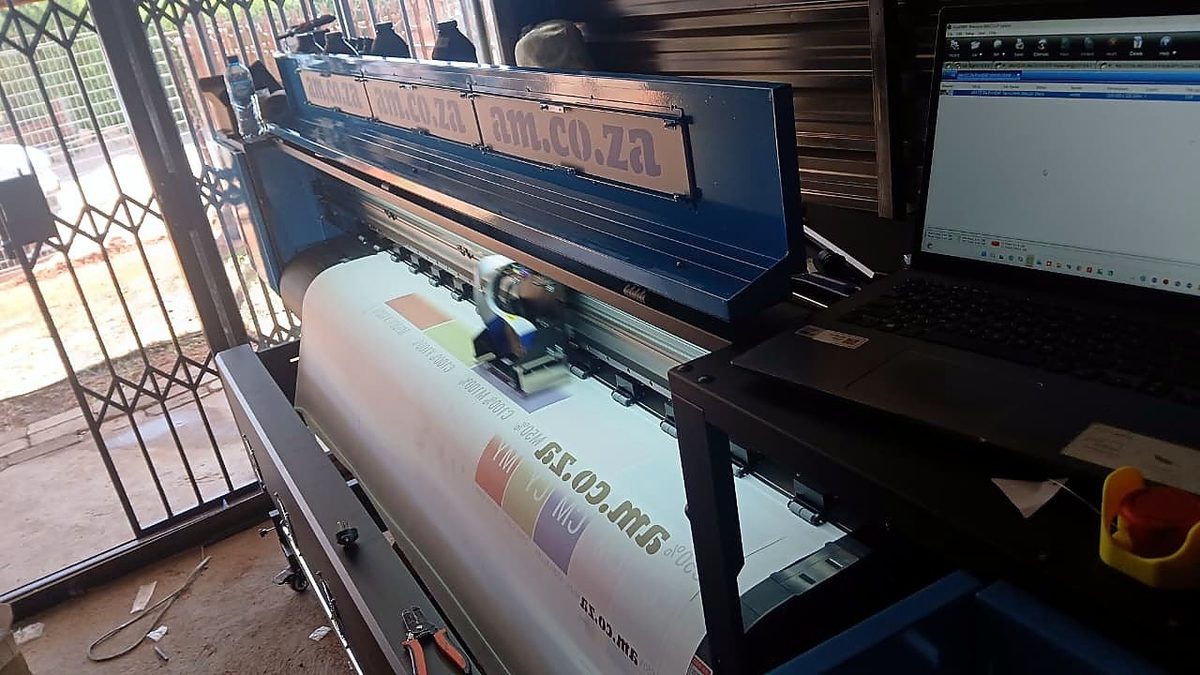
In small manufacturing, the digital layer is already part of every machine. A modern printer is driven from a RIP (raster image processor) on a laptop; a laser cutter or CNC router runs from design and toolpath software; many UV printers use cameras to find and align objects on the bed. AI does not arrive in these workshops as a new idea. It arrives as a new capability inside tools that are already there, and as a general-purpose assistant on the owner’s phone.
Part 2: How fast is AI being adopted?
Measuring AI adoption is harder than it looks. Surveys define “AI” differently, ask different people and reach different kinds of business. Voluntary online surveys tend to attract tech-minded respondents. Official statistics agencies ask more narrowly and later. The honest approach is to read several sources side by side.
The global picture: fast growth, shallow use
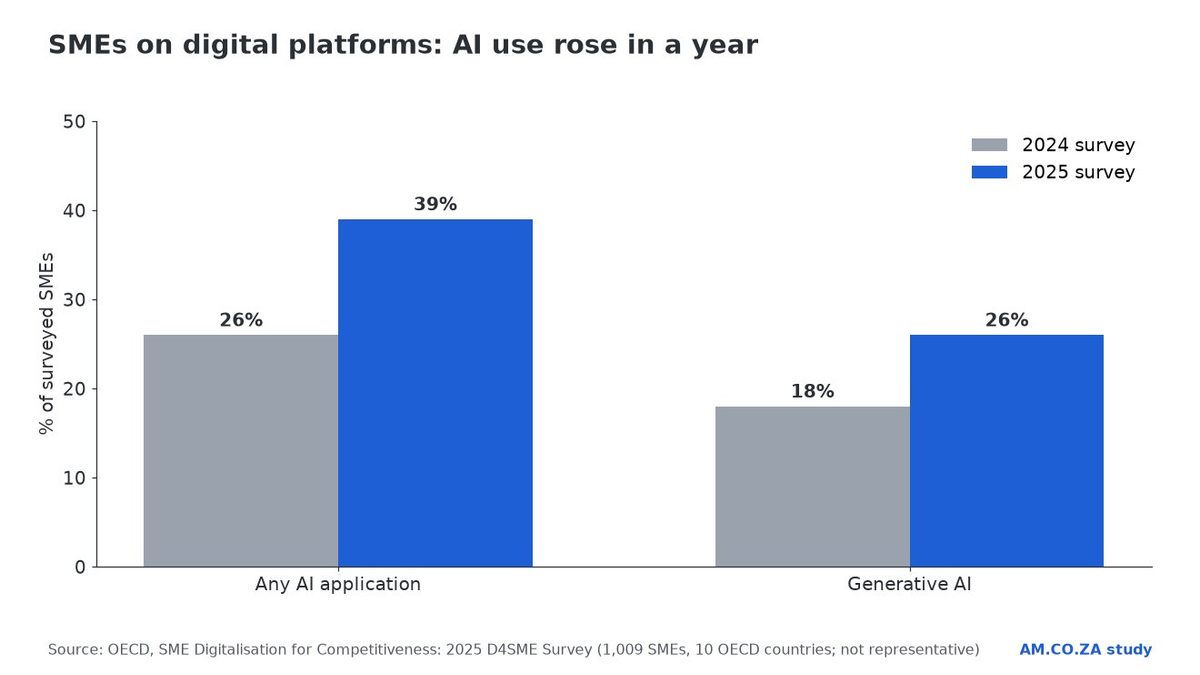
The OECD’s Digital for SMEs (D4SME) survey, which questioned 1,009 SMEs that use large digital platforms across ten OECD countries in late 2024, found that 39% used an AI application, up from 26% in the previous year’s survey. Generative AI, the kind that writes text and creates images, was the most common form, used by 26% (up from 18%). Among the 61% that did not use AI, nearly half (44%) planned to start soon. The non-users’ main worries were legal issues, data privacy and misinformation (OECD, SME Digitalisation for Competitiveness, 2025). The OECD stresses that the sample is not representative of all SMEs, but the direction is clear.
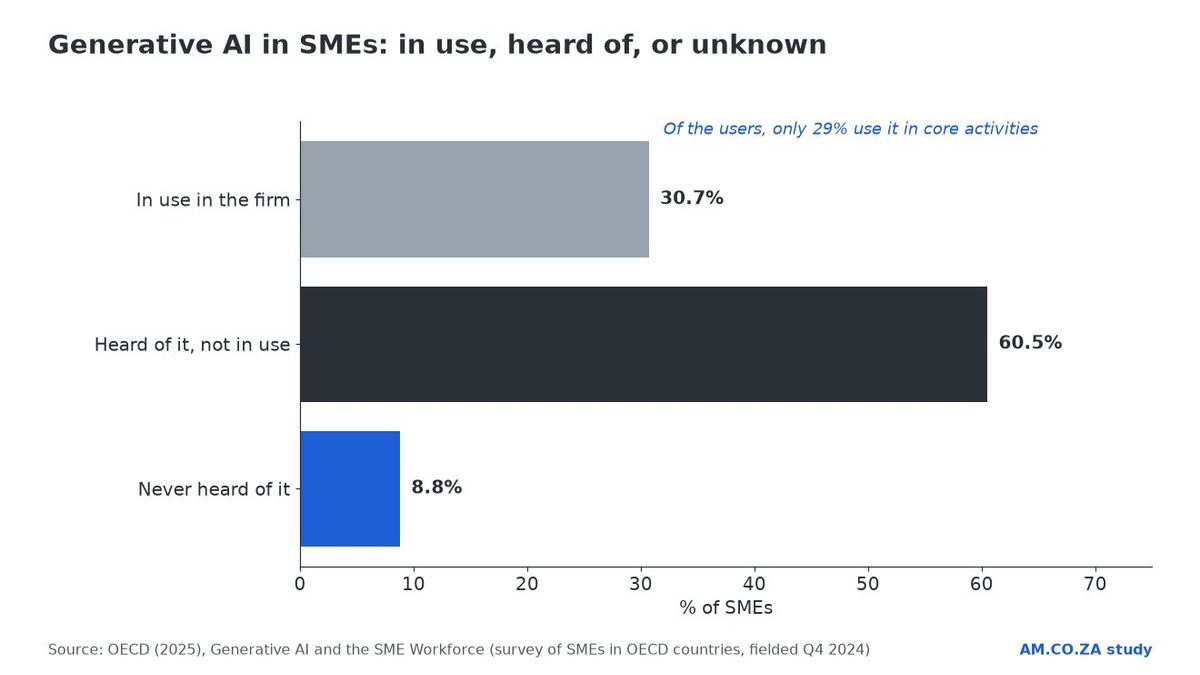
A second OECD study, Generative AI and the SME Workforce, found generative AI in use in 30.7% of SMEs, ranging from 24% in Japan to 39% in Germany. A further 60.5% had heard of it but were not using it, and 8.8% had never heard of it. Because larger SMEs are more likely to use it, those users account for 38.4% of SME employment. The most telling finding is about depth: among SMEs using generative AI, only 29% use it in the core activities of the company. (OECD, Generative AI and the SME Workforce). The OECD notes that official statistics agencies report much lower rates, from 1.3% of SMEs in Romania to 17.8% in Denmark in 2024; survey design and who is asked make a large difference.
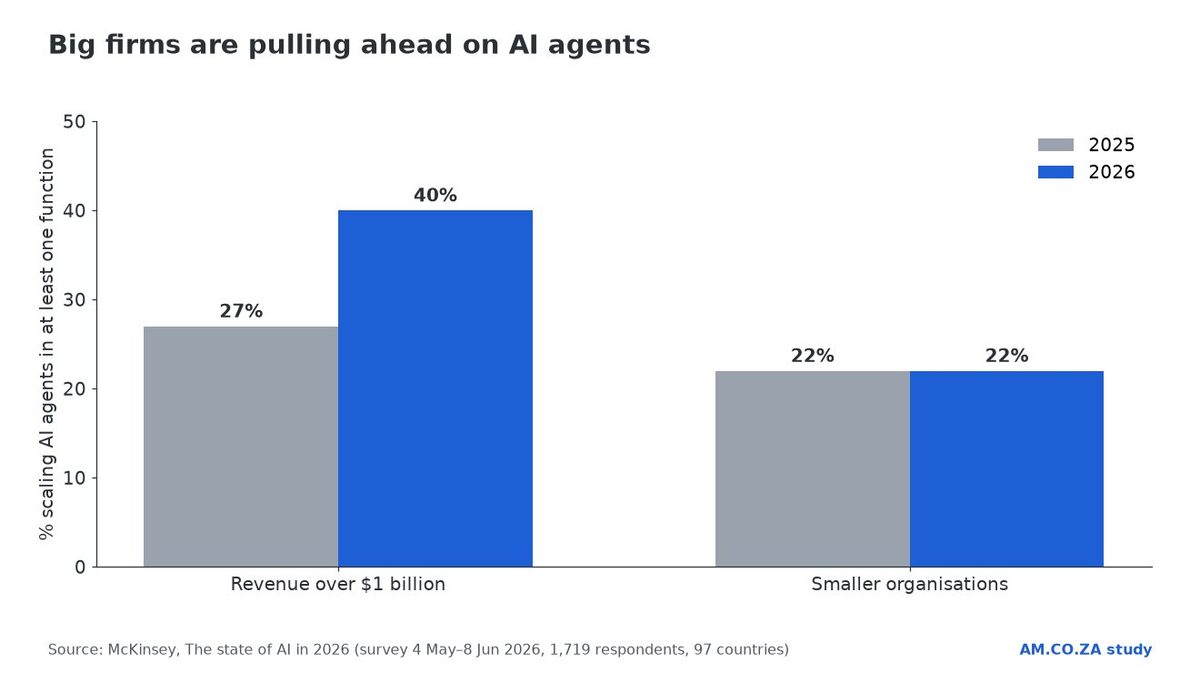
Among larger organisations, AI is now close to universal. McKinsey’s 2025 global survey found that 88% of respondents’ organisations regularly used AI in at least one business function, up from 78% a year earlier (McKinsey, The state of AI in 2025). Its 2026 survey, fielded in May and June 2026 among 1,719 respondents in 97 countries, found nearly nine in ten using AI regularly and 44% scaling it across the enterprise, up from 38%. But the gap by size is widening. Among organisations with more than $1 billion in revenue, the share scaling AI agents (systems that plan and carry out multi-step tasks) rose from 27% to 40%. Among smaller organisations it stayed flat at 22% (McKinsey, The state of AI in 2026).
McKinsey’s survey also carries a warning for anyone expecting instant profits. Only 37% of respondents attribute any EBIT impact to AI, and only about 6% are “high performers” that attribute 5% or more of EBIT to AI. About one in five said AI operating costs were constraining their use. Yet 80% said AI had improved their own productivity, and half said it helped them make better decisions. The high performers had something in common: nearly three-quarters had fundamentally redesigned workflows around AI rather than bolting it onto old ones (McKinsey, 2026). For a small business, that is the most useful lesson in the whole report.
South Africa: high use, high confusion
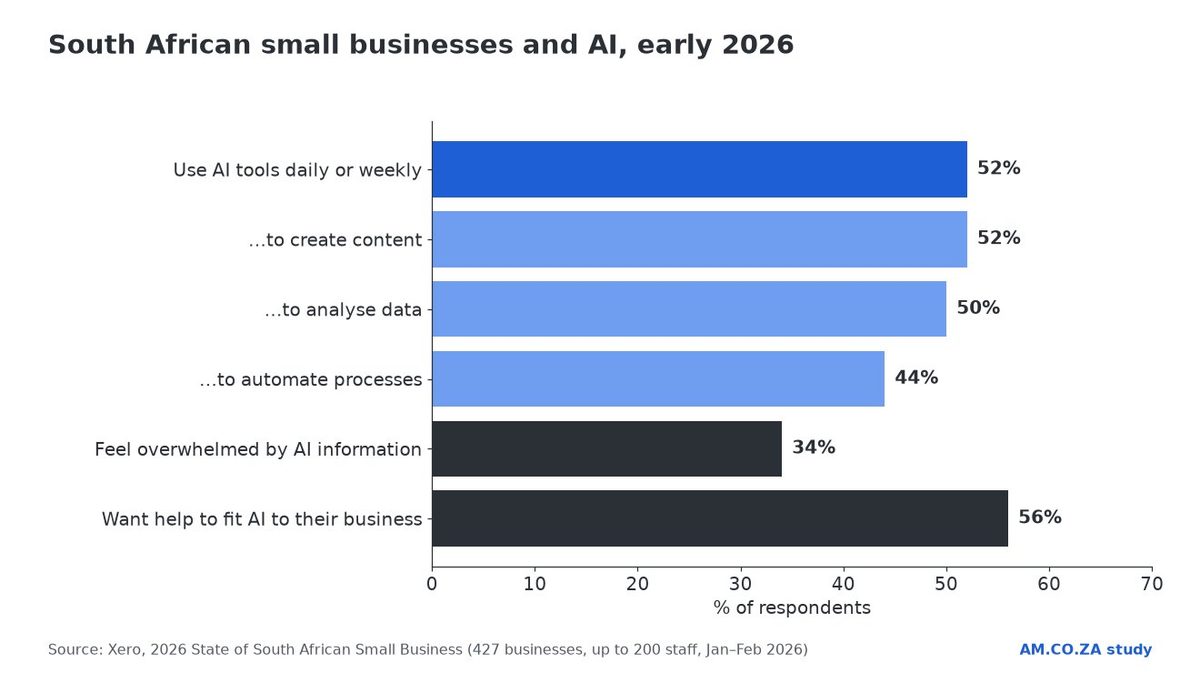
South African small businesses report high usage. In Xero’s survey, the 52% who used AI daily or weekly mostly used it to create content (52%), analyse data (50%) and automate processes (44%). But 34% of owners said they felt overwhelmed by information about AI, and 56% wanted more support to figure out how AI fits their specific business (Xero, 2026). When asked where they find business advice, 28% named generative AI tools or social media, alongside mentors (36%) and Google (36%). Accountants still came first: 77% called their accountant or bookkeeper their most trusted adviser.
Xero’s South African sample points the same way: owners are already experimenting, often without a firm plan. Separate reporting on manufacturing SMEs has repeatedly flagged financing of new technology as a brake on AI adoption, which matches what AM.CO.ZA customers say when the conversation turns from interest to budgets.
Put together, the evidence suggests a pattern that will be familiar to anyone who visits small workshops: AI is widely used, mostly through free or low-cost chat tools, mostly for writing and quick answers, and mostly by the owner personally. Deep, process-changing use is still rare.
Workers did not wait for permission
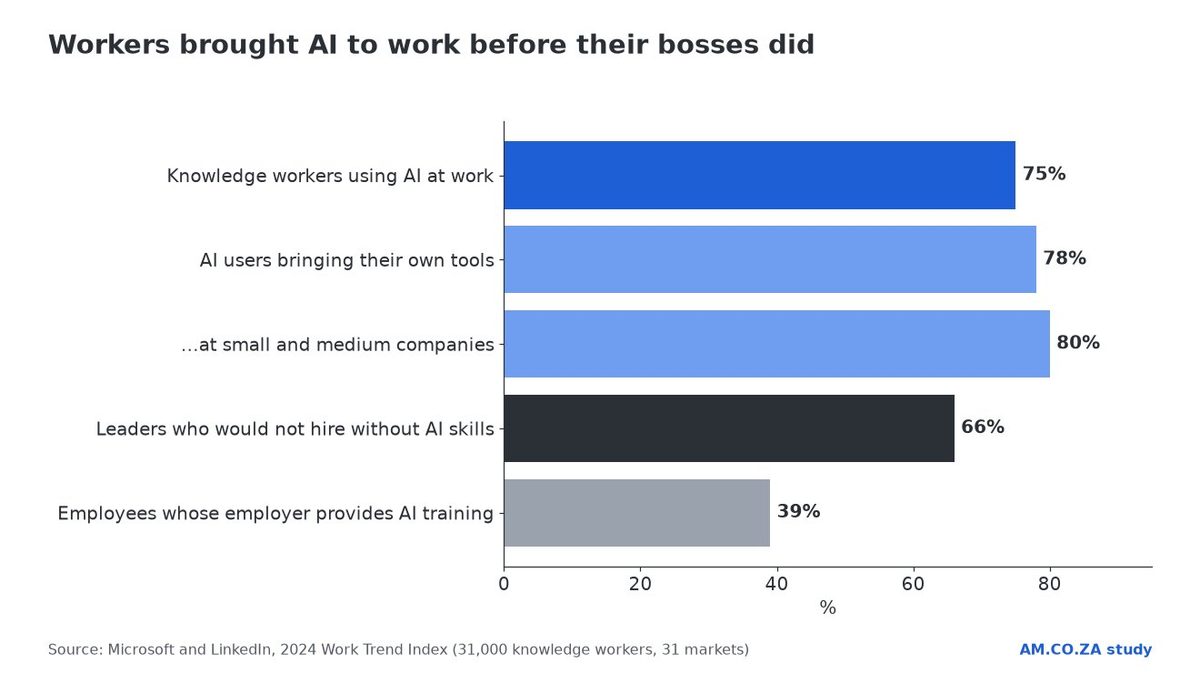
Much of the adoption is happening bottom-up. Microsoft and LinkedIn’s 2024 Work Trend Index, a survey of 31,000 knowledge workers in 31 markets, found that 75% were using generative AI at work, and that 78% of AI users brought their own AI tools to work. At small and medium-sized companies that figure was 80%. Leaders were moving more slowly: 79% said their company needed AI to stay competitive, but 60% worried their leadership lacked a plan. Two-thirds (66%) of leaders said they would not hire someone without AI skills, yet only 39% of employees said their organisation provided AI training (Microsoft WorkLab, 2024; Axios, May 2024).
Microsoft’s 2026 Work Trend Index, based on 20,000 AI users in ten countries (South Africa was not among them), adds a sharper finding: organisational factors such as culture, manager support and talent practices account for about twice the reported AI impact of individual effort alone (67% against 32%). Asked which human skills matter more as AI takes on work, users put quality control of AI output (50%) and critical thinking (46%) at the top, and 86% said they treat AI output as a starting point, not a final answer (Microsoft, 2026 Work Trend Index Annual Report).
The same report found that 66% of AI users said they were spending more time on higher-value work, and 58% said they were producing work they could not have produced a year earlier. Those are self-reported benefits from people who already use AI, so they overstate the average. But they match what owners describe: AI rarely removes a whole job, and more often removes the dull first hour of it.
For a ten-person print shop, “bring your own AI” is the norm, not the exception. The designer uses one chatbot, the owner another, the bookkeeper a third. That is fine for speed, but it means company information is flowing into tools nobody has checked, and good prompts and lessons stay in one person’s head. Part 6 returns to what that means under POPIA.
Part 3: What small businesses actually use AI for
The research and the trade’s experience point to the same handful of jobs where AI already saves time. None of them replaces the owner’s judgement. All of them can make a small team look and work bigger.
Marketing and content
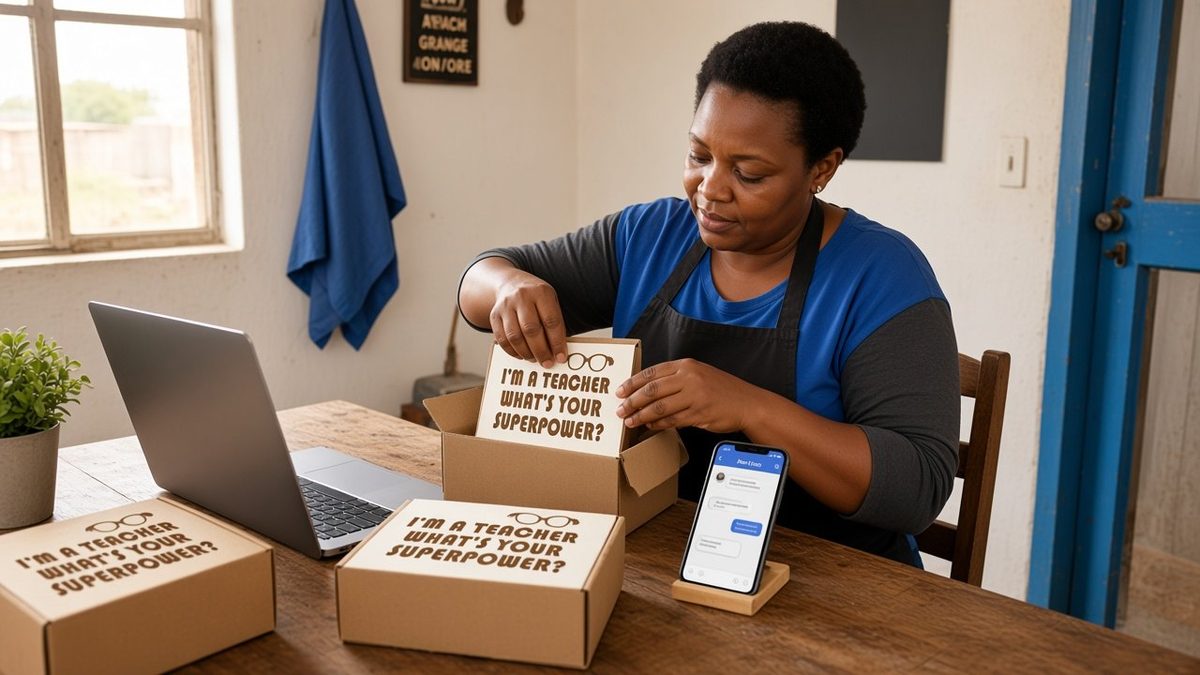
Content creation is the most common use in every survey quoted above. For a small business, that means product descriptions, social-media posts, adverts, newsletters, catalogue text, translations and replies to reviews. A home-based maker who sells engraved gifts can draft a week of posts in minutes, adapt the same message for WhatsApp, Facebook and a website, and test different headlines. AI image tools can mock up a product in different settings before anything is made.
The limits are just as clear. AI writes fluent, generic copy unless it is given real detail: the material, the sizes, the turnaround, the price rules and the customer’s actual words. It invents facts with confidence. And customers are learning to recognise bland AI text. The best results come from treating AI as a fast first draft and adding the business’s own photos, voice and proof.
Customer chat and enquiries

For most South African small businesses, sales happen in chat, mainly on WhatsApp and social media. AI helps here in three ways. It can draft replies to common questions, so the owner answers faster and more consistently. It can summarise a long thread before a call. And it can power an always-on assistant that answers from the business’s own information, such as products, prices, opening hours, delivery areas and care instructions.
The third use needs the most care. An assistant that answers from the general internet will invent stock levels, prices and promises. One that answers only from a checked knowledge base, cites where it found the answer and hands over to a person when unsure is far safer. AM.CO.ZA’s own experience is described in Part 8.
Quoting and pricing
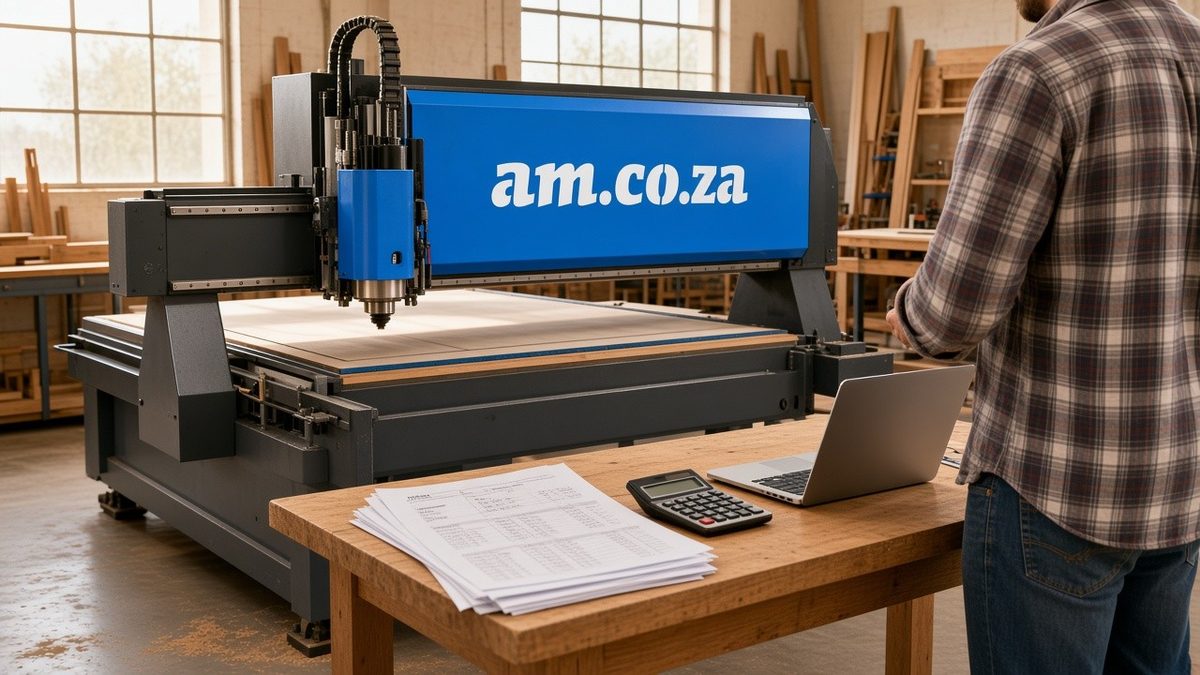
Quoting is where many small manufacturers lose the most time. A customer sends a photo or a rough sketch and asks “how much?”. AI can help turn that into a structured job: list the materials and sizes, estimate the sheet usage, draft the line items, and write a clear quotation with terms and lead times. It can also check a quote for missing items, such as setup time, finishing, packaging or delivery.
What AI should not do is set the price on its own. It does not know the business’s real machine hours, rejects, rent, wages, electricity or margin unless someone tells it, and it can make arithmetic errors. The safe pattern is a pricing sheet the owner controls, with AI used to read the enquiry, fill in the sheet and draft the words.
Design for print, signs, laser and CNC work
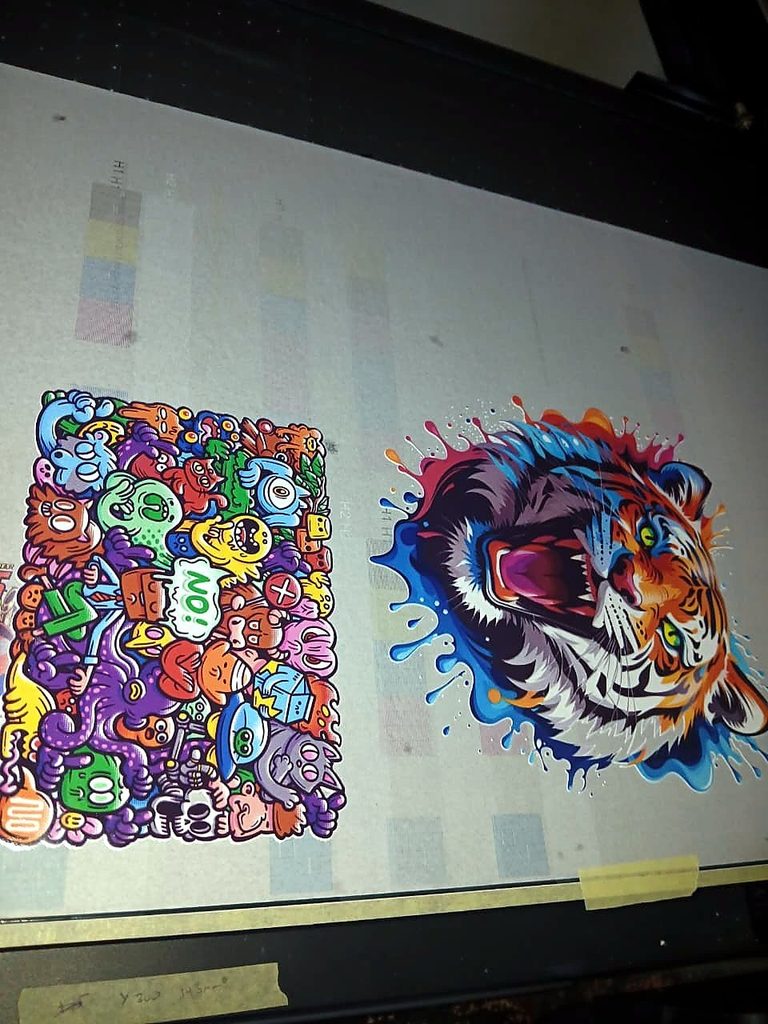
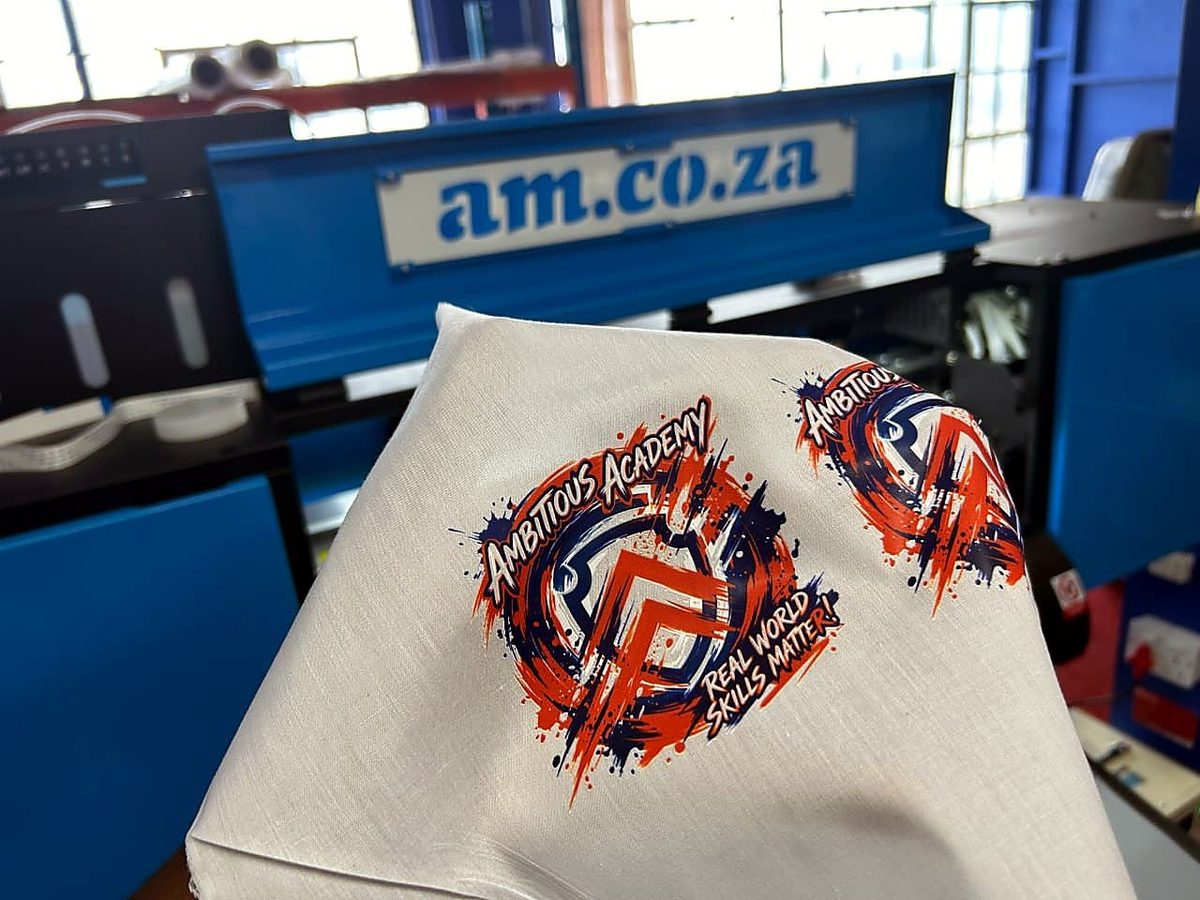
Design is where small manufacturers feel AI most directly. Image generators can produce concept artwork, patterns and backgrounds in seconds; upscalers can rescue a low-resolution customer logo; background-removal tools can prepare a photo for engraving. Vectorising tools turn a sketch into cut lines for a vinyl cutter, laser or router. A designer can show a customer five directions before lunch.
Three cautions apply. First, rights: a customer’s “logo from the internet” may belong to someone else, and AI-generated look-alikes of famous brands or characters can still infringe trademarks and copyright. Second, production reality: an attractive AI image may have fine detail that will not engrave, colours outside the printer’s range, or shapes that cannot be cut. The operator still has to prepare the file for the machine, material and process. Third, in the WEF’s latest employer survey, graphic designers sit just outside the ten fastest-declining jobs, and printing trades workers are inside that list (WEF, Future of Jobs Report 2025). For a print or sign shop, that is a reason to combine design skill with production skill, not to stop designing.
AI inside the machines
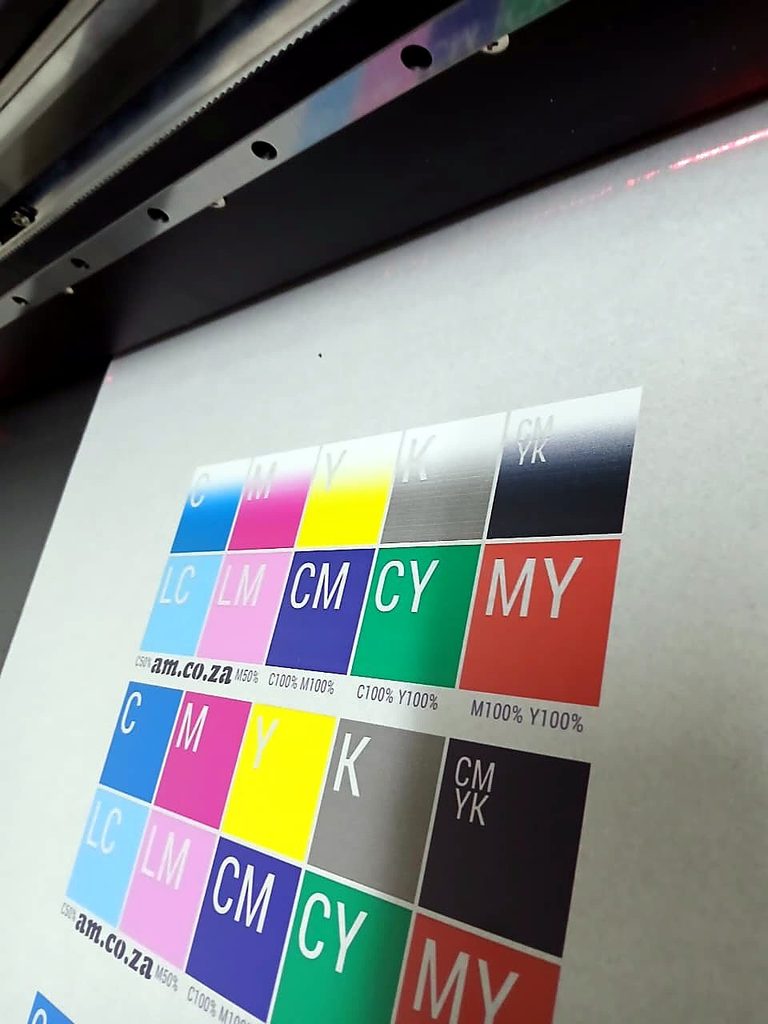
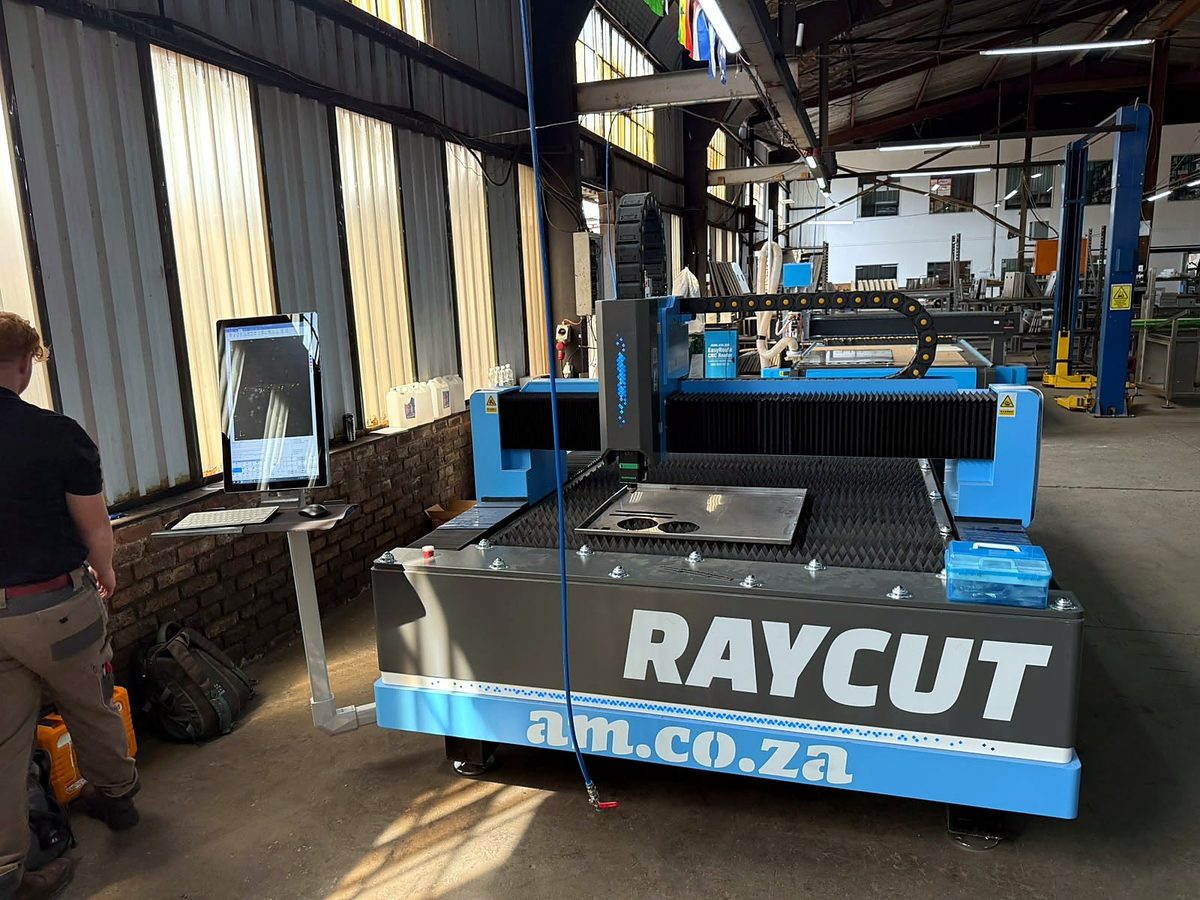
Machine makers have used forms of machine intelligence for years. Camera (CCD) systems on UV printers and laser cutters detect object positions or printed registration marks, so the machine prints or cuts exactly where it should. Nesting software arranges parts on a sheet to reduce waste. Height sensors and adaptive control adjust cutting as conditions change. The newer step is general-purpose AI assistants that can explain error codes, suggest settings for a new material, summarise a manual or help write a macro.
For a fabricator, the gains are real but bounded. AI can suggest a nest, a lead-in or a starting parameter; it cannot feel a blunt bit, smell a burning edge or see that a sheet is warped. McKinsey’s 2026 survey found that respondents most often reported AI-driven cost reductions in supply chain management, service operations and manufacturing (McKinsey, 2026). In a small workshop, those savings come from fewer test cuts, less scrap and faster troubleshooting, not from replacing the operator.

Bookkeeping, cash flow and admin
Accounting platforms increasingly read invoices and receipts, suggest how to categorise transactions and flag late payers. General AI tools can turn a messy spreadsheet into a summary, draft a polite reminder to a late payer, or explain a SARS letter in plain language. Given that 42% of Xero’s respondents struggled with late payments and only 50% kept digital records of transactions, receipts and expenses, the potential is large (Xero, 2026).
Here the human check matters most, because mistakes have legal and tax consequences. Xero’s Colin Timmis put it plainly in the report: insights from GenAI and social media “should be used as a stepping stone, alongside expert advice”. The 77% of owners who trust their accountant above all other advisers have the right instinct.
Stock and supply
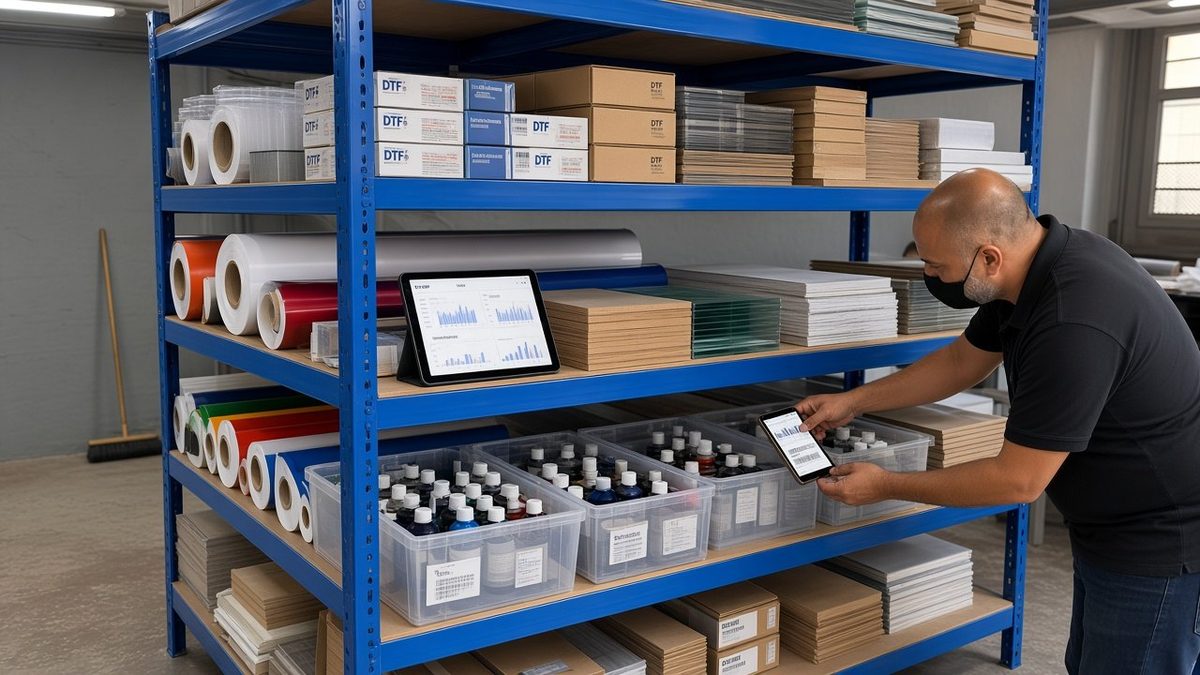
Stock is the quiet killer of small manufacturers: too much ties up cash, too little stops a job. A barcode or QR system on shelves, plus a simple spreadsheet or stock app, gives AI something to work with. It can then forecast when an ink, film or board will run out based on past jobs, draft purchase orders, and compare supplier quotes. For businesses that already track stock digitally, this is low-hanging fruit. For businesses that do not, the first step is the boring one: count and label what is on the shelf.
Home-based makers: a business in a phone
For the many South African entrepreneurs who work from a spare room, a garage or a kitchen table, AI matters in a particular way. These businesses usually have one person doing everything: making, photographing, posting, answering, quoting, delivering and keeping the books. They rarely have a designer, a marketer or a bookkeeper on call. A phone with a chat assistant can now cover part of each of those roles.
A home baker can ask for a week of social posts built around this week’s specials, then turn a voice note into a neat price list. A crafter with a small cutting machine can describe a design in words, generate a few concepts, and choose one to trace and cut. A sublimation or engraving business can ask for gift ideas for a local school’s year-end, then draft a message to the school. Someone selling on WhatsApp can paste a confusing customer message and ask for a clear, polite reply in English, isiZulu or Afrikaans, and then check it with someone who speaks the language well.
The limits for home businesses are the same as for everyone, only sharper. There is usually nobody else to catch a mistake, so the checking habit matters even more. Free accounts often have weaker data terms, so customer details should stay out. And because data costs fall hardest on people using prepaid mobile bundles, it pays to do heavy tasks such as image generation and large uploads on Wi-Fi.
What AI is good at, and what it is not
| Task | Where AI helps | What a person must check |
|---|---|---|
| Marketing posts and adverts | Fast drafts, variations, translations | Facts, prices, tone, claims, rights to images |
| Customer chat | Draft replies, summaries, answers from a checked knowledge base | Promises on price, stock, delivery and refunds |
| Quotations | Reading the enquiry, listing items, wording | The price, quantities and arithmetic |
| Design for print and cutting | Concepts, upscaling, background removal, vectorising | Production fit, colour, cut paths, copyright and trademarks |
| Machine set-up | Explaining manuals and error codes, suggesting starting settings | Test cuts, safety, material behaviour |
| Bookkeeping | Reading receipts, categorising, reminders, summaries | Tax treatment, VAT, final figures (with an accountant) |
| Stock | Forecasting reorders, drafting purchase orders | Real counts on the shelf, supplier terms |
Part 4: Costs and access: who gets to use AI?
The entry price for AI is low. Many chat assistants have free tiers, and paid plans for individuals cost about the same each month as a modest software subscription. But the real cost of using AI well is higher: a reliable connection, a decent device, stable power, time to learn and, for anything beyond chat, software that connects to the business’s own data. South Africa’s access picture is mixed.
Data: connected, but mostly by phone
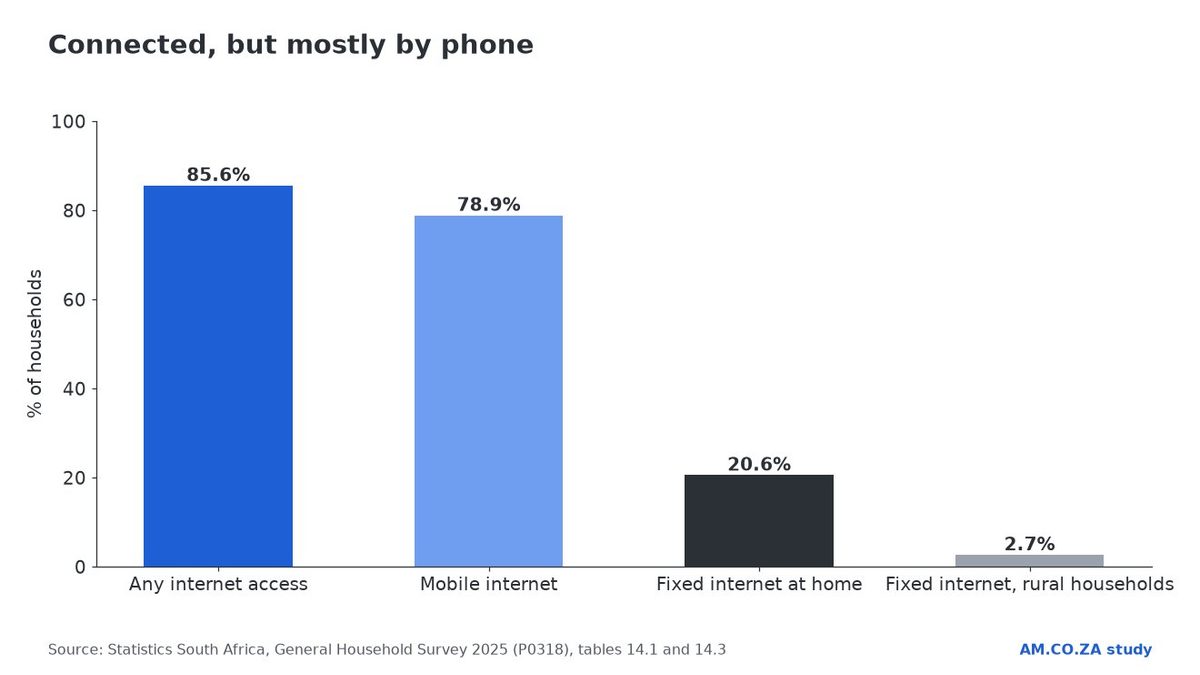
Stats SA’s General Household Survey found that 85.6% of households had access to the internet by some means in 2025. But that access is overwhelmingly mobile: 78.9% of households could get online through a mobile device, while only 20.6% had a fixed connection such as fibre or ADSL at home. In rural areas, fixed home internet reached just 2.7% of households (Stats SA, General Household Survey 2025, tables 14.1 and 14.3).
For a home-based business, that matters. Text chat with an AI assistant uses little data. Uploading photos and design files, generating images and joining video calls uses far more. A business running mainly on prepaid mobile data will feel those costs.
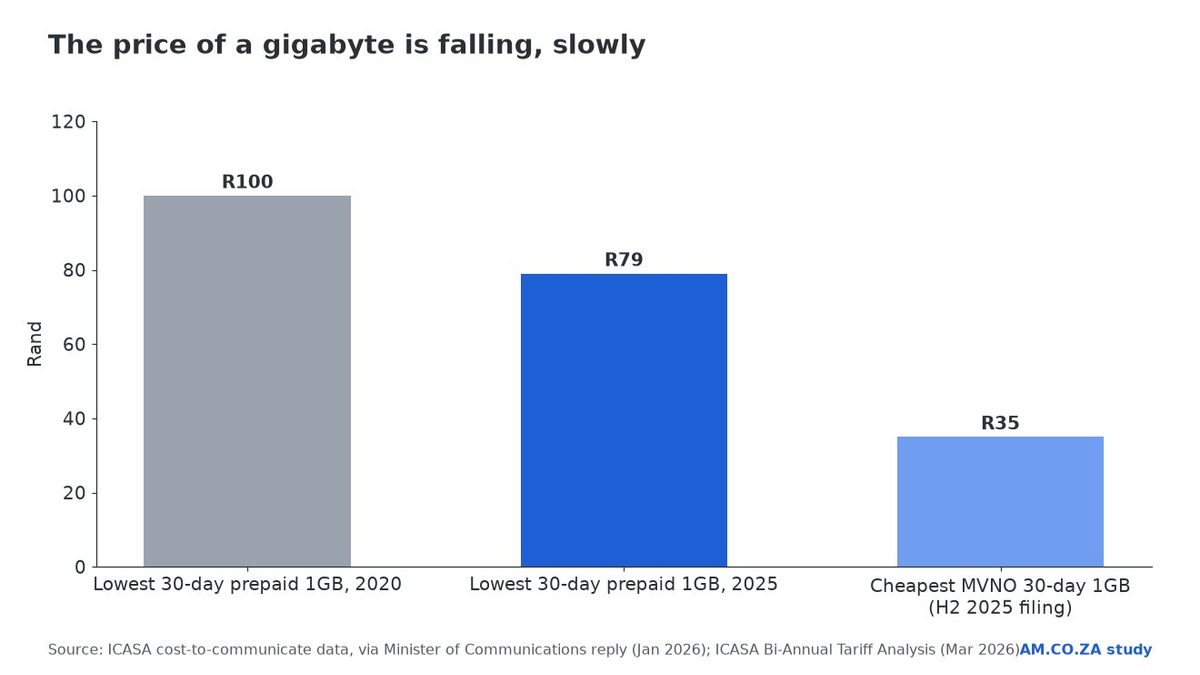
Prices are moving in the right direction, but slowly. According to ICASA data cited by the Minister of Communications in a parliamentary reply, the lowest 30-day prepaid price for 1GB fell from R100 in 2020 to R79 in 2025 (NCOP oral reply, January 2026; MyBroadband). ICASA’s tariff analysis for the second half of 2025 found mobile virtual network operators offering 30-day 1GB bundles from R35 (ICASA Bi-Annual Tariff Analysis, March 2026). ICASA’s State of the ICT Sector report says entry-level mobile broadband is now affordable by the international benchmark (a 2GB basket at R152, below a threshold of R186.36), but fixed broadband remains above it (ICASA, State of the ICT Sector Report 2026). Shopping around for data, and using Wi-Fi for heavy work, is a real AI cost saving.
Power: the load-shedding question has changed

For years, load-shedding would have topped any list of barriers to digital work. That has changed. As of 9 November 2026, Eskom reported about 540 days without load-shedding, an energy availability factor of about 68%, and a 79% fall in diesel spending so far this financial year. Localised “load reduction” still affects some areas, and Eskom aims to end it by March 2027 (EWN, 9 November 2026; Eskom media statement).
The lesson of the load-shedding years still applies, though. Many small businesses invested in inverters, batteries and solar, and those investments now protect against local outages, cable theft and substation failures. A laptop, a router and a phone on a small backup system keep a business’s digital side running even when the machines are off.
Skills and confidence
The biggest access barrier is not data or power. It is knowing what to do. The OECD found gaps in awareness, skills and uptake, particularly among older business leaders (OECD D4SME Roundtable 2025). Xero’s 34% “overwhelmed” figure says the same about South Africa. Large programmes are working on the problem: Microsoft says it trained 1,418,924 South Africans in AI and digital skills (Hypertext, January 2026), and it has committed R5.4 billion to cloud and AI infrastructure in South Africa by the end of 2027 (Microsoft, March 2025). But owner-managers need something narrower: practical help for their own trade, in their own language, on their own jobs.
What AI really costs a small business
The subscription is the smallest cost. The bigger costs are the owner’s time spent learning and checking, the data used to upload images and files, a device good enough to run design software alongside a browser, and, for connected uses, the work of getting price lists, product data and records into a clean digital form. A sensible budget treats AI like any other tool: start with one paid account for the person who will use it most, measure the time it saves over a month, and only then add more seats, software or integrations. Owners should also watch for “AI” labels on software that adds cost without saving time.
Finance and the price of “real” AI
Beyond chat tools, the costs rise quickly: industry software with AI features, integrations, sensors, cybersecurity and training. McKinsey found AI operating costs constraining use for about one in five organisations, even large ones (McKinsey, 2026). For South African SMEs, the Small Enterprise Development and Finance Agency (SEDFA) is the main state channel. It was formed on 1 October 2024 by merging the Small Enterprise Finance Agency (sefa), the Small Enterprise Development Agency (Seda) and the Co-operative Banks Development Agency. SEDFA offers asset finance for machinery and equipment, term loans, bridging loans and revolving credit, alongside coaching, incubation, a technology transfer programme and manufacturing supplier development. Its direct lending ranges from R50,000 to R15 million depending on the programme, and it says decisions on applications below R500,000 are typically made within 21 working days. Applications go through its OneSEDFA portal (SEDFA).
Part 5: Jobs and skills: replacement, or a new kind of work?
No question about AI generates more anxiety than jobs. The best available evidence points to large changes in tasks, uneven effects across occupations, and fewer outright job losses so far than many predicted.
What the global forecasts say
The World Economic Forum’s Future of Jobs Report 2025, based on employer surveys combined with ILO employment data, estimates that macro trends will create 170 million jobs and displace 92 million by 2030, a net gain of 78 million. AI and information processing alone are expected to create 11 million jobs and displace 9 million. Employers expect 39% of workers’ core skills to change by 2030, down from 44% in the 2023 edition (WEF, Jobs outlook; WEF, Skills outlook).
The same report names clerical roles, such as bank tellers, data-entry clerks, cashiers, administrative assistants and bookkeeping clerks, among the fastest-declining jobs. Printing and related trades workers are on that list too, though for printing the main drivers include trends other than AI, and graphic designers appear just outside the top ten. AI and big data top the list of fastest-growing skills, followed by networks and cybersecurity and technological literacy. Strikingly for makers, the WEF’s analysis found that none of the more than 2,800 skills it assessed had “very high capacity” to be replaced by current generative AI (WEF, Skills outlook).
In South Africa specifically, more than 60% of businesses surveyed by the WEF named skills gaps as a key barrier to transformation by 2030, and 34% planned to remove degree requirements to widen their talent pool (WEF, Region and economy insights).
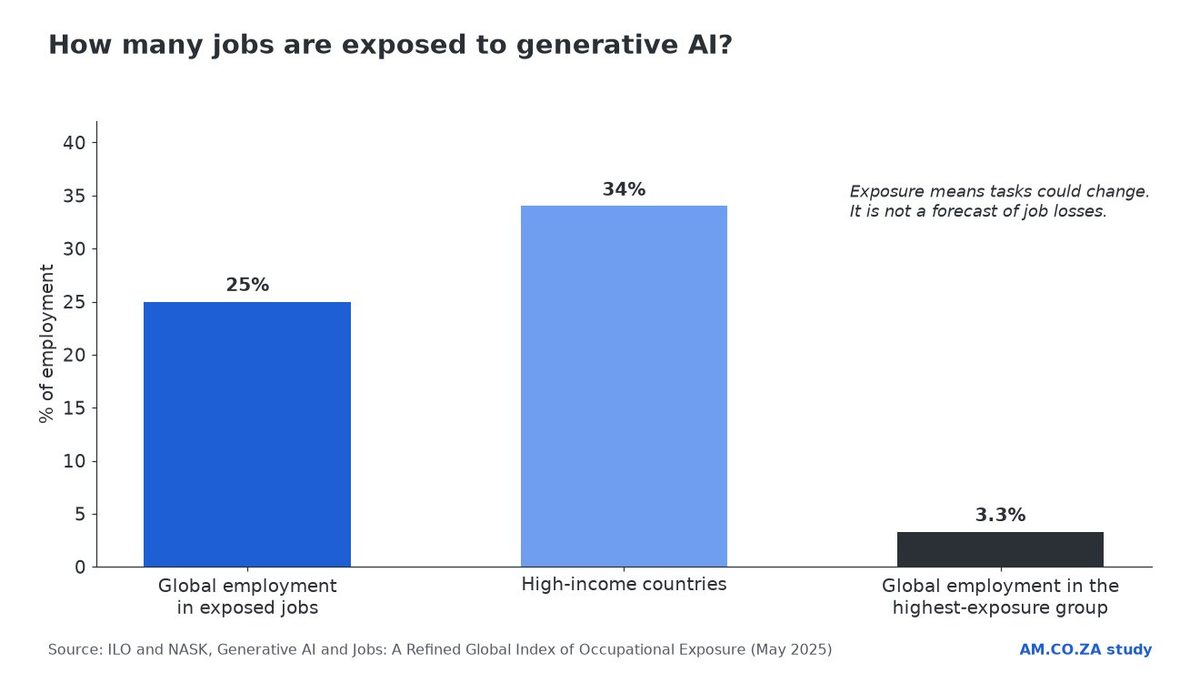
The International Labour Organization’s refined index, published with Poland’s NASK in May 2025, found that 25% of global employment is in occupations potentially exposed to generative AI, rising to 34% in high-income countries. Only 3.3% of global employment falls in the highest-exposure group. Clerical jobs are the most exposed, and women’s jobs are more exposed than men’s. The authors stress that exposure means tasks could change, not that jobs will disappear, and that “transformation, not replacement, is the most likely outcome” (ILO, May 2025).
What has actually happened so far
McKinsey’s 2026 survey offers rare evidence on outcomes rather than forecasts. Only 14% of respondents from organisations using AI said AI contributed to an overall decline in workforce size over the past year, less than half the 32% who expected reductions a year earlier. Two-thirds reported little or no AI-related change in total employment. Expectations are rising again, though: 39% now expect AI to reduce their head count over the next year, against 43% who expect little or no change (McKinsey, 2026).
What it means for a small workshop
For small manufacturers, print shops and makers, the picture is more encouraging than for office-heavy industries. The work is physical: loading boards, changing tools, weeding vinyl, pressing transfers, checking colour, packing and installing. These are exactly the tasks the WEF and ILO find hardest for AI to replace. What AI changes is the work around the machine: the quoting, design, marketing, admin and troubleshooting that often consume an owner’s evenings.
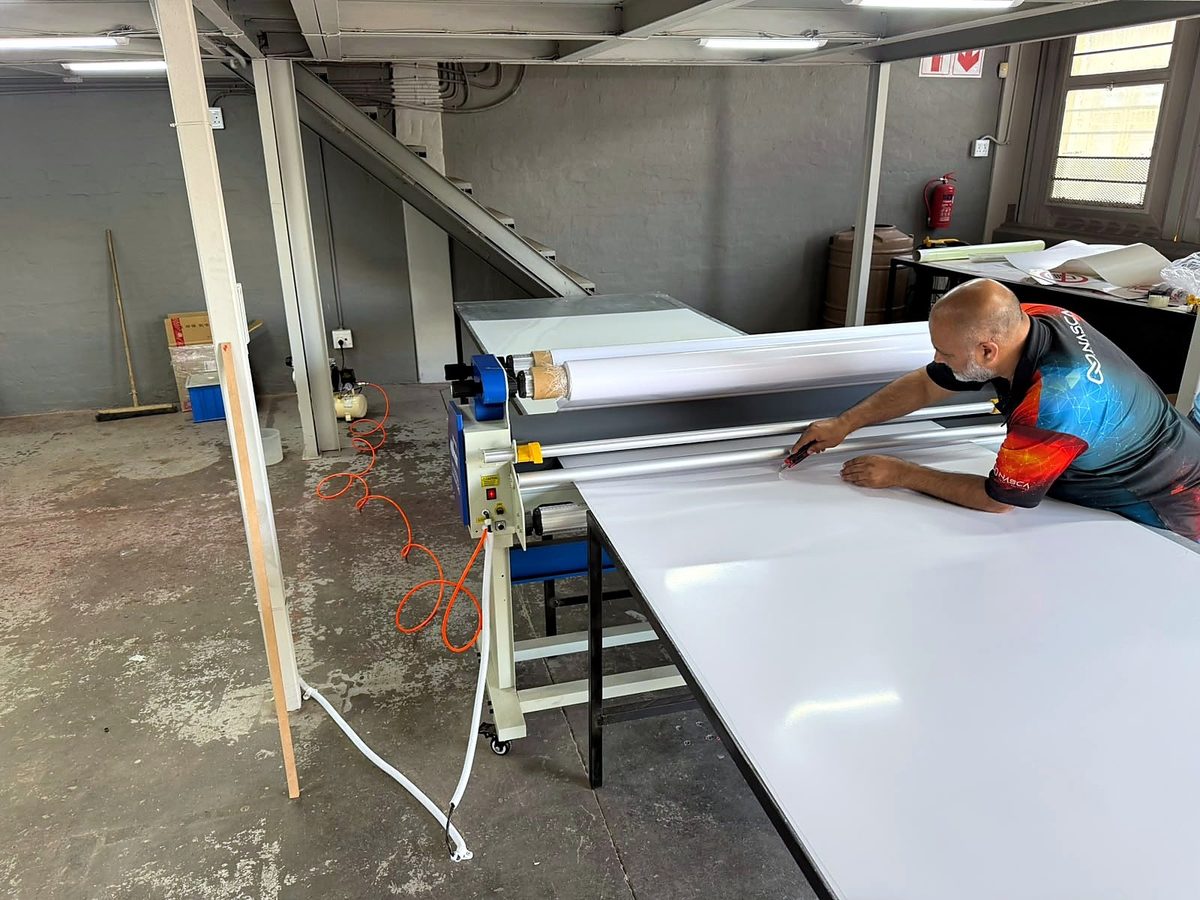
That points to a realistic goal: AI should free the owner and the team to spend more time on production and customers, and help a micro-business handle more orders before it needs to hire. When it does hire, the new person may need a different mix of skills: someone who can run a machine and also use AI tools to prepare files, answer customers and keep records. In a country where 35.7% of young people aged 15 to 24 are not in employment, education or training, a young person who combines practical machine skills with confident, careful AI use is exactly the kind of worker small businesses will want.
Three myths about AI and small business
- “AI is only for big companies.” The opposite is closer to the truth for everyday tools. A chat assistant costs the same for a one-person workshop as for a manager at a bank, and Xero’s survey shows small South African firms already use it widely. Where big companies are pulling ahead is in deeper, connected uses such as AI agents, which is why small firms should focus on connecting AI to their own clean data, one process at a time.
- “AI will replace my staff.” The evidence so far points to changed tasks more than lost jobs, especially in physical, skilled work. The WEF found none of the skills it assessed had very high capacity to be replaced by generative AI, and McKinsey found far fewer actual workforce reductions than firms had expected. AI is more likely to change what a hire needs to know than to remove the need to hire.
- “If the AI says it, it must be right.” AI tools produce fluent, confident text whether or not it is true. The government’s withdrawn AI policy shows how far invented references can travel. Every number, price, standard and source should be checked by a person before it is used.
Skills that matter more, not less
- Judgement and checking. Microsoft’s 2026 survey found that AI users rank quality control of AI output and critical thinking as the most important human skills. In a workshop, that means checking every quote, file and setting before it reaches a customer or a machine.
- Trade knowledge. AI can explain what a CO2 laser is. It cannot replace the experience of knowing how a particular acrylic behaves on a particular machine. Practical training stays essential.
- Clear writing and instructions. Getting good results from AI depends on describing the job precisely. That is a teachable skill, and it also improves communication with staff and customers.
- Data hygiene. AI is only as good as the information it is given. Clean price lists, product data, stock counts and job records multiply its value.
- Privacy and security awareness. Every staff member who uses AI needs to know what must never be pasted into a public tool, and how to spot an AI-assisted scam.
Ambitious Academy: skills that travel with the machines
AM.CO.ZA’s training arm, the Ambitious Academy, is built for the same people this study is about: operators, owners and school-leavers who need practical machine, graphics and business skills rather than abstract theory. Its flagship in-person programme is the Digital Machine Age (DMA) Specialist course — an eight-week, Monday-to-Friday programme in Germiston covering machinery (electrical and mechanical), printing and CNC digital control, production software, business case studies and tours of South African workshops (ambitious.academy/dma). Alongside DMA, the Academy runs online courses with certificates in areas such as CNC routing, DTF, large-format printing, vinyl cutting, ICC colour profiles and short-form video, each with a matching certification exam (ambitious.academy/online-courses). Study tracks include a Practical Class, Machine Class, Graphic Class and Business Compass, so a learner can choose hands-on machine work, software, or the business side of a workshop. Free software videos are also published at softwaretraining.co.za. Those are the kinds of skills AI makes more valuable, not less: the person who can run the machine, check the file and close the sale is harder to replace than the person who only pastes prompts.
Part 6: The risks: privacy, accuracy, dependency and fraud
AI’s risks for small businesses are not science fiction. They are ordinary business risks, made faster and larger: leaking customer information, making confident mistakes, relying on a supplier you cannot control, and being fooled by someone who sounds exactly like your bank or your biggest client.
POPIA: customer data does not belong in a public chatbot
The Protection of Personal Information Act (POPIA) applies to almost every business, however small, that keeps customer names, phone numbers, addresses or ID numbers. Pasting a customer list, a CV or a WhatsApp chat into a public AI tool is processing personal information, and the business remains responsible for it. The Act’s conditions for lawful processing, including purpose, minimality, security and openness, apply whether the processing is done by a person or a machine (POPIA).
Section 71 deals directly with automated decision-making. A person may not be subject to a decision that has legal consequences for them, or affects them to a substantial degree, if it is based solely on automated processing intended to profile them, including their performance at work, creditworthiness, reliability, location, health, personal preferences or conduct. There are exceptions, for example where the decision is connected to a contract and the person’s interests are protected, but they require that the person can make representations and receives enough information about the logic of the decision (POPIA Act 4 of 2013, section 71 (gov.za)). For a small business, that is a clear signal: do not let an AI tool alone decide who gets credit, who gets hired or who is fired.
The Information Regulator has said it is taking AI seriously. Speaking at the Regulator’s annual stakeholder engagement session in April 2025, Regulator member Alison Tilley said AI and data protection go together “like a horse and carriage”, and that the Regulator would be “drawn in to make sure AI treats people with dignity”. She noted that POPIA already anticipates part of the problem by requiring that, where companies use automated decision-making, “there has to be a human being in the loop” (ITWeb, 14 April 2025). The Information Regulator publishes its strategic and annual performance plans on its own site (Information Regulator, Strategic Reports). As of the POPIA materials on the Regulator’s site (Information Regulator, POPIA), section 71 itself still has no dedicated published guidance note, so small businesses should treat automated scoring, credit and hiring tools as needing a clear human review step.
Practical steps are simple. Use business accounts with clear data terms, not personal free accounts, for anything involving customers. Strip names, numbers and ID numbers before asking AI to analyse a list. Tell customers, in a privacy notice, if a chat assistant answers their questions. And keep a person responsible for any decision that matters to a customer or employee.
Accuracy: the government learned the hard way
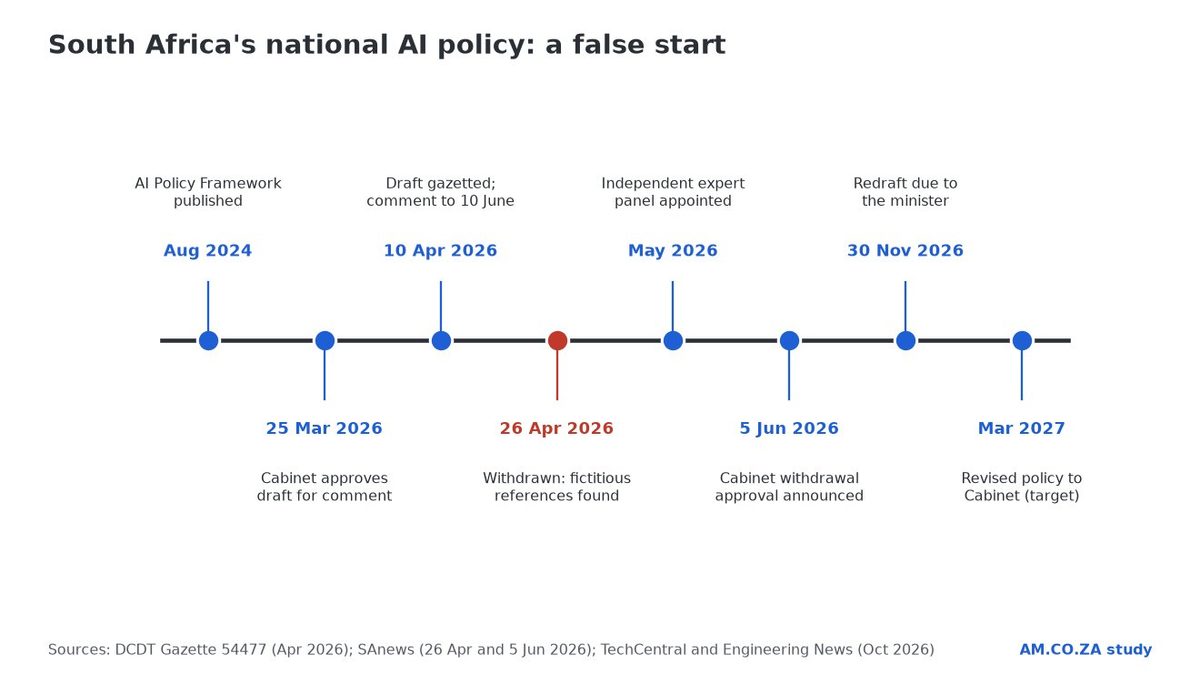
The most vivid South African lesson about AI accuracy came from the state itself. Cabinet approved a Draft National Artificial Intelligence Policy in March 2026, and it was gazetted for public comment on 10 April 2026 (Government Gazette 54477). Within days, reporting summarised by TechCentral showed that its reference list contained fictitious sources, some credited to journals that never published them (TechCentral, 26 April 2026). On 26 April, Communications and Digital Technologies Minister Solly Malatsi withdrew it, saying: “The most plausible explanation is that AI-generated citations were included without proper verification.” He added that the lapse “proves why vigilant human oversight over the use of artificial intelligence is critical” (SAnews, 26 April 2026). The department told Parliament that consequence management had commenced (Parliamentary reply NW5301 (NW5729E)).
If a national department can publish invented references, a busy small business can certainly send a quote with an invented specification, a tender response with a non-existent standard, or a social post with a made-up statistic. The rule is the one the minister stated: verify before anything leaves the building. Ask the AI where it got a fact, open the source, and treat any figure you cannot trace as wrong.
Dependency: renting your brain from someone else
Most AI tools used by small businesses belong to a handful of large foreign companies. Prices, features, limits and terms change without notice; free tiers shrink; accounts get suspended. A business that builds its customer service or quoting around one tool, with no copy of its own prompts, data and processes, is exposed. McKinsey found that some organisations were already choosing to build software in-house with agentic coding tools rather than buy additional software (McKinsey, 2026), but for a small business the more realistic defence is simpler: keep your own price lists, product data, templates and instructions in files you control, so you can move them to another tool if needed. Microsoft’s 2026 survey also found that its most advanced AI users deliberately do some work without AI (43%, against 30% of other users), to keep their own skills sharp.
Fraud: scams get a better voice
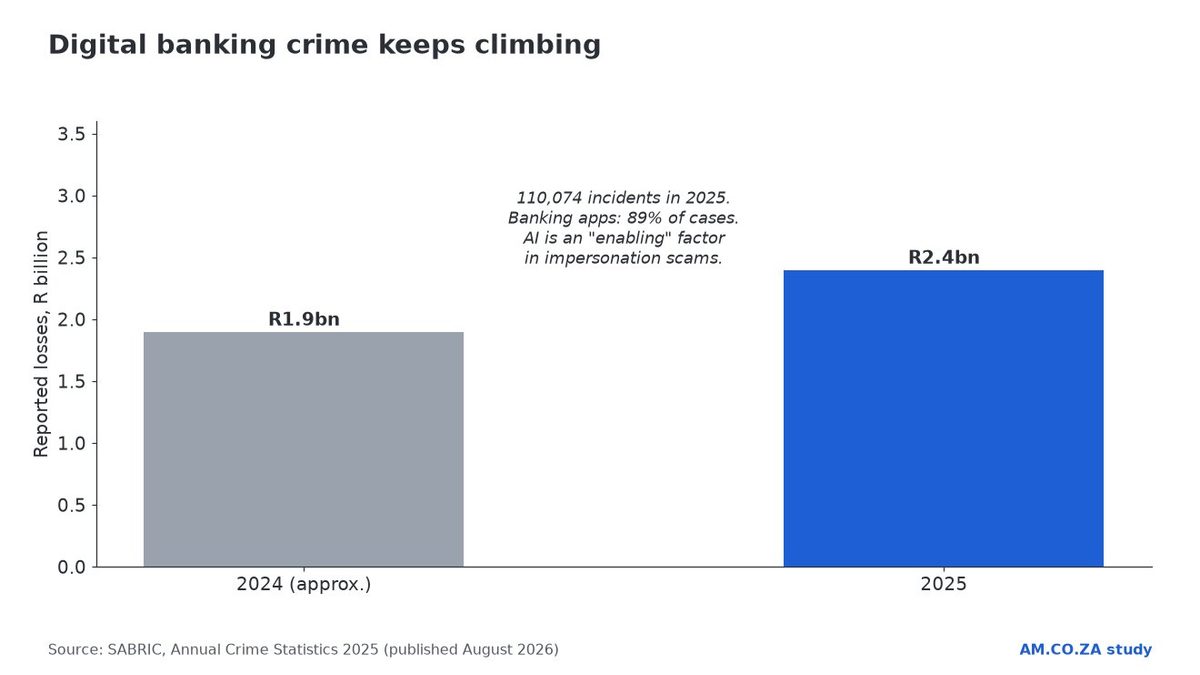
South African businesses already face heavy fraud. The South African Banking Risk Information Centre (SABRIC) reported that digital banking crime cost R2.4 billion in 2025, up from about R1.9 billion in 2024, across 110,074 reported incidents. Banking apps accounted for 89% of incidents and 70.5% of losses. Card fraud losses rose 18% to R1.7 billion. SABRIC said AI was “making some scams more convincing”, describing it as an “enabling rather than primary fraud vector” and noting isolated cases of cloned voices (SABRIC Annual Crime Statistics 2025).

The business risk is specific. A cloned voice of a supplier asks for payment to a “new account”. A fake email in perfect English, with a real-looking invoice, arrives from a “customer”. A deepfake video call impersonates a manager. Writing in TechCentral in August 2026, Nishan Maharaj of Entersekt noted Standard Bank’s March 2026 warning about AI-enabled impersonation and cited the Association of Certified Fraud Examiners’ 2026 Anti-Fraud Technology Benchmarking Report, which found that only 7% of organisations are more than moderately prepared to detect and prevent AI-powered fraud (TechCentral, 14 August 2026).
Defences cost nothing but discipline. Confirm any change of bank details by calling a number you already have, never one in the message. Agree a code word with key suppliers and family. Never act on urgency alone. Keep two people involved in large payments where possible.
Part 7: Where government policy stands
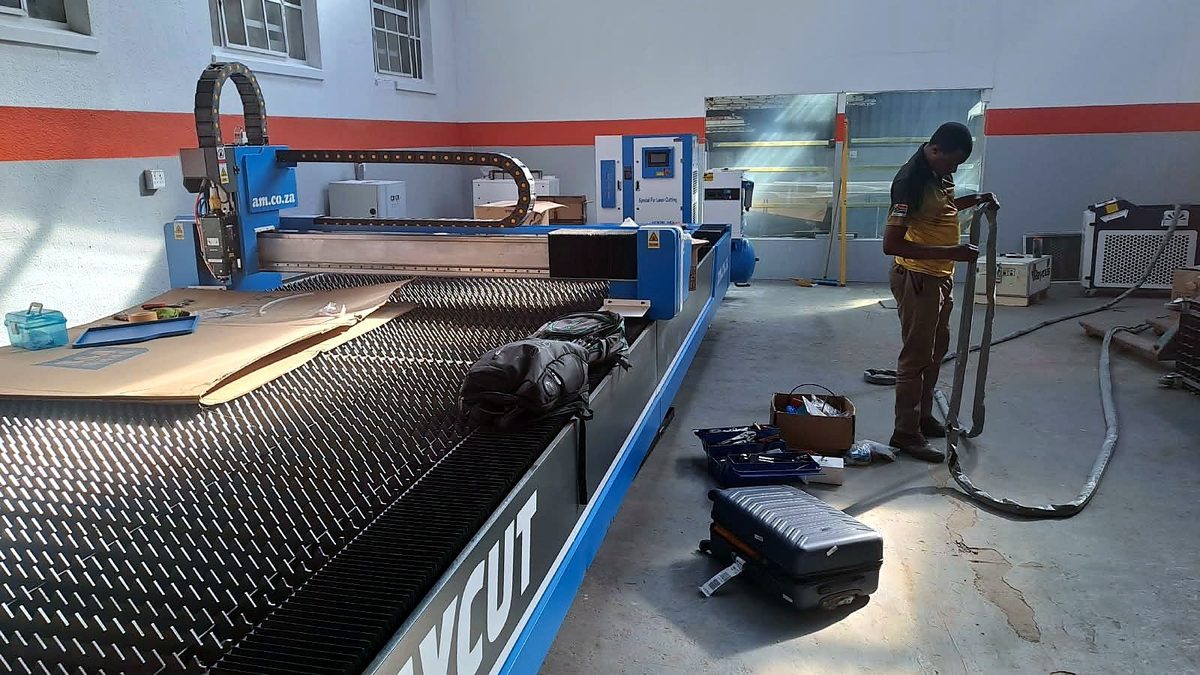
South Africa does not yet have a national AI law or an approved national AI policy. The Department of Communications and Digital Technologies released a discussion document on a national AI plan in April 2024 and published a National AI Policy Framework in August 2024. The withdrawn 2026 draft had proposed new bodies and incentives, including a National AI Commission, an AI Ethics Board and an AI Regulatory Authority, along with tax breaks, grants and subsidies (Government Gazette 54477); it was withdrawn 16 days after it was gazetted (SAnews, 26 April 2026), and the communications department placed two unnamed officials on precautionary suspension pending investigation (ITWeb). On 5 June 2026, Minister in the Presidency Khumbudzo Ntshavheni announced that Cabinet had approved the withdrawal, saying it “will allow a rework of the AI policy to ensure it achieves its intended goals and that it establishes national standards on the ethical use of AI” (SAnews, 5 June 2026).
In May 2026, Minister Malatsi appointed a seven-member independent expert panel chaired by Wits University AI researcher Benjamin Rosman, and a government drafting team led by the department is rewriting the policy. Jeanette Morwane, the department’s acting deputy director-general and project manager for the policy, said in late October that the team had a deadline of 30 November 2026 to submit the revised policy to the minister, followed by internal government consultations from December to February and submission to Cabinet by March 2027, mainly to gazette it for public comment (TechCentral, 29 October 2026). She said discussions were focusing on compute and data sovereignty and on model sovereignty, to ensure large language models incorporate South Africa’s official languages.
The direction has also shifted. Rather than creating new AI regulators, as the withdrawn draft proposed, Morwane said government should look at capacitating and empowering existing regulators (Engineering News, 23 October 2026). At the same event, National Consumer Commission acting commissioner Hardin Ratshisusu said regulators would “most likely” be able to address AI-based fraud and misinformation using the Consumer Protection Act, and Competition Commission commissioner Doris Tshepe said the commission was watching AI uses such as personalised pricing.
For small businesses, the practical meaning is that AI is already regulated, just not by an AI-specific law. POPIA covers personal information, the Consumer Protection Act covers misleading claims and unfair dealing, the Electronic Communications and Transactions Act covers electronic contracts, and copyright and trademark law covers what AI produces. A business that follows the existing rules is unlikely to be caught out by the new policy when it comes.
Part 8: AI alongside the machines
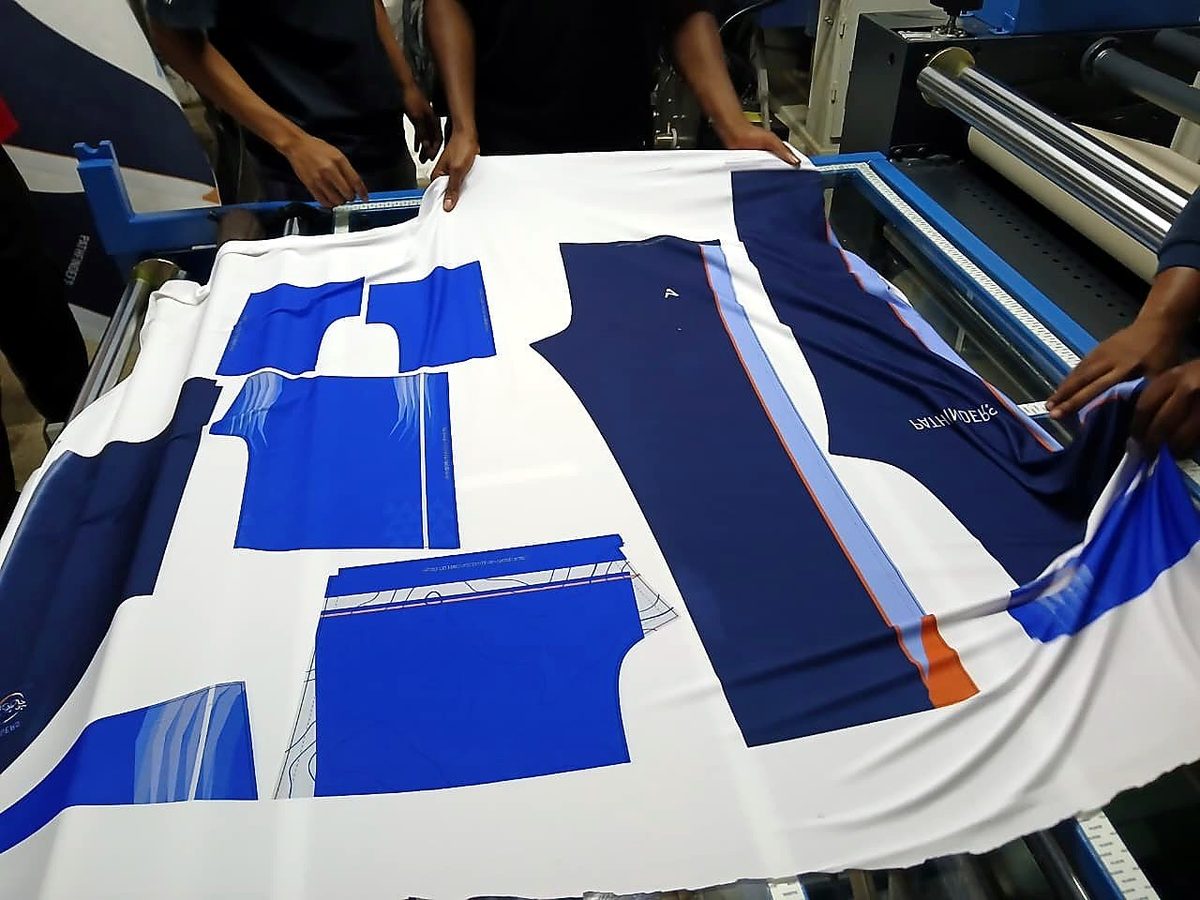
For small manufacturers, print shops and home-based makers, the most useful way to think about AI is as a helper at each step of a job, with the machine and the operator still at the centre. A typical job flows like this:
- Enquiry. A customer sends a WhatsApp message with a photo. AI helps draft a fast, friendly first reply and lists the questions to ask: size, quantity, material, deadline, delivery.
- Quote. AI reads the details into the business’s own pricing sheet and drafts the quotation. The owner checks the price and sends it.
- Design. AI tools produce concepts, clean up the customer’s logo, remove backgrounds or vectorise artwork. The designer checks rights and prepares the production file.
- Machine set-up. AI explains a manual, suggests a starting setting for a new material, or helps decode an error. The operator runs a test piece first.
- Production. The machine and the operator do the work. Built-in camera, nesting and sensor systems help with accuracy and material use.
- Finishing, packing and delivery. AI drafts care instructions, delivery messages and a request for a review or a photo.
- Admin. AI helps categorise receipts, chase late payments politely and update stock counts and reorder lists.

At every step, the person checks before anything goes to the customer or the machine. That is how AI fits alongside a router, laser, printer or press: it saves minutes on the work around the job, so more hours go into the job itself.
How AM.CO.ZA uses AI
AM.CO.ZA has built its own AI tools around one principle: answers should come from checked information, with sources, not from guesswork. Its assistant, Ephraim AI, answers questions through Ask AI, a live chat drawing on the AM.CO.ZA public knowledge base for visitors in Southern Africa (SADC). Visitors can ask about machines, consumables, applications and support, and can add a photo of a machine or a sample.
For people who already use their own chatbot, AI Connect provides a single prompt to paste into ChatGPT, Meta AI, Gemini, Copilot or Claude. It tells the user’s AI to read the AM.CO.ZA public knowledge base, starting with current stock, then application scenarios, and to cite the pages it used rather than inventing stock or prices. Developers and businesses that want to build their own assistant can use AI Builder, which explains how to use the AM.CO.ZA public knowledge data for retrieval-augmented generation (RAG), custom assistants or local models.
The same approach runs through after-sales support. Every AM.CO.ZA machine carries a barcode that anyone can check at am.co.za/status for warranty and service history. Buythis, AM.CO.ZA’s procurement site, lists more than 900 spare parts for AM.CO.ZA machines, and on-site installation, repair and maintenance are handled through Machine.Africa. Public prices on Buythis are already Cheers VIP prices. A companion AM.CO.ZA study, Factories of One, covers South Africa’s small-machine economy.
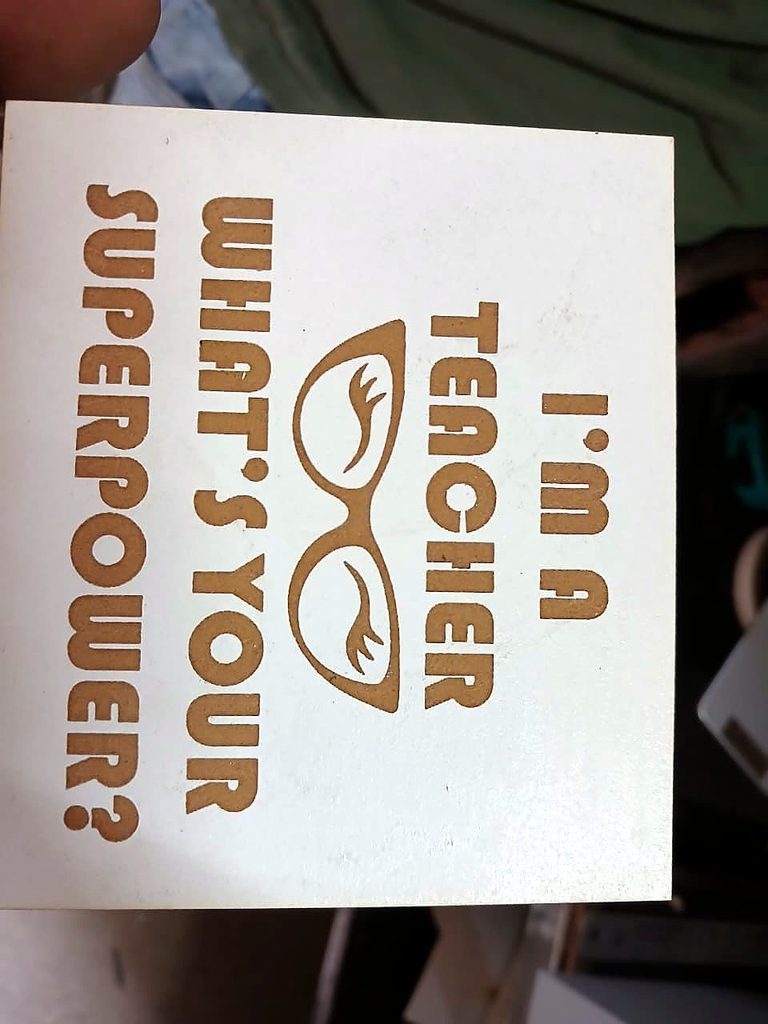
Five ideas for makers
- Turn your price list into an AI-ready document. A clear table of products, sizes, materials, prices and lead times makes every AI quote and customer reply better and safer.
- Keep a “job book”. Record the settings, materials and results of each job. Over time it becomes your own knowledge base, which AI can search and summarise.
- Photograph everything. Good photos of finished work feed marketing, help AI write accurate descriptions, and build trust with customers.
- Use AI to learn, not only to produce. Ask it to explain a technique, a material or a machine feature, then test that knowledge on scrap.
- Offer AI-assisted personalisation. Names, school badges, event dates and custom designs are where small machines beat mass production. AI makes it faster to produce many variations; the machine makes each one real.
Part 9: A getting-started checklist
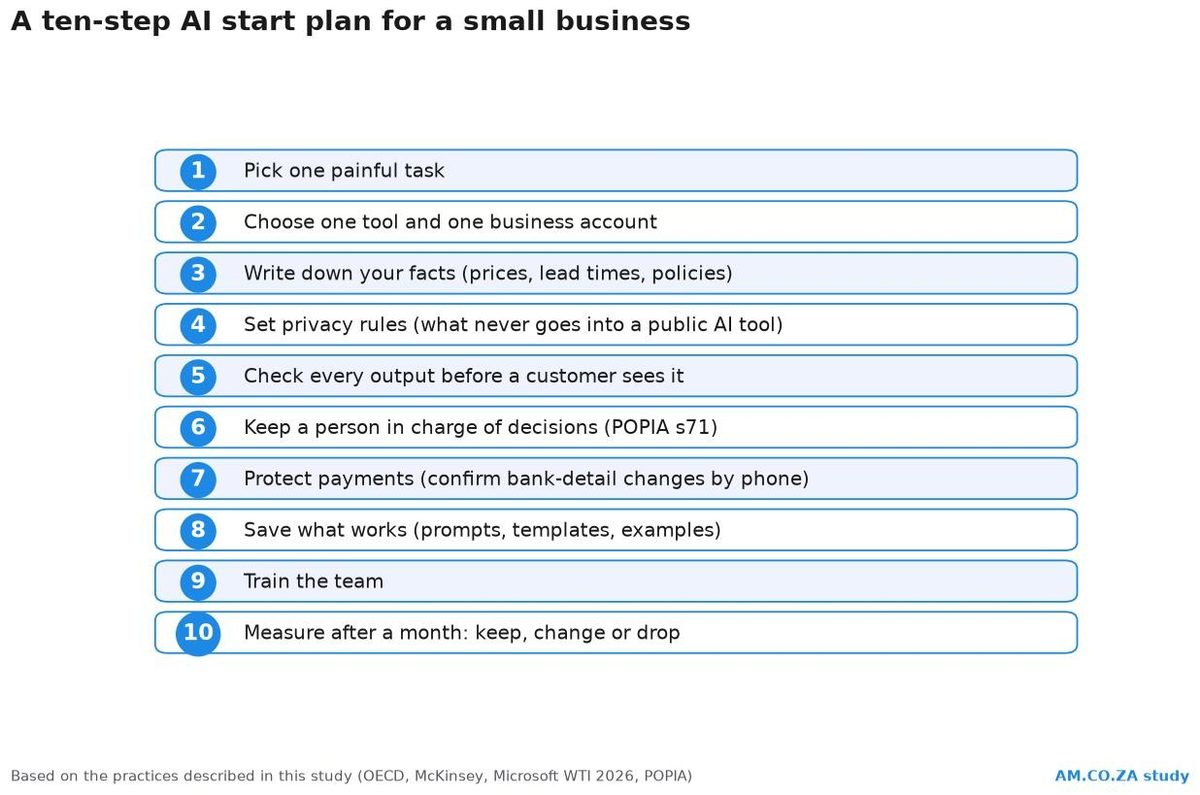
For a small business that has not yet used AI deliberately, or that uses it in scattered ways, these ten steps offer a safe, low-cost start.
- Pick one painful task. Choose a job that eats time every week, such as replying to enquiries, writing posts, quoting or chasing payments. Start there, not everywhere.
- Choose one tool and one account. Use a business account with clear terms on how your data is used. Avoid a mix of free personal accounts for business data.
- Write down your facts. Prepare a one-page document with your products, prices, lead times, delivery areas and policies. Give it to the AI every time you ask it something important.
- Set privacy rules. Agree what must never go into a public AI tool: ID numbers, bank details, customer lists, staff records, passwords. Remove names before analysing data.
- Check every output. Read every quote, message and figure before it leaves. Ask the AI for its sources and open them. Treat anything you cannot check as wrong.
- Keep a person in charge of decisions. AI can recommend; a person decides on prices, credit, hiring and complaints, as POPIA section 71 expects.
- Protect payments. Confirm any change of bank details by calling a number you already have. Agree code words with key suppliers. Never pay on urgency alone.
- Save what works. Keep good prompts, templates and examples in a shared document so the whole team benefits and you can move to another tool if needed.
- Train the team. Show staff what the business uses AI for, what is not allowed, and how to check results. Use free courses and supplier training.
- Measure after a month. Note how much time the task took before and after, and whether quality or customer response improved. Keep what works; drop what does not.
Conclusion: the businesses that learn to steer will win
AI’s arrival in South Africa’s small businesses is real, fast and uneven. Owners are already using it, mostly for writing, quick answers and marketing, mostly through free tools, and often without a plan. The global evidence shows that the gains are real at the level of individual productivity, but turning them into profit requires changing how work is done, not just adding a chatbot. Large firms are pulling ahead on deeper uses such as AI agents, and small firms risk being left with the shallow end.
For South Africa, the stakes are higher than in most countries. With unemployment at 33.7% and millions of people working in very small and informal businesses, AI’s best contribution is not to replace workers but to help small businesses compete, formalise and grow. That needs affordable data, reliable power, practical skills and sensible rules. Mobile access is broad, data prices are falling, load-shedding has eased, and a revised national AI policy is due to go to Cabinet in 2027. Skills and confidence remain the biggest gap.
The risks are real but manageable with ordinary discipline: protect personal information under POPIA, check every output, keep your own data and know-how, keep a person in charge of decisions that matter, and treat every unexpected payment request as a possible scam. The government’s own withdrawn AI policy is the clearest warning of what happens when checking is skipped.
For small manufacturers, print shops and home-based makers, the outlook is better than the headlines suggest. Their work is physical, skilled and personal, which is exactly what AI finds hardest to replace. AI can take hours out of quoting, design, marketing and admin, and give them back to production and customers. The businesses that learn to use it carefully, alongside their machines and their own judgement, will be the ones that grow.
Disclosure: This study was prepared by AM.CO.ZA, a supplier of machines, consumables, spare parts and training to small manufacturers, print and sign businesses and makers. AM.CO.ZA’s products and AI tools are mentioned in Part 8. The study relies on the public sources listed below; where survey samples are not representative, this is noted in the text. Images marked “Illustration only” are illustrations; photos are from AM.CO.ZA.
Sources
South African statistics and economy
- Stats SA, General Household Survey 2025 (full report, tables 14.1 and 14.3). https://www.statssa.gov.za/publications/P0318/P03182025.pdf
- Stats SA, Quarterly Labour Force Survey Q3 2026 (statistical release). https://www.statssa.gov.za/publications/P0211/P02113rdQuarter2026.pdf
- FinMark Trust, FinScope MSME South Africa 2024 key findings. https://www.finmark.org.za/knowledge-hub/articles/finscope-msme-south-africa-2024-key-findings-highlight-urgent-need-for-informal-sector-support?entity=blog
- Stats SA, Quarterly Labour Force Survey Q3 2026 (media release). https://www.statssa.gov.za/publications/P0211/Media%20Release%20QLFS%20Q3%202026.pdf
- ICASA, Bi-Annual Tariff Analysis Report, March 2026. https://www.icasa.org.za/uploads/files/2025-26-FY-Q4-Bi-Annual-Tariff-Analysis-Report-For-Publication-23032026.pdf
- ICASA, State of the ICT Sector Report 2026. https://www.icasa.org.za/uploads/files/The-State-of-the-ICT-Sector-Report-of-South-Africa-31-March-2026.pdf
- NCOP oral reply on data prices, January 2026. https://static.pmg.org.za/RCW1418-2026-01-09.pdf
- MyBroadband, data prices. https://mybroadband.co.za/news/broadband/628760-data-prices-plummet-in-south-africa.html
- EWN, Eskom targets end to load reduction, 9 November 2026. https://www.ewn.co.za/2026/11/09/eskom-targets-end-to-load-reduction-after-540-days-free-of-load-shedding
- SEDFA. https://www.sedfa.org.za/
AI adoption surveys
- Xero, 2026 State of Small Business Report (South Africa). https://brandfolder.xero.com/NE531UQB/as/m3xjstjh28hhk8sj9rvqs8xx/2026_State_of_Small_Business_Report
- OECD, SME Digitalisation for Competitiveness: The 2025 OECD D4SME Survey. https://www.oecd.org/content/dam/oecd/en/publications/reports/2025/04/sme-digitalisation-for-competitiveness_3116862a/197e3077-en.pdf
- OECD, Generative AI and the SME Workforce. https://www.oecd.org/en/publications/generative-ai-and-the-sme-workforce_2d08b99d-en/full-report/component-4.html
- OECD, D4SME Roundtable Roundup 2025. https://www.oecd.org/content/dam/oecd/en/events/2025/04/6th-d4sme-meeting/D4SME-Roundtable-Roundup-2025.pdf
- McKinsey, The state of AI in 2026. https://www.mckinsey.com/capabilities/quantumblack/our-insights/the-state-of-ai
- McKinsey, The state of AI in 2025. https://www.mckinsey.com/capabilities/quantumblack/our-insights/the-state-of-ai-2025
- Microsoft WorkLab, 2024 Work Trend Index. https://www.microsoft.com/en-us/worklab/work-trend-index/ai-at-work-is-here-now-comes-the-hard-part
- Axios, Employees bring their own AI, May 2024. https://www.axios.com/2024/05/08/employees-bring-their-own-ai-microsoft-linkedin
- Microsoft, 2026 Work Trend Index Annual Report. https://marketingassets.microsoft.com/adobe/assets/urn:aaid:aem:a2213889-7dac-4d02-bb50-db1f38e9d0d4/original/as/EN-GB-Analyst%20Report%20-%202026%20Work%20Trends%20Index%20Report.pdf
- Hypertext, Microsoft trained more than 1.4 million South Africans, January 2026. https://htxt.co.za/2026/01/microsoft-trained-more-than-1-4-million-south-africans-on-ai/
- Microsoft, Microsoft invests R5.4bn in South Africa, March 2025. https://news.microsoft.com/source/emea/features/microsoft-invests-zar-5-4bn-in-south-africa/
Jobs and skills
- WEF, Future of Jobs Report 2025: Jobs outlook. https://www.weforum.org/publications/the-future-of-jobs-report-2025/in-full/2-jobs-outlook/
- WEF, Future of Jobs Report 2025: Skills outlook. https://www.weforum.org/publications/the-future-of-jobs-report-2025/in-full/3-skills-outlook/
- WEF, Future of Jobs Report 2025: Region, economy and industry insights. https://www.weforum.org/publications/the-future-of-jobs-report-2025/in-full/5-region-economy-and-industry-insights/
- ILO, One in four jobs at risk of being transformed by GenAI, May 2025. https://www.ilo.org/resource/news/one-four-jobs-risk-being-transformed-genai-new-ilo%E2%80%93nask-global-index-shows
Privacy, fraud and risk
- Information Regulator, Strategic Reports (annual performance plans). https://inforegulator.org.za/strategic-reports/
- Information Regulator, POPIA. https://inforegulator.org.za/popia/
- Protection of Personal Information Act 4 of 2013. https://www.gov.za/documents/protection-personal-information-act
- POPIA Act PDF (includes section 71 on automated decision making). https://www.gov.za/sites/default/files/gcis_document/201409/3706726-11act4of2013popi.pdf
- ITWeb, Information Regulator readies for AI era, 14 April 2025. https://www.itweb.co.za/article/information-regulator-readies-for-ai-era/KWEBb7yLkGNvmRjO
- SABRIC, Annual Crime Statistics Report 2025. https://www.sabric.co.za/wp-content/uploads/2026/08/SABRIC-Annual-Crime-Statistics-Report-2025.pdf
- TechCentral, AI fraud is outrunning South African banking defences, 14 August 2026. https://techcentral.co.za/ai-fraud-is-outrunning-south-african-banking-defences/284855/
AI policy
- Government Gazette 54477, Notice 3880: Draft South Africa National Artificial Intelligence Policy, April 2026. https://www.gov.za/sites/default/files/gcis_document/202604/54477gen3880.pdf
- SAnews, Minister announces withdrawal of draft AI policy, April 2026. https://www.sanews.gov.za/south-africa/minister-announces-withdrawal-draft-ai-policy
- SAnews, Cabinet approves withdrawal of AI policy, 5 June 2026. https://www.sanews.gov.za/south-africa/cabinet-approves-withdrawal-ai-policy
- PMG, Question to the Minister of Communications and Digital Technologies, NW5301 (NW5729E), reply October 2026. https://pmg.org.za/committee-question/41355/
- TechCentral, South Africa’s AI policy team is racing a 30 November deadline, 29 October 2026. https://techcentral.co.za/south-africa-national-ai-policy-deadline-cabinet-march-2027/287817/
- Engineering News, Revised national AI policy paper expected in March, 23 October 2026. https://www.engineeringnews.co.za/article/revised-national-ai-policy-paper-expected-in-march-2026-10-23
- ITWeb, Two officials suspended over botched draft AI policy. https://www.itweb.co.za/article/two-officials-suspended-over-botched-draft-ai-policy/xA9POvNEoGJqo4J8
- TechCentral, Malatsi withdraws AI policy after fictitious sources scandal, 26 April 2026. https://techcentral.co.za/malatsi-withdraws-ai-policy-after-fictitious-sources-scandal/280674/
You have read 1 out of 5 free articles. Log in or register for unlimited access.










 Loading ...