
The South African government wanted economic growth of 5.4%, but it fell to under 1%


The South African Government’s National Development Plan (NDP) 2030 set a goal of 5.4% GDP growth. Instead of increasing economic growth, it plummeted to under 1%.
The government published its National Development Plan (NDP) 2030 in 2012, providing a roadmap for the country over the next eighteen years.
The former Minister in the Presidency of the National Planning Commission, Trevor Manuel, launched the plan during a joint sitting of both houses of Parliament.
Manuel said the NDP was the product of thousands of inputs and perspectives from South Africans.
It received inputs from individuals and organisations and engaged with government departments, provinces, municipalities, and state-owned enterprises.
“They spoke about the ravages of crime. They expressed concern that good policies are poorly implemented and therefore fail,” Manuel said.
These consultations and feedback were used to develop the NDP, which set overarching objectives and key targets for various sectors.
The National Development Plan also made 119 recommendations on how these targets can be achieved.
“It is a plan for a better future in which no person lives in poverty, where no one goes hungry, where there is work for all,” he said.
To address the extreme levels of unemployment, especially youth unemployment, the NDP 2030 focused on economic growth.
It said Gross Domestic Product (GDP) should increase by 2.7 times in real terms by 2023. This represents inflation-adjusted growth.
Achieving this target required an average annual Gross Domestic Product (GDP) growth of 5.4% between 2012 and 2030.
It added that GDP per capita should increase from about R50,000 per person in 2010 to R110,000 in 2030, in constant prices.
Simply put, the government wanted to more than double GDP per capita, which is a good measure of living standards.
Time to take see what really happened
2030 is fast approaching, and it is time to see how the government performed in achieving its National Development Plan targets.
Between 2012 and 2025, South Africa’s real GDP growth has been characterized by a prolonged period of stagnation.
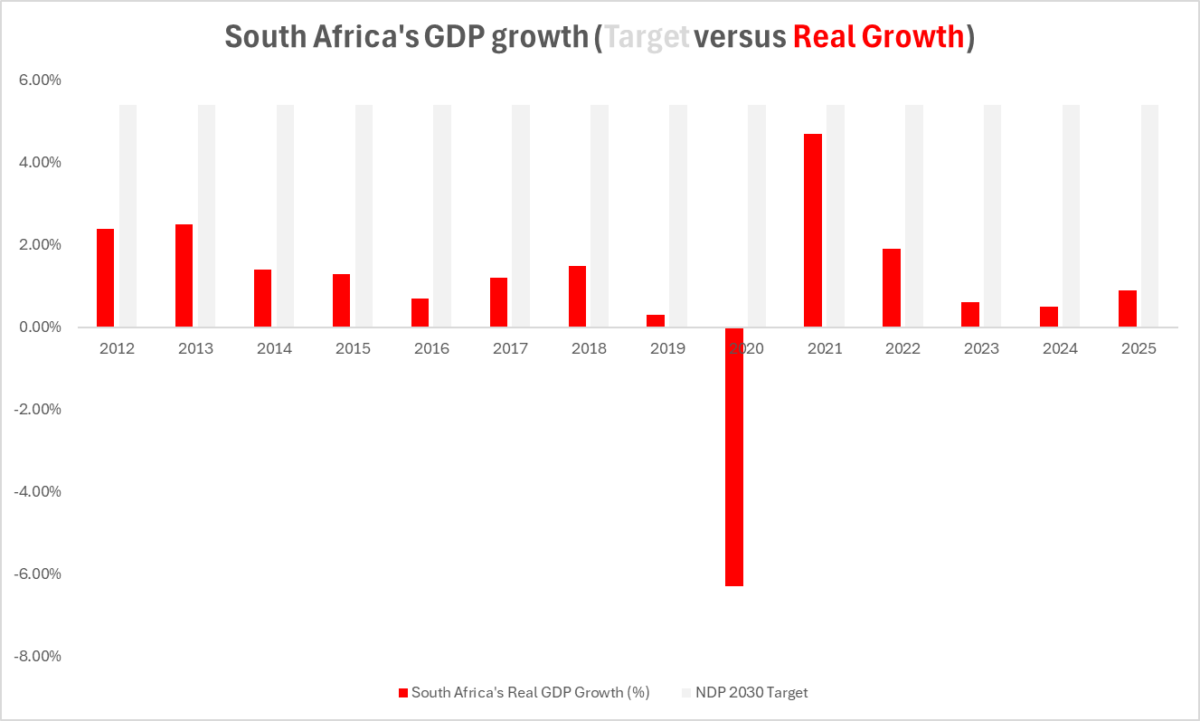
During the Presidency of Jacob Zuma, South Africa’s economic growth fell from 2.4% in 2012 to 0.3% by 2019.
In the decade after the NDP 2030 was launched, GDP growth averaged only 0.8%, which is significantly lower than the population growth rate.
This means that on a per capita basis, South Africans have generally become poorer over this period.
Despite the optimism when Cyril Ramaphosa took over from Zuma as president, it did not stem the economic decline.
Over the last three years, South Africa’s economic growth has failed to exceed 1%. This was much slower than population growth.
As a result of this poor growth rate, South Africa’s GDP per capita declined further. This means people are getting poorer.
The chart below shows South Africa’s NDP 2030 GDP growth target, along with the actual growth which was achieved.
It should be noted that the 2025 growth rate has not been finalized and is based on the consensus of the World Bank and the National Treasury.







 Loading ...