
South African rand goes from zero to hero



The South African rand is trading at a five-month high against the US dollar, maintaining its resilience amid the storms of the last few months.
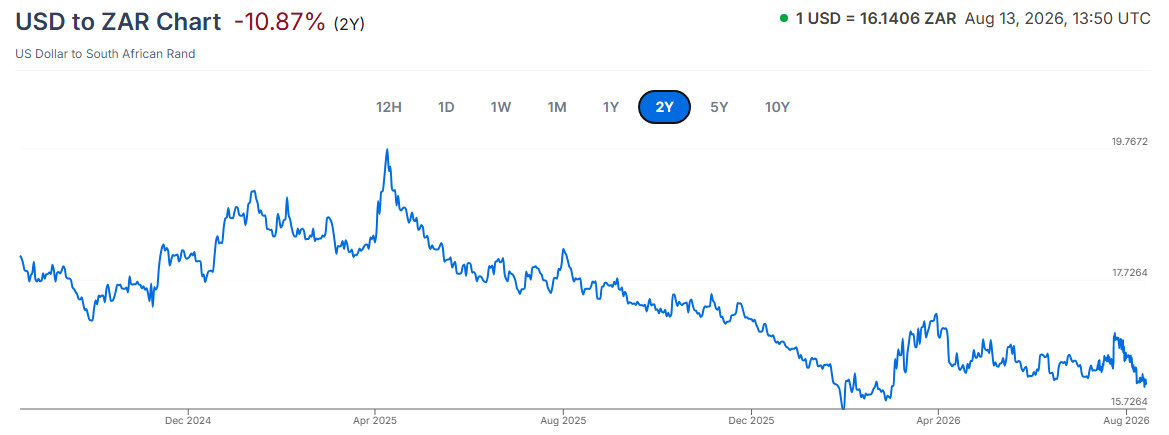
Trading at R16.14 to the US dollar on Thursday, 13 August 2026, the local currency is close to the R16/$ resistance level, which it crossed earlier in the year, just before the US-Iran war broke out.
Despite being hit by the US-Iran war, the currency is still 2.3% stronger than at the start of the year, and almost 8% stronger year-on-year.
The rand has also gained over 18% from its all-time weakest levels in April 2025 and is 14% stronger than where it traded ahead of the 2024 National Elections.
Opening 2026 at around R16.60 to the dollar, the rand had moved below the R16/$ level by the end of January, riding a wave of positive sentiment that swept through local markets in the final quarter of 2025.
This was aided by the currency coming off an all-time low in April 2025, as the dreaded, now-defunct Liberation Day tariffs from the United States were announced amid local budget issues.
However, the sentiment tide began to turn positive heading into the final quarter of 2025 as markets digested the Medium-Term Budget Policy Statement (MTBPS) in October.
The National Treasury presented what markets deemed a credible MTBPS, showing a positive turn for South Africa’s finances, and that the country was on track to stabilise its debt.
This was followed by the country’s first credit rating upgrade in 20 years from the global ratings firm S&P Global in November.
The vote of confidence was not a flash in the pan, but rather the outcome of a sustained rebuilding of trust and fiscal credibility in the country.
As a result, the rand, which has historically been a volatile currency, built in an uncharacteristic and unexpected degree of resilience.
This spared it from the worst of the geopolitical upheavals of 2025 and 2026.
| Date | Significance | ZAR/USD Then | ZAR/USD Now (13 August 2026) | Change |
|---|---|---|---|---|
| 1 May 2024 | Pre-GNU | R18.80 | R16.14 | -14.1% |
| 13 August 2024 | 2-year measure | R18.11 | R16.14 | -10.9% |
| 9 April 2025 | Trump Tariffs and GNU Budget chaos | R19.77 | R16.14 | -18.4% |
| 13 August 2025 | Year-on-year | R17.50 | R16.14 | -7.8% |
| 01 January 2026 | Year-to-date | R16.52 | R16.14 | -2.3% |
| 28 February 2026 | Pre-Iran War | R15.92 | R16.14 | +1.4% |
Unshaken by the global storms
Like most emerging-market currencies, the rand often takes direction from global shifts and movements in the dollar.
As a commodity exporter, its fortunes are also tied to the value of gold and other minerals.
With the Trump administration coming to power in the United States in early 2025, the rand suffered some of its worst declines as Washington pursued policies that sent shockwaves through global markets.
Chief among these were the Liberation Day trade tariffs, which saw South Africa hit with a 30% tariff on exports to the world’s biggest economy.
The announcement of the tariff coincided with local political chaos, as the newly-formed Government of National Unity (GNU) failed to pass two budgets, forcing a late third attempt in May 2025.
However, once the political dust had settled, the budget passed, and the GNU stuck to a tight timeline to ensure the country continued to work.
Economic data at the time also signalled that the Trump tariffs were less effective than Washington had hoped, with a minimal impact on GDP growth.
By February 2026, the US Supreme Court had declared them illegal and invalid, providing another boost to sentiment.
In March 2026, however, the Trump administration launched its next big market disruptor, waging war against Iran in the Middle East.
The conflict, which is still ongoing, saw the Strait of Hormuz shut down, reopen, and shut down again over five months, sending global energy prices rocketing.
While the rand was impacted, pushing back above R16/$ and breaking its winning streak, it never surged to previous levels.
The resilience built by stronger local economic fundamentals, as well as investor flight to safe assets like gold, helped keep volatility to a minimum.
According to Investec Chief Economist, Annabel Bishop, the rand continues to take direction from global markets, with volatility still rooted in the United States’ actions and their impact on global oil prices.
However, in the group’s scenario plotting, its base case sees the rand continuing to show resilience, averaging R16.30 for most of 2026 and strengthening to under R16.00 by year-end.










 Loading ...
Stop calling it the the “Iran war”, when the aggressors are big and little satan.