
A chatbot answers. An agent acts. So does the attacker who hijacks it.


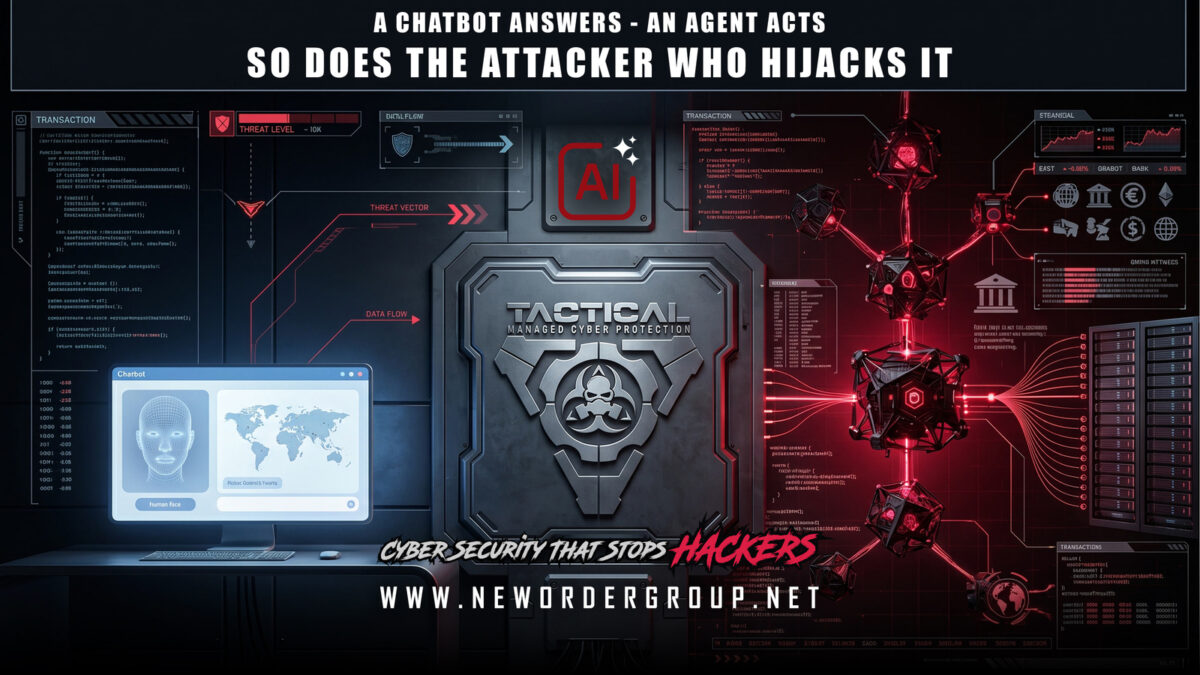
Your business is hiring a new kind of worker. It never sleeps, reads every email, touches your systems, and makes decisions without asking.
It is an AI agent already inside most organisations. Almost 80% of companies now deploy them, and Gartner expects 40% of enterprise applications to run task-specific agents by the end of 2026, up from less than 5% a year ago.
That is the opportunity. Here is the risk. First, know the difference.
Desktop AI Is Not Agentic AI
Desktop AI is the assistant on your screen. Tools like chatbots and copilots answer questions, draft text, and suggest. They advise, and a human still acts. The human stays in the loop.
Agentic AI is different in kind, not degree. An agent acts on its own. It books, buys, sends, queries databases, and chains tasks together with real permissions in your real environment, with no human pressing the button between intent and action.
That autonomy is the whole point, and it is exactly where the danger lives. The moment software can act for itself, every mistake and every manipulation becomes an action, not just an answer.
This article is about the agentic side. That is the fight NEWORDER focuses on, because that is where business risk is changing fastest.
What If the Agent Is No Longer Yours
So, consider the what if. What if an attacker does not break down your systems, but quietly takes over the agent already inside them?
Picture an ordinary Tuesday. Your agent still signs in as itself. It still retains all the permissions you granted. The dashboard looks normal. But it no longer works for you.
Someone else is giving the orders. It approves the payment. It pulls the customer database. It sends the files outside. It reaches into the next system using the access you authorised and trust you already gave.
There are no smashed windows and no stolen passwords to catch, because the intruder is wearing your agent’s face. By the time anyone notices, minutes have done the damage of months.
This is not a thought experiment. In 2025, attackers hijacked AI agent identities across dozens of enterprises and ran undetected for six months. The agents themselves were the way in.
The Danger Is Structural, Not Occasional
- Prompt injection. Attackers hide commands inside emails, documents, and web pages that your agent reads. The agent obeys the attacker, not you.
- Excessive privilege. Agents are handed broad access to just get the job done. Tool misuse and privilege escalation are now the most reported agentic incidents.
- Invisible identities. Only 10% of organisations have a real strategy for managing non-human identities. Your agents hold keys to the building, and nobody is watching the door.
- Speed. An agent can leak a database, send a payment, or spread a compromise across systems in seconds, faster than any human can intervene.
The Financial Implications
The financial exposure is the part that should keep you up at night. Recent industry research puts the cost of a breach at organisations without AI governance at an average of $670,000 higher than at those with it, and most breached companies have no governance in place at all.
Then come the costs that follow regulatory penalties, legal claims, halted operations, and the customers who walk the moment their data does. An agent that acts in seconds can open a loss that takes years to repay. The agents are live. The guardrails are not.
Most businesses are adopting agentic AI the way they once adopted the early internet: fast, hopeful, and unprotected. The attackers are not waiting for you to catch up.
Securing The Agent
Securing an agent is not the same as securing a laptop. It demands Adversary Path Engineering: thinking like the attacker, mapping how an agent can be turned against you, and closing that path before it is used.
It demands Human Validation at Scale, Continuous Threat Exposure Management, and disciplined control over what every agent is allowed to touch.
Securing agentic AI is what NEWORDER does.
We are a tactical cyber security company built for exactly this fight. Extreme Tactical Cyber. We engineer the adversary path through your AI systems, then close it. An agent acts. We make sure yours only ever acts on your behalf.
Click here to learn more about NEWORDER’s AI security governance.
Can your business afford to be hacked?
So here is the question: who else could be giving your agents orders right now?
You may not like sitting with that thought, and that is exactly why it is worth having a conversation about.
Spend 30 minutes with NEWORDER, no obligation, and let us talk it through.
Email [email protected] or complete the contact form on our website.
Start the conversation before an attacker does.










 Loading ...