
White people own 21% of South Africa’s land


Afriforum released a new report which shows that white people own 21% of South Africa’s land, well below the regularly quoted 72%.
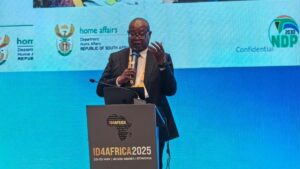
The report, titled “Fact Check: False claims about land ownership in South Africa,” was released at a conference on private property rights.
It stated that inaccurate land ownership statistics are often cited in South Africa without proper scrutiny.
“It is disconcerting that these statistics are used to justify radical land reform policies, including eroding property rights and expropriation without compensation,” it said.
Ernst van Zyl, head of public relations at Afriforum, said one of the claims is that white South Africans own 72% of the country’s land.
This figure is derived from the 2017 Land Audit Report, which refers to agricultural land and smallholdings in South Africa.
Van Zyl said that the 2017 Land Audit Report raised questions about the audit’s accuracy, methodology, and interpretation.
“In early 2025, members of Parliament acknowledged that a credible land audit was necessary to address the untrustworthiness of the existing statistics,” he said.
Despite these problems, the 2017 Land Audit’s statistics continue to be cited, which Van Zyl said is misleading and potentially dishonest.
“The claim that whites control 72% of the land is disinformation, in the original and true sense of the word,” he said.
He added that the government’s data is outdated and inconsistent, failing to properly classify state-owned land, corporate holdings, or traditional communal territories.
Furthermore, the report highlighted governance failures within the land reform process, including widespread corruption and high failure rates on redistributed farms.
What the Afriforum report revealed
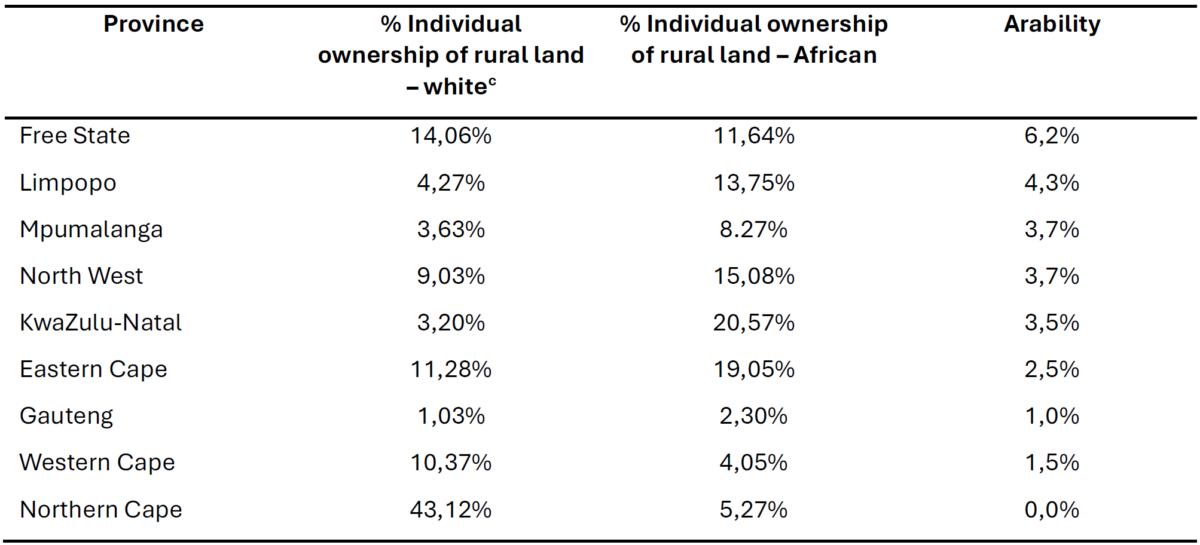
The Afriforum report argued that the 72% white-owned land figure refers only to individually owned agricultural land and smallholdings.
When measured against South Africa’s total land area, white-owned rural land accounts for approximately 21%.
The state, not white people, is the largest single landholder, controlling roughly 23% of the country’s land.
It added that a significant portion of South African land cannot be classified by race due to various ownership structures.
Trusts, companies, and community-based organisations comprise nearly 45.9% of land ownership that cannot be racially profiled.
That means that only about 30% of South Africa’s total 122 million hectares can be accurately profiled by race.
Afriforum said that 2.8 million hectares administered by the Ingonyama Trust were classified as state land rather than attributed to a racial category.
The Zulu Monarch serves as the sole trustee of the Ingonyama Trust. Classifying it as state land reduces black land control in reporting.
The report further argued that measuring land in South Africa purely by hectares ignores productive value.
Only 26.4% of South Africa’s land is arable. For example, the Northern Cape contains 43% of all individually owned white rural land, yet it has 0% arable land.
Another focus of the report was urbanisation in South Africa, which increased from 56% in 1993 to 67% in 2024.
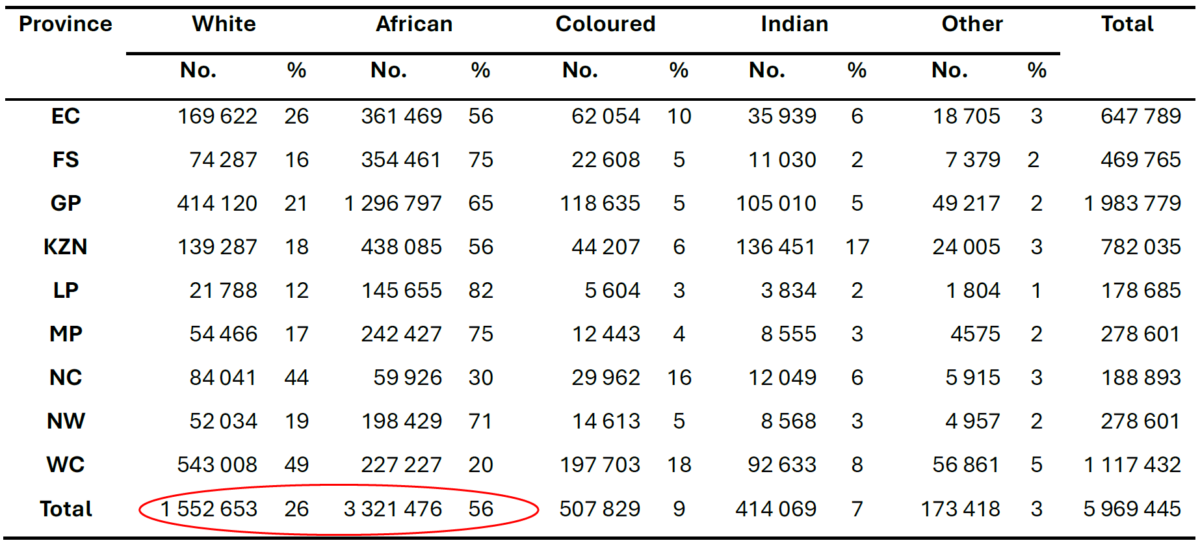
Black South Africans own more individual urban land than white people in eight of the nine provinces. The Northern Cape was the only exception.
For individual urban land ownership, white people own approximately 26% of the parcels nationally.
Share of individually owned rural land
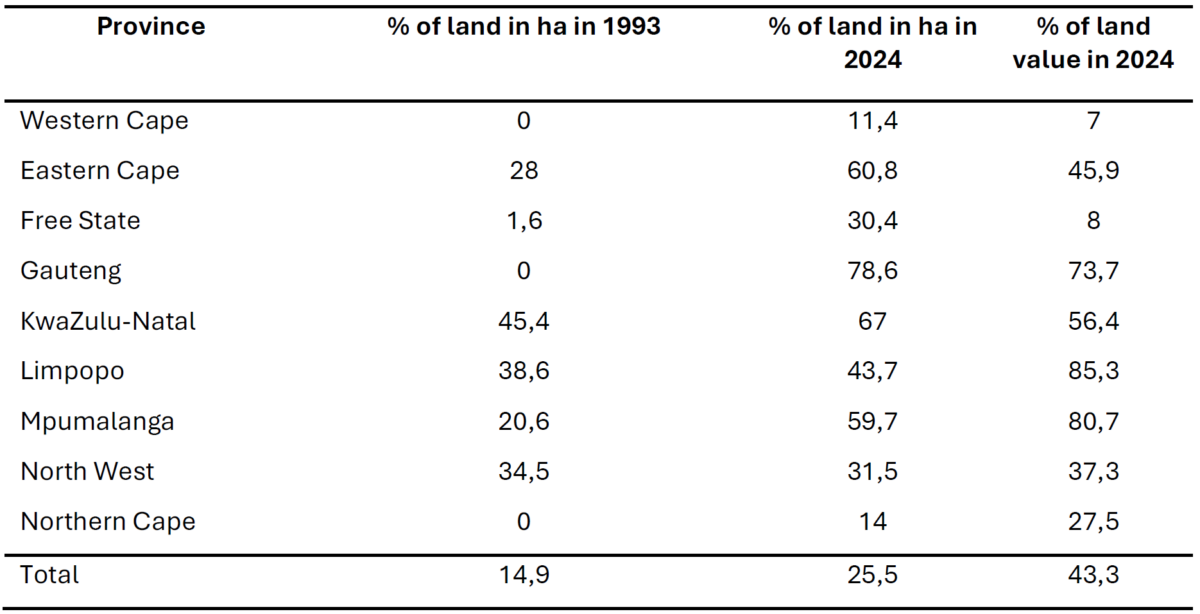
Agricultural land under black ownership
Individual-owned erven per race
 Loading ...
The only people that left racism behind and believed in the new South Africa in 1994, were the whites. This created the opportunities the anc wanted, The End.