
The ANC is dying



The African National Congress (ANC) is on its last legs, after having had such a destructive impact on the economy and the country that its failures have become undeniable to the electorate.
This is according to renowned economist Dawie Roodt, who expressed these opinions in an interview with the Praag podcast.
ANC support dropped to 40% in the 2024 National elections after holding an outright majority since 1994.
It faced a similar reality in the 2021 Local Government Elections (LGEs) when it received 45% of the national vote.
Roodt said that South Africans are gradually changing their mindset and voting habits to remove the ANC from power, seeing it as a destructive force.
Roodt said that incompetence and corruption have weakened the party, but the central reason for its demise will be its foundational ideology.
“The ideology the ANC subscribes to is a leftist ideology. You can call it socialism, communism, developmentalism, but it is rooted in the ideas codified by Karl Marx,” Roodt said.
Karl Marx’s ideology was developed in the mid-19th century. According to the Economic Times Economy dictionary, “Marxism is a social, economic and political philosophy that analyses the impact of the ruling class on the labourers.”
“This leads to uneven distribution of wealth and privileges in the society. It stimulates the workers to protest the injustice.” It aims for a communist society, free of class distinctions and equal wealth.
The ANC’s alignment with leftist ideology, Roodt argues, emerged when the world split in two: the capitalist West and the communist East.
“The ANC had to choose a side, and they chose the East. It made sense to them: Europe, especially Britain, were colonial powers, and had little desire for the ANC to play a major role in South Africa,” he explained.
Outdated ideologies

The party saw itself as nonracial and supporting equality, especially of workers, so they aligned with socialist/communist ideology. Roodt argues that they’re still ideologically aligned that way today.
Marx’s labour theories were developed 200 years ago, when the economy was vastly different and centred on primary and secondary sectors such as mining, agriculture and factories, and these are where the worst labour abuses happened, Roodt said.
This is no longer the case, he explains. “For example, in South Africa 100 years ago, agriculture and mining made up more than 80% of the economy. Today it’s less than 20%. The world has changed.”
However, the ANC continues to base their policy decisions and actions on Marxist labour theory.
“Today, the ANC’s ideology is still clearly rooted in Marxist labour theory. The ANC is part of a tripartite alliance with the South African Communist Party (SACP) and COSATU,” he said,
Roodt explained that the ANC’s left-leaning, Marx-inspired ideology is the driving force behind its most controversial policies.
This includes the expropriation of land without compensation, National Health Insurance (NHI), and the Basic Education Laws Amendment Act (BELA). “These flow naturally from the ideology,” Roodt said.
“If the ideology is not suitable for a modern economy, then the policies based on it will also be unsuitable.”
Waning support
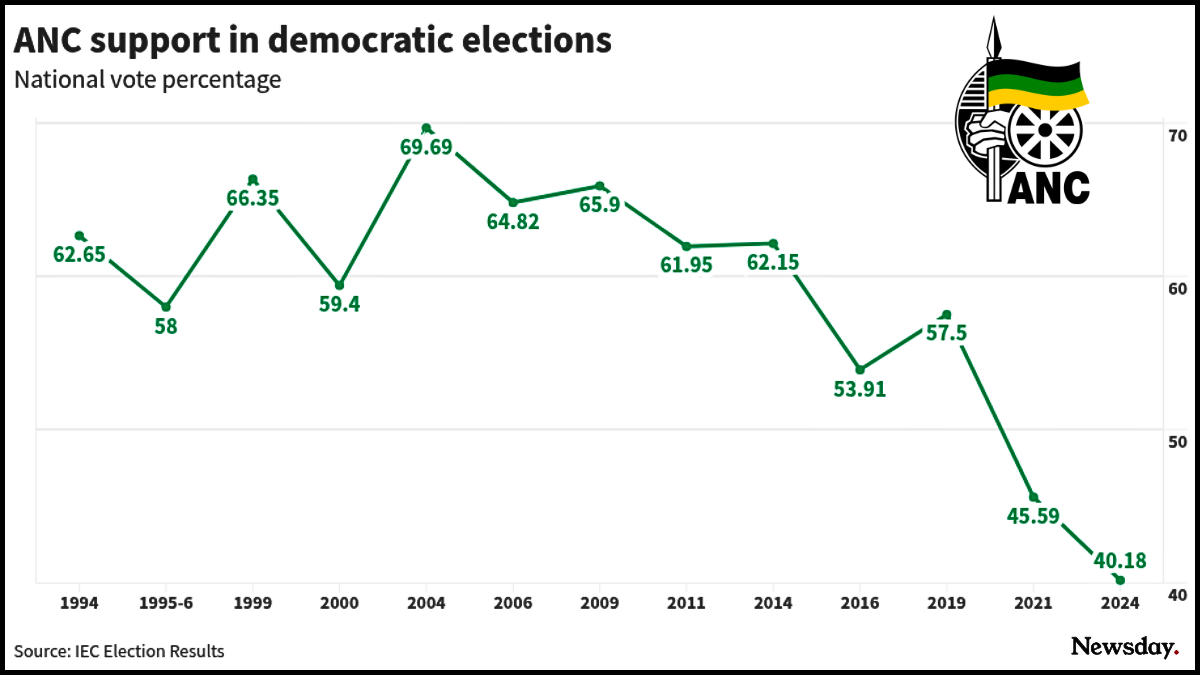
The ANC saw significant success at the national level for the first three terms that it was in power, steadily increasing its share of seats in the country’s National Assembly.
In the 1994 general elections, the ANC won 62.6% of the vote. Five years later, this increased to 66.3%.
By 2004, reached the height of its reign when it secured more than two-thirds of the vote, 69.7%, under Thabo Mbeki. However, it would only be downhill from there.
The initial decline was slow, dropping to 65.9% under newly elected ANC President Jacob Zuma in 2009 and then to 62.1% in 2014.
The 2019 elections saw the party come the closest it had been to losing its outright majority, when it achieved 57.5% of the vote in the 2019 elections under Cyril Ramaphosa.
The party itself has blamed service delivery issues for its decline. At a roll call event in mid-September, Cyril Ramaphosa warned over 4,600 of the party’s municipal councillors that if it does not tend to this, it will lose the remainder of its support.
“If we don’t tend to the needs of the people, then we die,” he said. He warned that any councillor who opposes the party’s attempts to “reform service delivery” in its municipalities will be shown the door.
Recent polling data from the Social Research Foundation indicates that support for the ANC is on the decline.
In a survey of 1,002 registered voters, the foundation recorded that the ANC had 37% of the respondents’ support, coming neck and neck with the Democratic Alliance, which received 32%.
This shows a decline over the last year. In a separate poll in June 2025, the ANC was found to have 40% of voter support, a decrease from 45% in September 2024.
The foundation also questioned voters on their opinions of the leading party. “Seventy three percent linked the ANC with the phrase ‘broken promises’, and 63% said it only cares about itself,” the foundation said.
Additionally, only 22% of respondents believed that the ANC has the best policies.









 Loading ...
Best news i have read all year.