
Secrecy surrounds Jacob Zuma’s MK Party funding



During one of South Africa’s fiercest election contests, Jacob Zuma’s uMkhonto weSizwe Party (MKP) reported just R2.8 million in declared income from donations and membership fees — a sum critics say hardly matches its high-profile campaign.
This figure comes from the Independent Electoral Commission’s (IEC’s) Annual Political Party Funding Report for the 2023/2024 financial year.
The time period raises eyebrows, as it was an expensive year for political parties, who criss-crossed the country to campaign, holding costly rallies, and purchased tens of thousands of posters, among other expenses.
Political parties have legal parameters when it comes to funding, including rules relating to donation disclosure and annual caps.
During this period, the source of any donation over R100,000 had to be disclosed, with an annual cap of R15 million per donor or entity.
This has since been doubled, while parties and donors find unique ways to circumvent these.
Every year, registered parties have to submit reports on their funding and finances to the IEC.
For the 2023/24 financial year, the MKP submitted an unaudited report, declaring that its campaign war chest was a meager R2,801,614 since its founding in December 2023, which lasted to just before the elections.
This includes.
- R705,000 of donations above the R100,000 threshold;
- R53,204 of donations below the threshold; and
- R2,801,614 in membership fees.
Following these elections, the MKP amassed 58/400 seats in the National Assembly, 9/90 in the National Council of Provinces, and 58/487 across the country’s nine provincial legislatures – not bad for a supposed R2.8 million campaign.
For reference, the ANC declared R536 million in private funding for this same period, the DA R213.3 million, and the EFF R110.7 million.
Another key thing to note is the discrepancy in the report submitted to the IEC, and quarterly donation declaration reports.
While the MKP declared R705,000 in donations above the threshold prior to the 2024 elections to the IEC in its financial statements, they did not, as is legally required, disclose where this came from.
The party has only ever declared the identity of one donor: the South African Policy Education Initiative, a not-for-profit organisation registered with the Department of Social Development.
It donated R380,555 in June 2024, after the elections.
Civil watchdog My Vote Counts (MVC) has consistently raised the alarm of non-compliance of funding regulations by parties.
It is further complicated by the fact that the entity meant to enforce the Political Funding Act, the IEC, practically has no teeth. They can only legally investigate something if they are given prime face evidence.
In the absence of a valid complaint, the IEC’s power to investigate parties for noncompliance is fairly limited.
The “IEC’s lack of investigative capacity, budget, and unclear legislative mandate have hamstrung its efforts to enforce compliance,” wrote MVC.
They said that this is seen in “evidence of noncompliance by parties such as MKP, which held large rallies on an alleged shoestring budget of R2.8 million.
The IEC acknowledges noncompliance and the difficulties it has in enforcing the Act, noting that it is working towards ‘an intensification of investigations on valid complaints by political parties and candidates’ .
MVC said that “the lack of enforcement of the Act’s disclosure requirements highlights once again that closing the PFA’s existing loopholes is insufficient.”
“The IEC needs to be given adequate budget, staff capacity, and a clear legislative mandate to monitor and investigate parties’ funding sources and fundraising activities.”
ActionSA national chairperson, Michael Beaumont, told Newsday that “it is absolutely impossible to have run a campaign on R2.8 million.”
He referenced how the costs of an event which includes stadium hire, for example, would run into the tens of millions of rands along.
“I believe they ran one of the most expensive election campaigns in the hundreds of millions,” said Beaumont.
“Lawmakers have not given the IEC any teeth to deal with non-compliance and shadiness by parties. It is only parties that comply with the law that face their wrath. Non-compliant parties seemingly have a hall pass.”
Allegations of MKP private funders

There have been numerous allegations about the source of MKP’s millions – one of which from alleged multi-billion-rand diamond ponzi scheme kingpin, Louis Liebenberg, a known ally of the former president.
The known Zuma supporter and financier was arrested last year alongside eight others for allegedly orchestrating a ponzi scheme.
Liebenberg made headlines when he gave cows to the former president in April 2022 and co-funded his court case against prosecutor Billy Downer and journalist Karyn Maughan.
Liebenberg paid R1 million for an item that was auctioned at an MKP gala dinner that was held on the eve of the party’s pre-election manifesto launch.
“I fund any party and anyone who deserves my support. Like I said, even though I did not pay the [full] R28 million that Zuma owes in legal fees, I do not count how much I give because I do not count,” he said in 2024 before his arrest.
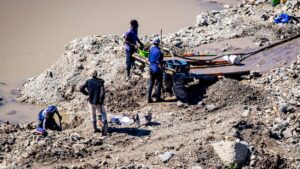
Former Police Minister Bheki Cele echoed these allegations in Parliament last week, saying that Zuma and his party are “funded by the king of the zama zamas.”
MKP spokesperson Nhlamulo Ndlela dismissed the statements as “reckless political posturing,” saying that Cele, with his access to intelligence as a former minister, failed to act on any such information during his tenure.
MK Party to receive millions from the taxpayer

Represented political parties in South Africa receive funds from the taxpayer.
The Political Party Funding Act of 2021 (PPFA) established the Represented Political Party Fund (RPPF), which channels public funding from the IEC to parties represented in the National Assembly and provincial legislatures.
The fund is capitalised by the National Treasury and distributed quarterly according to a recently changed formula: 10% is allocated equally to all parties, while 90% is distributed proportionally.
According to statistics from the IEC, Treasury allocated R1.68 billion to this fund since 2021/22.
Additional funding streams for parties come from parliamentary and provincial allocations to provide proportional financial and administrative support to represented parties, to the tune of at least R5.82 billion since 2021/22.
Funds from the RPPF may only be used for specific purposes, excluding salaries, fees, or legal costs; however such funds are reportedly often abused.
In the 2023/24 FY, just before the elections where MK garnered representation, R2.18 billion from the fiscus went to represented political parties, according to the recently published IEC report.
The ANC got about R1.72 billion, the DA R644 million, the EFF R309 million, the IFP R132 million, and the FF Plus R94 million.
With the MK Party amassing 14.6% of the national vote, and a significant portion of KwaZulu-Natal, Mpumalanga and Gauteng, they are set to receive a sizeable chunk this year.
For example, in KZN alone, the ANC got around 55% of the vote in 2019, which gave them a R120 million annual legislature allocation. In 2024, the MKP emerged as the largest party in the province, with 45% of the vote.
MKP millions in debt

MKP treasurer general Mpiyakhe Limba revealed in late August that MKP is sitting in at least R28 million in debt, with independent auditors having findings against the party’s finances.
Limba accused the now-expelled former Secretary General of the MKP, Floyd Shivambu, for the party’s financial woes.
“He left us with a debt of R28 million. That was the mistake he made,” said Limba.
According to to the MKP treasurer, the party appointed an independent company, Nduma Chartered Accountants, before the annual audit by the Auditor General.
He said that findings were made against them, but insisted these had more to do with bookkeeping “rather than any form of corruption.” The MKP declined to divulge details of the debt.
This R28 million debt revelation follows accusations by Shivambu about money being siphoned from the organisation.
In a media briefing before he announced his ‘Mayibuye iAfrika Consultation Process,” the former MKP SG alleged that R7 million is being looted from the MKP’s coffers every month by some of its members.
Shivambu, who was the MKP’s SG for seven months after defecting from the EFF, said that the organisation’s finances are a mess.
“Withdrawals of no less than R7 million every month from the organisational coffers. We are talking about this because I have raised this internally to say, ‘stop what you are doing because you are going to get the party de-registered as a political party’,” alleged Shivambu.
“Every SG who has ever raised that got removed from the leadership of MKP,” he added. He would not give further details on the matter.








 Loading ...
The party is led by a convicted criminal. Did you expect honesty and integrity?