
Helen Zille explains why DA administrations collapsed in Johannesburg



The Democratic Alliance’s (DA) previous administrations in Johannesburg were repeatedly brought down not by policy failure, but by unstable coalitions and political extortion.
This is the assessment of Helen Zille, the party’s chairperson of its Federal Council and now its mayoral candidate for the City of Johannesburg.
In an interview with Newsday, Zille described the experiences post the 2016 and 2021 local government elections with Herman Mashaba and Dr Mpho Phalatse respectively.
When the DA first took office in Johannesburg, it did so through fragile alliances that were constantly on the brink of collapse.
With no outright majority, the party was forced to rely on small and shifting partners who often used their leverage to extract positions and concessions.
The result was what Zille has described as “kingmaker chaos”: administrations that spent more time negotiating survival than delivering basic services.
Governance became reactive rather than strategic, with mayoral changes and motions of no confidence interrupting every attempt at long-term planning.
She claimed that despite early gains, both DA-led administrations fell victim to unstable coalitions, personality clashes, and a fragmented political landscape that rewarded parties with outsized influence.
Herman Mashaba’s tenure

Mashaba, a self-made businessman who had joined the DA a couple of years before the 2016 elections, was elected in a coalition arrangement, defeating the African National Congress’s (ANC) candidate, Mpho Parks Tau, by 144 votes to 125.
His election marked the first time since 1994 that the city was not run by the ANC.
The DA made an agreement with the Economic Freedom Fighters (EFF) to get a majority in the council.
“We didn’t get enough votes together with various coalition partners to get over the line and we needed over 50% of the council seats to govern properly,” said Zille.
“I was deeply opposed to that agreement and had a good confrontation, I could put it, at FedEx about it. In the end, I was removed from FedEx.”
Zille, whose bad blood with Mashaba is no secret in the South African political scene, said that because the DA was dependent on the EFF, “Herman Mashaba knew that to stay in office, he had to dance to the EFF’s tune.”
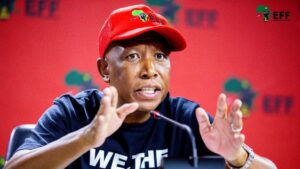
“Because when the EFF has put you into power, they will demand their pound of flesh again and again and again.”
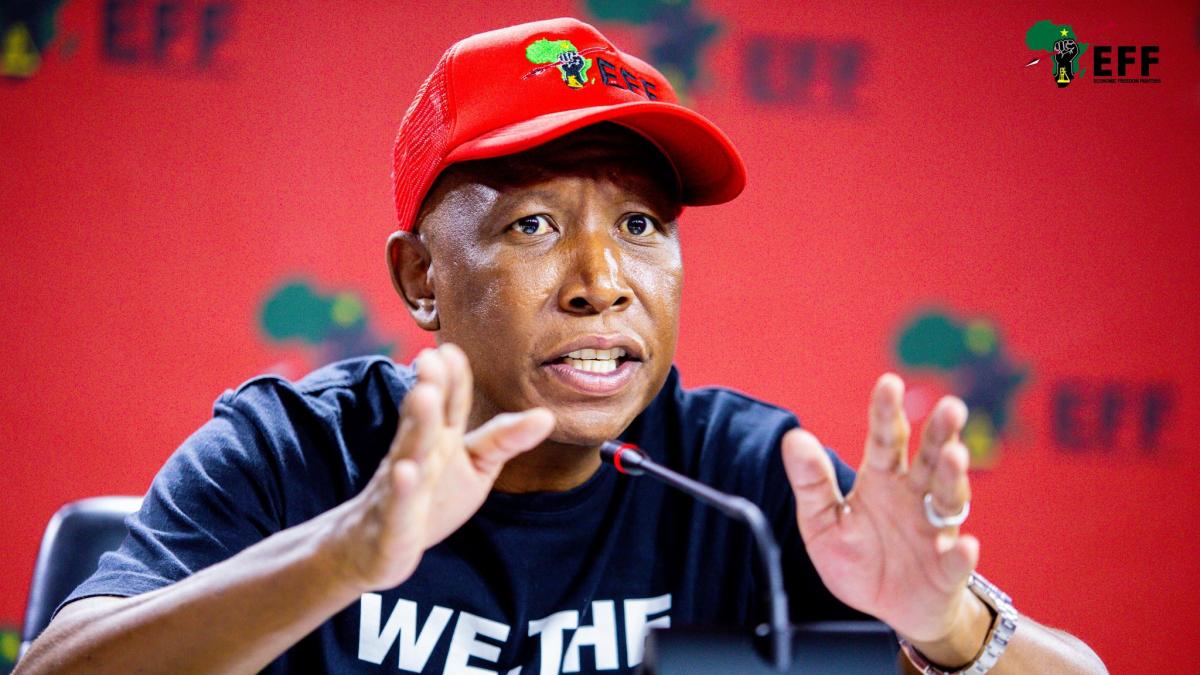
The DA mayoral candidate went on to say that the EFF “isn’t particularly interested in becoming a councillor or an MMC because that’s not where the money is. The money is in the administration, controlling tenders.”
She said that they were able to use their leverage of the balance of power in the council and the threat of withdrawing their support to bring the government down.
Thereby, they were requiring Mashaba “to do their bidding in terms of key positions in the council.”
“And I’m afraid that is what he did. And that’s why we called him the EFF mayor at that time. Julius Malema was making all kinds of demands in return for their continued support and I’m afraid Herman was acceding to them.”
These allegations were echoed by investigative journalists Pauli van Wyk and Micah Reddy in their book, Malema: Money. Power. Patronage.
The book alleges that Mashaba unwittingly strengthened Malema’s rent seeking the day he made a politically expedient deal with the EFF and started wearing blinkers.
“According to a source with direct knowledge of the haggling between Mashaba and the EFF, the latter was holding the mayor’s agenda hostage in the hope of extracting quid pro quos, such as influencing the appointment of key officials,” noted van Wyk and Reddy.
ActionSA and Mashaba have fiercely denied these allegations.
In response to questions from Newsday, Mashaba reflected on his achievements as Johannesburg mayor, his public spats with Zille, and the role of the EFF in his administration – vehemently disagreeing with Zille’s account.
He said he uncovered widespread corruption from “the first day,” saving the city R2.1 billion by cutting “vanity projects” and exposing a well over R100 billion infrastructure backlog left by the ANC.
He insisted that his focus was on service delivery for neglected communities, which are largely black non-DA constituencies, which he said led some DA councillors to label him “an EFF mayor.”
Mashaba rejected this label and allegations, saying, “not a single EFF person has ever approached Herman Mashaba to discuss corruption or tenders.”
He maintained that the EFF never interfered with his decisions, even when he fired corrupt officials, while “some in the DA did.”
Zille was removed from the DA’s FedEx in 2017, which she alleges was for her opposition to working with the EFF, while the DA claims it was for Tweets she made about colonialism.
Mashaba accused Zille and DA insiders of plotting with the ANC to oust him, describing “secret meetings organised by the IRR with the ANC,” orchestrated by Zille who was working at the institute at the time.
Zille has denied this, previously telling Newsday that it “is an entirely unfounded figment of a diseased imagination.”
While admitting to working for the IRR briefly in 2019, Zille said “no such meeting with the ANC occurred, along with the agenda alleged by Mashaba.”
Mashaba resigned after Zille’s return to DA leadership, calling her a “racist” that he would not want to be associated with.
Zille said that Mashaba resigned because of an impending motion of no confidence brought forward by the ANC, which many in the DA caucus would have supported.
“He became an EFF mayor and his own party was going to vote him out, that is why he left,” claimed Zille.
Dr Mpho Phalatse

Phalatse, a medical doctor and DA councillor, was elected Executive Mayor of Johannesburg on 22 November 2021 following the local government elections.
Although the DA lacked a majority in the 270-seat council, she won 144 votes against the ANC’s Mpho Moerane, thanks to support from numerous parties.
The DA formed a coalition alongside Mashaba’s ActionSA, the IFP, VF+, ACDP, PA, UIM and COPE.
The coalition began to fracture early in 2022, when smaller parties, spearheaded by COPE’s Colleen Makhubele, whose party held one seat in the council, began mobilising against Phalatse.
Phalatse was removed by a motion of no confidence on 30 September 2022, led by smaller parties and supported by the ANC and EFF.
Dada Morero briefly replaced her, but the South Gauteng High Court overturned the decision, ruling it “unlawful and unconstitutional.” Phalatse was reinstated two days later, returning to office amid coalition turmoil.
Reflecting on this period, DA Johannesburg caucus leader Belinda Kayser-Echeozonjoku told Newsay that political parties in the coalition “did not stick to their word” and used the time “for pure political games.”
“MMCs from different parties did not cooperate with other departments not from their parties. There was such a lack of cooperation,” said Kayser-Echeozonjoku.
“Smaller parties carried unyielding power, consistently seeking greener pastures elsewhere and undermining the authority of Dr. Phalatse by lodging disputes with the coalition forum instead of engaging.”
“The ANC got wind of this, and enticed others over.”
Additionally, Kayser-Echeozonjoku stated that opposition parties politicized Johannesburg’s labor force and their roles in the local government, undermining each other’s work.
“Dr. Phalatse was doing incredible work. But, greed and political games made it incredibly difficult.”
Continued tensions over cabinet posts among parties in the coalition, particularly with the Patriotic Alliance, which had the key swing votes, led to a second motion of no confidence on 26 January 2023, which passed 140–129.
ActionSA backed Phalatse, but blamed the DA’s leadership for the collapse. ActionSA accused the DA of “arrogance,” offering up an MMC position of its own.
Al Jama-ah’s Thapelo Amad, whose party got less than 1% of the vote, was elected mayor with ANC and EFF support.
After Amad resigned a couple months later amid controversy, Phalatse was nominated by her party to replace him.
Failed negotiations among those in the former ‘multi-party coalition,’ saw the DA unable to come to an agreement with ActionSA, IFP, VF+, ACDP, UIM and PA.
In an interview with Wits Vuvuzela, Phalatse said that the reason negotiations failed is because the DA could not come to terms with the proposition by the PA to nominate Kenny Kunene as mayor.
“[We] could not fathom how such could be allowed,” she said.
The PA, the swing vote in council, then put their weight behind Gwamanda, alongside the ANC, EFF, Al Jama-ah, AIC, AHC, ATM, Good, PAC, Cope and APC. In return, Kunene received an executive position and now has control over the city’s transport portfolio.
“Simply, people refused to keep to their word. To have a successful working relationship that focuses on service delivery, you have to have trust,” said Kayser-Echeozonjoku.











 Loading ...
It is simple.
They do not have enough support to govern without relying on the support of populist, entitled clowns.
That will never be forthcoming unless they care allowed to continue their looting