
South Africa’s richest province warns of an education collapse



The Gauteng Department of Education (GDE) is under immense fiscal pressure, with continued budget cuts threatening “collapse” of the provincial system overseeing 2.4 million public school learners in 2025.
Last week, Gauteng Education MEC, Matome Chiloane, told the media that financial challenges in his department are due to the R12 billion budget cuts it suffered in the past five years.
He said that if the challenges facing the GDE and other provincial education departments are not urgently resolved, “the system will collapse.”
“We are currently embarking on the process between the Minister of Finance as well as the Minister of Education together, with the Provincial Treasury and education departments to find a way on how best to resolve the challenges.”
Provincial education departments have faced mounting budget pressures driven by national fiscal adjustments, unfunded wage agreements, and broader economic constraints.
Basic Education Minister Siviwe Gwarube’s spokesperson Lukhanyo Vangqa said that the Minister flagged the financial constraints impacting the education sector from as early as September of 2024.
“The Minister took proactive steps to inform the Minister of Finance, Parliament and the President about the serious financial difficulties facing the provincial education departments.”
He told Newsday that the financial challenges facing the education sector is a result of years of austerity, financial mismanagement and wrong priorities.
“For example while the country cut the budget for education over the years, failing State Owned Enterprises got over R130 Billion in bailouts.”
“The Minister called on all MEC to submit financial recovery plans and she has called for a political 10X10 which will include the Minister of Finance together with his MECs of Finance on one side and the Minister of Basic Education with her MEC’s of Education on the other.”
Chiloane said that the GDE has been able to stay afloat because they “have been able to manage the budget quite well,” despite recently returning over R50 million of unspent allocations to Treasury.
But such financial woes have had a detrimental impact on the GDE, its programs, schools, learners and teachers.
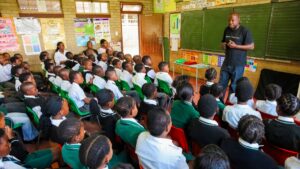
From maintenance backlogs, scholar transport, school nutrition to subsidy cuts, the cash crunch and the department dealing with a large influx of learners annually is having a profound impact on school operations.
The GDE told Parliament this year that migration from other provinces strains its infrastructure and budget, with over 100,000 new learners entering the province annually.
According to an analysis from The Outlier, Gauteng has built or refurbished only 48 schools since the 2015/16 financial year.
Yet on average, schools in Gauteng accommodate 1,100 learners, which is nearly double the national average.
Slashing state subsidies

Just this month, the GDE informed around 750 public schools in the province that their state subsidy will be cut by more than 60%.
The department informed quintile 5 schools in the province that the national tariff of R315 per learner for resource allocations will be in effect for 2026, citing alignment with national standards and budget constraints.
For years, quintile 4 and 5 schools in the province received the same amount of R838 per learner for expenses such as textbooks, stationary, and water and electricity, among others.
“This decision is placing enormous financial pressure on public schools,” said Deon Lerm, Gauteng Manager of FEDSAS (Federation of Governing Bodies of South African Schools).
“The assumption is often that schools that charge school fees are wealthy schools. This is not the case. Not all quintile 5 schools in Gauteng are in wealthier neighbourhoods.”
Contrary to what the department has been advocating, these are often rather the ‘least poor’ among those who attend government schools.
According to FEDSAS, many of these schools cannot absorb the sudden change in policy.
FEDSAS’s Education in Numbers report shows that applications for exemption of school fees and defaults on payments have increased drastically, with up to 35% of school fees unable to be recovered at some of these schools.
Speaking to Newsday on condition of anonymity, various schools have warned that this will lead to significantly higher school fees, and since not all fees are recoverable, it will place immense financial pressure on them.
“Combined with this sudden loss of more than 60% of the subsidy, the immensity of the provincial education department’s decision becomes clear,” said Lerm.
FEDSAS criticised the GDE for sending post provisioning and resource allocation letters after the 30 September 2025 deadline, which schools rely on to prepare their budgets.
CEO Dr Jaco Deacon said that while the department may apply national tariffs, it must comply with the procedural safeguards set out in the Schools Act.
Deacon argued the decision is invalid due to the missed deadline and warned that FEDSAS will escalate the matter if the reduced rate is enforced.
He said that the decision could “be interpreted at the hand of the fact that this provincial department had to return R53 million to the National Revenue Fund.”
While affirming its commitment to constructive engagement, FEDSAS stated it would act to protect its members’ interests in cases of procedural non-compliance and called for accountability to curb systemic decay in public education.
Maintenance backlogs and cutting non-personnel areas
For example, earlier this year Chiloane revealed that the GDE has a R31.3 billion maintainance backlog for school infrastructure, but the department allocated just 1.36% of what is needed.
“Unfortunately, the department is unable to cover all concerns, especially now due to budget cuts,” said Chiloane.
Additionally, the 2024/25 financial year saw a R4.5 billion shortfall in Gauteng, forcing the provincial education department to cut spending on scholar transport, school nutrition, and other non-personnel areas.
This was in order to preserve approximately 3,400 teaching posts.
These challenges followed earlier reductions between 2020 and 2023, which began amid the COVID-19 recovery period and ongoing wage disputes.
Nationally, the combined provincial education funding pressures were estimated to range between R78 billion and R118 billion from 2021/22 to 2027/28.
Gauteng’s cumulative share of this burden aligns with roughly R12 billion, averaging around R2 to R3 billion in annual shortfalls.






 Loading ...
You reap what you sow !!!!!