
Cyril Ramaphosa must pack his bags and leave the Union Buildings



The “old generation” of South African leaders, including President Cyril Ramaphosa, have had their turn and have shown that they are not capable of running South Africa’s economy, according to political economist Moeletsi Mbeki.
Mbeki is an author and chairman of the South African Institute of International Affairs, a think tank based at the University of the Witwatersrand.
During an interview with Palatable Politics, Mbeki said that these leaders, who led the struggle against apartheid, now need to leave the country in the hands of a new generation of leadership that can manage the economy.
“They got us a democracy at the end. That was a huge achievement, but they’re not capable of running a complex economy like South Africa,” he said.
Mbeki said that Ramaphosa himself has admitted this during the first convention of the National Dialogue.
“He was asking, ‘Why is this country poor?’ because he doesn’t know why,” he said. “You have to give him credit for having the courage to say that he doesn’t know why.”
During his opening address at the First National Convention at the University of South Africa, Ramaphosa said that at the National Convention, “we will have difficult conversations about many issues, including:
Why do South African women have to live in fear of men? Why do so many people live in abject poverty while so few live lives of opulence? Why, after decades of democracy, are the prospects for a white child so much better than those of a black child?
Why do women get paid less than men for the same work? Why, when we have a Bill of Rights, are LGBTQI+ people still discriminated against, stigmatised and harassed?
Why do clinics run out of medicine? Why do taps run dry?”
If he does not know how South Africa’s economic problems emerged or how to fix them, he should hand over to somebody else who is more capable, Mbeki said.
“My brother, you have to pack your bags from the union buildings and hand over to somebody who knows how to solve the problem of poverty,” he said.
According to Mbeki, the ANC can only be valuable to South Africa again if a new generation of competent leaders takes over the party.
This absence of competent leadership has left South Africa in a position where it can’t compete against the economies of countries such as the United States, China, Germany, Japan, and Malaysia, Mbeki explained.
Mbeki’s remarks come at a time when Ramaphosa has just unveiled a new plan to save the economy.
In Ramaphosa’s first State of the Nation Address, he made several promises to South Africa to improve the economy.
This included an intention to reduce unemployment rates, which Ramaphosa said in 2018 had increased to an unacceptable level.
He also promised to improve economic growth and investment in South Africa.
Failure to deliver on unemployment, GDP growth: An “economic emergency”

Years later, addressing the media following a special National Executive Committee meeting in Birchwood, Gauteng, on 7 October 2025, Ramaphosa declared that South Africa is now experiencing an “economic emergency.”
The president unveiled a 10-point plan and a “war room” to revive growth, create jobs, and strengthen state capacity.
The plan, which includes improving electricity and logistics infrastructure, however, was widely criticized. Opposition parties argued that the ANC is responsible for these economic challenges and that the same leadership cannot be expected to resolve these issues effectively.
Experts like Dr. Iraj Abedian have highlighted that the ANC’s policies over the past 15 years have not made the economy conducive to investment and industrialisation.
“This is not a recent issue. It is a 15-year consistent lack of attention to what makes an economy favourable for and conducive to industrialisation and the creation of high-value jobs.”
Despite Ramaphosa’s promise of a “new dawn” for employment when taking office, unemployment has continued to rise.
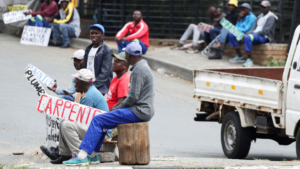
When he took office, the unemployment rate sat at 27.2%. After seven years, the rate has risen to 33.2%, according to Statistics South Africa (StatsSA).
Youth unemployment during the same period rose from 53.7% to 62.2%.
The Democratic Alliance (DA) Head of Policy, Mat Cuthbert, said in response to the new plan that the rate of unemployment is not acceptable, and neither is the fact that more than a year after the formation of the GNU, annual GDP growth remains at 0.6%.
The DA, which governs alongside the ANC in the GNU, questioned Ramaphosa and the ANC’s ability to execute the plan at the required speed and depth.
“The ANC’s declining electoral support is a direct consequence of its failure to deliver services, cadre deployment, and mismanagement of the economy,” Cuthbert said.








 Loading ...
Agree with both Old Optimist and Mokone, liberation parties never end up running a country successfully and yes our President had such potential but has been a disappointment as he has avoided making the tough decisions. We won’t find the change within the ANC we need to turn our country around! Sadly so many of the people in our country have remained uneducated, can we even hope that voters will be capable of making the right choices to bring about change.