
ANC declares an economic emergency and sets up ‘War Room’



The African National Congress (ANC) has declared what it calls an “economic emergency,” unveiling a 10-point plan which it says will revive growth, create jobs, and strengthen state capacity.
Addressing the media at the conclusion of a special National Executive Committee (NEC) meeting in Birchwood, Gauteng, ANC President Cyril Ramaphosa said that “we will focus on implementation and delivery.”
The ten priorities listed by Ramaphosa are:
- Use electricity tariffs and transmission investment to drive economic activity;
- Accelerate the recovery of the freight and logistics sector;
- Rebuild the chrome and manganese industries;
- Improve the state’s capacity to manage major projects;
- Drive local economic development and investment in local infrastructure;
- Scale up labour activation and public employment programmes;
- Expand SMME support and transform Development Finance Institutions;
- Enable growth of provincial economies outside main urban centres;
- Diversify trade partners and expand export markets;
- Ensure effective budget and macroeconomic coordination
Ramaphosa announced that an “Economic War Room” will be established in the Presidency to coordinate performance monitoring and publish regular progress scorecards.
“We must accelerate the pace and massively scale up our efforts. These ten interventions signal the urgency and intent of the ANC as we move rapidly to address an economic emergency.”
A struggling economy

South Africa’s economy has been struggling with sluggish growth for more than a decade, held back by energy shortages, crumbling infrastructure, policy uncertainty and low investor confidence.
While the country emerged from the COVID-19 shock with modest gains, GDP growth has averaged below 1%, well below population growth, leading to rising unemployment and deepening inequality.
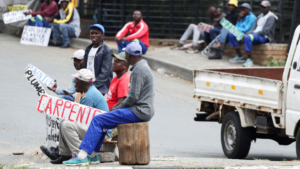
Unemployment remains stubbornly high at around 33%, with youth joblessness exceeding 45%, according to the latest data from Statistics South Africa.
Years of loadshedding, unreliable logistics networks and global trade instability have added to economic pressures.
Despite a R1-trillion infrastructure pipeline and several reform commitments under the 7th administration, progress has been slow. Both the IMF and the South African Reserve Bank have warned that without urgent structural reforms, the economy risks stagnation.
The ANC’s economy revival plans

Ramaphosa said that the plan prioritises stabilising South Africa’s energy and logistics systems.
This includes using electricity tariffs and transmission investments to stimulate industrial activity, with preferential rates for ferrochrome, manganese, and steel, and fast-tracking 14,500 km of new transmission lines.
The plan also targets the recovery of the freight and logistics sector through private sector participation in rail and ports and upgrading export corridors.
The ANC said that it will rebuild the chrome and manganese industries, expand alloy and battery precursor production, and protect local manufacturing through defensive tariffs.
Local economic development will focus on townships, rural areas, and small towns via municipal technical units.
Labour activation and public employment programmes, including the Presidential Employment Stimulus, will be scaled up with enhanced training for artisans and apprentices.
Strengthening state capacity is central, said Ramaphosa, with professionalised project management, a cross-government coordination unit, and ringfenced catalytic projects.
An Economic War Room in the Presidency will oversee implementation, monitor performance, and publish progress scorecards.
According to Ramaphosa, the ANC “will enforce professional, merit-based public service appointments, act on SIU reports, and strengthen integrity standards to restore public trust and enable state-led industrialisation.”
Fixing what you broke

Despite these ambitious goals, the plan has faced significant criticism from various quarters.
Opposition parties and some analysts argue that the ANC, having been in power for over three decades, is largely responsible for the current economic challenges, including the energy crisis and infrastructure decay.
They contend that the same leadership that contributed to the problems cannot be expected to resolve them effectively.
Experts like Dr. Iraj Abedian have highlighted that the ANC’s policies over the past 15 years, have not made the economy conducive to investment and industrialisation.
“This is not a recent issue. It is a 15-year consistent lack of attention to what makes an economy favourable for and conducive to industrialisation and the creation of high-value jobs.”
This is most emblematic in the collapse of the country’s infrastructure over the past 15 years, with the government failing to adequately invest in maintenance.
“Industrialisation and the creation of jobs require a set of integrated infrastructure, which has not been the case for South Africa,” Abedian said.
“This includes the reliable availability of cheap electricity, access to quality infrastructure, and efficient service delivery from municipalities. These issues are at the heart of our economic struggles.”
The end result of this decline is the loss of thousands of jobs at companies that can no longer survive in a stagnant economy.
Additionally, economists like Dawie Roodt argue that many policies proposed by the ANC have been detrimental.
Speaking to Newsday, he said that South Africa got to the economic situation it is in because:
- The ANC’s ideology “is rooted in an outdated early industrial revolution ideology” insufficient for a modern economy;
- Policies that want to centralise everything;
- Cadre deployment;
- Endemic corruption.
Broad-Based Black Economic Empowerment (BEE) is cited as a major reason for South Africa’s economic stagnation by Roodt.
He says its implementation has led to elite enrichment, increased corruption, high compliance costs, and deterred foreign and domestic investment by shifting focus from merit and innovation to politically connected individuals and “fronting”.
However, the ANC said that its policies are “non-negotiable.”













 Loading ...
Good old Frogboiler. When stumped simply coin a new word concept and voila! PROBLEM SOLVED. He has clearly forgotten that Zuma sent him to the ESKOM WAR ROOM and that was an amazing success with 8 years of relentless load shedding on his special watch. So, add WAR ROOM to the laundry list of ANC deflection tactics along with legkotla, Commissions of Enquiry, National Dialogue ( of which not a word has been uttered since its muted launch). Reason, the ANC appointed “ panels” or whatever are far too busy trying to find ways of spending the R150 m budget. It is truly sickening!!!