

The sad story of one of South Africa’s forgotten historic pools

The Arthur Nathan Swimming Pool in Bloemfontein, was once one of the city’s crown jewels of sports, recreation and tourism.
Located in South Africa’s judicial capital and first opened in 1907, generations of residents recall it as the heartbeat of local leisure life, a place that was seemingly always abuzz.
It was declared a heritage site in the 1990s, but today, despite decades of promises, master plans, and millions of rands spent, the historic facility has slipped into neglect and disrepair.
Bloemfontein’s swimming tradition stretches back to its founding in 1846, when residents cooled off in the spruit and the dams that formed along it.
In the mid-1860s, a large dam was constructed south of the settlement, serving as a communal spot for bathing and washing.
By the 1890s, the city was changing rapidly, boasting two new dams and its first privately owned swimming bath.
According to Dr. Hannes Haasbroek of the National Museum in Bloemfontein, post-Anglo-Boer War development prompted the Town Council to approve plans for a municipal swimming pool in 1905.
Construction began the following year at a cost of £7,050, and on 7 October 1907, the pool officially opened.
Initially known as the Fairview Pool, it was a striking structure roofed and walled with imported iron and glass panels from England, designed for year-round use.
The roof, however, was dismantled in the 1920s and later repurposed to cover the Old Market Building.
From the start, strict gender segregation was enforced, with certain days reserved for women.
The ban on mixed bathing caused heated debate until 1913, when limited co-swimming was permitted under strict rules that now seem quaint.
Despite such controversies, the pool became a focal point of Bloemfontein life, hosting its first swimming gala in 1908 and serving the community for decades.
In 1967, it was renamed after Arthur Nathan, a celebrated coach and referee who raised swimming standards across the Free State and Northern Cape.
Declared a national monument in 1995, the pool stood as a reminder of Bloemfontein’s rich recreational history.
As studies show, municipal pools are vital public spaces promoting health, inclusion and community life.


Crumbling piece by piece
The Arthur Nathan Swimming Pool, once a landmark of community life in Bloemfontein, has been closed since the late 1990s and now stands as a stark reminder of urban decay.
Declared a heritage site, the complex has been left abandoned for more than two decades. The entrance archway, once a symbol of civic pride, is now weathered and crumbling, while graffiti covers much of the structure.
Rusted fencing and overgrown weeds add to the sense of dereliction.
Inside, the pool that once drew families and athletes is dry and littered with debris. The basin is stained with algae, while mosaic tiles have chipped and discoloured.
Surrounding buildings tell the same story: gutted ablution blocks, broken windows and a pergola sagging under years of neglect.
The former kiosk, where children once queued for refreshments, has been vandalised and shows signs of fire damage.
Across the site, broken bottles, scraps of plastic and rubble have replaced the crowds that once filled the space.
Local residents say the pool’s decline reflects broader challenges in maintaining public facilities. Despite its heritage status, no significant restoration efforts have been undertaken.
Community members have long called for the site to be rehabilitated, either as a functioning pool or repurposed as a recreational facility.
While they have made significant strides in clearing vegetation and cleaning the site, it is an uphill battle as funding and political will remain obstacles.


Mangaung’s costly promises and future plans
In the 2020 to 2022 financial years, nearly R8 million rand was spent for two companies, Nala Consulting and Boitsepanaphe Quantity Surveyors, to determine the scope of the project and compile bid documents.
This was funded by the Urban Settlements Development Grant (USDG), with a R12 million swimming pool maintenance budget over two financial years.
In 2022, former acting city manager Tebogo Motlashuping said that a final renovation plan had been approved, with the overall project estimated at R58.1 million.
He said that the project was first put out to tender in October 2021, but no bids were received. In response to Lotriet’s 2022 query, he said that the renovation remains on the Metro’s agenda.
Once appointed, construction will begin after contract signing and site handover, and is expected to take 12 months.
The project has already secured approval from the Free State Heritage Foundation, given its heritage site status.
He said that it will be restored for training and recreational use, while the Stadium Swimming Pool will host official events.
The City said that USDG funds for the project are ringfenced, meaning no borrowing will be required.
While Mangaung’s tariff documents put entry to the three-decade long closed pool at R39, its state and shut gates beg to differ.
“There is nothing further to show for it,” said Lotriet. The renovation project was supposed to start in August of 2022, but nothing came of it.
The Mangaung Metropolitan Municipality (MMM) did not respond to queries from Newsday by time of publication.
Speaking to the Bloemfontein Courant several months ago, municipal spokesperson Qondile Khedama said the city’s goal is still renovation.
However, he explained that the metro would need an estimated R64 million, and the project is currently not funded. It does not appear on any of the budgets or development plans.
He added that the city is exploring various funding avenues, including allocations from the municipality, the Municipal Infrastructure Grant, public-private partnerships, and collaboration with national departments.
Khedama said that planning has been put in place to ensure that all construction items are completed within the specified timeframe of a year.
These include upgrades to sewer and water networks, stormwater drainage, paving, landscaping, the main and splash pools, new ablution facilities, pump station refurbishment, security, pergola and kitchen upgrades, and parking.
“MMM therefore would like to assure the public that the municipality is actively pursuing multiple strategies to secure the necessary financial resources.”
“If successfully funded and completed, the renovations will ensure that the site remains an important heritage asset and a modern recreation space for generations to come,” Khedama concluded.


Desire to fix it is there
A year ago, there was renewed desire to renovate the Arthur Nathan Swimming Pool, but not from the metro.
Founder of the Bloemfontein Neighbourhood Association, Anneke Anker, told the Bloemfontein Current that residents have long complained about criminals hiding in the abandoned site.
The municipality said that it has since put a fence up, but many parts are broken.
Remembering the site’s past as a place where children learned to swim inspired her to rally the community.
“Let’s take ownership as a collective… if we don’t take care of it now we will not have anything left for our children.”
Martin Slabbert of Love Mangaung echoed the call, stressing that restoring the pool is a vital step toward reviving the City of Roses.
He argued the project should be community-led to ensure sustainability. “The only way it can be done is if it’s ceded to a non-profit with many stakeholders involved. The community needs hope,” he said.
Park Road CPF secretary Mohau Nhlapo said that the project would also be about jobs and safety.
He highlighted the importance of reviving heritage sites while creating employment opportunities through patrols and maintenance.
She had said that a report would be submitted to the municipal council which would communicate a way forward.
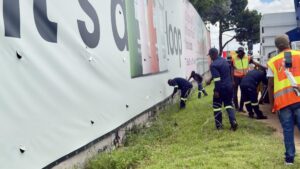
They have consistently worked on the site, making major progress in clearing overgrown vegetation, draining the pool, and cleaning.
In a recent social media post, Love Mangaung said that “we are still maintaining Arthur Nathan swimming pool almost one year after the initial clean up.”
“We secured the perimeter and help keep the place safe so that no further looting takes place.”
Lotriet believes that a public-private partnership is the way to go, but a long-term business plan and guaranteed funding are needed.
Other images of the Arthur Nathan Swimming Pool in Bloemfontein






 Loading ...
Unbelievable!!! In today’s South Africa many children could have been taught to be water safe and be aware of the dangers of water in this pool. The people in charge of maintaining this pool are shortsighted, selfish and cruel to their fellow man.