
ANC in serious trouble



The African National Congress’ (ANC’s) electoral slide is expected to continue come next year’s polls, as compounding lack of trust in the organisation’s leadership and service delivery woes eat away at its support.
Over the weekend, reports emerged of current polling placing the ANC at just 29% support from registered voters nationally.
This is a steep 11 percentage point drop from its historic-low 40% it achieved in the 2024 general elections, leading to them having to form a coalition government.
While polls do not give a definitive picture regarding what would happen if the elections were to be held in the near future, these polls, often very accurate, gauge voter sentiment at a given time.
The Democratic Alliance’s (DA’s) recent internal polling, which sees the ANC at 29%, has proven particularly accurate, with its November 2023 polling placing the ANC at 40%. Yet, they do admit that the margin of error may be great.
Regardless, these reports follow a recent study from the Mapungubwe Institute for Strategic Reflection, which shows that ANC support is eroding and is likely to only achieve an outright majority in two of the nine provinces come 2029.
According to the study, for the ruling party to stem the decline, it would require strong, inspirational leadership, unambiguous clean governance, and a clear mission statement.
This is an incredibly daunting task for the party that has been in power for over three decades. According to a Afrobarometer survey, 83% believe that the country is going in the wrong direction – more than double the 41% recorded in 2011.
Polling has the ANC in an even tougher spot come 2026 across the country’s eight metropolitan municipalities, where it already only governs with an outright majority in two – Buffalo City and Mangaung – after losing support in 2021.
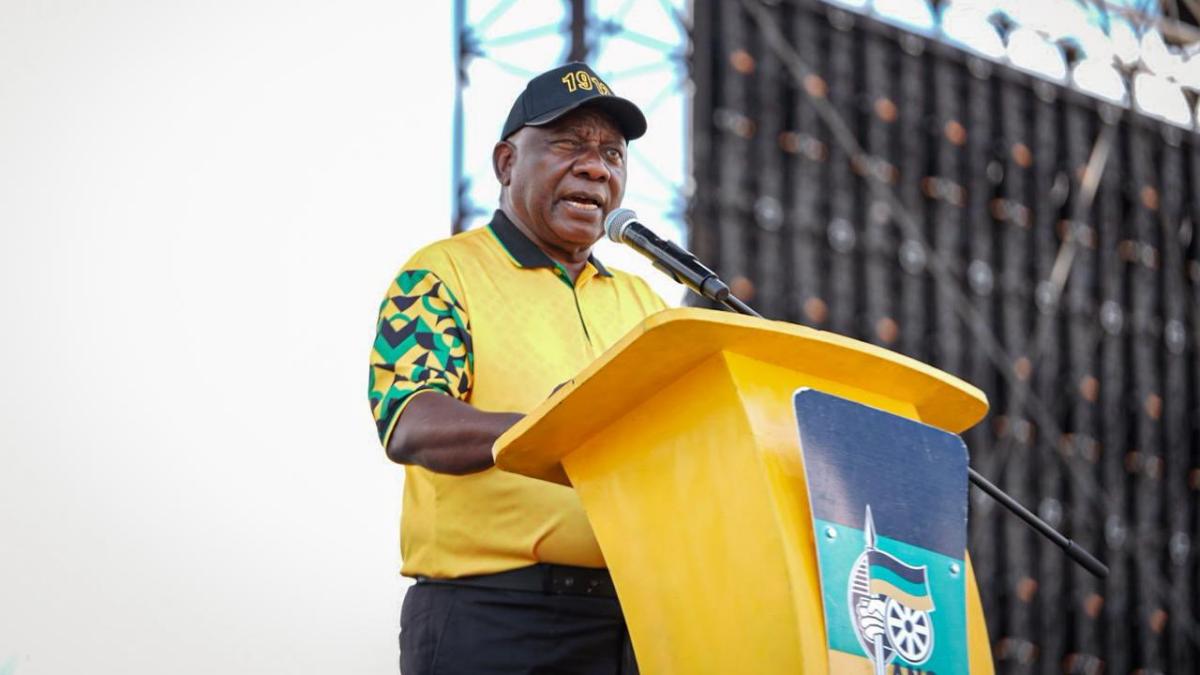
In South Africa’s economic hub, Johannesburg, currently characterised by ailing services as pointed out by President Cyril Ramaphosa during a visit earlier this year, polling sees that ANC getting a 10 percentage point drop to achieve 23%.
In the capital city of Tshwane, the ANC is polling at 27%, an eight percentage point drop from 2021, while Ekurhuleni polling puts the ANC at 19%, a massive 19 percentage point drop.
In eThekwini, the ANC has a polled 28 percentage points lower than 2021 at 14% – making them the third-largest party in the metro. It managed to attain 15% in the 2024 polls in the city.
In Cape Town, the ANC is polling three percentage points lower than the previous election, at 19%.

The decline of ANC support
Following the 2024 election results, ANC Secretary General Fikhile Mbalula said that the results show “people’s concerns about shortcomings in governance and delivery,” from the party.
In an interview with State of the Nation, Dr. Frans Cronje said that the ANC’s decline stems from strategic blunders, lack of delivery, and weak leadership.
Cronje added that the ANC’s failure to improve living conditions,once the foundation of its support, has deepened the decline.
Dr. Ralph Mathekga wrote in a Geopolitical Intelligence Services report that “misgovernance, corruption and waning trust” continue to hurt the ANC’s electoral prospects.
“Post-independence politics in South Africa has been completely dominated by the ANC. But in recent years, the party has struggled to maintain its position amid allegations of corruption, cronyism and short-sighted populism.”
“The ANC is fully aware that it would have to undergo a massive renewal to win back the voters it has lost, and party leaders have indicated the need for introspection but not yet put forward solutions.”
Cronje said if South Africa can lift growth to around 3% by the 2029 election, the ANC has a good chance of regaining a majority.
Given South Africa’s sub-1% growth, over 30% unemployment, and political volatility, investors see little incentive otherwise.
According to Cronje, securing property rights and encouraging investment is essential, and concessions already granted to industries like automotive could be extended more broadly.
Cronje said the ANC’s deeper problem is its “lack of strategic acumen. ” While capable individuals exist inside its ranks, he said the structure of its 100-member executive committee makes reform nearly impossible.
He added that decisions stall in consensus-seeking, and the party lacks a decisive leader: more non-executive chairman than CEO.
Some ANC members understand the urgency of reforms, energy, steel, infrastructure, and U.S. partnership, but any initiative dies inside the party machinery.
Without reform, South Africa risks an “enclave future”: the middle class adapts while the poor suffer, and the ANC itself declines fastest, said Cronje.
Mathekga said that to curb the electoral decline of the ANC, “instead of focusing on political expediency and his own survival as a leader, President Ramaphosa could set the stage for the party to elect credible leadership in its next elective conference to be held in 2027.”
“Such a move could hold back the rapid electoral decline currently experienced by the party as shown in the 2024 election and 2025 polling, which both show the party faring badly compared with just five years ago.”
“The ANC has been engaged in a process of renewal and revitalisation. This process is not yet complete, and the election results show that we need to intensify and accelerate the fundamental renewal of our movement,” said Mbalula.
“We enter a new term with both a clear mandate and a firm commitment to improve the maintenance of infrastructure and the provision of services in communities throughout the country,” he added.








 Loading ...
Consequences of incompetence, corruption, negligence of duty, nepotism, theft from the State, etc., etc. Need anyone go on to add to the list?