
DA keeps the ANC in power


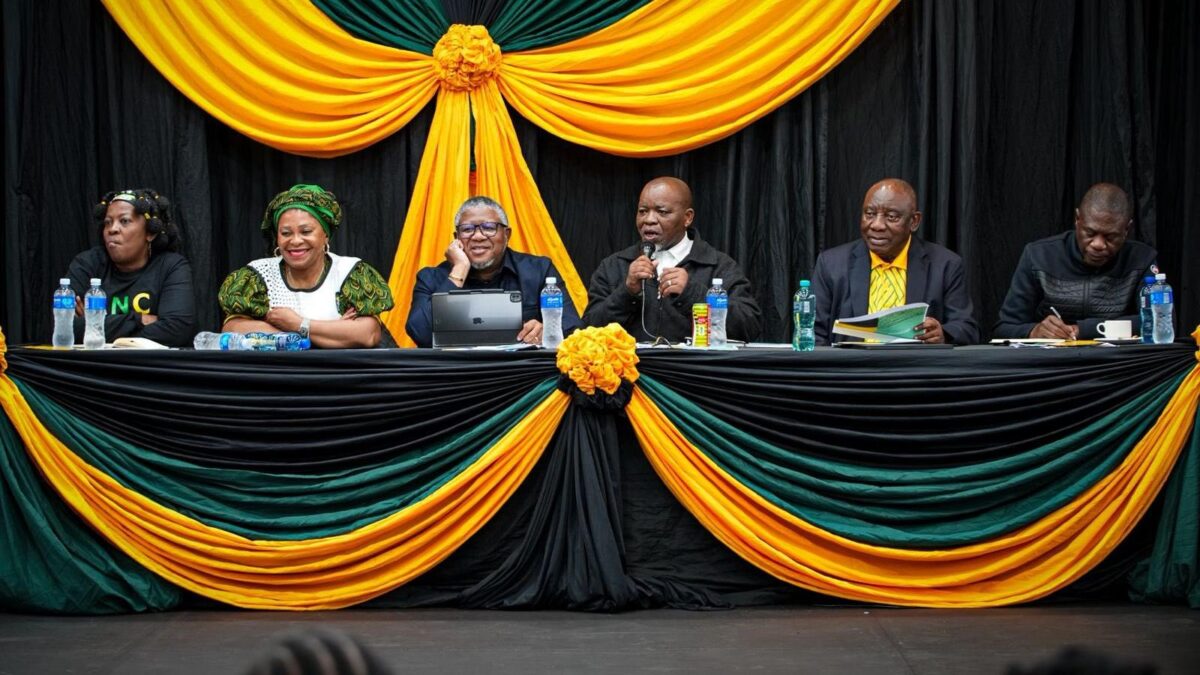
Political analyst and author Moeletsi Mbeki said that the Democratic Alliance is taking a dangerous gamble to keep the ANC in power and prolong its failed policies.
Mbeki shared his views during an interview at the Centre for Business Ethics at the Gordon Institute of Business Science (GIBS).
He said that under the ANC government, the South African economy actively lost its industrial capacity, making the country systematically poorer.
“Under ANC rule, the country was getting poorer, and unemployment increased significantly. That is why the ANC got voted out,” he said.
However, despite dropping to 40% in the 2024 national elections, the ANC remained in power through a government of national unity (GNU).
Its main partner in the new government is the Democratic Alliance (DA), which Mbeki said was a gamble.
“The ANC is kept relevant in power by the DA. The DA is taking a huge gamble by propping up the ANC so it can continue with its failed policies,” he said.
As the ANC’s socialist policies remain under the new government of national unity, economic growth has not recovered.
“The country operates under a stunted form of capitalism that fails to absorb its own labour force, directly causing the high unemployment rate,” Mbeki said.
He explained that the economy is frozen because the private economy of South Africa has to be taxed to finance both the state and redistribution.
“What the state does is take profits made in the private sector and redistribute those funds to the poor as social welfare and to the civil service as salaries,” he said.
As this is not a productive use of money the state takes out of the economy, it leads to slow economic growth.
The ANC is using the DA as a stopgap

Anthea Jeffery, author of Countdown to Socialism and Head of Policy Research at the Institute of Race Relations, has an equally scathing review of the GNU.
She explained that when the government of national unity was formed in June 2024, there was a lot of hope among South Africans.
Many believed that the ANC’s coalition with the DA and other opposition parties, such as the IFP, would put the handbrake on government excesses.
“People hoped it might be more difficult for the ANC to press forward with its agenda, or perhaps even that they were beginning to rethink it,” Jeffery said.
However, this did not happen. “Minister Mmamoloko Kubayi explained that the GNU idea was simply a variation on Lenin’s New Economic Policy,” she said.
By forming a coalition with parties perceived as more free-market oriented, the ANC could improve its credibility.
“However, as Minister Kubayi formulated it, this certainly didn’t mean they were giving up on the National Democratic Revolution,” Jeffery said.
“They were simply taking a little detour, a step back, so that they could step forward more decisively thereafter.”
She explained that the ANC follows Lenin’s New Economic Policy playbook, where it first gained political control through a democratic election.
“Then you move the society you’re controlling closer and closer to the point where the state has ultimate control over the economy,” she said.
She said the Black Economic Empowerment (BEE) is a good example of how the ANC is reducing businesses’ autonomy.
“Managers must be chosen according to racial targets. They’re expected to do deals with people chosen by race,” she said.
“If the GNU were really a way of rolling back, we would have seen it on something like BEE. Instead, we’ve seen various initiatives to tighten it up,” she said.








 Loading ...
Very valid comments by both Mbeki & Jeffery; even if FF+ turns the table tenfold, it would not make a shadow’s difference without the sum totals of Anti ANC supporters.
SA & its people suffers because of the ANC’s forced BBEEE thuggery!
SA desparately needs enmassed mind shifted voters focussed to replace the corruptly inspired ANC Looters, with hands-on business & economically minded leaders (all ethnics} in all Govt & SOEs.
Afterall, SA’s wellbeing is depedant on a sound managed Businees model, not be ruled primarily only by Politicians!!