
The South African who has served in Parliament for 36 years



Freedom Front Plus (FF+) leader Dr Corné Mulder has politics running in his veins, having served as a Member of Parliament for over 35 years.
Mulder also comes from a long line of politicians. His father was elected a Member of Parliament (MP) for the National Party the year he was born and later served as a member of Prime Minister John Vorster’s Cabinet for ten years.
In an interview with Newsday, the FF+ leader explained that his grandfather and great-grandfather were also politicians, the latter of whom was an MP during Paul Kruger’s Parliament in the old South African Republic.
However, Mulder would first pursue his interest in law before following in the footsteps of his father and grandfathers.
He was born in 1958 in Randfontein, on Johannesburg’s Western outskirts. However, moved to Cape Town for six years after his father was elected as an MP.
He attended Afrikaanse Seuns Hoerskool (Affies), where he matriculated in 1976, having been deputy head boy of the school and headboy of the boarding house.
After finishing school, he spent a year doing national service in the South African Navy, before going to Potchefstroom to study, which he said has been a family tradition.
Although politics was his hobby, Mulder said that he did not make it his primary field of study at university.
“Although we came from a very political home where we discussed politics morning, noon, and night, my father told us, ‘you can’t say you want to go into politics,’” he said.
“That may be your field of interest, but go out there and qualify yourself for something else if you can. So politics was my hobby, but I studied law.”
Mulder added that his father paid for his tuition on three conditions. The first two were that his father would stop paying if he got married or failed a subject.
The final was that they were not allowed to study on bursaries, which would take money away from children who could not afford education.
After completing his undergraduate degree in Law, taking International Politics and Political Science as extra subjects, he did his LLB at the North West University.
He then pursued his doctorate, completing research at the Institute for Advanced Legal Studies at the University of London and the Max-Planck Institute for Public and International Law, where he became the youngest person to receive a doctorate in the faculty.
By this point, he was 26 and decided to go and do his articles at a law firm in Pretoria. This would mark the end of his “education” and the beginning of his political career.
Joining the Conservative Party

After running against PW Botha for Prime Minister in 1978, Mulder’s father, also named Cornelius Mulder, narrowly lost by six votes. However, the second round saw him lose by 24 votes.
He was then expelled from the party in 1978 after information arose about his involvement in what became known as the Muldergate scandal, in which the apartheid regime used state funds to influence local and foreign media outlets.
Following his expulsion, Mulder senior formed the Conservative Party (CP) in 1982 after several members of the NP broke away with him.
After six years of the party’s existence, Mulder, who had just completed his articles, was elected as an MP for the party in 1988.
This would see him serve alongside his brother, Pieter, as the opposition to the NP.
However, Mulder says that younger party politicians who encouraged the CP to engage in talks for a democratic South Africa were met with resistance.
“This was when we were going into the negotiations for the current dispensation. We tried to convince the CP that it had to participate,” Mulder said.
“We were a group of young politicians, but we couldn’t convince the older guys. They didn’t want to participate. They didn’t want to give credence to the New South Africa.”
This protest against the older party members saw Mulder and several other younger politicians expelled from the CP.
Forming the Vryheidsfront
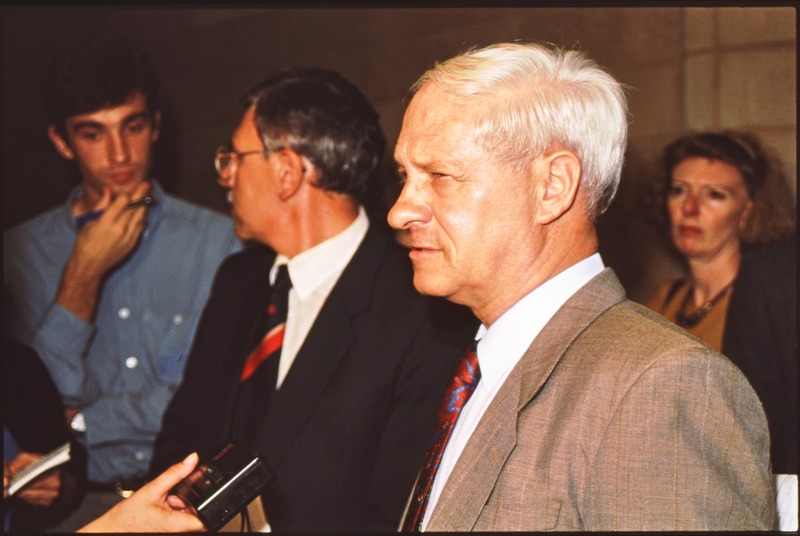
He says that about six or seven of those expelled from the party then partnered with Constand Viljoen, who had previously been a member of the Afrikaaner Volksfront and was the former head of the South African Defence Force.
Viljoen had helped form the Afrikaaner Volksfront, which Mulder described as a civic organisation with a military component. However, disagreements with other members saw Viljoen leave to start the Freedom Front.
At this point, the “+” had not yet been added to the name.
“We formed the party about four or five weeks before the election of the 27th of April 1994, and we did quite well,” Mulder said.
“But we had to marry two cultures, a culture of young politicians with a military culture. Some generals joined the party, which was one of the first challenges. However, it was quite successful.”
The Freedom Front won 3.3% of the national vote (639,643 votes cast) in the 1994 elections, earning them six seats in Parliament.
“We went into parliament and it was a fascinating experience. There was Mr. Mandela, there was Mr. General Viljoen, Mr. De Klerk was there, and Mr. Buthelezi from the IFP,” said Mulder.
He says that the CP soon realised they had made a mistake and closed down, which led to the two parties merging.
“They tried to convince us to do all kinds of things, such as changing our name. We said no. The only compromise we were prepared to do was to add a ‘+’,” he said.
This saw the party’s name change to the Freedom Front Plus.
“So the conservative party was then absorbed and merged into us. We took their assets, and they disappeared from the scene. Later on, the Federal Alliance also merged with us.”
Corné’s brother Pieter was appointed party leader in 2001 and remained in the position until he was succeeded by Dr Pieter Groenewald in 2016.
Corné Mulder was an MP for the FF+ from the 1994 elections, serving as its Western Cape leader and Chief Parliamentary Whip, until he was appointed party leader in February 2025.
“I have spent 36 years as an opposition in Parliament and the last year in government as part of the Government of National Unity,” he said.











 Loading ...
Was Muldergate a corruption move?