
Hidden tax on petrol in South Africa increased for first time in 5 years



During Finance Minister Enoch Godongwana’s budget speech, it was announced that the Road Accident Fund levy on fuel in South Africa will increase for the first time since 2021.
After five years of keeping the levy stable, the increase comes at a time when an inquiry into the management of the Road Accident Fund has uncovered severe mismanagement, irregularities and inefficiencies.
The Standing Committee on Public Accounts (SCOPA) began probing the fund after the RAF received an adverse audit opinion for the 2024/2025 financial year.
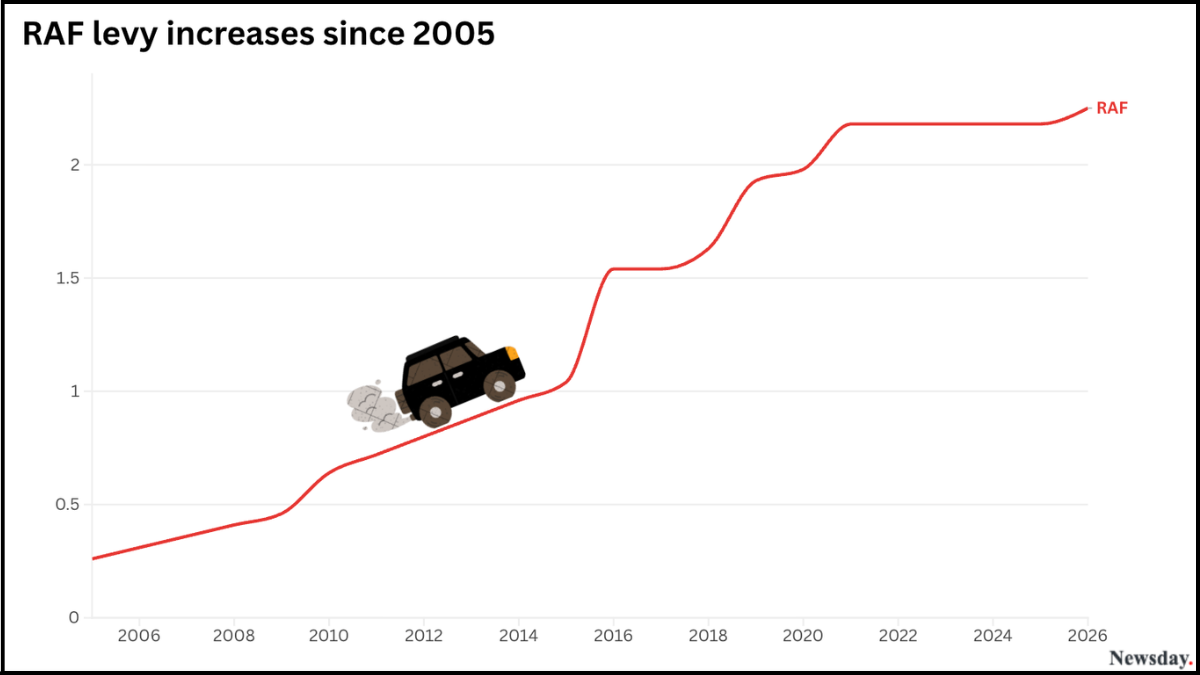
South Africans have been paying a R2.18 RAF levy on every litre of petrol or diesel for the last three years, allowing the RAF to collect R50.1 billion in the 2024/2025 year.
The R2.18 amount was steadily increasing over the last twenty years, but remained unchanged since 2021 until now. It will increase by 7c per litre, according to Godongwane.
The state insurance agency warned in its most recent report that the current fuel levy is not feasible for the sustained settlement of claims or ensuring the fund’s long-term sustainability.
The RAF paid out R42.6 billion in claims in the financial year ended in March 2025, and had R10.4 billion in unpaid claims for the year.
From 2022 to 2025, the RAF has raised R195 billion in fuel levies, and R185 billion has been paid out in claims.
These benefits can include compensation for medical expenses, loss of income, funeral costs, general damages, and future medical and rehabilitation expenses.
Contributions to the RAF have increased by 1400% for petrol users and 2016% for diesel users since January 2000.
The new increase, which would bring the levy to R2.25 per litre of petrol or diesel. Minister Godongwana said that increases to some taxes are simply unaffordable.
The entity’s adverse audit opinion for the 2024/2025 financial year was caused by the RAF using an accounting standard that “fundamentally differs from the prescribed GRAP standard,” according to the Auditor General.
This resulted in an understatement of the Fund’s liabilities and expenditure. The entity further failed to record irregular expenditure due to inadequate systems to detect and disclose it.
Currently, the Standing Committee on Public Accounts (SCOPA), is busy finalising a probe into the state-insurance entity and its governance failures.
South African motorists support “dysfunctional” government entity
The inquiry has uncovered far-reaching governance failures at the RAF. “Dysfunction is the right way to describe it,” said SCOPA chair Sengezo Zibi.
The RAF board recently placed its acting CEO, CFO, Chief Governance Officer and the Head of the CEO’s office on precautionary suspension.
One of the most alarming revelations, Zibi noted, is that the major change to the fund’s accounting policy, affecting 500,000 claimants, was implemented without any recorded executive meeting or board approval.
Suppliers were consulted and preparations were made before the RAF’s own governance structures had even discussed the decision.
SCOPA also heard that the RAF outsourced nearly R1 billion in procurement to two external companies, each awarded contracts worth R500 million, without examining invoices or questioning the spending.
This lack of oversight allowed suppliers to procure from relatives and friends at allegedly inflated prices.
On top of this, the RAF spent more than R100 million on disciplinary cases over the past five years, routinely using external lawyers and chairpersons who billed hourly rates.
Many employees remained on suspension for up to four years without being charged, while acting staff filled their posts, effectively doubling salary costs.
The committee also heard that the RAF’s decision to dismiss its panel of attorneys resulted in thousands of unattended court cases.
Current attorneys are each handling up to 5,000 matters, forcing them to appear in multiple courts simultaneously.
When they cannot, the RAF either pays full costs for postponements or suffers inflated default judgments, adding billions to its liabilities.
The suspended CEO of the RAF refused to appear before the committee, calling it a “kangaroo court” and ignoring summons.
The address he previously used to communicate with Parliament turned out to be an abandoned house, with the sheriff finding signs no one had lived there “for a while.” A second address was also a dead end.


 Loading ...