
Criminal industry worth R60 billion in South Africa


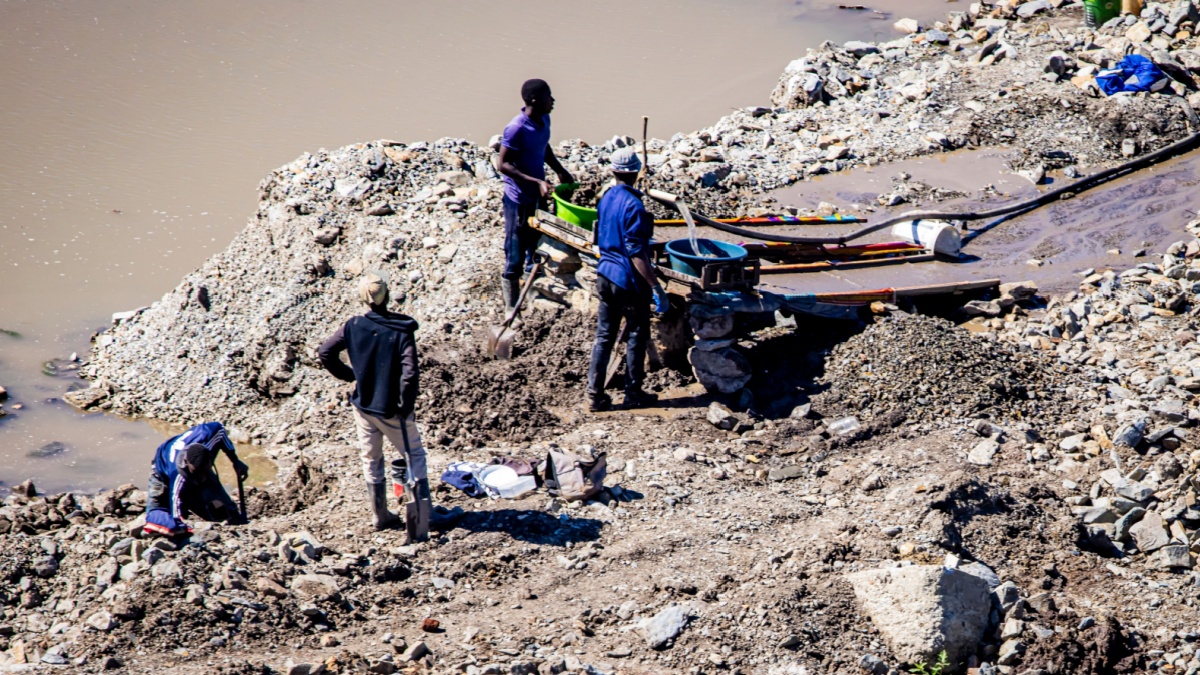
Over the past few years, South Africa’s illegal mining industry has become a persistent and deepening crisis.
Despite ongoing media attention and crackdown efforts, a 2025 report from PWC found that the value of illegal mining has ballooned from R7 billion in 2017 to R60 billion by 2025.
Illegal mining is the extraction of minerals or precious metals without the permission of the state or compliance with safety and legal regulations.
According to the Minister of Mineral and Petroleum Resources, Gwede Mantashe, the criminal activity is often linked to broader organised crimes.
This includes illicit financial flows, extreme violence, human trafficking, gender-based violence and femecide, as well as the smuggling of weapons and explosives.
He added that there has been a “disturbing trend” whereby illegal mining activities are linked to undocumented foreign nationals.
The government established the nationwide Operation Vala Umgodi in 2023 to combat illegal mining in seven provinces: the Free State, Gauteng, KwaZulu-Natal, Limpopo, Mpumalanga, North West and the Northern Cape.
According to the National Integrated Plan on illegal Mining, since December 2023, 20,367 arrests have been made in connection with so-called ‘Zama-Zamas’ and 16,645 cases have been opened.
The South African Police Service has plans to extend its crackdown on the activity, allocating around R1.8 billion and 4,302 personnel over the next 18 months.
Delivering remarks at the South African Human Rights Commission (SAHRC) national Inquiry into Policy Framework around Artisanal Mining earlier this month, Mantashe said that the landscape of illegal mining is changing.
“Whereas illegal mining was once largely confined to derelict and ownerless mines, it is now increasingly encroaching on operational and licensed mines, posing serious risks to safety, security, and economic stability,” he said.
I don’t know if we’re winning the war on Zama-Zamas – Mantashe

The focus of illegal mining has also shifted. PWC reported that the original primary target of illegal mining was gold, due to the high value of the metal, straightforward processing and the large number of abandoned gold mines across the country.
“Over time, however, the focus has broadened. Other commodities such as copper, chrome and coal have increasingly become targets for illegal miners, reflecting both shifting market dynamics and the continued vulnerability of unregulated mining sites,” PWC found.
Mining companies across the sector have therefore been forced to respond to the rise in illegal activity with increased security measures and partnerships with law enforcement.
Major mining company Sibanye-Stillwater listed underground intrusion and theft of copper cables as the company’s most severe security threat in 2024, amounting to R53.4 million in losses.
While the scope of illegal mining has widened from gold, the gold mining industry remains under increasing threat, made more severe by favourable gold prices over the last few years.
In 2024, Harmony Gold invested R647 million in security measures to protect the group’s gold mining operations in South Africa.
The impact of the crime, therefore, extends beyond stolen resources. Heightened security costs and disrupted operations cost mining companies billions.
This is while efforts to control the criminal activity, rehabilitate derelict mines, and close mine openings cost the Department of Mineral Resources more still.
Over the past financial year, Mantashe said the Department has rehabilitated four asbestos mines and closed 280 mine openings with a funding injection of R180 million.
“For the current financial year, a further R134.7 million was transferred to Mintek to continue this important work,” he said.
These cumulative costs divert attention and funding away from infrastructure development and economic growth initiatives.
Despite the significant financial and human resources that have been dedicated to the issue, when questioned on whether South Africa is winning the war on illegal mining, Mantashe said at the 2026 Mining Indaba that he “doesn’t know.”












 Loading ...