
South Africa still seen as more corrupt than ever before



Anti-corruption advocacy group Transparency International has released its Corruption Perceptions Index (CPI) for 2025, revealing that South Africa has failed to improve its standing, remaining at a score of 41 out of 100.
Ranking 182 countries and territories around the world by their perceived levels of public sector corruption, the group creates the CPI based on 13 independent data sources.
This ranking, published 10 February 2026, places South Africa 81st least-perceived to be corrupt.
The index uses a scale of 0 (highly corrupt) to 100 (very clean). For 2025, the global average dropped for the first time in over a decade, settling at just 42 out of 100.
The CPI measures perceived levels of public-sector corruption. According to the report and previous indices, this generally covers instances involving:
- Bribery;
- Diversion of public funds;
- Officials using their public office for private gain without facing consequences;
- Ability of governments to contain corruption in the public sector;
- Excessive red tape in the public sector which may increase opportunities for corruption;
- Nepotistic appointments in the civil service;
- Legal protection for people who report cases of bribery and corruption.
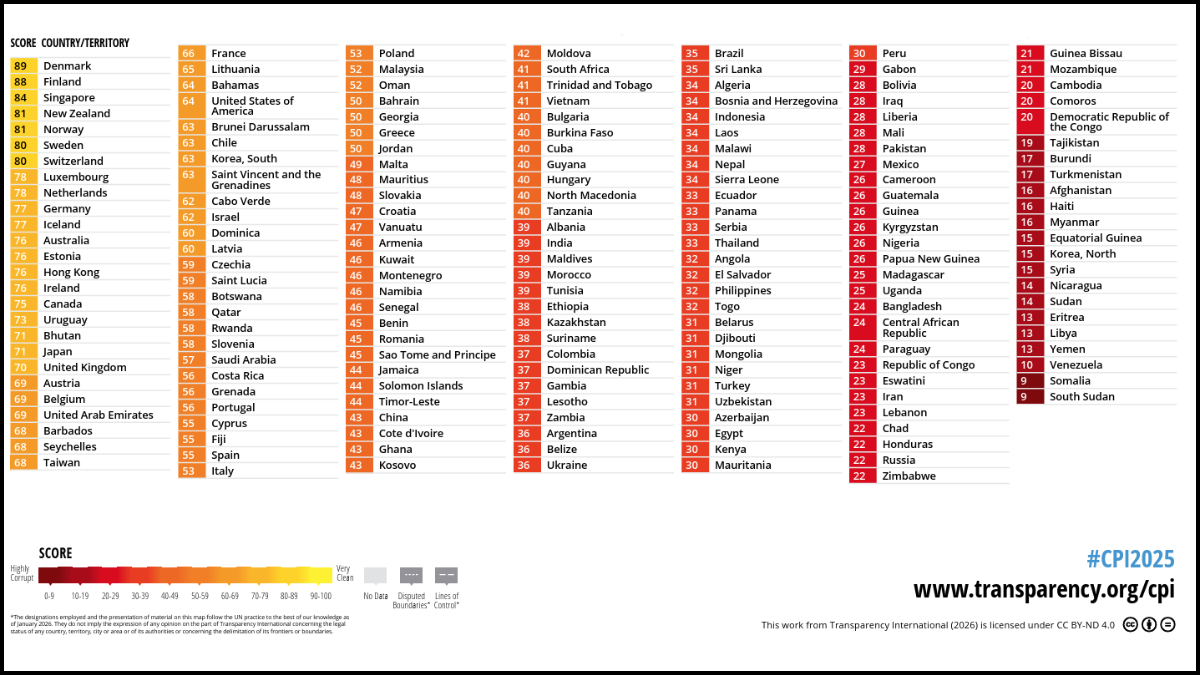
For the eighth consecutive year, Denmark has secured the top spot as the least corrupt nation, achieving a score of 89 out of 100.
Finland followed closely with 88, while Singapore (84), New Zealand (81), and Norway (81) rounded out the top performers.
The number of countries scoring above 80 has shrunk significantly, dropping from 12 a decade ago to just five in 2025.
Conversely, conflict-affected and repressive states remain at the bottom of the index. Somalia and South Sudan were marked as the worst performers, both scoring 9, followed by Venezuela with a score of 10.
Where does South Africa stand?
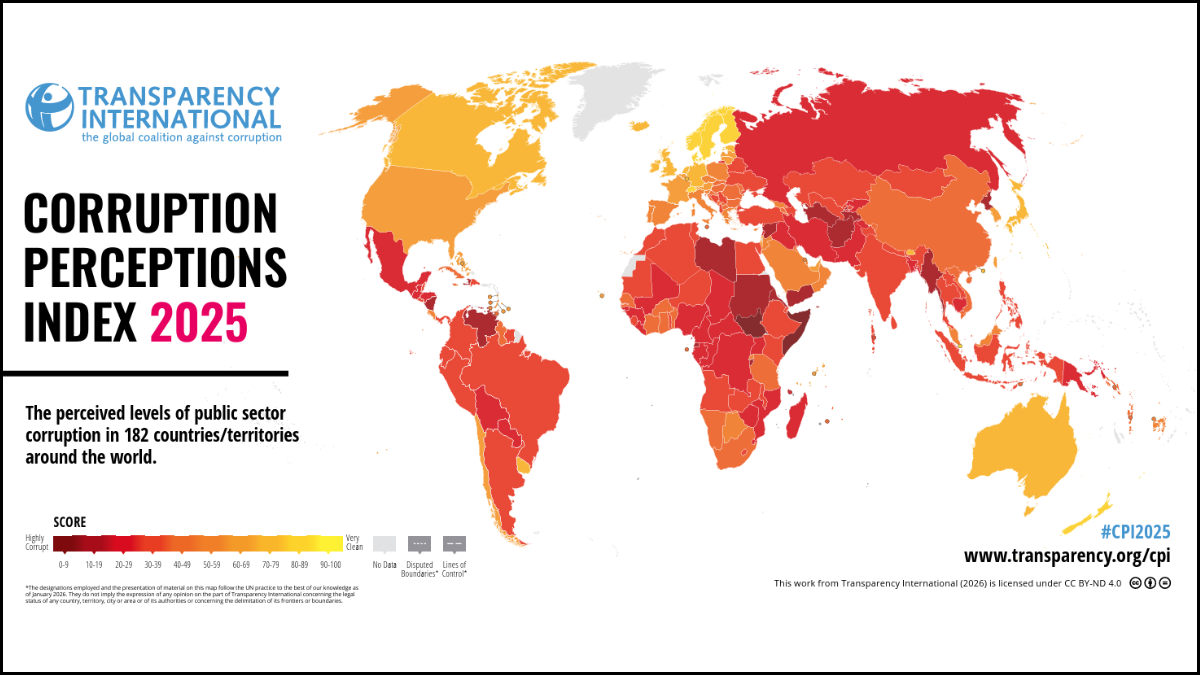
In 2025, South Africa received a score of 41/100.
This score places South Africa just below the global average of 42. It indicates that the country has stagnated, failing to recover ground lost over the last decade.
The highest score that it achieved was 45 in 2016.
While South Africa outperforms the Sub-Saharan Africa regional average—which sits at a dismal 32/100—it remains firmly among the majority of countries failing to keep corruption under control.
According to the report, 122 out of 182 countries scored under 50 this year.
A major theme of the 2025 results is the link between access to justice and corruption.
The report found that in countries with high levels of corruption, people struggle to access or afford justice, noting that “when justice is for sale, written laws become meaningless and impunity flourishes.”
François Valérian, Chair of Transparency International, warned that the world is seeing a “dangerous disregard for international norms.”
“In an interconnected world, we need both national action and multilateral cooperation to protect the public interest and tackle shared challenges like corruption,” Valérian said.
Maíra Martini, CEO of Transparency International, added that leaders are too often falling short of their mandates.
“We’re calling on governments and leaders to act with integrity and live up to their responsibilities to provide a better future for their citizens,” Martini said.
Global trends and justice
The 2025 report highlights a “clear blueprint” regarding why countries are failing: the erosion of independent institutions and the politicisation of justice systems.
Transparency International noted that persistently low or declining scores usually accompany “the politicisation of justice systems, undue influence over political processes, and a failure to safeguard civic space.”
“Countries with long-term improvements in CPI scores have largely seen sustained effort from political leaders and regulators to implement broad legal and institutional reforms,” the report stated.
However, for many nations, the trend is negative. “The vast majority of countries are failing to keep corruption under control,” said Transparency International.












 Loading ...