
DA leader performance: John Steenhuisen, Mmusi Maimane, Helen Zille, and Tony Leon



On 4 February 2026, Democratic Alliance (DA) Federal Leader John Steenhuisen announced he would not seek a third term as party leader.
Steenhuisen said that he delivered on his 2019 promise to be a party of national government in South Africa.
He added that the DA is now in the strongest position it has ever been in, holding levers of executive and legislative power in the Government of National Unity (GNU).
He used his speech to contrast the party’s current governing status with the crisis he believes he inherited from Mmusi Maimane.
“I proudly picked up the party’s banner when its internal polling was down to just 16% and after the media declared the Death of the DA,” he said.
“I worked hard with others who love the DA to not only resurrect the party’s fortunes but also carry it to new heights.”
“Instead of 16%, the DA is now consistently polling at 30%, and is within striking distance of becoming the biggest political party in South Africa.”
He added that the DA he inherited was reading its own obituary in a country that was in rapid decline. “The DA I leave behind co-governs a country that is firmly on the up.”
He will now focus all his time and energy as Minister of Agriculture on defeating the devastating foot-and-mouth disease outbreak.
“I will pursue mass vaccination to ensure that this is the last mass outbreak of foot-and-mouth disease our country ever sees,” he said.
“After leading the DA into the GNU, my next chapter must be to eradicate this devastating disease from our shores once and for all.”
He said that this is not a part-time job, which would be unfair to farmers if he split his time between his ministerial job and a leadership and election campaign.
How John Steenhuisen truly performed as DA leader
Steenhuisen made many claims during his speech, including that he rescued the party from the brink of collapse.
He also claimed exceptional growth and that the DA is within striking distance of becoming the biggest political party in South Africa.
However, it is easy to make spectacular claims in a speech. This is why it is important to look at the data to assess Steenhuisen’s true performance.
The DA has its roots in the Progressive Federal Party, which merged with the Independent Party and the National Democratic Movement in 1989.
The newly formed Democratic Party (DP) merged with the New National Party (NNP) and the Federal Alliance to form the Democratic Alliance (DA) in 2000.
The party further expanded by absorbing Patricia de Lille’s Independent Democrats in 2010, solidifying its stronghold in the Western Cape.
The DA had four leaders over the last 30 years – Tony Leon, Helen Zille, Mmusi Maimane, and John Steenhuisen.
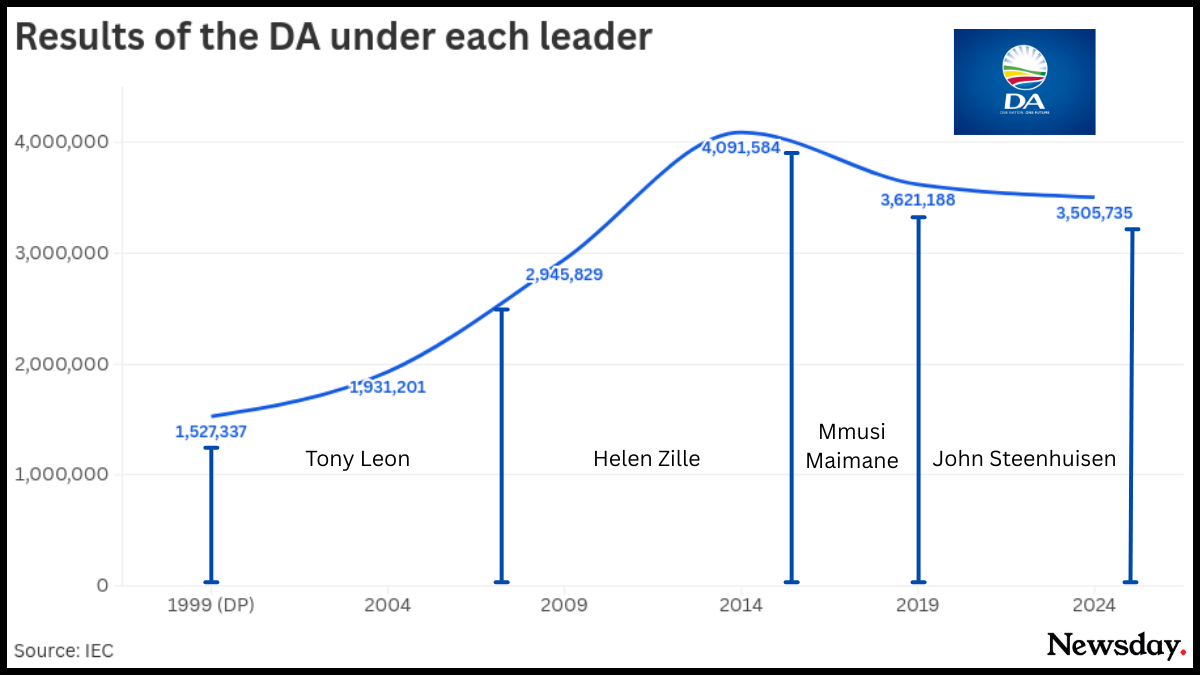
To assess their performance, Newsday used two metrics: the total number of votes and the percentage of total votes.
These metrics show that Tony Leon and Helen Zille had by far the biggest impact on the Democratic Alliance’s success.
The tables below show by how much each DA leader grew the party’s performance using the two metrics mentioned above.
| Leader | Year | Total Votes | Increase |
| Tony Leon | 1999 (DP) | 1,527,337 | +351.3% |
| Tony Leon | 2004 | 1,931,201 | +26.4% |
| Helen Zille | 2009 | 2,945,829 | +52.5% |
| Helen Zille | 2014 | 4,091,584 | +38.9% |
| Mmusi Maimane | 2019 | 3,621,188 | -11.5% |
| John Steenhuisen | 2024 | 3,505,735 | -3.2% |
| Leader | Year | % of Vote | Increase |
| Tony Leon | 1999 (DP) | 9.56% | +7.83pp |
| Tony Leon | 2004 | 12.37% | +2.81pp |
| Helen Zille | 2009 | 16.66% | +4.29pp |
| Helen Zille | 2014 | 22.23% | +5.57pp |
| Mmusi Maimane | 2019 | 20.77% | -1.46pp |
| John Steenhuisen | 2024 | 21.81% | +1.04pp |






 Loading ...