
The main reason many black farmers are struggling in South Africa


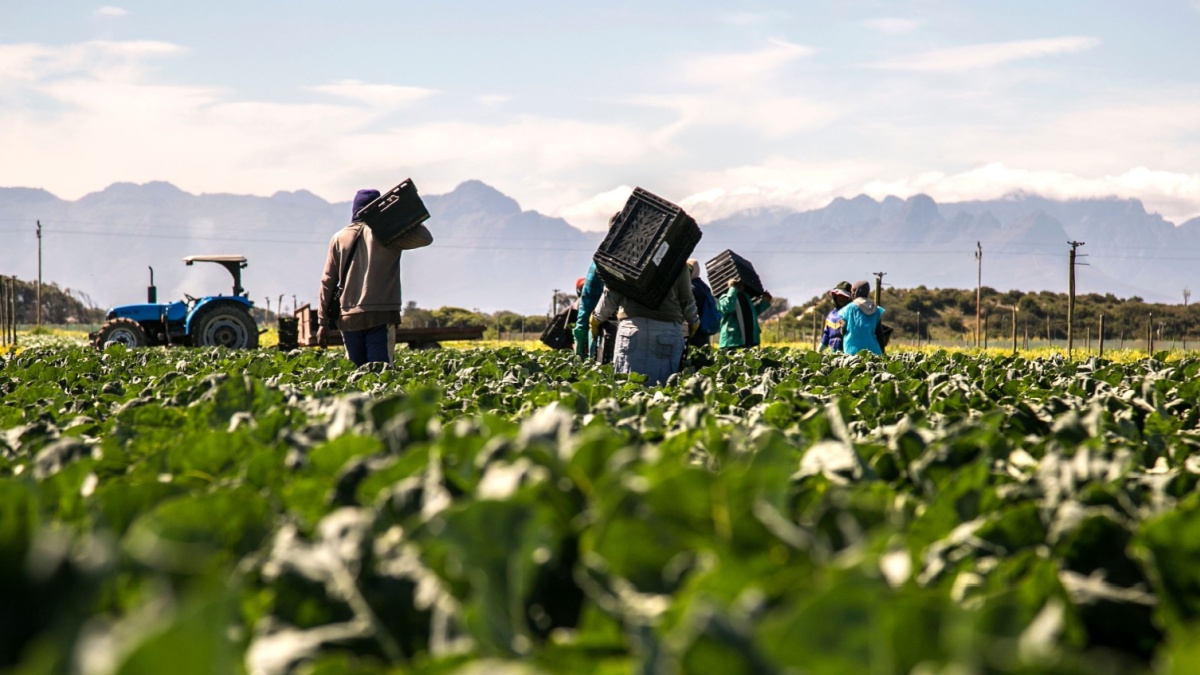
Many skilled black farmers in South Africa struggle to build commercially successful businesses because they do not own the land they farm, limiting their access to capital.
This is the view of Dr Theo de Jager, an agricultural leader, farmer, policy advocate, and Executive Director of the Southern African Agri Initiative (SAAI).
He was also the former President of the World Farmers Organisation (WFO) and is one of the most respected voices in South Africa’s farming industry.
During a conversation with Lelethu Shayi, De Jager explained that access to capital is the lifeblood for commercial farmers.
The easiest and fastest way to access capital is to approach a bank and use your farm as security, if you have a title deed.
However, if you do not have a title deed to give to a bank as security, you cannot access production loans.
Because title deeds are not available in many parts of Africa, the capital was never unlocked for the development of commercial agriculture.
“In South Africa, we see the same thing. Some of our best soils and high-potential production areas are the former homelands, which are communal areas,” he said.
He explained that these excellent agricultural areas lack commercial farms because farmers do not hold title deeds to the land.
De Jager added that many beneficiaries of land reform are in the same situation, as they cannot access capital, as they do not have title deeds for the farms.
“The problem here is not the farmer. It is not that these beneficiaries cannot farm. Many of them are better farmers than I,” he said.
“When you do not own the land, you do not have access to capital. It’s as simple as that. Now they must wait for the government to capitalise them.”
He said the government is a very poor bank and that people must wait for a very long time to get access to capital.
“We have assisted some of our members in applying for capitalisation in 2020 and 2021. They only got the money this year,” he said.
This long waiting period makes it impossible to effectively run a commercial farm. “They are set up to fail,” De Jager said.
Give title deeds to people who live on communal lands – Michael Jordaan

Bank Zero chairman Michael Jordaan said giving title deeds to people living on communal land is an easy way to make them property owners.
Jordaan is one of South Africa’s most respected business leaders. He served as FNB’s CEO from 2004 to 2013, during which FNB became the country’s leading bank.
He recently addressed the issue of land reform in South Africa, where he proposed giving title deeds to people who live on communal lands.
He argued that land reform is a crucial economic and political issue that requires urgent attention.
Land is important for livelihoods and food security, and it holds a deep symbolic meaning for many people.
Jordaan said there has been some progress. 24% of farmland has been redistributed or land rights restored since 1994, close to the government’s 30% target.
However, Jordaan said that there is one major initiative that would significantly impact land reform and property ownership.
This is granting legal title to many millions of families who live freely and openly on land that, notionally, does not belong to them.
Approximately 13% of South Africa’s land is held in trust by tribal authorities. Approximately 17 million people reside on these communal lands.
“Allocating title deeds to these subsistence farmers would turn impoverished rural dwellers into property owners,” he said.
Newly titled farmland could be leveraged for development loans or eventually even sold. This would unlock and unleash a massive amount of capital for growth.
“In one fell swoop, a third of our citizens would build wealth through property appreciation while having stability and control over their livelihoods,” he said.
“They could make changes and improvements to their properties without the threat that their living rights could arbitrarily be taken away.”
Release the land

Although there have been numerous promises and policy statements to empower black farmers to own land, the South African government is holding onto roughly 2.5 million hectares of land.
The failure to release this land adds to the ongoing frustration over the minimal contribution of black farmers to commercial agricultural output.
These views were presented by Wandile Sihlobo, chief economist of the Agricultural Business Chamber of South Africa (Agbiz) and a member of President Cyril Ramaphosa’s Economic Advisory Council.
Writing on key policy areas that the South African government must prioritise to boost its agriculture in 2026, Sihlobo said that the Department of Land Reform and Rural Development “has, quite frankly, been dismal in 2025.”
“We did not see any meaningful progress on land reform beyond a few high-level policy statements that sought to spark more conversation rather than implementation,” said Sihlobo.
The South African government has initiated the “Pro-Active Land Acquisition Strategy”, which strategically buys high-potential agricultural land, holds it in a state trust, and leases it to Black farmers.
Sihlobo noted that the South African government has roughly 2.5 million hectares of land for this strategy. “This land must be released to deserving beneficiaries with title deeds,” he said.
South Africa’s land reform primarily relies on long-term leases rather than immediate ownership.
Through the Proactive Land Acquisition Scheme (PLAS), black farming households and communities receive 30-year leases, renewable for another 20 years, meaning full ownership is only possible after 50 years.
The Agbiz chief economist said that the Department of Land Reform and Rural Development should refocus on the approach previously led by former minister Thoko Didiza.
This approach supported land release through a Land Reform Agency endorsed by organised agriculture and the Land Bank.
“The failure to release this land adds to the continuous frustration of the minimal contribution of black farmers to commercial agricultural output,” said Sihlobo.
At the time, then-minister Didiza was looking to establish the Agency, which was met with support from many in the sector.
“The Department… must revive such conversations and reconnect with farmers. The approach, though, must not be the never-ending meetings, but more action-oriented,” concluded Sihlobo.










 Loading ...
The assertion by Dr Theo de Jager that black farmers fail because they don’t own the land is total nonsense!
The main reason why black farmers fail (whether they own the land or not) is their incompetence and ignorance of how the world works. In other words, a total lack of knowledge about how wealth is created. This is, of course, true as well of many black “entrepreneurs” or BEE tenderpreneurs.
All the land in Africa, north of SA, belongs to blacks. How successful are they in farming, industry, services, and business in general? Can those countries survive without Western democracies’ help? Of course not!