
Dramatic shakeup for KwaZulu-Natal’s government as kingmaker quits coalition



The National Freedom Party (NFP), the kingmaker in the province, has announced its immediate withdrawal from the KwaZulu-Natal (KZN) Government of Provincial Unity (GPU).
The decision, made by the party’s National Executive Committee (NEC) during a meeting on January 5, effectively pulls the plug on the fragile coalition that has governed the province since the 2024 elections.
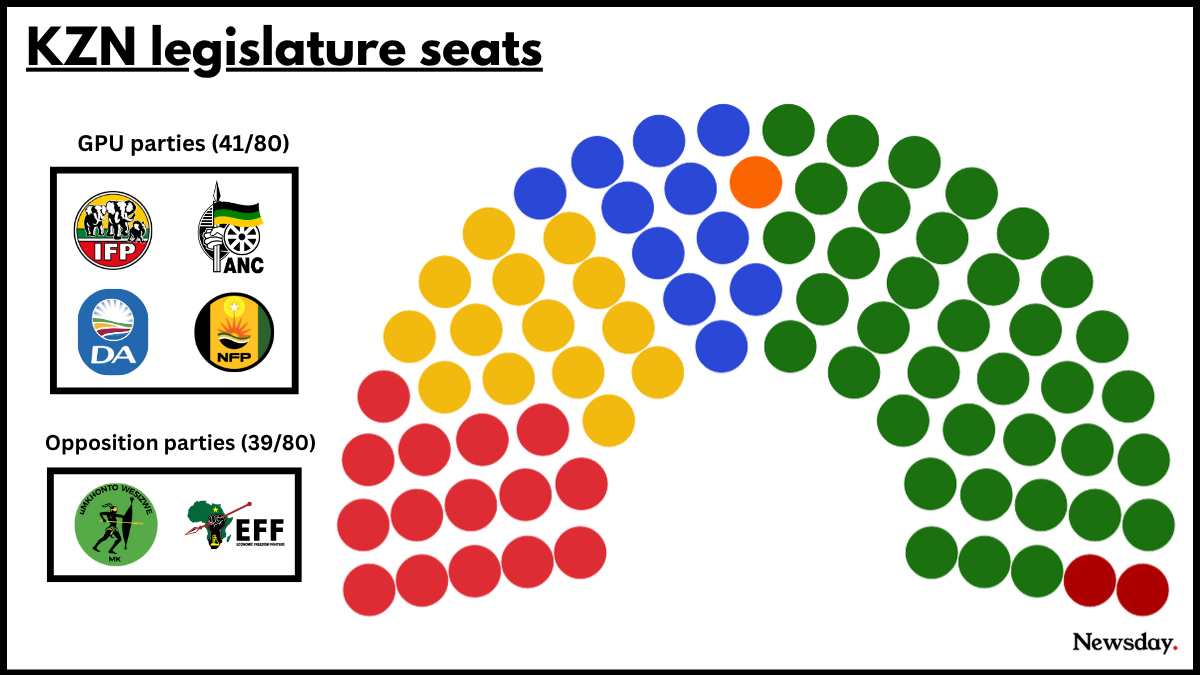
With just one seat in the 80-member legislature, the NFP’s departure strips the GPU, comprising the Inkatha Freedom Party (IFP), African National Congress (ANC), and Democratic Alliance (DA), of its razor-thin majority, leaving it vulnerable to opposition challenges.
The GPU was formed in the aftermath of the 2024 national and provincial elections, where no single party secured an outright majority in KZN.
The IFP’s Thami Ntuli holds the premiership, originally supported by the ANC, DA and NFP, totalling 41 seats against the uMkhonto weSizwe (MK) Party’s 37 and the Economic Freedom Fighters’ (EFF) two.
The NFP’s sole representative, Mbali Shinga, who serves as MEC for Social Development, provided the critical vote that tipped the scales.
However, internal discord within the NFP has now unravelled this alliance, with factions in the party either for or against working with former President Jacob Zuma’s party.
The crux of the conflict can be traced back to a failed motion of no confidence against Premier Ntuli, sponsored by the MK Party on December 15, 2025.
NFP president Ivan Barnes reportedly directed Shinga to support the motion, which could have handed control of the province, and its R150-billion annual budget, to the MK Party and EFF.
Shinga defied this order, either abstaining or voting against it, ensuring the motion’s defeat amid chaotic scenes in the legislature.
This act of insubordination led to her suspension and ongoing disciplinary proceedings for alleged gross misconduct and defiance of party directives.
In a strongly worded letter to Shinga, the NFP’s Acting Secretary General, Sunset Bheki Xaba, invoked the party’s constitution to demand her resignation by 9 a.m. on January 8, 2026.
The NEC said that Shinga’s role as MEC was contingent on the NFP’s participation in the GPU, stating, “Shinga’s position as MEC was based on the party’s participation in the unity government, which can no longer continue.”
Barnes said that the reason is that “we cannot stay in a setup where our voice is ignored.”
The implications of the NFP’s exit are profound. The GPU now holds only 40 seats, opening the door for renewed no-confidence motions from the MK Party and EFF.
This could lead to governmental instability, potentially forcing new alliances, a minority administration, or even snap elections.
The saga exposes the fragility of coalition politics in South Africa. The NFP’s small size, one seat in the 80-seat legislature, allows for it to be the kingmaker in the province.
Who is the NFP’s sole suspended representative
Shinga, thrust into the national spotlight as “the woman who stopped the MK Party,” has portrayed her stance as a principled defence against political bullying and chaos.
In an interview with the Daily Maverick, she described the MK Party’s behaviour during the no-confidence vote as “disgusting,” Shinga exclaimed, “And I was supposed to work with those people (MK)!”
She framed her defiance as broader than party politics, asserting, “I am standing for justice and precedent. This is down to the emancipation of women.”
Criticising Barnes directly, Shinga claimed he lacked authority to align with MK and EFF, calling it “just his personal choice” and labelling NFP management as “embarrassing… chaos.”
She admitted the party is “highly factionalised,” highlighting deep divisions that have plagued the NFP since its inception.














 Loading ...
Nice to see a politician with morals and backbone. But in our politics, it seems political suicide.