
The biggest wind farms in South Africa



South Africa’s five biggest wind farms contribute over 720 megawatts (MW) of capacity to the country’s renewable energy mix.
While not as large as solar, according to data from the National Energy Regulator of South Africa (NERSA), wind energy plants account for 28% of the country’s renewable energy capacity.
This puts the national capacity of the energy source at 4,738 MW.
While wind farms tend to have a greater energy yield per MW of capacity installed, the capital expenditure and maintenance costs tend to be significantly higher than those of solar farms.
A study comparing two 400 MW farms, one solar and one wind, found that, in terms of capital expenditure, the cost per kilowatt of energy for the wind project was roughly 50% more than its counterpart.
Similarly, the operational cost per kilowatt per year of maintaining the wind farm was more than four times that of the solar farm.
However, the return on investment of the wind farm was approximately one and a half times that of the solar plant, although it was realised over a slightly more extended period.
The largest wind farm in South Africa is the Roggeveld Wind Farm in the Western Cape, with a capacity of 147 MW.
The plant, which is operated by the South African-based firm Red Rocket, comprises 44 Nordex turbines with a capacity of 3.15 MW and another three with a capacity of 3 MW.
It produces around 613 gigawatt hours (GWh) of energy per year, which is enough to power 49,200 households over the same period, avoiding 502,900 tonnes of CO₂ emissions.
Italian renewable energy firm Enel Green Power also operates several major wind farms in South Africa, including two with 147 MW of capacity.
These are the Soetwater and Karusa farms, located next to each other in the Northern Cape.
According to the company, these farms feature Vestas V136-4.2 MW turbines, which are the largest on the African continent to date.
Enel also operates three 140 MW facilities: Garob (Northern Cape), Nxuba (Eastern Cape), and Oyster Bay (Eastern Cape). Each comprises between 40 and 46 turbines.
The Norwegian-owned Mainstream Renewable Power also operates two wind farms, each with a capacity of 140 MW: the Khobab Wind Farm and the Kangnas Wind Farm.
The Khobab facility comprises 61 151-metre-high wind turbines, which can generate around 563.5 GWh of energy per year, or enough to power up to 170,000 South African homes.
The farm, which is just outside Loeriesfontein in the Northern Cape, was completed in 2017 and has been supplying power to the grid since.
Kangnas Wind Farm is situated just outside Springbok and commenced commercial operations in November 2020.
It also has 61 turbines; however, these are 168 metres tall. The farm generates roughly 513 GWh per year, which it claims can power 154,625 homes.
Mainstream Renewable Power also operates a 138 MW wind farm, known as the Loeriesfontein 2 Wind Farm, located approximately seven kilometres from the Khobab site.
It has the same number and specification of turbines as the nearby plant. The facility spans roughly 3,453 hectares of agricultural land, which is the same as 4,933 rugby fields.
Endangering wildlife
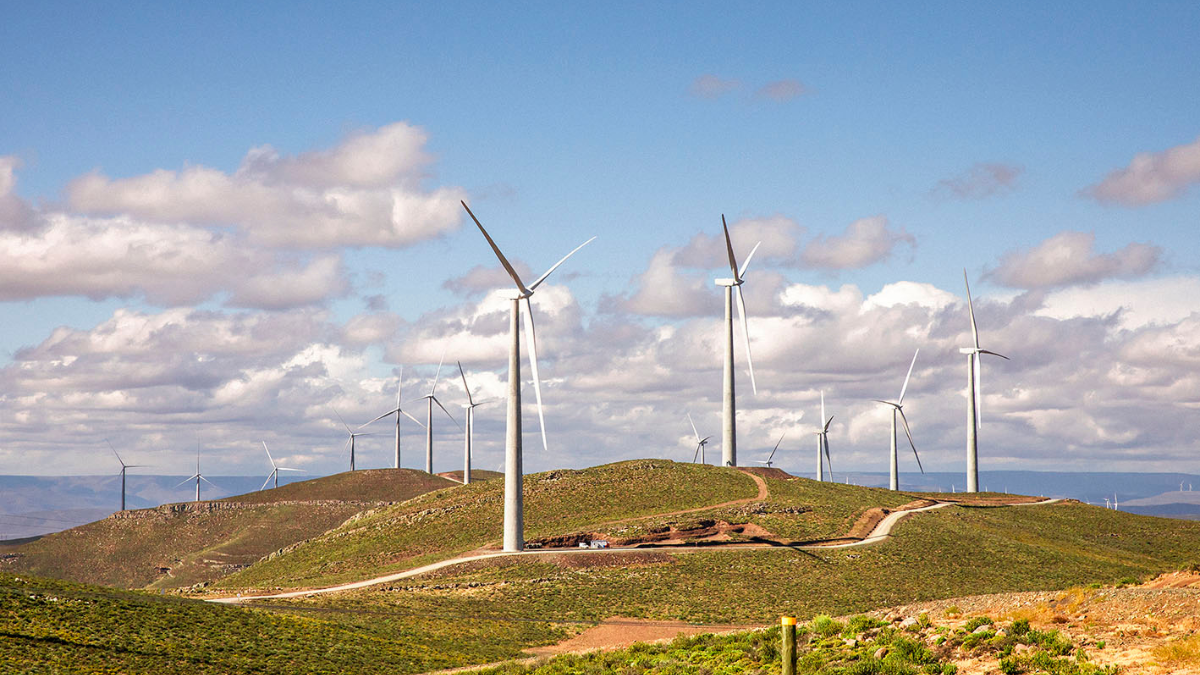
While wind energy has the advantage of significantly fewer carbon emissions than traditional coal power, it has been found to have an impact on wildlife, especially birds.
According to a report by BirdLife South Africa, which surveyed 33 of the 35 wind farms across South Africa over an eight-year period, 2,444 dead birds were found from over 200 species.
The organisation pointed out that, by law, all wind farms must have an Environmental Management Programme (EMP), which includes monitoring bird deaths caused by turbines.
Despite several plants doing their best to comply with the necessary legislation, the report found that many wind farms fail to do so, with two facilities not providing any data.
To address this, BirdLife suggests that the Department of Forestry, Fisheries and the Environment should conduct regular audits of EMPs.
In some cases, wind farms are being proactive about the situation by employing bird spotters as an early warning system to prevent casualties.















 Loading ...
Not only birds – under-earth life also suffers, because fan creates VIBRATION, coming directly in the earth. Did you ever sleep in a house above a subway?? Same story.