
The two South Africans who went to Cambridge and worked at Google’s AI company



Google DeepMind, an Artificial Intelligence (AI) company based in the UK, is one of the pioneers of what most know AI as today.
The company, led by Demis Hassabis, was responsible for building a computer programme that taught itself how to play chess and later how to play Go, considered the most complex board game on Earth, setting the standard in machine learning.
In its formative years, the DeepMind team comprised some of the top minds in the field who were eager to explore something that many believed was impossible.
This included two South Africans: Shakir Mohamed and Ulrich Paquet.
Mohamed studied Electrical and Information Engineering at the University of the Witwatersrand, earning the Chancellor’s Medal and the Bernard Price Prize during his time at the institution.
He was also awarded the Dr D.L. Bernstein Award, the Schneider Automation Student Award, and the Altech Electronic Engineering Medal.
After completing his degree with distinction in 2005, Mohamed began working for Nedbank in credit and risk analysis for retail home loans.
However, this was just a stepping stone, as he was accepted into Cambridge University to begin his PhD in statistical machine learning the following year after receiving a Commonwealth Scholarship from the institution.
In recent interviews, he has commented on how few people were aware of what machine learning was at the time, saying that it would make his day if someone had heard of it before.
His doctoral research spanned four years, and after completing it, he moved to Canada to work as a research assistant in a research programme on neural computation and adaptive perception at the University of British Columbia.
Mohamed then returned to the UK and joined DeepMind Technologies, a tech start-up, in April 2013. Google acquired the company for $600 million the following year.
Following the acquisition, Mohamed was appointed as a research director, where he continues to develop general-purpose learning algorithms.
His areas of research include machine learning, Bayesian statistics, deep learning, sociotechnical AI, and AI more broadly.
Today, his work has been cited 37,236 times, according to Google Scholar, with nearly 30,000 of those made since 2020. He has an h-index of 47.
Ulrich Paquet
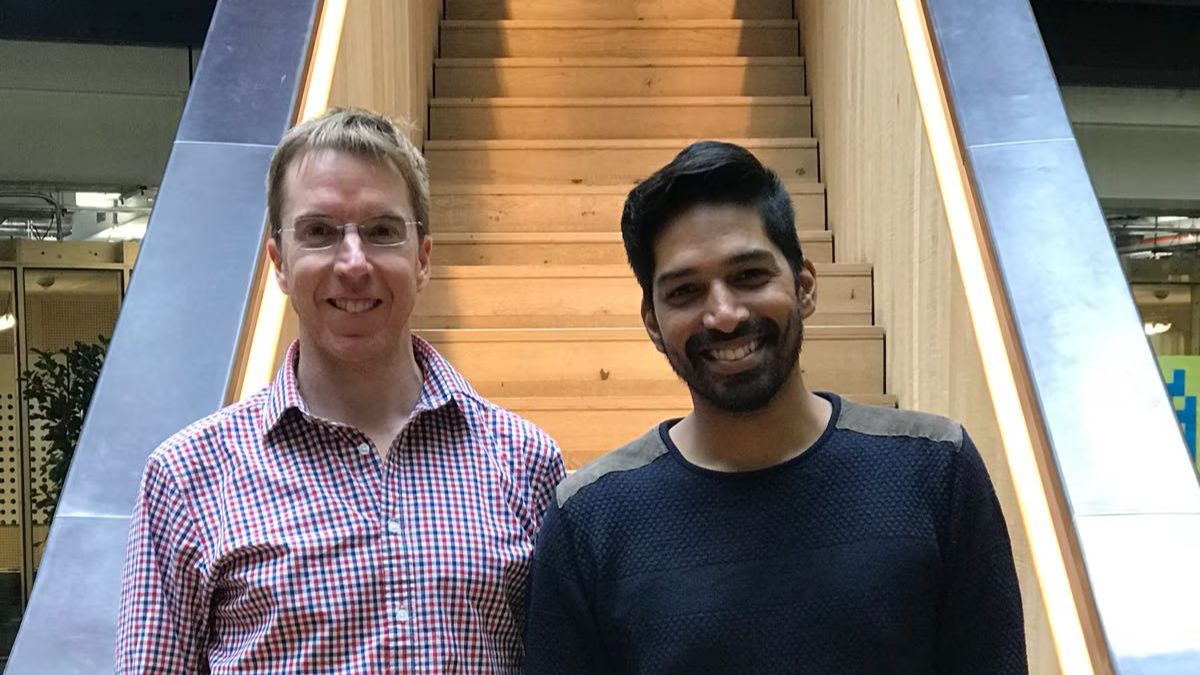
Paquet also started his studies in South Africa, attending the University of Pretoria, where he says he first developed his interest in AI.
After completing a Master’s degree in Computer Science, he was awarded a Commonwealth Scholarship to study at Cambridge, the same one received by Mohamed. He also pursued the same field of study as his fellow South African.
His doctoral thesis focused on probabilistic principles in supervised and unsupervised machine learning, the foundation of much of his future work in AI.
Following his studies, Paquet landed a job at a company that developed technologies related to facial recognition and image similarity search.
Soon afterwards, he joined Microsoft as a senior researcher and was appointed to work on the Xbox One launch team, based between the UK and Israel.
Here, he developed systems for recommending products to customers based on their preferences, behaviour, and other data.
“We did all the machine learning design for the backend recommender system, which took about two or three years to get right,” he said in a 2024 interview.
Following his time at Microsoft, he went back to the UK to work for a company called Vocal IQ, which was acquired by Apple in 2015. This resulted in Paquet being appointed as a research manager at the American tech giant.
He was there for no longer than a year before heading back to the UK to join Google DeepMind.
While at DeepMind, Paquet worked on AlphaZero, the company’s latest AI project at the time, which attempted to create a programme that could train itself to master the games of chess, shogi, and Go.
“It was amazing how they thought about chess, which was so different and was done in a way that you could almost mistake for creativity,” Magnus Carlsen said on the Lex Fridman podcast.
“The way AlphaZero sacrifices pieces like a knight or two or three pawns is hard to understand and fascinating to see.”
Having become close friends after their studies and later working together at Google DeepMind, Mohamed and Paquet started the Deep Learning Indaba to strengthen AI research in Africa.
The idea came about when the two were attending an AI conference in Barcelona and realised that they were the only Africans they would encounter at such gatherings.
The Deep Learning Indaba takes place annually, with the first being hosted by the University of the Witwatersrand and the 2025 edition having taken place in Rwanda.
















 Loading ...