
From a conservative Afrikaner to MK operative



Despite conservative roots, Carl Niehaus’s career has seen him go from one side of the political spectrum to the other.
Born in December 1959, he grew up in the town of Zeerust, which he describes as a deeply conservative community, located in what was formerly the Transvaal Province, now the North West Province.
“My dad was a very conservative supporter of the National Party and later joined the Conservative Party, which was even more conservative,” Niehaus told Newsday.
After moving to Johannesburg at the age of 13, he attended an Afrikaans school called Hoërskool Die Adelaar in Witpoortjie, Roodepoort.
“At this point, I had no other contact with the majority of black people in this country. That is how I grew up.”
However, this changed after visiting Soweto at the age of 16, causing him to become politically sensitised.
“It was part of a Dutch Reformed Church missionary outreach to Soweto. I was absolutely shocked by the conditions under which people lived.”
Niehaus describes one interaction during the visit as having a profound impact on him.
“There was this old man, sitting on an old paraffin can, and when I walked up to him, he jumped up and presented the paraffin tin to me,” he explained.
“It unsettled me. He should not have shown me this extraordinary kind of respect because my skin colour happened to be white.”
These experiences began having more of an impact on him, driving curiosity around the rationale behind the need for an apartheid regime.
Once he finished school, Niehaus attended the Rand Afrikaans Universiteit, an all-white Afrikaans institution, where he studied theology.
“Quite soon after I went to university, I began articulating my anti-establishment views,” Niehaus said.
He also became romantically involved with a woman who shared his views about the apartheid state and the university they attended. Her name was Jansie Lourens.
Niehaus soon began articulating his political views in his second year, advocating for the university to be open to all races.
In his third year at the institution, he posted flyers calling for the full integration of the institution and the release of Nelson Mandela around the university campus.
After CCTV footage identified him as the guilty party, he was expelled from the institution and was forced to compensate for all the tuition fees paid for by the bursary he had received to study there.
“This was a huge challenge to my family because my dad was not a rich man. So after I was expelled, my father went into a rage and kicked me out of the house,” he said.
“I ended up on the streets, sleeping on a park bench for a couple of days because I had nowhere else to go.”
Joining the ANC
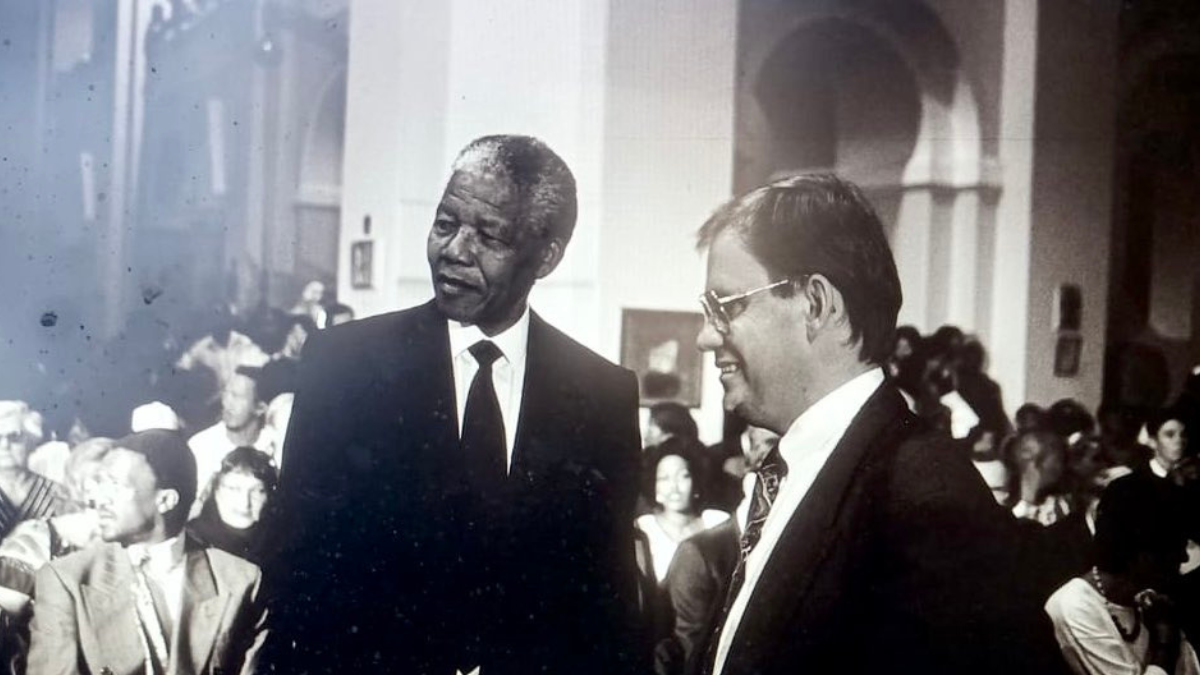
With not much direction, he ended up at St Mary’s Cathedral in Johannesburg seeking a way to continue supporting the struggle against the apartheid regime.
Through the church, Niehaus was introduced to Dr Beyers Naudé.
“And that’s where the relationship between Oom Bey and me, as we called him, began. He was like a father to me, a mentor.”
Naudé was a member of the Dutch Reformed Church and introduced Niehaus to a congregation in Alexandra, which is also where he began cutting his political teeth.
He describes this part of his life as a major contributor to his radicalisation, mainly because he was often blocked from entering Alex due to not having a permit.
“So in 1979, I told Oom Bey that I wanted to join the ANC,” Niehaus said.
While most ANC members were outside of the country, it was decided that Alexandra would become the base of Niehaus’s operations.
It wasn’t long before he became integrated into uMkhonto we Sizwe, the paramilitary group of the ANC.
Going to prison

After resuming his studies at the University of the Witwatersrand in 1982, he continued to support the struggle alongside Professor David Webster, who was a social anthropologist at the university, and Naudé.
However, a spy named Robert Whitecross soon infiltrated the cell, gathering valuable intelligence about the workings of MK, including sabotage operations, weapons smuggling, and arms caches.
Whitecross also found evidence that Niehaus was involved in a reconnaissance mission with the intention of sabotaging the Johannesburg Gas Works.
“So when I was arrested, the security police basically had the case sewn up.”
As a result, Niehaus was charged with high treason and sentenced to 15 years in prison, with Lourens being sentenced to four.
He was incarcerated at Pretoria Central Prison, where he says he underwent significant periods of solitary confinement as well as constant physical beatings.
“I am proud that I never gave them any information about anyone else, but I lost a large part of my hearing because of those beatings,” he said.
He says that Lourens also underwent interrogation, including being made to strip naked, stand on bricks, and sing Die Stem.
“They recorded it and played it back to me, saying, ‘You better start talking, look what’s happening to your fiancée,’” he explained.
It was in prison that he met Jacob Zuma, with whom he remained a close ally.
Zuma led the party’s advanced negotiations team when negotiations started between the apartheid government and the ANC.
He was released in 1991 after serving eight years and went straight back to work for the ANC, where he found a position in the department of information and publicity.
He eventually became the head of the department and spokesperson for the agency, which allowed him to work closely with President Nelson Mandela, also serving as his spokesperson.
A democratic South Africa

Following the country’s first democratic elections in 1994, Niehaus was appointed as a member of Parliament after being elected into the party’s National Executive Council.
Then in 1997, Mandela appointed him as the South African ambassador to the Netherlands, a position he held for four years.
His return to South Africa saw him go into the private sector, working at Deloitte, but he says he soon figured out that “I was not cut out to be a business person. I’m a politician.”
After leaving the company, Niehaus held several short-lived positions, including a contract with the Presidency, serving as the spokesperson for the Rhema Church, and as the CEO of the Gauteng Economic Development Agency.
He returned to the ANC’s communications department in the run-up to the 2009 general elections; however, he resigned after three months when news broke about his financial difficulties and alleged fraud.
Joining the EFF

While a close comrade of Jacob Zuma, Niehaus remained outside of mainstream politics for the next decade.
When he returned as spokesperson of the MK Military Veterans Association in 2017, he increasingly came into conflict with the Cyril Ramaphosa-led NEC.
Tensions began to mount between Niehaus and the ANC as he felt himself slowly being pushed out of the party.
In 2021, the ANC announced that it had fired Niehaus from his position in Secretary-General Ace Magashule’s office, and he officially left the party in 2022 after serving for 43 years.
After forming his own movement and party called the African Radical Economic Transformation Alliance (ARETMA), he soon decided to merge with the Economic Freedom Fighters.
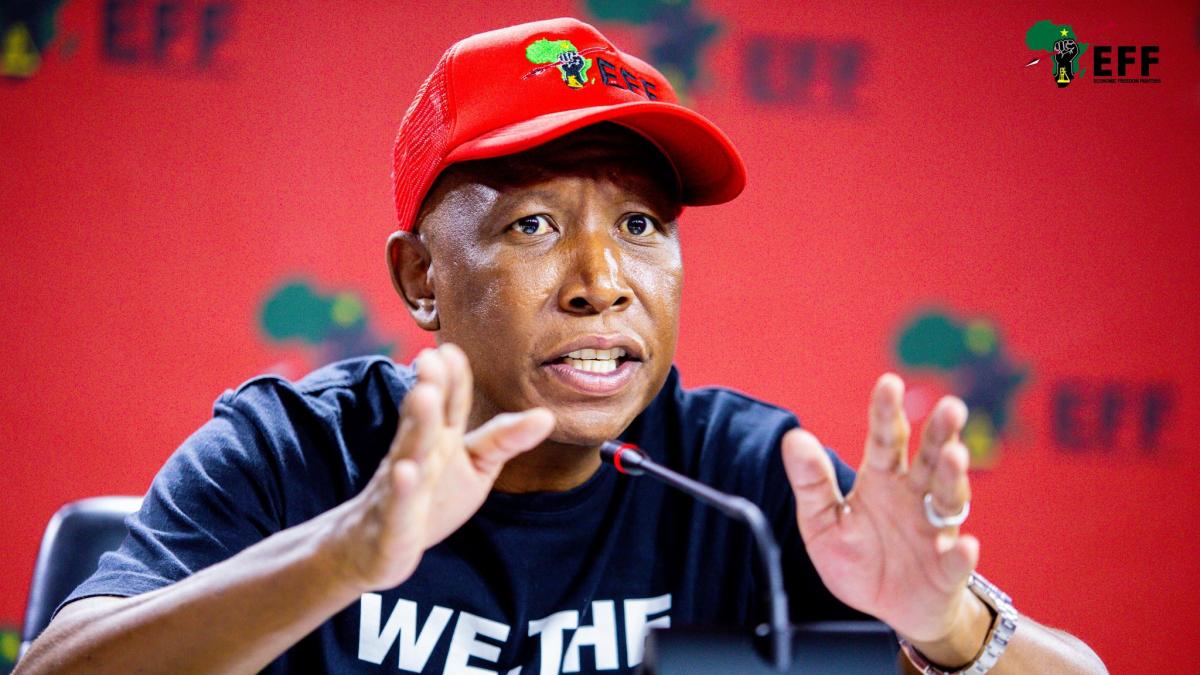
Today, Niehaus represents the EFF in Parliament, serving on the Portfolio Committee on Correctional Services, the Portfolio Committee on Defence and Military Veterans, and the Joint Standing Committee on Defence.







 Loading ...
Wat ‘n poephol