
Golf estates are more separatist than Orania



While the Afrikaans-only settlement in the Karoo, Orania, is widely criticised for its highly exclusive residential policies, political analyst Dr Frans Cronje argues that living in a gated estate is essentially the same, or more separatist.
Cronje was speaking during an interview with Dr Mbuyiseni Ndlozi on an episode of the African Renaissance Podcast.
Cronje argued that, as South Africa’s state systems collapse, the middle and upper classes will increasingly move to “fortified islands of great comfort and prosperity” – the “enclave phenomenon” which he argues has already begun.
Ndlozi asserted that the Afrikaans community of Orania is South Africa’s first real enclave, but Cronje argued that Orania is a weak enclave.
“It doesn’t have nearly the same kind of fortifications or the substantive depth of private estates,” he said.
He asserts that the real separatist communities are already pervasive in South Africa in the form of private lifestyle estates that are removed from the reality of System collapse.
Orania is a Karoo town founded by a movement for a self-governing community of Afrikaners, with a focus on cultural and language preservation and self-determination.
The town is found on the banks of the Orange River and has an exclusively white, Afrikaans, Christian population.
Orania has its own town flag, radio station and local currency, the Ora. Although the town is based in the Thembelihle Municipality, it receives no services from the municipality.
The concept of Orania as a self-governing Afrikaner homeland predates the town, with origins traced back to 1952.
The idea gained momentum in the 1970s with the belief that the apartheid system was unsustainable.
With it came the idea to create a designated Afrikaner homeland for language and culture preservation.
The Orania Movement was formally founded in 1988, consolidating various groups advocating for an exclusively Afrikaner region.
The town is admittedly controversial in contemporary South Africa, given the country’s painful past of systemic racial injustice. The town only allows approved, Christian Afrikaaners to live in its community.
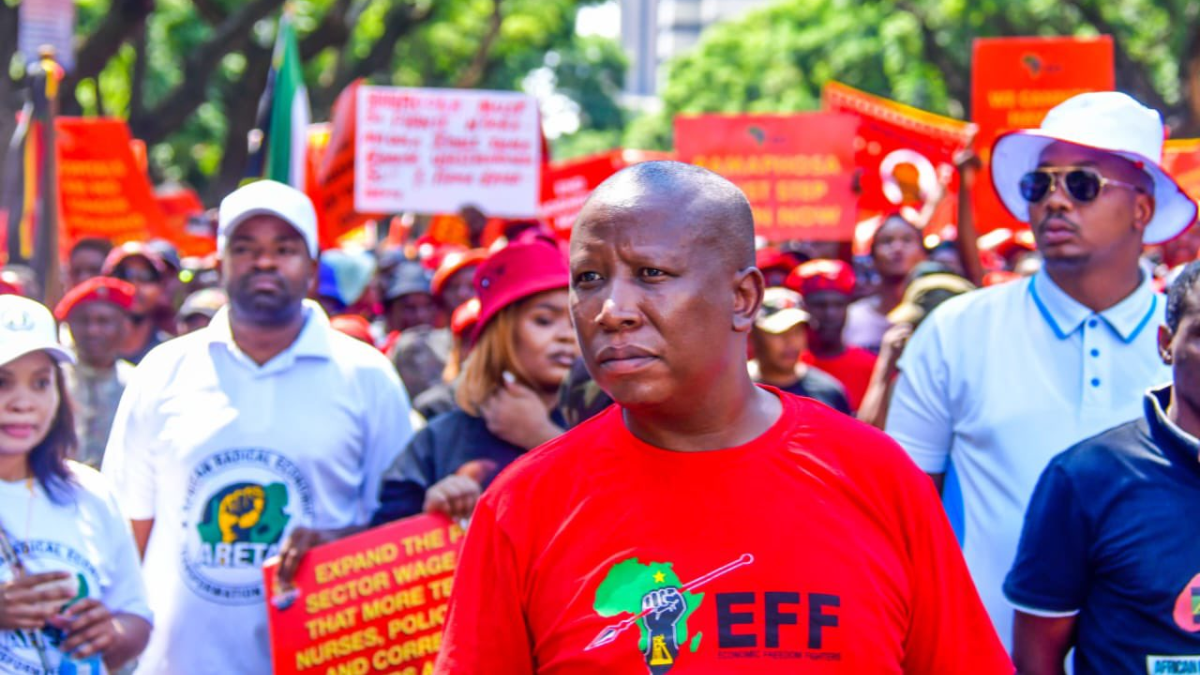
The Economic Freedom Fighters (EFF) have recently been calling for a review of the town’s status, arguing that it promotes ideologies of apartheid and threatens national unity.
‘Fortified islands of comfort and prosperity’

“People are rude about Orania, but if you live in a walled golf estate, you’ve done exactly the same thing in some respects,” he said.
Houses in gated, residential estates now account for more than 490,000 homes nationwide, nearly four times the number recorded in 2003.
This is according to research from Real Estate Investor. Researchers say, however, that the appeal of these estates goes beyond security.
These developments offer private infrastructure, backup power and water security, making them self-sufficient micro-cities within a broader urban area.
According to Cronje, these estates “effectively appropriate all functions of the state.” As the functions of the state weaken, these enclaves will become stronger, Cronje says.
“The estate outside my office, they sometimes park a blue fire engine outside. This is a private fire engine. When I grew up in Johannesburg, there weren’t such things. Now there are,” he said.
Lightstone data shows that freehold homes made up 66% of all sales in 2009. By 2023, freehold home sales dropped to 56%, while sectional titles rose to 29%.
Homes in residential estates are, on average, double the price of a freehold property. South Africans are seemingly paying this high price for the convenience and security offered by the estate lifestyle.
“There are some issues at play,” Property Economist François Viruly told Newsday. “A particular sector of the market has managed to extricate itself from the urban environment through gated communities.”
“Safety has a role to play, but it is also a reflection of municipalities that are unable to provide a reasonable urban environment and related infrastructure.”
















 Loading ...
I used to enjoy what Cronje said, but – much like the liars at Afriforum – I’m afraid I don’t anymore after this load of kak.
““It doesn’t have nearly the same kind of fortifications or the substantive depth of private estates,” he said.” yeah because it’s in the freaking Karoo and is a totally racist location(whoops!). If he’s bothered to do a colour check on his hated golf estates he might find out that the only test is money.
Talk about going from hero to zero in my eyes.