
Civil society organisations send urgent plea to South Africa’s Chief Justice



Twenty-three leading civil society and media organisations have written to Chief Justice Mandisa Maya, expressing serious concern over a recent gag order imposed on public-interest investigative nonprofit, Open Secrets.
Earlier this week, Open Secrets confirmed that it is currently “unable to speak on a matter of significant public importance” due to a court-imposed restriction.
The organisation, which exposes private sector economic crimes, says it will challenge the gag order with the help of legal partners PowerLaw Africa.
Founded as a nonprofit watchdog, Open Secrets investigates private sector economic crimes and advocates for accountability through research, advocacy, and law.
In a statement, Open Secrets said, “We are not permitted to disclose anything related to the matter including the names of the parties that may be involved.”
They are prohibited even from sharing the court order or discussing any details such as the date it was granted, the judge who granted it, or the court which issued the order.
“What we can say is simple: efforts to muzzle public-interest journalism endanger everyone’s right to know.”
In a joint statement, the Civil Society organisations said that “there can be no mistaking its breadth: Open Secrets is effectively silenced, not only prevented from reporting, but from even explaining why it cannot do so.”
The signatories warn that the order undermines South Africa’s constitutional commitment to open justice and the public’s right to know.
Moreover, the breadth of the order immunises those who seek it and the court granting it from scrutiny, “and so strikes at the very transparency on which public confidence in the judiciary depends”, write the organisations.
The letter urges the Chief Justice, in her capacity as head of the judiciary, to consider measures to safeguard against the excessive use of gagging orders, including:
- Issuing guidance to judicial officers reaffirming the presumption of open justice and cautioning against the harmful effects of pre-publication interdicts (so-called gagging orders); and
- Encouraging judicial education on balancing rights to freedom of expression, media freedom, privacy, and reputation.
The organisations note that the Open Secrets matter is not an isolated case.
“Reports suggest that similarly sweeping gagging orders are being more frequently sought, and granted, against journalists and civil society actors,” the letter states.
“If left unchecked, this pattern risks chilling public-interest investigation and eroding public confidence in the judiciary.”
Speaking to Newsday, director of Open Secrets Hennie Van Vuuren explained that “organisations like Open Secrets work to expose the profiteers of economic crime the people also who profit from human rights abuse.”
“It’s crucial that the work of organisations like Open Secrets, but other non-profit newsrooms and commercial media for that matter, is protected in our ability to present fact-based information.”
Given its extensive exposés, there have been attempts from the powerful and the wealthy to target an organisation with limited resources.”
“It’s not the first time that somebody has put pressure or tried to put pressure on Open Secrets, and certainly we have faced attempts to… slap us as well.”
However, this time is different.
“This is certainly… one of the first instances that it’s been as far reaching as it is in this instance where I cannot even speak to you about who’s involved or which court the matter is being heard,” said Van Vuuren.
“We truly… have been gagged, yeah, we’ve been gagged.”
The signatories of the letter
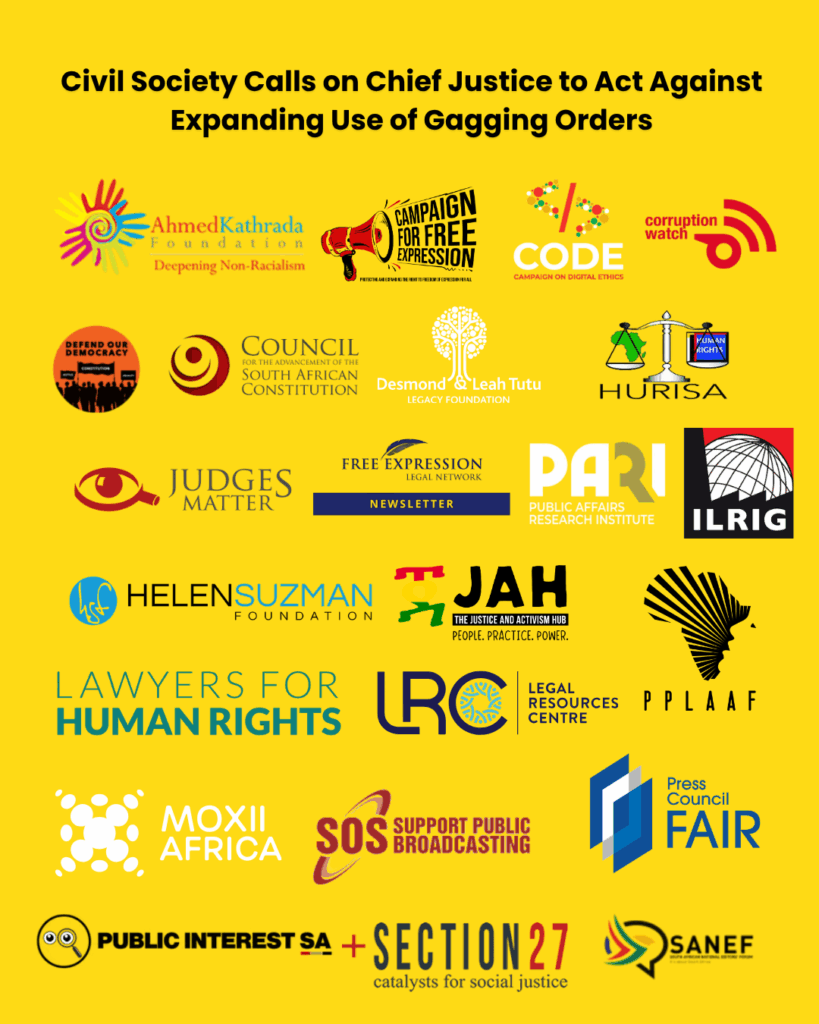
- Neeshan Balton — Ahmed Kathrada Foundation
- Nicole Fritz — Campaign for Free Expression
- Kavisha Pillay — Campaign on Digital Ethics (CODE)
- Lawson Naidoo — Council for the Advancement of the South African Constitution (CASAC)
- Naledi Kuali — Defend Our Democracy (DoD)
- Janet Jobson — The Desmond and Leah Tutu Legacy Foundation
- Lord Ntambw and Moira Campbell — Corruption Watch
- Anton Harber — Free Expression Legal Network (FELN)
- Naseema Fakir — Helen Suzman Foundation
- Corlett Letlojane — Human Rights Institute of South Africa (HURISA)
- Dale McKinley — International Labour, Research and Information Group (ILRIG)
- Alison Tilley and Mbekezeli Benjamin — Judges Matter
- Mark Heywood — Justice and Activism Hub
- Wayne Ncube — Lawyers for Human Rights
- Nersan Govender — Legal Resources Centre (LRC)
- William Bird — Moxii Africa (formerly Media Monitoring Africa)
- Jimmy Kande — Platform to Protect Whistleblowers in Africa (PPLAAF)
- Roshnee Narrandes — Platform to Protect Whistleblowers in Africa (PPLAAF) –Southern Africa
- Phathiswa Magopeni — Press Council of South Africa
- Sithembile Mbete — Public Affairs Research Institute (PARI)
- Tebogo Khaas — Public Interest South Africa
- Uyanda Siyotula — SOS Support Public Broadcasting Coalition (SOS)
- Sasha Stevenson — Section27
- Reggy Moalusi — South African National Editors Forum (SANEF)













 Loading ...